
By Thorsten Meyer

Get business pricing on tech for your team
- Business-only prices and quantity discounts
- Tax-exempt purchasing
- Multiple users, one account, clear invoices
Every era measures national and economic power in the unit that happens to be scarce at the time. For agrarian empires it was arable land and the people to work it. For the industrial age it was steel tonnage and coal. For the twentieth century it became GDP — a measure of how much a nation of humans could produce with their labor. Each of these units made sense because it tracked the binding constraint of its moment.
I think the binding constraint is changing again, and I want to name the unit that replaces the old one before the shift finishes happening, because naming it clarifies almost everything else. The emerging measure of economic and national power is agents per gigawatt — how much autonomous cognitive work a nation or a company can run, set by how much intelligence it can produce per unit of energy it can command.
This is not a metaphor. It is, I will argue, the literal accounting unit of the economy we are building, and once you adopt it, the disparate stories of the last two years — the buildout, the sovereignty fights, the energy scramble, the labor question — resolve into a single coherent picture.
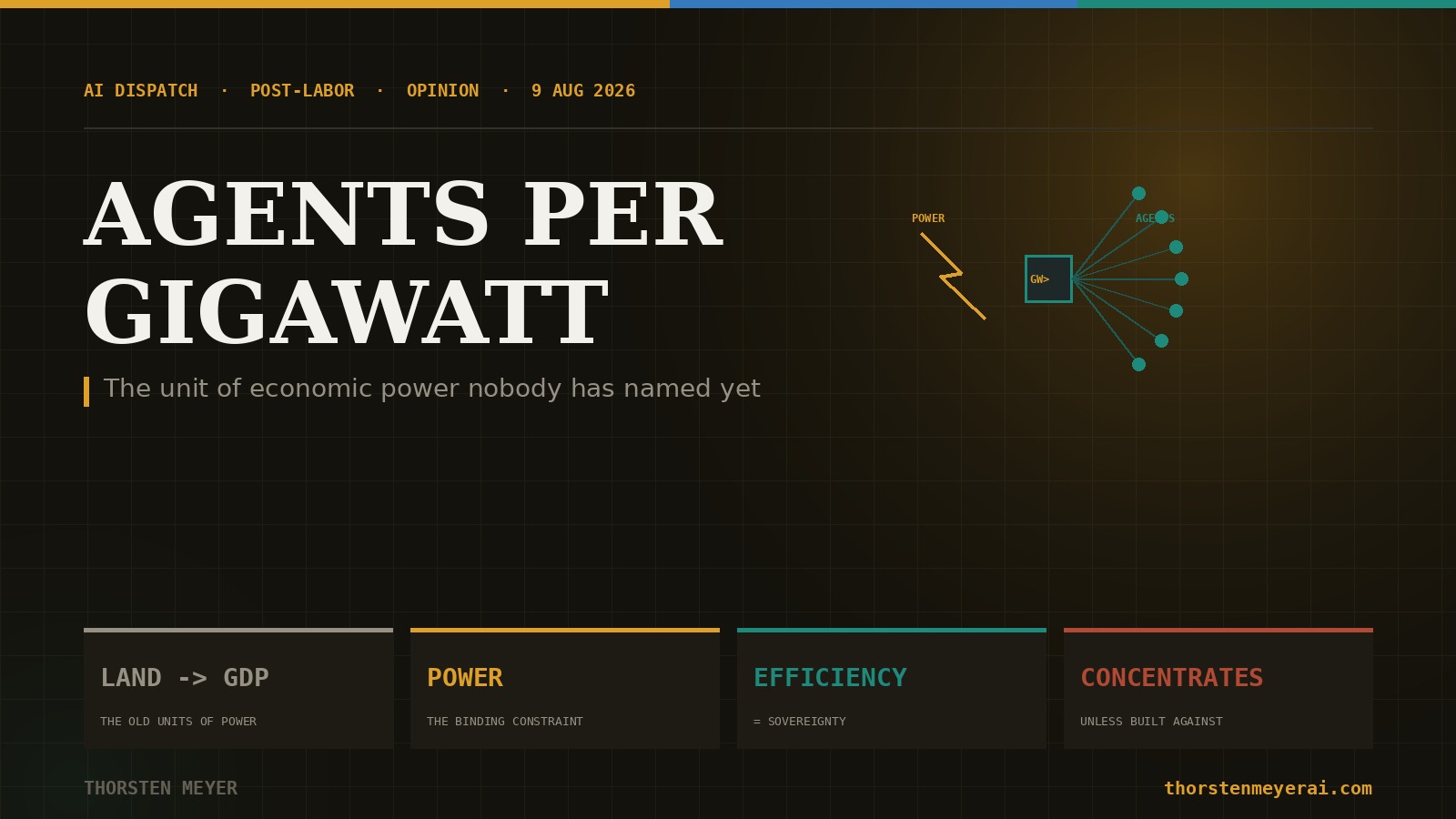
Every era measures power in whatever is scarce: land, then steel, then GDP. The binding constraint is changing again — and the new unit is how much autonomous cognition a nation or company can produce per unit of energy it can command.
▲ Opinion & analysis · not investment adviceMore agents means more tokens, which takes compute, which takes chips, which take one thing above all — power. The energy story and the AI story became the same story.
Once you hold it, the separate stories of the moment stop being separate — they’re all the same ratio, seen from different angles.
Adopting it drags three things into the open that softer framings let you avoid.
And the unit rewards concentration — unless we deliberately build against it.
Why the old unit stops working
GDP measures the output of human labor and the capital that augments it. It has been a serviceable proxy for national power because, for two centuries, human labor was the productive engine, and everything else — factories, tools, institutions — existed to make that labor more productive. Population and productivity were the two levers, and GDP captured their product.
That proxy breaks when a large and growing share of cognitive work stops coming from humans. If a nation's economic output increasingly flows not from its people thinking and deciding but from fleets of autonomous agents doing so — drafting, analyzing, coding, negotiating, researching, at volumes and speeds no human workforce could match — then a measure built around human labor is measuring the wrong thing. It is like measuring an industrial economy by the number of draft animals it owns: not wrong exactly, just increasingly beside the point.
The new productive engine is autonomous cognition at scale. And autonomous cognition, unlike human labor, is not bounded by population. It is bounded by something else entirely — and that something else is the new unit.
high efficiency AI server power supplies
As an affiliate, we earn on qualifying purchases.
As an affiliate, we earn on qualifying purchases.
What actually caps agent capacity
Follow the chain of constraints down to the bottom and you arrive somewhere specific.
You want to run more agents. Each agent is, mechanically, a stream of tokens — a model thinking, step by step, on your behalf. To run more of them, or to run them faster, or to have them think harder, you need to produce more tokens. Producing tokens takes compute. Compute takes chips. And chips, running flat out in enormous quantities, take one thing above all others: power. Not abstractly — literally. The binding constraint on how many agents you can run is how many gigawatts of electricity you can generate, deliver, and turn into computation without the whole thing melting.
This is why the energy story and the AI story have quietly become the same story. The scramble for power-purchase agreements, the reopened nuclear plants, the datacenters sited next to their own generation — these are not adjacent to the AI buildout, they are the AI buildout, seen from the layer that actually binds. A gigawatt of reliable, deliverable power is the raw feedstock of cognition now. Everything upstream of it — the models, the chips, the software — is a conversion process turning watts into thought. Which means the honest unit of productive capacity is not the number of chips you own or the cleverness of your model. It is the rate at which you can convert energy into intelligence, and the ceiling on that is measured in gigawatts.
Hence: agents per gigawatt. How much autonomous cognitive work you get out of each unit of power you can command. That ratio — improved by better chips, better models, better quantization, better cooling, everything I have been writing about all year — is the actual figure of merit. The whole industry is, whether it says so or not, in a race to raise it.
energy-efficient data center hardware
As an affiliate, we earn on qualifying purchases.
As an affiliate, we earn on qualifying purchases.
The unit reframes everything at once
Here is why I find this framing clarifying rather than merely cute: once you hold it, the seemingly separate stories of the moment stop being separate.
The buildout — the trillions flowing into datacenters — is a race to install agents-per-gigawatt capacity. That is what a datacenter is under this accounting: a machine for converting power into cognition. The financing structures I wrote about are the capital markets learning to fund the construction of that capacity. The question of whether it is a bubble is the question of whether the demand for converted cognition will fill the capacity being built. Same unit, applied to the balance sheet.
The hardware re-founding — the specialized inference silicon, the low-voltage designs, the pooled-memory interconnects — is entirely a campaign to raise the ratio. Every advance I described in the hardware piece reduces to the same thing: more agents out of each gigawatt in. Low-voltage inference is agents-per-gigawatt optimization. The token factory is an agents-per-gigawatt facility. Even the optical-transceiver fight is a skirmish over a component that sets how efficiently power becomes coordinated cognition.
The sovereignty question — the one I keep returning to — becomes suddenly precise. National AI power is not measured in papers published or models released. It is measured in sovereign agents-per-gigawatt capacity: how much autonomous cognition a nation can run on infrastructure it controls, powered by energy it commands. A country that must import its chips, rent its datacenters, and buy its interconnects has a low sovereign ratio no matter how brilliant its researchers. And this is where Europe's position becomes legible as the specific vulnerability it is. Europe can consume abundant intelligence beautifully. Its sovereign agents-per-gigawatt capacity — chips it fabricates, power it controls, fleets it owns — is thin. In a world measured in this unit, that is the number that matters, and it is the one Europe is behind on.
The labor question — the deepest one — is the exchange rate between the old unit and the new. The trillions of operating cash flow the buildout needs have to come from work that used to be done by humans and priced in wages, now done by agents and priced in tokens. The transition from a GDP economy to an agents-per-gigawatt economy is the post-labor transition, stated in units. That is not a side effect of the shift. It is the shift.
autonomous agent computing devices
As an affiliate, we earn on qualifying purchases.
As an affiliate, we earn on qualifying purchases.
The uncomfortable clarity the unit provides
Adopting this unit forces a few things into the open that softer framings let you avoid, and I would rather state them plainly.
It makes explicit that power generation is now a determinant of geopolitical rank in a way it has not been since the age of coal. The nations that can build gigawatts fastest — through whatever mix of nuclear, gas, solar, and grid they can marshal — will lead not just in energy but in cognition, because the two have merged. Energy policy has quietly become intelligence policy. A country throttling its own power buildout is throttling its own future agent capacity, whether or not anyone frames it that way.
It makes explicit that efficiency is sovereignty. If you cannot command more gigawatts, your only other lever to raise your agent capacity is to get more agents out of the gigawatts you have — which is to say, better models, better quantization, better local inference. This is the entire strategic case for the efficiency work, restated: for a power-constrained region or a resource-constrained builder, squeezing more cognition out of each watt is not a nice-to-have, it is the only available path to a competitive ratio. It is why I run quantized models on my own hardware and treat every watt as something to account for. At small scale, on my own fleet, I am optimizing exactly the ratio that nations are optimizing at large scale. The unit is the same all the way up.
And it makes explicit the thing the optimistic accounts keep soft: this unit concentrates power by its nature. Gigawatts and fabs and interconnects are not evenly distributed and cannot be quickly made so. A measure of power that reduces to "who can convert the most energy into the most cognition" is a measure that rewards those who already command energy and capital at scale. Left alone, agents-per-gigawatt is a concentrating unit. Which is, once more, the argument for keeping capability distributed — for open weights, for local inference, for sovereign capacity spread across many hands rather than pooled in few. Not because it is economically optimal. Because the alternative is a concentration of the means of producing intelligence that no society should be comfortable handing to three companies and two states.
AI compute energy management systems
As an affiliate, we earn on qualifying purchases.
As an affiliate, we earn on qualifying purchases.
Where this lands
The unit of power is changing, the way it changed when we moved from land to steel to GDP. The new unit is agents per gigawatt — autonomous cognitive work per unit of commanded energy — and it is not a metaphor but the literal accounting of the economy now under construction. It fuses the energy story and the AI story into one. It turns the buildout into a race for conversion capacity, the hardware fight into a race for the ratio, and the sovereignty question into a precise and uncomfortable measurement. It names the post-labor transition as an exchange between two units of value.
Adopt it and the picture snaps into focus, including the parts we would rather not see clearly: that energy is now intelligence, that efficiency is now sovereignty, and that the unit rewards concentration unless we deliberately build against it. I would rather we saw it clearly and built against it on purpose. Naming the unit is the first step. This is me naming it.
Opinion and analysis from a builder, founder, and post-labor economist running a local-first inference operation; the capstone of a series on the economics of the AI buildout, following "A Token Is a Token," "How to Raise a Few Billion Dollars," and the AI-hardware essay. The "agents per gigawatt" framing and its conclusions are the author's own. Not investment advice. Point-in-time as of 9 August 2026.
Fall Picks
fall essentials
As an affiliate, we earn on qualifying purchases.