
The evolution of AI hardware is marked by new chips and architectures that deliver faster, more energy-efficient performance. Companies like NVIDIA, Google, Apple, and AMD are launching innovative processors, from GPUs and TPUs to neural engines, that power everything from data centers to edge devices. Breakthrough designs like neuromorphic chips and chiplet architectures boost scalability and sustainability. If you want to explore how these advancements are shaping AI’s future, there’s more to uncover ahead.
Key Takeaways
- Next-generation AI chips feature hybrid architectures combining CPUs, GPUs, NPUs, and chiplets for enhanced scalability and performance.
- Neuromorphic and spike-based processors mimic brain functions for ultra-low-power AI applications.
- Disaggregated and resource-sharing architectures optimize efficiency and flexibility across large-scale AI deployments.
- Specialized AI accelerators like Google’s TPU v7 and NVIDIA’s Blackwell significantly boost inference speeds and energy efficiency.
- Modular, open ecosystem designs facilitate faster innovation, deployment, and address talent and supply chain challenges.

NVIDIA RTX PRO 4000 Blackwell Graphics Card – 24GB GDDR7 ECC Memory, PCIe 5.0 x16, 4X DisplayPort 2.1b, Single Slot Full Height AI Workstation GPU, Retail Packaging
Professional GPU with Blackwell Architecture
As an affiliate, we earn on qualifying purchases.
As an affiliate, we earn on qualifying purchases.
Milestones in AI Hardware Development

The development of AI hardware has evolved through a series of key milestones that transformed its capabilities and applications. Initially, general-purpose CPUs handled early AI tasks, but their limited parallelism slowed progress. The adoption of GPUs, especially NVIDIA’s CUDA GPUs in 2006, revolutionized training by enabling massive parallel processing, sparking the deep learning boom. Later, specialized AI chips like Google’s TPU in 2016 optimized both training and inference for large-scale models, boosting efficiency. Industry giants such as Apple, Intel, and AMD introduced integrated neural engines and dedicated accelerators in their chips, targeting edge devices and consumers. Recently, AI-driven chip design with tools like Synopsys DSO.ai has slashed development cycles, accelerating innovation. These milestones collectively pushed AI hardware from basic processors to sophisticated, purpose-built systems. AI Hardware advancements continue to address emerging security and performance challenges in the field.

LOOKSEVEN 3 Pack Hydrogel Film Transparent Soft TPU Screen Protector Compatible with Google Pixel 7, High Sensitivity Protective Film (Not Tempered Film)
【Compatibility】 This Screen protector only fits for Google Pixel 7, Its sensitivity is much higher than the tempered…
As an affiliate, we earn on qualifying purchases.
As an affiliate, we earn on qualifying purchases.
Leading Companies and Platform Innovations

Leading companies are at the forefront of innovation, shaping the landscape of AI hardware through specialized chips and platforms. NVIDIA dominates with its GPUs like the H100 and platforms such as DGX Cloud Lepton, enabling flexible, high-performance AI training and inference. Google’s TPU v7 “Ironwood” offers exceptional exaflops performance, optimized for large-scale inference tasks. AMD’s Instinct GPUs improve LLM fine-tuning, while Ryzen AI chips lead in AI-powered PCs. Apple’s M5 chip markedly boosts AI GPU compute, integrating Neural Engines for efficient local AI tasks. Intel expands its AI accelerator portfolio with new GPUs targeting data centers and edge devices. These companies’ platform innovations, from hardware to cloud solutions, drive AI’s rapid expansion across industries and applications. Choosing reliable hardware is crucial for ensuring secure and effective AI deployment, especially in critical applications.

The Probability Engine: How AI Really Works And Why It Changes Everything
As an affiliate, we earn on qualifying purchases.
As an affiliate, we earn on qualifying purchases.
Breakthrough Architectures and Design Strategies
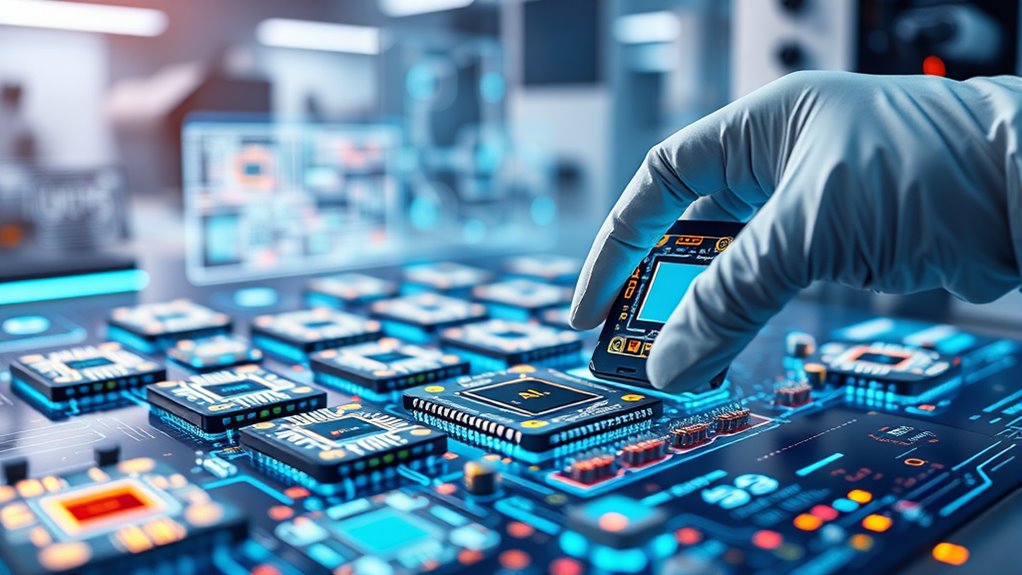
Innovative architectures are transforming AI hardware by pushing beyond traditional designs to achieve greater efficiency and scalability. Neuromorphic chips mimic brain functions for ultra-low-power tasks, while heterogeneous systems combine CPU, GPU, and NPU on a single die, boosting performance. Chiplet-based architectures like GICv5 enable scalable, multi-die systems suitable for large workloads. Open frameworks such as NVIDIA Dynamo facilitate distributed inference, dramatically improving speed. These strategies optimize resource use and reduce latency, supporting diverse applications from cloud to edge. Additionally, AI trend on Instagram exemplifies how AI-driven tools are enhancing hardware design processes through trend analysis and automation.

NEUROMORPHIC COMPUTING SYSTEM ARCHITECTURES: Brain-inspired processors event-driven computation and energy-efficient intelligence
As an affiliate, we earn on qualifying purchases.
As an affiliate, we earn on qualifying purchases.
Benchmarking Performance and Technical Advances

How do we measure the true performance of cutting-edge AI hardware? You look beyond raw clock speeds and focus on benchmarks that capture efficiency and throughput. For instance, Google’s TPU v7 “Ironwood” reaches 29.3 peak FLOPS per watt, combining high computational power with energy efficiency. Apple’s M5 chip delivers a fourfold increase in GPU AI performance over its predecessor, with a 16-core Neural Engine and high memory bandwidth. AMD’s MI325X GPU outperforms earlier models by 30% in Llama 2 fine-tuning, demonstrating improved data center and PC capabilities. NVIDIA’s Blackwell GPUs accelerate multimodal AI inference up to 30 times faster with frameworks like Dynamo. These benchmarks reveal not just raw speed but also how well hardware balances power, memory bandwidth, and scalability for advanced AI workloads. Additionally, the development of specialized AI chips tailored for specific tasks further enhances overall system performance and efficiency.
Market Trends and Real-World Applications

You see AI hardware being adopted across various industries, from autonomous vehicles to healthcare, transforming how they operate. Companies deploy AI chips in cloud data centers, edge devices, and embedded systems to meet specific performance needs. As a result, market trends reflect a growing demand for specialized solutions tailored to real-world applications. Maximize space and organization principles are also influencing hardware design, promoting more efficient and sustainable systems.
Industry Adoption Patterns
The adoption of AI hardware is rapidly expanding across multiple industries, driven by the need for faster processing, improved efficiency, and real-time decision-making. You’ll see AI chips powering cloud platforms like NVIDIA DGX Cloud and Google TPU pods, enabling large-scale data analysis. At the edge, companies use Apple’s Neural Engines and AMD Ryzen AI to deliver on-device AI for smartphones, autonomous vehicles, and IoT devices. In manufacturing, AI accelerators support digital twins and predictive maintenance, boosting productivity. Healthcare benefits from AI-driven imaging, while consumer electronics integrate NPUs for smarter devices. As demand grows, enterprises rely on validated, scalable AI hardware solutions to meet performance needs. This trend reflects a shift toward widespread, industry-specific AI adoption, shaping how businesses operate and innovate. Creating specialized hardware tailored for specific applications is becoming increasingly important to optimize AI performance and energy efficiency.
Deployment in Key Sectors
Deployment of AI hardware across key sectors exemplifies its transformative impact on industry and society. In healthcare, AI accelerates medical imaging analysis, enabling faster diagnoses and personalized treatments. Autonomous vehicles rely on specialized chips for real-time perception and decision-making, improving safety and efficiency. Manufacturing benefits from digital twins and predictive maintenance, reducing downtime and costs. In finance, AI hardware powers high-frequency trading and fraud detection, enhancing security and speed. Consumer electronics incorporate NPUs and edge AI chips for smarter devices, from smartphones to smart home systems. Cloud providers deploy powerful GPUs and TPUs to support large-scale AI workloads, driving innovation. As AI hardware becomes more advanced and accessible, these sectors will continue to evolve, unbaring new possibilities and efficiencies across industries. Additionally, regional differences in access to local legal resources can influence the deployment and adoption of AI solutions in different areas.
Future Challenges and Emerging Directions
As AI hardware continues to evolve, energy efficiency becomes more critical, pushing innovations like neuromorphic and low-precision architectures. Scaling and integration challenges grow as designs become more complex, requiring multi-chiplet and disaggregated systems. To succeed, you’ll need open ecosystems and advanced tooling, but talent shortages and geopolitical factors may slow progress. Additionally, advancements in chip technology are essential to meet these demands and ensure sustainable growth in the field.
Energy-Efficient Architectures
Energy efficiency has become a critical focus in AI hardware development, as the demand for powerful models grows alongside power and thermal constraints. To address this, emerging architectures emphasize low-precision computation, neuromorphic designs, and specialized dataflow optimizations. These innovations aim to reduce energy consumption without sacrificing performance. You’ll see a shift toward hybrid systems that combine digital and analog processing, leveraging the strengths of each to boost efficiency. Additionally, chip architectures are adopting disaggregated and multi-chiplet designs to optimize resource sharing and minimize waste. This focus on energy-efficient architectures not only extends deployment into edge and mobile environments but also helps meet sustainability goals while maintaining high-performance AI processing.
- Low-precision formats like MXFP6 to reduce power and memory needs
- Neuromorphic chips mimicking brain efficiency through spike-based processing
- Heterogeneous, disaggregated architectures for optimized resource utilization
- Dataflow and memory access optimizations to minimize energy waste
- Advances in material science are enabling the development of more sustainable and heat-efficient chip components.
Scaling and Integration
How will scaling AI hardware keep pace with the growing complexity of models and diverse application demands? You’ll need to embrace advanced integration techniques like multi-chiplet and multi-die architectures, which enable systems to scale efficiently without sacrificing performance or increasing power consumption. Heterogeneous designs combining CPUs, GPUs, NPUs, and media engines on a single die will become more prevalent, optimizing resource allocation for specific tasks. Modular approaches, such as chiplet-based systems, allow for flexible expansion, reducing manufacturing costs and improving scalability. Open ecosystems and frameworks will play a crucial role in simplifying deployment and optimization across diverse hardware setups. To meet future challenges, you’ll also need to address talent gaps and supply chain constraints, ensuring that innovations in scaling and integration translate into practical, robust AI solutions. Staying informed about the latest best practices in hardware design will be essential to overcoming these hurdles effectively.
Frequently Asked Questions
How Do Neuromorphic Chips Compare to Traditional AI Accelerators?
You’ll find neuromorphic chips differ from traditional AI accelerators by mimicking brain architecture, enabling ultra-low-power processing through spike-based signals. Unlike conventional chips optimized for digital computation, neuromorphic designs excel at real-time, energy-efficient tasks like sensory processing. They’re ideal for edge applications where power is limited, but they’re still evolving and aren’t yet as versatile or powerful as traditional accelerators like GPUs or TPUs for large-scale AI training and inference.
What Role Will Quantum Computing Play in Future AI Hardware?
Quantum computing will revolutionize AI hardware by enabling exponential speedups for complex problems like optimization, pattern recognition, and large-scale simulations. You’ll see it complement classical accelerators, handling tasks that current chips struggle with, especially in training and inference of massive models. As quantum systems become more practical, expect breakthroughs in AI efficiency, enabling more advanced, real-time applications that are currently out of reach, pushing AI capabilities to new heights.
How Are AI Hardware Designs Adapting to Energy Efficiency Demands?
You see sleek, efficient chips next to bulky, power-hungry processors. AI hardware designs adapt by embracing neuromorphic chips that mimic brain efficiency and low-precision formats like 6-bit MXFP6, reducing energy use. Heterogeneous architectures combine CPU, GPU, and NPU on a single die, optimizing power and performance. These innovations prioritize energy savings without sacrificing speed, shaping a future where AI hardware runs smarter and leaner, conserving essential resources.
What Are the Biggest Challenges in Scaling Multi-Chiplet AI Architectures?
You face significant challenges when scaling multi-chiplet AI architectures. You need to manage complex interconnects to guarantee high bandwidth and low latency, which can be difficult as chiplets increase. Additionally, coordinating power, thermal dissipation, and synchronization across multiple dies complicates design and manufacturing. You also encounter software and firmware hurdles, making it harder to optimize performance and maintain system stability as your architecture grows more intricate.
How Will Open-Source Frameworks Impact Proprietary AI Hardware Innovation?
You might worry that open-source frameworks threaten proprietary innovation, but they actually fuel it. They lower barriers, enabling you to experiment faster, optimize designs, and collaborate across industries. By sharing tools like PyTorch and TensorRT, you push boundaries without fear of being locked in. This openness sparks healthy competition, inspires breakthrough ideas, and accelerates your ability to develop cutting-edge AI hardware, benefiting everyone.
Conclusion
As you navigate the ever-evolving landscape of AI hardware, remember that each new chip and architecture shapes the symphony of innovation. Like a masterful conductor, emerging technologies orchestrate breakthroughs that push boundaries and reveal unseen potentials. Stay attentive to these shifts, for they’re the compass guiding you through this dynamic terrain. Embrace the future’s promise, where each stride in AI hardware fuels a universe of endless possibilities waiting to be uncovered.