
Every organization runs on documents that carry numbers, and almost every one of those numbers has, at some point, been wrong. Not maliciously — just the ordinary way numbers go wrong. Someone pulled a figure from a spreadsheet in March, pasted it into a board deck, and the spreadsheet moved on without the deck. A proposal went out with last quarter’s churn rate because nobody remembered which file was current. A clause got “tidied up” in a restyle and quietly changed its meaning. The deck looked finished. It was finished. It was also subtly, confidently false.

Get business pricing on tech for your team
- Business-only prices and quantity discounts
- Tax-exempt purchasing
- Multiple users, one account, clear invoices
Briefro is built around the suspicion that this is the real problem with document tooling — not that slides are slow to make, though they are, but that the documents we make are untethered from the truth they claim to report. Its pitch is unusually narrow for an AI product: turn a prompt into a polished, branded deck, document, or proposal, where every figure is bound to your actual data, the regulated language is locked, the output is reproducible — and the whole thing is generated on hardware you own, so none of it ever leaves the building.
That last clause is not a footnote. It’s the thread that connects Briefro to everything else in this portfolio, and it’s where this spotlight starts.
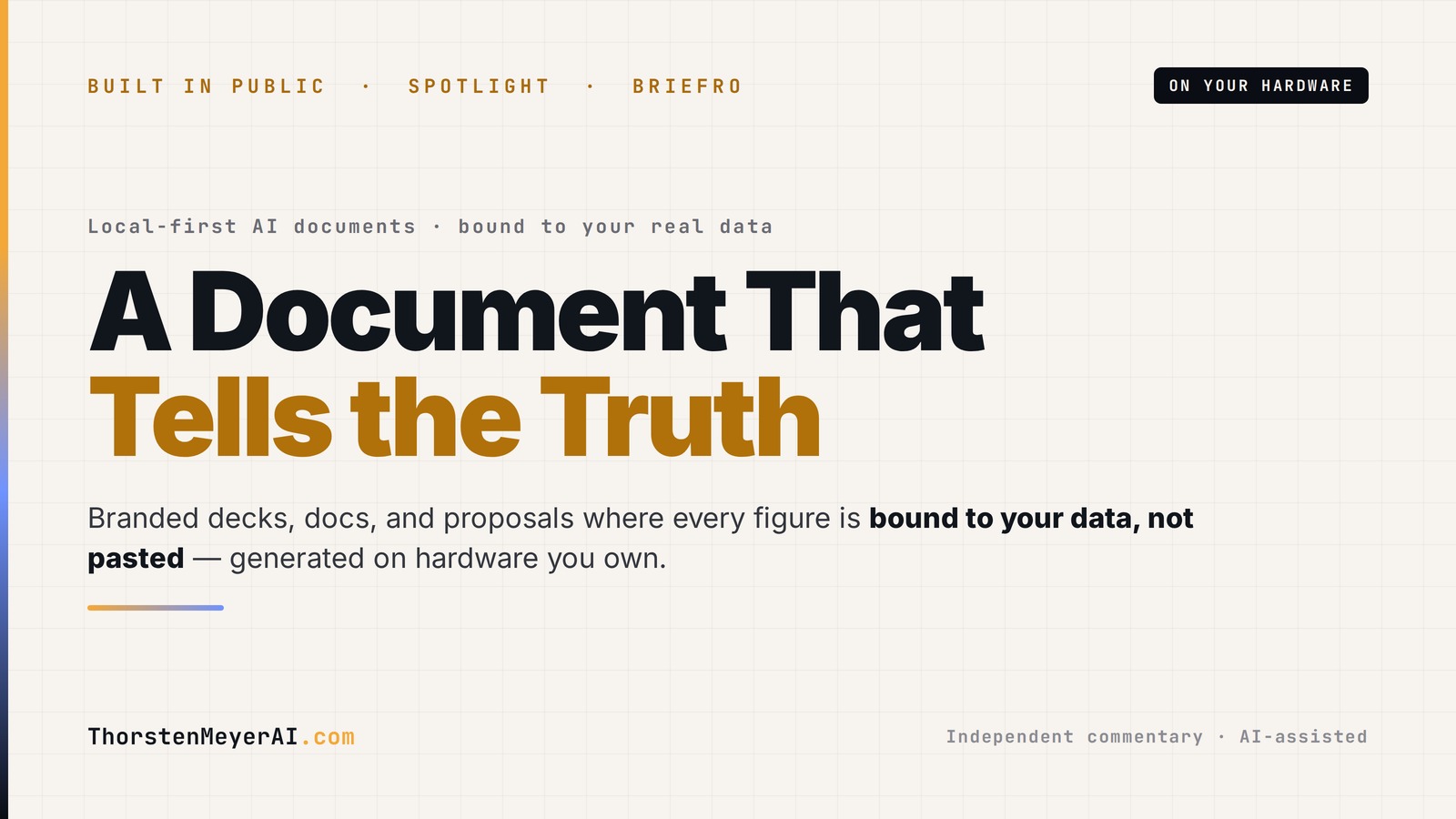
A Document That Tells the Truth
A prompt becomes a polished, branded deck, document, or proposal — where every figure is bound to your actual data, the regulated language is locked, the export is reproducible, and the whole thing is generated on hardware you own.
re-upload the data and this figure updates itself. A pasted number drifts; a bound one can’t.
The v1 contract deliberately killed the marketing site — spec written, then archived with “do not build any of it now.” The app shipped; briefro.com served nothing; four legal pages 404’d to an empty /. Subtraction taken to its end — refused until the product was real. This is the work of finally building it.
main, staged as one clean concern, committed once, and merged by PR — the dirty branch never touched.stdin, never on the command line, so the password never hit the process list.- Rotate the FTP password. It was pasted into a setup transcript, so it’s flagged for rotation as a precaution — noted, not buried.
- One-command redeploy pending. A deploy script that bakes in the control-only-TLS font trick is still to be written.
- What-if is unmerged and broken. The scenario engine reaches the KPIs but not yet the chart’s value labels; it lives on a local branch until the bug is fixed.
- Frontier vs. core. The trust architecture — local generation, data-binding, locked clauses, deterministic export — is load-bearing; some features around it are still evolving.
Independent commentary, produced with AI assistance under human editorial oversight. The views are the author’s own and may change. This is not business, financial, legal, or technical advice. Briefro is an early-stage product; some capabilities are shipped while others are in development or unmerged. Legal-page references describe templates, not advice. Infrastructure identifiers and credentials have been deliberately omitted. Product, model, and company names are trademarks of their respective owners; mention does not imply endorsement.
Three commitments, and everything downstream of them
Briefro makes three commitments, and almost every feature is a consequence of one of them.
It runs on your hardware. Contracts, board decks, research, client data — none of it leaves your machine or your LAN. The privacy and the IP stay yours, not because a vendor promises to be careful with them, but because they never arrive at the vendor in the first place. For finance, legal, healthcare, and client work, that’s not a feature, it’s the precondition for using an AI tool at all. It’s the clean answer to the “can we legally put this in the cloud?” review that quietly kills so many internal AI projects.
Documents are bound to your real data. Charts, KPIs, and tables connect to your datasets rather than being pasted in as dead values. Re-upload the data and the document updates itself — no stale numbers, no transcription errors, no divergence between the spreadsheet and the slide. This is the mechanism behind the product’s whole claim to truthfulness: a figure that’s bound can’t drift from its source the way a pasted one does.
It speaks your brand. Colors, fonts, logos, and voice come from a brand kit and get applied automatically, so the output looks like you without a round of brand-police rework. One source can then fan out into internal, client, and public variants without the versions drifting apart.
Minutes instead of hours is the headline benefit, and it’s real, but it’s the least interesting one. The interesting ones are the trust mechanics underneath.
secure local-first document editing software
As an affiliate, we earn on qualifying purchases.
As an affiliate, we earn on qualifying purchases.
What “tells the truth” actually means
It’s easy to slap “grounded, not hallucinated” on an AI product. Briefro’s design tries to earn it through specific, boring, verifiable choices rather than a promise.
Generation is steered by your knowledge base and cites its sources, so a draft is making claims you can trace rather than claims that merely sound right. Approved legal and finance language renders verbatim from a clause library — the model can fill in the blanks, but it structurally cannot rewrite the wording, which is exactly the guarantee a compliance team needs before letting a generative tool near a contract. Exports are deterministic and reproducible, so a document you sent can be reconstructed and defended later, which is the difference between “audit-ready” as a slogan and as a property. And what-if scenarios let you flex an assumption — price, churn, occupancy — and watch the dependent numbers recompute, so the model isn’t inventing a sensitivity analysis, it’s running one.
I want to be honest about the maturity here, because the house style of this series is to undersell rather than oversell. Briefro shipped as a real, working v1 application — that part is done. But some of the most attractive capabilities are still in motion: the what-if scenario engine, per the project’s own development notes, currently lives on an unmerged branch with a known, unresolved bug (the scenario adjustments reach the KPIs but not yet the chart’s value labels). It’s a good feature and it’s coming; it isn’t finished. The honest version of the pitch is that the trust architecture — local generation, data-binding, locked clauses, deterministic export — is the load-bearing idea, and the frontier features around it are exactly that, a frontier.
As an affiliate, we earn on qualifying purchases.
Who it’s for
For a creator or a small agency, Briefro turns a spreadsheet, a study, or your own analytics into a branded carousel, one-pager, or deck in minutes, keeps a single voice across every format, and — because it runs offline on your own machine — keeps working on a flight, in a café, or behind a corporate firewall that no SaaS tool can reach. Client work especially benefits: batch-produce one tailored deliverable per client from a single template and a data file, with advertising and affiliate disclosures handled correctly so partnerships stay compliant.
For a business, the same machinery reads differently. Board decks, QBRs, investment memos, and proposals get bound to live data instead of copy-paste. Sensitive information never touches an external cloud. Regulated language locks down. A single template plus a data table produces hundreds of personalized proposals, each scoped to that record’s real figures. And it runs on the Mac fleet you already own — no per-seat SaaS bill, no new vendor to procure, no cloud-residency review. Vertical packs for finance, legal, consulting, SaaS, real estate, agencies, retail, and healthcare ship templates and a knowledge starter so a team isn’t staring at a blank page on day one.
What Briefro is really trying to replace is a stack: a slide tool, a spreadsheet, a brand guide, and a cloud AI subscription, stitched together by hand and held together by hope that the numbers still match. You keep the judgment and the message. Briefro does the assembly.
brand kit template for presentations
As an affiliate, we earn on qualifying purchases.
As an affiliate, we earn on qualifying purchases.
Built in public: the homepage that was deliberately not built
Here is the part I find most telling about how this portfolio works, and it’s almost a joke at first: Briefro had no public website on purpose.
The v1 build contract explicitly killed the marketing site. The spec for it was written, then archived with the instruction “do not build any of it now.” So the project shipped a complete application and a thorough internal devlog, and briefro.com served nothing. The four German-law legal pages that did exist had a logo linking to / — which 404’d, because there was no homepage for it to reach. That’s edit-by-subtraction taken to its logical end: the marketing site wasn’t forgotten, it was refused until the product underneath it was real. This spotlight covers the work of finally building it, now that there’s something true to point at.
The brief was “modern and fancy,” which is a trap, because the default modern-and-fancy is the generic AI-template look everyone now recognizes on sight: Inter or Roboto, a purple-on-white gradient, a centered hero over three cards. The chosen direction deliberately walks away from all of it. The site is styled as a local-intelligence instrument — a dark charcoal canvas that reads like a terminal rather than a marketing splash, a single dominant warm-amber signal color with a sharp electric-blue secondary, a distinctive grotesk paired with a mono face for eyebrows and section numbers, and texture (a faint masked engineering grid, a gradient mesh, an SVG grain overlay) instead of a flat fill. The hero is asymmetric — body text beside a floating cluster of data panels — and the one piece of motion is a single orchestrated, CSS-only page-load, not a scatter of effects. The feature cards describe Briefro’s actual shipped capabilities, not invented benefits. It’s a homepage that tries to look like the product it’s selling: precise, owned, instrument-grade.
reproducible proposal generation software
As an affiliate, we earn on qualifying purchases.
As an affiliate, we earn on qualifying purchases.
The compliance decision that’s actually a privacy decision
The legal pages map English content onto German statutes, because the operator is based in Germany: an Impressum under § 5 DDG (the law that replaced the TMG), a named editorial-responsibility holder under § 18 (2) MStV, an explicit § 36 VSBG refusal to enter consumer arbitration, the liability and no-monitoring statements under §§ 7–10 DDG, a German-law terms page with the CISG excluded and the statutory liability tiers preserved, and an affiliate disclosure meeting the UWG’s recognizability requirement plus the Amazon Associates wording. One quietly sharp detail: the EU’s Online Dispute Resolution platform shut down in July 2025, so it is deliberately not linked — because linking to a dead mandatory platform is itself a warning risk. These are templates reflecting real requirements, not legal advice, and the project notes flag that the Impressum and privacy text should be lawyer-reviewed.
But the most consequential technical choice on the whole site is about fonts, which sounds absurd until you remember that loading webfonts from Google’s CDN transmits every visitor’s IP address to Google — a documented liability under German law after the well-known Munich court ruling. Briefro’s application already self-hosts its fonts for exactly this reason, so the marketing site does the same: the Geist and Geist Mono files are served locally, and the page makes zero third-party requests. There is nothing to consent to because nothing leaks. That’s not a compliance checkbox; it’s the same local-first conviction that defines the product, applied to its own front door.
Shipping it without breaking anything else
The deployment story is where the discipline shows, and it’s worth telling because it’s the unglamorous opposite of “the AI just did it.”
At the moment the site was ready to commit, the working tree was sitting on an unmerged feature branch — the very what-if branch with the known bug and a stack of uncommitted, half-finished edits. Committing the website there would have violated the repo’s one-branch-one-concern rule and risked sweeping broken, unfinished code into the record. Forcibly switching the dirty tree to the main branch was also unsafe. The solution was an isolated worktree built off main: the site was copied in (minus its secrets), staged as a single clean concern, committed once, pushed, merged by pull request, and the worktree removed — all without the primary working tree ever being touched. The broken feature branch stayed local, unmerged, and correctly excluded, exactly because it was neither finished nor pushed.
The credentials were handled with matching care. The host’s FTP credentials lived in a single local file, locked down and git-ignored twice — once at the site level and once at the repo root — and the exclusion was verified before every commit, to the point that git refused to add the file even when it was named directly. During deployment the credentials were fed to the uploader through a config file on standard input rather than as command-line arguments, so the password never appeared in the process list. The one honest blemish, which the report flags itself: the password was pasted into a setup transcript, so it needs rotating as a precaution — noted as an open item rather than quietly buried.
Even the upload had a real bug worth keeping. The HTML and CSS went up cleanly, but the two binary font files first arrived as zero-byte files — a known failure mode when pushing binaries over a fully encrypted FTPS data channel to certain servers. The fix was precise rather than panicked: keep TLS on the control channel, so the login stays encrypted, and let the public, non-secret font bytes travel on a cleartext data channel. Both fonts then uploaded at full size. Afterward, every remote file was checked byte-for-byte against its local copy, and every URL confirmed serving over HTTPS. Briefro is live at https://briefro.com — a homepage plus four cohesive, German-law-aware legal pages, in one coherent dark brand, making zero third-party requests.
The open items are listed plainly: rotate that FTP password, add a one-command redeploy script that bakes in the control-only-TLS trick for fonts, optionally restyle the older internal devlog, and finish-and-merge the what-if branch once its chart bug is fixed. Shipped, again, is not the same word as finished.
Why this one belongs in the portfolio
Briefro is a document generator, and it would be easy to file it next to the other “AI makes your slides” tools and forget it. But it’s doing something the others structurally can’t, and the something is the portfolio’s whole thesis in miniature. It keeps your data on your own ground by default. It binds its output to a verifiable source instead of asking you to trust a fluent draft. It fences the model away from the language that’s legally not allowed to change. And it was built the way it asks you to work — refusing the marketing site until the product was real, isolating one concern at a time, guarding the secrets, checking the bytes.
A document that tells the truth is a good promise for a tool. It’s a better one when the tool was built by someone willing to tell the truth about how — including the branch that’s still broken and the password that still needs rotating. That honesty is the product and the practice, and in this portfolio they’re the same thing.
Independent commentary, produced with AI assistance under human editorial oversight; the views are the author’s own and may change. This is not business, financial, legal, or technical advice. Briefro is an early-stage product; some capabilities are shipped while others are in development, unmerged, or evolving and may change. The German-law references describe templates, not legal advice — the Impressum and privacy text should be reviewed by a qualified lawyer. Infrastructure identifiers and credentials have been deliberately omitted. Product, model, and company names are trademarks of their respective owners; mention does not imply affiliation, sponsorship, or endorsement. © 2026 Thorsten Meyer · Powered by Thorsten Meyer AI. See Imprint/Impressum and Privacy Policy.
Fall Picks
fall essentials
As an affiliate, we earn on qualifying purchases.