
Thorsten Meyer | ThorstenMeyerAI.com | February 2026
Executive Summary
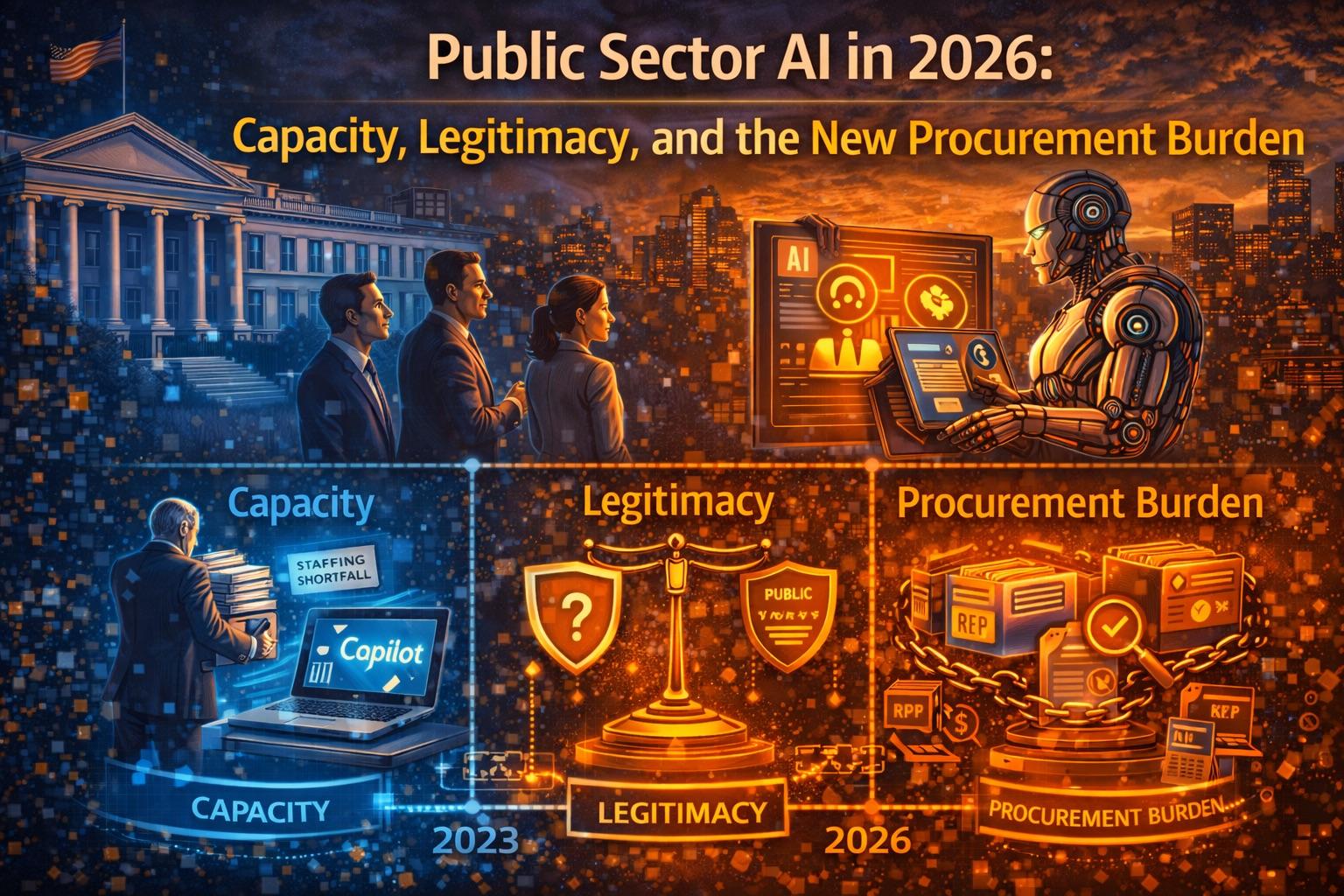
90% of federal agency respondents are planning to or already using AI. Only 12% of civilian agencies have completed AI adoption plans. 2% of defense agencies have. 55% cite workforce shortages as the primary barrier. 50% of US residents are uncomfortable with government AI — up from 45% a year ago. The AI in government market is projected at $22.4 billion globally, growing at 17.8% CAGR to nearly $100 billion by 2033.
These numbers describe a sector under simultaneous pressure from two directions: deployment demand is accelerating while institutional capacity lags behind. Worldwide AI spending will reach $2.52 trillion in 2026, a 44% increase year-over-year (Gartner). The UK committed £573 million in government AI contracts by August 2025 — surpassing all of 2024 spending. US federal agencies committed $5.6 billion to AI between 2022 and 2024.
But public-sector AI is not an enterprise efficiency problem. It is a legitimacy problem. Governments optimize for fairness, contestability, and continuity under legal mandate — not margin. A welfare eligibility error is politically and socially costly in ways that a private-sector process failure is not. The OECD’s latest data frames the stakes: unemployment is stable at 5.0%, but youth unemployment sits at 11.2%, and the income gap between top and bottom deciles averages 8.4:1 across OECD countries. AI-enabled modernization in societies with this level of baseline inequality can deepen administrative inequity even while aggregate efficiency improves.
The strategic bottleneck is not model capability. It is state capacity: procurement literacy, workforce readiness, and governance at scale.
| Metric | Value |
|---|---|
| Federal respondents planning/using AI | 90% |
| Civilian agencies: completed AI plans | 12% |
| Defense agencies: completed AI plans | 2% |
| Workforce shortages as barrier | 55% |
| AI in government market (2024) | $22.4B |
| AI in government market (2033) | ~$100B (17.8% CAGR) |
| Worldwide AI spending (2026) | $2.52T (+44% YoY, Gartner) |
| UK govt AI contracts (by Aug 2025) | £573M (surpassed all 2024) |
| US federal AI commitment (2022–2024) | $5.6B |
| Public servants: experimented with AI | 60%+ |
| Public servants: received guidance | 35% |
| US residents: uncomfortable with govt AI | 50% (up from 45%) |
| OECD unemployment (Dec 2025) | 5.0% (stable) |
| Youth unemployment (OECD) | 11.2% |
| Income gap, top vs bottom decile (OECD) | 8.4:1 |
public sector AI procurement software
As an affiliate, we earn on qualifying purchases.
As an affiliate, we earn on qualifying purchases.
1. Why Public Agencies Face a Different AI Problem
Enterprises optimize for margin and competitiveness. Governments optimize for legitimacy, fairness, and continuity under legal mandate. That changes deployment logic at every level.
The Legitimacy Constraint
| Dimension | Enterprise | Public Sector |
|---|---|---|
| Explainability threshold | Nice-to-have; investor-facing | Mandatory; decisions must be contestable |
| Failure tolerance | Revenue impact, remediation cost | Political cost, citizen harm, legal liability |
| Time horizon | Quarterly/annual ROI | Must remain governable across political cycles |
| Accountability chain | Board → shareholders | Minister → legislature → citizens |
| Equity requirement | Market-driven | Constitutional and statutory obligation |
A procurement delay is manageable. A welfare eligibility error, a biased policing recommendation, or an opaque immigration decision is politically and socially costly in ways that no private-sector analogy captures.
The Trust Deficit
| Trust Signal | Value | Source |
|---|---|---|
| US residents uncomfortable with govt AI | 50% (up from 45%) | Smart Cities Dive survey |
| Believe AI helps serve residents faster | 59% | Smart Cities Dive survey |
| AI improves operating cost efficiency | 59% | Smart Cities Dive survey |
| Negative impact on privacy | 50%+ | Smart Cities Dive survey |
| Trust human services over AI | ~50% | Smart Cities Dive survey |
| Trust AI services more | ~20% | Smart Cities Dive survey |
| Want mandatory disclosure of AI use | 76%+ | Smart Cities Dive survey |
| Say more regulation needed | 72% | KPMG Trust in AI |
| Current regulations sufficient | 29% | KPMG Trust in AI |
| More willing to trust with laws in place | 81% | KPMG Trust in AI |
50% of US residents are uncomfortable with government AI — but 59% believe it can improve speed and efficiency. The gap is not about capability rejection. It is about trust architecture: citizens want the benefits, but only with transparency, disclosure, and regulation. 81% say they would trust AI more with laws in place. The policy implication is direct: trust infrastructure is a precondition for deployment, not an afterthought.
“Citizens want the speed. They do not trust the process. That is a governance problem, not a technology problem.”
government AI compliance and governance tools
As an affiliate, we earn on qualifying purchases.
As an affiliate, we earn on qualifying purchases.
2. OECD Signals and Social Risk Framing
Three OECD-backed data points should anchor every public-sector AI strategy.
The Baseline Context
| OECD Signal | Value | Strategic Implication |
|---|---|---|
| Unemployment (Dec 2025) | 5.0% (stable) | No broad labour collapse — but no cushion either |
| Youth unemployment | 11.2% | Transition pressure concentrated in vulnerable segments |
| Income ratio (top/bottom decile) | 8.4:1 | Baseline inequality already material |
| EU unemployment | 5.9% (near record low) | Tight labour markets complicate workforce redesign |
| Euro area | 6.2% (near record low) | Same dynamic across eurozone |
Why This Matters for AI Deployment
AI-enabled state modernization is occurring in societies where inequality and transition vulnerability are already structural. If benefits accrue mainly to already-capable groups — digitally fluent, formally employed, high-trust communities — AI can deepen administrative inequity even while aggregate efficiency improves.
Three risk scenarios:
- Digital access gap. AI-powered services that assume digital literacy exclude populations that most need government support. In 2026, “omnichannel equity” — ensuring digital services are backed by phone and in-person support — is becoming a professional standard, not a luxury.
- Automation of gatekeeping. Benefits eligibility, immigration processing, and policing triage are high-impact decisions where algorithmic bias has disproportionate effects on the bottom of the 8.4:1 income distribution.
- Workforce displacement concentration. Youth at 11.2% unemployment absorb more transition volatility. Entry-level government roles — clerks, processors, intake coordinators — face disproportionate automation exposure.
The board-level question for ministers: does our AI strategy reduce the 8.4:1 gap, or does it operationalize it into faster, harder-to-contest decisions?
AI training for public sector workforce
As an affiliate, we earn on qualifying purchases.
As an affiliate, we earn on qualifying purchases.
3. Procurement Is Now the Core Governance Instrument
Most public-sector AI failures begin in procurement design — not in model selection or deployment execution.
Where Procurement Fails
| Failure Mode | What Happens | Consequence |
|---|---|---|
| Vague functional requirements | Vendor defines scope and success | Agency loses control over what the system does |
| No model-performance clauses | No contractual quality baseline | Degradation goes undetected until citizen complaints |
| No auditability standards | Black-box decisions | Legal challenge, political exposure |
| No redress obligations | No citizen recourse mechanism | Trust erosion, democratic legitimacy risk |
| No portability provisions | Single-vendor lock-in | Switching costs escalate across political cycles |
US federal policy is moving: M-25-22 now requires agencies to obtain vendor documentation “facilitating transparency and explainability” for AI procured after September 2025. But the gap between policy mandate and procurement practice remains wide.
Over 60% of public servants have experimented with AI. Only 35% have received any guidance. US states rank worst in AI capacity building, “most still in the early stages.” The Open Contracting Partnership identified a clear pattern: “shadow AI adoption” through free pilots, grants, and built-in features — outside formal procurement channels entirely.
A Modern Procurement Framework
| Requirement | What It Means | Why It Matters |
|---|---|---|
| Decision traceability by default | Every AI recommendation linked to inputs, rules, model version, human approver | Legal contestability, audit readiness |
| Appeal-ready design | Citizen-facing decisions include rationale and escalation channels | Democratic accountability, trust |
| Model and vendor portability | No critical service architecturally trapped in one stack | Political-cycle resilience, competition |
| Operational stress testing | Bias, drift, edge-case tests tied to local demographics | Equity across population groups |
| Public-interest performance metrics | Not just speed/cost: error equity, appeals resolution, access parity | Legitimacy, not just efficiency |
“The procurement template is the governance instrument. Get that wrong, and no amount of model tuning fixes it.”
AI explainability and transparency tools for government
As an affiliate, we earn on qualifying purchases.
As an affiliate, we earn on qualifying purchases.
4. Workforce Reality: Capacity Before Scale
55% of federal agency respondents cite workforce shortages as the primary barrier to AI adoption. This is not a hiring problem — it is a capability architecture problem.
The Three Capability Gaps
| Role | Capability Needed | Current State |
|---|---|---|
| Caseworkers | Decision-support literacy: when to trust, override, or escalate AI recommendations | Most have tooling access without decision frameworks |
| Procurement teams | Technical contract capability: model-performance clauses, audit rights, portability terms | “Strategic buying expertise” is rare; most rely on vendor-drafted terms |
| Internal audit / inspectorates | Model-governance skills: bias testing, drift detection, explainability review | Function barely exists in most agencies |
Without Workforce Readiness, Two Pathologies Emerge
| Pathology | What It Looks Like | Cost |
|---|---|---|
| Automation theatre | Pilot-heavy, impact-light. Many experiments, few scaled deployments. 12% completed plans. | Budget consumed, no service improvement |
| Black-box dependency | Outsourced cognition without institutional understanding. Vendor runs the model; agency cannot explain decisions. | Legitimacy risk, vendor lock-in, democratic deficit |
Only 12% of civilian agencies have completed adoption plans. 65% use AI for document processing, 45% for workflow automation — but these are entry-level applications. Scaling to high-impact citizen decisions requires workforce capability that most agencies have not built.
The Practical Sequence
| Phase | Action | Prerequisite |
|---|---|---|
| 1. Classify | Map decision types by risk: advisory, assisted-decision, autonomous action | Decision taxonomy, risk framework |
| 2. Augment | Deploy low-risk augmentation first (document processing, scheduling, triage support) | Basic digital literacy |
| 3. Institutionalize | Build review boards, audit functions, appeal mechanisms | Governance capability |
| 4. Expand | Only then increase autonomy to higher-risk decision classes | Proven governance at lower levels |
Skipping phases 1–3 produces the 12% completion rate. Building them produces institutional capability that compounds across deployments.
5. Fiscal Pressure and the Credibility Calculus
Governments are under pressure to show productivity gains. State and local IT spending is expected to reach $160 billion in 2026, with AI as the primary growth category. But rushed deployments trigger expensive remediation, legal disputes, and credibility erosion.
The Credibility-First Calculus
| Approach | Year 1 | Year 3–5 |
|---|---|---|
| Rushed, broad rollout | Fast visibility, political credit | Reversals, litigation, citizen backlash, remediation costs |
| Credibility-first portfolio | Slower start, fewer headline wins | Fewer reversals, lower litigation, better adoption, stable political support |
A credibility-first strategy is often fiscally superior over 3–5 years:
- Fewer reversals and rollbacks
- Lower litigation burden (algorithmic accountability suits are growing)
- Better citizen adoption (trust enables usage)
- More stable political support (no “AI scandal” cycle)
The Regulatory Landscape Is Tightening
| Regulation | Status | Requirement |
|---|---|---|
| M-25-22 (US Federal) | Active (Sep 2025+) | Vendor documentation, transparency, explainability |
| Colorado AI Act (SB 24-205) | Effective June 2026 | Impact assessments for high-risk AI systems |
| Algorithmic Accountability Act | Under consideration | Impact assessments for systems affecting 1M+ people |
| NYC Local Law 144 | Active | Bias audits for automated employment decisions |
| Connecticut | Active | AI impact assessments for state agencies |
| NIST AI RMF / ISO 42001 | Framework (voluntary) | Risk identification, mitigation templates |
For finance ministries, this argues for a portfolio approach: a small number of high-confidence deployments with rigorous assurance, rather than broad but fragile rollouts. The political cost of one high-profile AI failure can exceed the combined budget of ten well-governed pilots.
6. Practical Actions for Public-Sector Leaders
1. Set a national/agency AI service taxonomy. Three classes: advisory (information support, no decision authority), assisted-decision (AI recommends, human decides and is accountable), and autonomous action (AI decides within defined parameters, human oversight at exception level). Every deployment classified before procurement begins.
2. Mandate algorithmic impact assessments for high-impact decisions. Benefits eligibility, immigration, policing triage, welfare allocation, and any decision affecting legal rights. Colorado’s framework (effective June 2026) and the federal M-25-22 guidance provide starting templates.
3. Build internal procurement academies. AI contracting, model-performance clauses, audit-right provisions, portability terms, and bias-testing requirements. The 55% workforce gap does not close with generic training — it requires procurement-specific capability building. Georgia’s expansion to 19 qualified AI contractors shows that broadening the vendor pool is feasible when procurement teams are capable.
4. Publish service-level trust dashboards. Accuracy rates, appeal volumes and resolution times, response speed, and equity indicators across demographic groups. 76%+ of citizens want mandatory AI disclosure. Meet that demand proactively — dashboards build trust faster than press releases.
5. Fund frontline retraining as part of AI budgets. Not as a separate “later” initiative. Caseworker decision literacy, procurement technical capability, and audit/inspectorate model-governance skills — budgeted within each AI deployment, not treated as overhead.
| Action | Owner | Timeline |
|---|---|---|
| AI service taxonomy | Minister / Agency head | Q1 2026 |
| Algorithmic impact assessments | CTO + Legal + Policy | Q2 2026 |
| Procurement academy pilot | CPO + Digital team | Q2 2026 |
| Trust dashboards (first services) | CDO + Service delivery | Q3 2026 |
| Frontline retraining integration | CHRO + Budget office | Ongoing with each deployment |
What to Watch
Whether governments standardize interoperable assurance frameworks. The current pattern is bespoke, agency-by-agency governance — expensive and inconsistent. Shared frameworks for audit, bias testing, and explainability standards would reduce duplication and raise the floor. The NIST AI RMF and ISO 42001 provide voluntary templates, but mandatory adoption is the signal to watch.
Growth of shared public-sector AI infrastructure. Identity verification, audit logging, secure execution environments, and model registries as sovereign digital public goods — not vendor-specific services. Countries that build these as shared infrastructure will scale faster and cheaper than those that procure them per-agency.
Political salience of AI-driven service errors in election cycles. A welfare denial, a policing misclassification, or a permit delay driven by an opaque algorithm becomes a campaign issue when it affects enough voters. The political cost function is asymmetric: one high-profile AI error can set an agency’s modernization program back years. Credibility-first strategy is risk management, not conservatism.
The Bottom Line
90% planning to use AI. 12% have completed plans. 55% lack workforce capability. 50% of citizens are uncomfortable. 35% of public servants received guidance. 8.4:1 income inequality. 11.2% youth unemployment. The gap between AI deployment pressure and institutional capacity is where legitimacy gets spent.
Public-sector AI is not an efficiency optimization. It is a state capacity test. Procurement literacy, workforce readiness, and governance architecture determine whether AI improves services or amplifies the fractures that citizens already experience. The agencies that build capacity before they scale autonomy will earn the trust that — in democratic governance — is the only currency that compounds.
The fastest way to set public-sector AI back a decade is to deploy it faster than the institution can govern it.
In government, the speed of deployment is limited by the speed of accountability — and that is exactly as it should be.
Thorsten Meyer is an AI strategy advisor who has noticed that the phrase “move fast and break things” sounds different when the thing you are breaking is someone’s benefits eligibility determination. More at ThorstenMeyerAI.com.
Sources
- Google/Government Executive Survey — 90% Federal Respondents Using AI (Jan 2026)
- Google/Government Executive — 12% Civilian, 2% Defense Completed AI Plans
- Google/Government Executive — 55% Workforce Shortages as Barrier
- Google/Government Executive — 65% Document Processing, 45% Workflow Automation
- Open Contracting Partnership — Public Sector AI Procurement Shifts (Nov 2025)
- Open Contracting — UK £573M AI Contracts by Aug 2025
- Open Contracting — US $5.6B Federal AI Commitment (2022–2024)
- Open Contracting — 60% Experimented, 35% Received Guidance
- Smart Cities Dive — 50% US Residents Uncomfortable with Govt AI (2025)
- Smart Cities Dive — 59% Believe AI Improves Speed/Efficiency
- Smart Cities Dive — 76%+ Want Mandatory AI Disclosure
- KPMG Trust in AI 2025 — 72% Want More Regulation, 29% Sufficient
- KPMG — 81% More Willing to Trust AI with Laws in Place
- OECD — 5.0% Unemployment, 11.2% Youth (Feb 2026 release)
- OECD Society at a Glance 2024 — 8.4:1 Income Decile Ratio
- Gartner — $2.52T Worldwide AI Spending 2026 (+44% YoY)
- Grand View Research — $22.4B AI in Government Market (2024)
- M-25-22 — US Federal AI Procurement Guardrails (Sep 2025+)
- Colorado AI Act (SB 24-205) — High-Risk AI Impact Assessments (June 2026)
- Forrester — Tech Nationalism Reshaping Public-Sector AI Procurement (2026)
- OECD — Building an AI-Ready Public Workforce (2026)
- GovTech — $160.2B State/Local IT Spending (2026)
© 2026 Thorsten Meyer. All rights reserved. ThorstenMeyerAI.com




![Huawei’s AI Strategy: Dominating AI As Frontier AI Lab With Noah’s Ark, Pangu Ecosystem [In-Depth Analysis, 2026] - Klover.ai](https://thorstenmeyerai.com/wp-content/uploads/2026/09/huawei-s-ai-strategy-dominating-ai-as-frontier-ai-lab-with-noah-s-ark-pangu-ecos-featured-260x140.jpg)