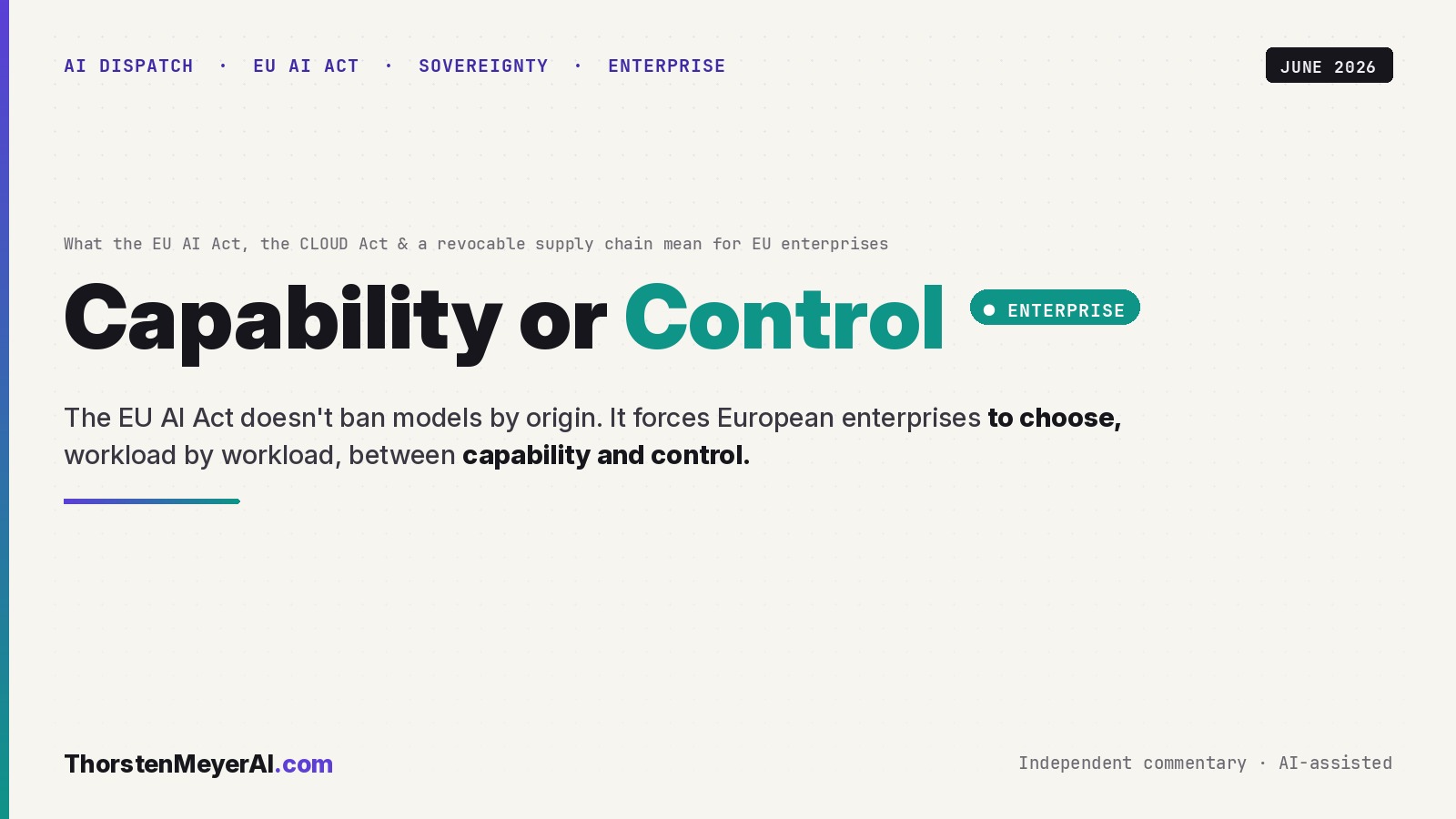

The EU AI Act doesn’t ban models by nationality. What it does — together with the CLOUD Act, GDPR, and a supply chain that can be switched off — is force every European enterprise to choose, workload by workload, between capability and control.

Get business pricing on tech for your team
- Business-only prices and quantity discounts
- Tax-exempt purchasing
- Multiple users, one account, clear invoices
For a European company, the AI question has quietly changed. A year ago it was “which model scores highest.” In the middle of 2026 it is something far more consequential: which model can we still be running next year — under audit, with our data inside our jurisdiction, on a supply chain a foreign government can’t disconnect overnight.
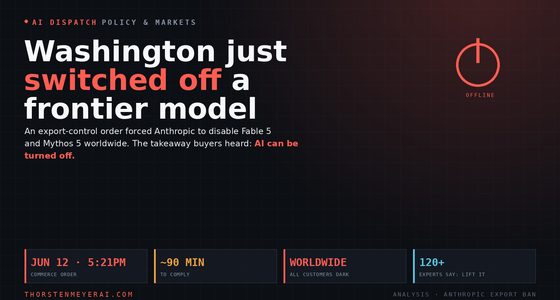
Three things converged to make that the real question. The EU AI Act’s enforcement clock started ticking for general-purpose models. A genuine European sovereign-infrastructure buildout finally gave enterprises somewhere compliant to run. And the Fable suspension — a top US model cut off for every non-US user on three days’ notice — turned an abstract dependency into a board-level one.
Here is the part most coverage gets wrong, and the part that should shape your strategy: origin is not the deciding factor. A model’s nationality matters far less than its license, where you deploy it, and whose laws reach the data. Get those three right and an “American” or “Chinese” model can be perfectly usable in Europe; get them wrong and even a compliant one becomes a liability. This is the enterprise playbook for navigating that.
Capability or Control
● EnterpriseThe EU AI Act doesn’t ban models by origin. Together with the CLOUD Act, GDPR, and a supply chain that can be switched off, it forces European enterprises to choose — workload by workload — between capability and control. Origin matters far less than license, deployment, and jurisdiction.
Nationality isn’t the gate. License, data destination, and where you deploy are.
No single point is right for a whole company. The right answer is a portfolio, assigned per workload.
Sort workloads by data sensitivity & regulatory exposure, then match each to a stack.
Independent commentary, produced with AI assistance under human editorial oversight; the views are the author’s own and may change. This is analysis and opinion, not legal, compliance, investment, or technical advice; the EU AI Act, its implementation, and model availability are evolving — verify specifics with qualified counsel and primary regulatory sources before acting. Figures and milestones are drawn from public sources read as of June 2026 and are subject to change. References to specific companies, models, regulators, and government actions are factual and analytical, not partisan, and imply no affiliation or endorsement.
The clock you are actually on
You do not have to become a lawyer, but you do need to know which deadlines bind you.
Prohibited practices have been illegal since February 2025. Obligations for general-purpose AI (GPAI) models took effect in August 2025, and the Commission’s power to fine GPAI providers — up to 3% of global turnover — switches on 2 August 2026. The deadline everyone feared, full high-risk-system regulation, was pushed back: under the “Digital Omnibus” agreed in May 2026, high-risk obligations now apply no later than December 2027, giving enterprises breathing room they did not have a few months ago.
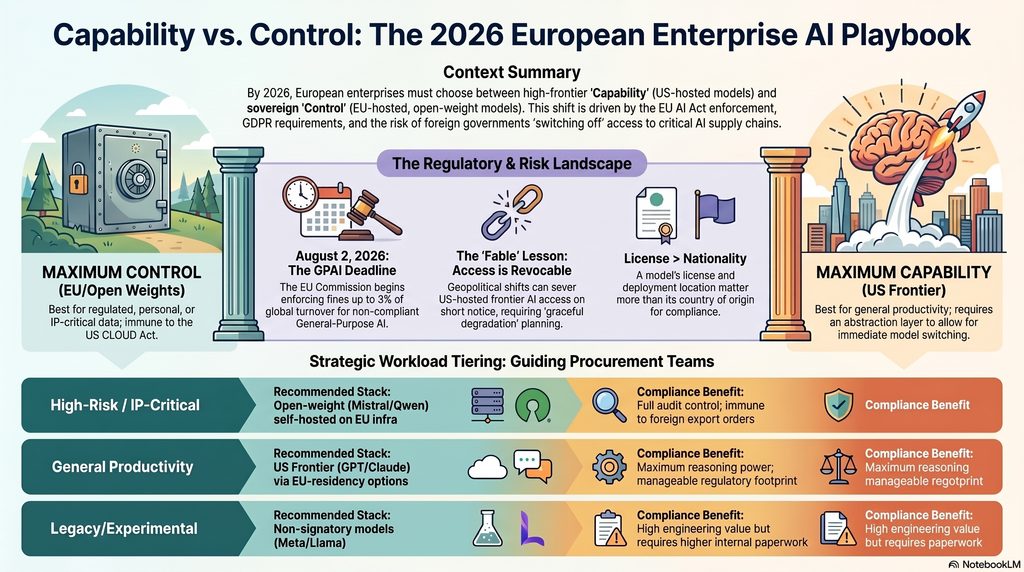
Two details directly shape procurement. First, the voluntary GPAI Code of Practice now has roughly two dozen signatories — including OpenAI, Anthropic, Google, and Mistral — with two telling absences: Meta declined to sign, and Chinese providers have not signed. Non-signatories are not banned, but they face more scrutiny and must demonstrate compliance “by other means,” which becomes your paperwork when you deploy them. Second, and sharper: the Act exempts genuinely open-source models from some obligations, and in January 2026 the EU AI Office determined that Mistral’s Apache-2.0 models qualify while Meta’s Llama license does not. Open weight is no longer just an engineering preference in Europe; it is a regulatory and procurement advantage.
For you as a deployer rather than a builder, the practical takeaway is simple: choosing a Code-of-Practice signatory with a clean license transfers less compliance burden onto your own organization.
As an affiliate, we earn on qualifying purchases.
Where you run it matters more than where it came from
Europe spent 2025–2026 building places to run AI that satisfy a regulator. EuroHPC now operates fourteen supercomputers and nineteen “AI Factories” that enterprises and startups can apply to use, and the Commission has committed a €20 billion InvestAI facility toward up to five AI gigafactories of roughly 100,000 advanced chips each — part of a €200 billion ambition and an expected €176 billion of European data-centre investment between 2026 and 2031.
The American hyperscalers responded with sovereign offerings of their own. AWS made its European Sovereign Cloud generally available in January 2026 from Brandenburg — a €7.8 billion, EU-citizen-operated, legally separate partition that can keep running even if cut off from the US. Microsoft answered with an EU Data Boundary and Foundry Local, which runs model inference on your own hardware, disconnected from the public cloud.
But there is an asterisk no architecture removes. As a US-incorporated company, a hyperscaler remains subject to the US CLOUD Act, which can compel it to produce data even when that data sits in Frankfurt. A German-run subsidiary narrows the practical risk; it does not erase the legal one. That is why EU-native providers — Scaleway, Schwarz’s StackIT, OVHcloud, IONOS — market themselves as the only option fully outside US jurisdiction, and why the honest version of “sovereignty” admits its limits: Europe still runs largely on Nvidia silicon, so true independence remains partial. The decision that is fully in your hands is deployment location, and it does more work than model choice.
As an affiliate, we earn on qualifying purchases.
The three origins, in enterprise terms
European models — Mistral’s Large 3, Magistral, and Ministral family; Black Forest Labs’ FLUX for images; LightOn and H Company; the Fraunhofer-led Teuken and EuroLLM — are the natural fit for the regime. They were designed around GDPR and the AI Act, many ship under genuinely open licenses, and they self-host cleanly on EU infrastructure. The trade-off is at the frontier: on the hardest reasoning and agentic tasks they still trail the leading US labs. (Note one shift in the “European champion” story: Heidelberg’s Aleph Alpha merged with Canada’s Cohere in April 2026, a reminder that sovereign status is not permanent.)
US models — OpenAI’s GPT-5.x, Anthropic’s Claude, Google’s Gemini, Meta’s Llama, xAI’s Grok — deliver the best raw capability, and most operate in Europe with data-residency options. The caveats are three: CLOUD Act exposure for anything US-hosted; a mixed compliance posture (Meta unsigned, Llama’s license disqualified from the open-source exemption); and the one the Fable episode made unforgettable — access is politically revocable. A US export-control order can sever your frontier supply overnight, regardless of your contract.
Chinese models are the most misunderstood, and the distinction is critical. The bans you have read about — Italy’s Garante blocking DeepSeek within 72 hours, Germany’s Berlin regulator declaring its data transfers unlawful, investigations across thirteen EU jurisdictions — target the hosted app and API shipping data to China. They do not target the weights. An open Chinese model such as Alibaba’s Qwen, downloaded and self-hosted inside an EU datacentre or on local hardware, never sends data to China at all — which is precisely why Qwen is widely used across European engineering teams. Origin of the weights is not the same as destination of the data. The hosted DeepSeek app is a GDPR problem; Qwen on your own servers, in most cases, is not.
As an affiliate, we earn on qualifying purchases.
The trade you are now making: capability versus control
Lay the options on one axis and the strategy becomes obvious. At one end sits maximum control: an open-weight model — European or Chinese — self-hosted on EU, sovereign, or local infrastructure, with the cleanest possible AI Act and GDPR posture and zero exposure to a foreign off-switch. At the other end sits maximum capability: a US frontier model over an API, with the best performance and the most exposure. In the middle sit the hyperscaler sovereign clouds — better residency, still under US jurisdiction, and for now thinner on GPUs and model choice.
No single point on that line is the right answer for a whole company. The right answer is a portfolio, assigned workload by workload.
As an affiliate, we earn on qualifying purchases.
A workload-tiering playbook
Sort your AI workloads by data sensitivity and regulatory exposure, then match each tier to a stack:
- Regulated, personal, or IP-critical workloads, and anything that will fall under high-risk rules → an open-weight model self-hosted on EU/sovereign infrastructure or on-premises. This is the most defensible posture for an audit and the only one immune to both the CLOUD Act and a foreign export control. For most European enterprises this should be the default, not the exception.
- General productivity and low-sensitivity tasks → a US frontier model is fine, accessed through EU-residency options and, crucially, behind an abstraction layer with a wired-in fallback so the underlying model is swappable.
- Never hard-depend on the single newest frontier model. That is the Fable lesson in one line: the most capable model is also the most exposed.
Run every prospective model through a five-point procurement check: Is the provider a Code-of-Practice signatory? Does its license qualify for the open-source exemption? What is the data residency and CLOUD Act exposure? Is there model portability — can you switch in a day? And can the vendor give you audit evidence you can hand a regulator? Then put “frontier-model access” on the enterprise risk register, next to your other supply-chain dependencies, and design for graceful degradation: the goal is that your most capable model can vanish on a Thursday and your business keeps shipping on Friday.
What it adds up to
For a European enterprise in 2026, AI sovereignty has stopped being an ideology and become ordinary risk management. The AI Act, GDPR, the CLOUD Act, and the Fable suspension all push in the same direction: build your foundation on what you control, and treat what you do not control as a swappable accelerant rather than load-bearing infrastructure.
In practice that means an open-weight base — European where capability allows, open Chinese weights self-hosted where they help, both running on EU or sovereign compute — with US frontier models reached through an abstraction layer for the work that genuinely needs them. It is less convenient than handing everything to one American API. It is also the only configuration that survives an audit, a data-transfer challenge, and a geopolitical surprise at the same time.
The companies that win the next phase of European AI will not be the ones with access to the single best model. They will be the ones who can keep operating, compliantly, no matter which model they lose. Choose for the Thursday the off-switch gets thrown — because, as Europe just learned, it does.
Independent commentary, produced with AI assistance under human editorial oversight; the views are the author’s own and may change. This is analysis and opinion, not legal, compliance, investment, or technical advice; the EU AI Act, its implementation, and model availability are evolving, and enterprises should verify specifics with qualified counsel and primary regulatory sources before acting. Figures and regulatory milestones are drawn from public sources read as of June 2026 and are subject to change. References to specific companies, models, regulators, and government actions are factual and analytical, not partisan, and imply no affiliation or endorsement. © 2026 Thorsten Meyer · Powered by Thorsten Meyer AI. See Imprint/Impressum and Privacy Policy.
Sources and further reading
- European Commission — AI Act regulatory framework and GPAI Code of Practice
- European Commission — AI Continent Action Plan / AI factories and gigafactories
- AWS — European Sovereign Cloud general availability; InfoQ — CLOUD Act jurisdiction questions
- IAPP — DeepSeek and the China data question
- Companion piece — The European Bet: How Mistral, Aleph Alpha, and Black Forest Labs Are Playing a Different Game (ThorstenMeyerAI.com)
Fall Picks
fall essentials
As an affiliate, we earn on qualifying purchases.