
Abstract
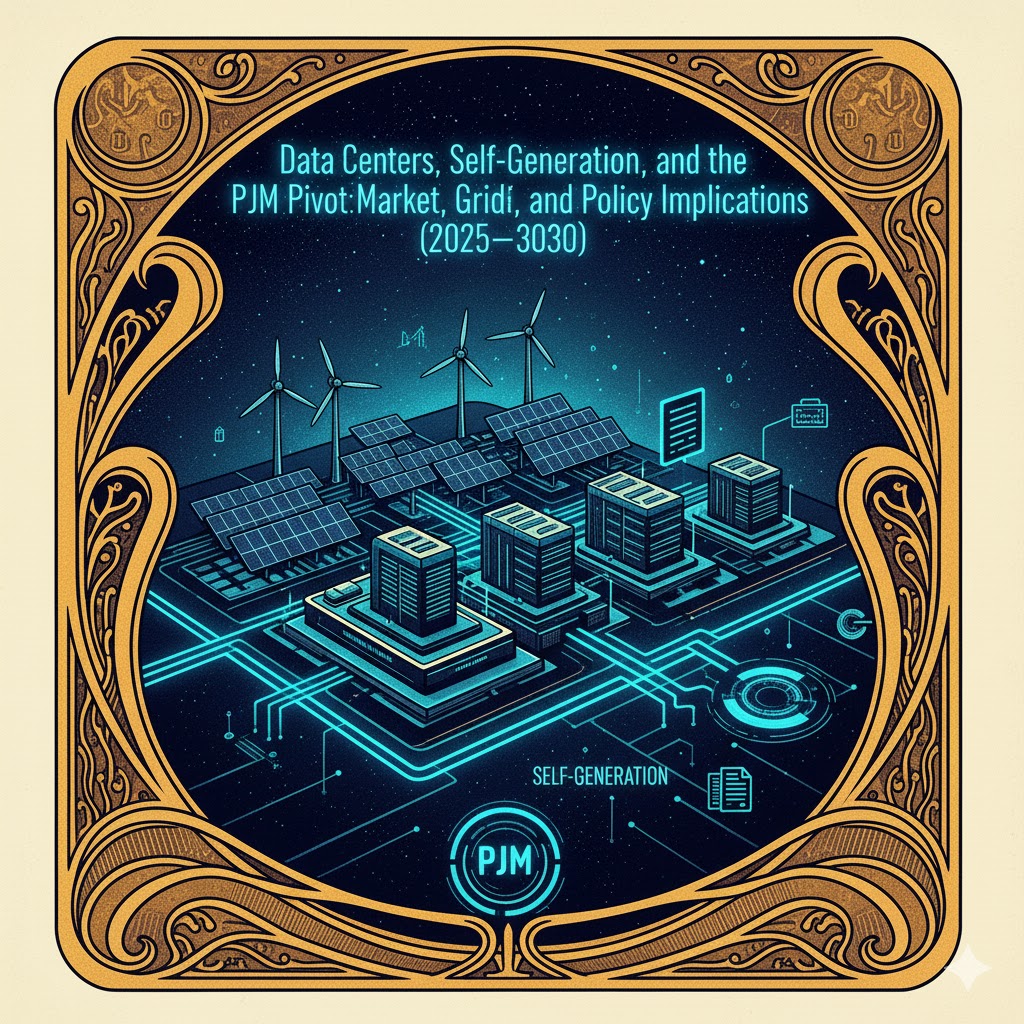
Four governors in the PJM Interconnection footprint (PA, MD, NJ, VA) are advancing a policy concept to fast-track data-center approvals conditioned on those facilities guaranteeing dependable power to the grid (i.e., “bring your own megawatts”). This paper examines the proposal against PJM’s surging load outlook, capacity-market dynamics, interconnection bottlenecks, and state-level consumer protection aims. We model likely outcomes for reliability, prices, emissions, and investment, and offer a playbook for hyperscalers, independent power producers (IPPs), utilities, and policymakers. Inside Climate News+1

Power Backup Systems for Data Centers: UPS, Generators, and Redundancy
As an affiliate, we earn on qualifying purchases.
As an affiliate, we earn on qualifying purchases.
Executive Summary
- Demand shock: PJM’s 2025 Long-Term Load Forecast projects ~32 GW peak-load growth 2024–2030, ~30 GW from data centers—a structural step-change for capacity planning and pricing. insidelines.pjm.com+2datacenterdynamics.com+2
- Policy response: The governors’ concept would expedite siting for data centers that guarantee firm power (not necessarily on-site) and can inject it into PJM, shifting the burden of resource adequacy from ratepayers to large loads. Inside Climate News+1
- Market stress: PJM is already moving on a Critical Issue Fast Path (CIFP) for large loads, exploring “non-capacity-backed load (NCBL)” treatment >50 MW; stakeholders are split, citing fairness, reliability, and technology neutrality. utilitydive.com+1
- Price signals: Capacity prices have spiked (from $28.92/MW-day in 2024/25 to $329.17 in 2026/27), reflecting tightness driven in part by projected data-center growth. ieefa.org
- Bottlenecks & remedies: FERC approved a PJM plan to fast-track power plants, drawing criticism that the change advantages gas over clean projects; PJM and Google also launched an AI partnership to accelerate interconnection-queue processing. AP News+1
- State posture: A new “PJM Governors Collaborative” indicates sustained, coordinated pressure for reforms to reliability, costs, and governance—setting the stage for state-driven conditions on high-load campuses. PA.gov+1
Bottom line: Conditioning data-center approvals on self-supplied, firm power can ease near-term adequacy stress and social-license concerns, but without strong guardrails it risks locking in gas, undermining decarbonization and creating uneven access for other customers. The winning playbook is portfolio-based firming (renewables + storage + thermal peakers or long-duration options), location-aware siting, and transparent cost allocation so that reliability improves without socializing risk.

Renewable Energy Transition: Strategies for Sustainable Systems, Clean Energy Policy, and Global Solutions
As an affiliate, we earn on qualifying purchases.
As an affiliate, we earn on qualifying purchases.
1) System Context: PJM’s “New Load Curve”
PJM saw record winter peaks in January 2025 amid extreme cold, highlighting limited reserve margins. Simultaneously, the interconnection queue is historically backlogged—delaying new clean capacity that could cover data-center growth. Reuters+1
- Growth mix: Forecasts attribute ~30 GW of peak growth this decade to data centers, largely around Northern Virginia and adjacent states—co-located with existing fiber, skilled workforce, and substation density. datacenterdynamics.com+1
- Planning pressure: PJM’s own updates emphasize rising costs and adequacy concerns under high-growth scenarios; independent modeling shows +44 TWh higher demand by 2030 vs. earlier forecasts in data-center-heavy cases. insidelines.pjm.com+1
Oxseryn 4400-Watts Inverter Generator, Open Frame Generator Gas Powered, Emergency Home Backup, RV Ready 30A Outlet, EPA Compliment
Powerful Output: 4400 peak watts and 3400 running watts, 2*120V AC ports, 1* 30A RV port, 1*12V DC…
As an affiliate, we earn on qualifying purchases.
As an affiliate, we earn on qualifying purchases.
2) The Governors’ Proposal: “Fast Track if You Firm”
Core idea: Large data centers gain expedited siting and approvals if they guarantee dependable power into PJM. Firming assets may be off-site so long as they connect within the same grid area and deliver verifiable capacity/energy. Implementation leverages state authority over siting/permits and, potentially, directives to transmission owners. Inside Climate News+1
Motivations
- Avoid shifting adequacy costs onto households/SMBs as hyperscale load arrives.
- Reduce “first-mover strain” on local substations and long-lead transmission reinforcements.
- Maintain economic-development upside while containing reliability risks. PA.gov
Contested points
- Process equity: Priority lanes for one class of customer may disadvantage others in interconnection and cost allocation. utilitydive.com
- Resource mix: Expediency could favor gas-fired peakers/CCGTs over clean projects given current queue timelines and financing conditions. AP News

Critical Cooling: Case Studies in Data Centers, Cleanrooms, and High-Tech HVAC: How Precision Cooling Systems Power the Digital and Industrial World
As an affiliate, we earn on qualifying purchases.
As an affiliate, we earn on qualifying purchases.
3) Market Mechanics Likely to Change
3.1 Capacity Market & NCBL
- Treating >50 MW campuses as NCBL pushes them to self-procure firm capacity rather than relying on PJM’s centralized capacity market—reducing uplift to other customers but creating bilateral complexity. utilitydive.com
- Price trajectory: With elevated RPM clearing prices already visible, self-supply contracts (PPAs + tolling + RA products) may undercut or complement auction exposure while accelerating project FIDs near load pockets. ieefa.org
3.2 Interconnection & Siting
- Queue automation: PJM–Google AI workflow promises to speed viability screens and network-upgrade studies, improving time-to-energization—critical for off-site firming assets that underpin approvals. Reuters
- State fast tracks: Governors’ concept would coordinate permitting of both data-center and enabling generation/transmission, reducing sequencing risk (load arrives before capacity). Factor This™
4) Reliability, Emissions, and Cost: Scenario View (Qualitative)
Scenario A — Gas-heavy firming (fastest path):
- Reliability: Improves quickly; dispatchable MWs map to peaks.
- Costs: Near-term stable; fuel/price volatility risk persists.
- Emissions: Upward pressure; risks to state climate targets.
Evidence pointer: FERC-approved PJM fast-track criticized for favoring gas, reflecting real-world lead-time constraints. AP News
Scenario B — Balanced portfolio (renewables + storage + limited thermal):
- Reliability: Good, if storage duration matches peak shapes and winter risk.
- Costs: Competitive all-in LCOE with IRA-enhanced clean PPAs; capex front-loaded.
- Emissions: Declines over time; aligns with state goals.
Evidence pointer: PJM and Synapse modeling show feasible growth but emphasize timelines and upgrade needs to integrate new resources. Synapse Energy+1
Scenario C — Clean-dominant with long-duration storage (LDS) and DR:
- Reliability: Strong in steady state; ramp/rare-event coverage must be proven.
- Costs: Lower over lifecycle; early-stage technology risk, procurement complexity.
- Emissions: Material decline; reputational benefits for hyperscalers.
Evidence pointer: Queue delays are the gating factor; AI-accelerated studies and state fast-tracks determine feasibility. Reuters+1
5) Winners and Losers
Potential Winners
- Hyperscalers that pre-aggregate firming portfolios (hybrid PPAs, storage tolling, reciprocating engines/peakers as bridge) gain siting certainty and community buy-in. Inside Climate News
- IPPs & funds offering turn-key “MW-as-a-Service” (capacity + EACs + shape + RPS compliance) near PJM load pockets.
- OEMs & software enabling queue automation, grid digital twins, and constraint-aware siting (see PJM–Google). Reuters
Potential Losers/Risks
- Ratepayers if cost allocation still socializes network upgrades for private campus timelines; needs guardrails. Inside Climate News
- Pure-play renewables without firming partners, if gas-first pathways dominate fast tracks. AP News
6) Policy Design: Guardrails That Matter
- Resource-neutral firmness standard
- Define qualifying firmness (ELCC-based, seasonal reliability credits, penalties for non-performance) to avoid implicit technology bias.
- Calibrate with PJM’s capacity accreditation and winter-peak realities. utilitydive.com
- Transparent cost allocation
- Ensure network-upgrade costs follow the cost-causer (the campus + its enabling resources), with limited socialization unless broad benefits are demonstrated. utilitydive.com
- Portfolio compliance option
- Permit off-site portfolios (renewables + storage + thermal) that meet a carbon-intensity trajectory (e.g., declining tCO₂/MWh bands to 2030), preventing indefinite gas lock-in. Factor This™
- Local-benefit compacts
- Tie fast-track approvals to distribution upgrades, workforce programs, and community resilience (e.g., black-start capable storage serving critical facilities during outages).
- Queue reforms + AI-assisted studies
- Institutionalize the PJM–Google interconnection automation, publish SLAs for study milestones, and establish “deliverability corridors” for clean resources near growth nodes. Reuters
- Market interface
- If NCBL expands, standardize bilateral RA contracts and performance penalties to keep system incentives aligned with RPM and seasonal risk. utilitydive.com
7) Tactical Playbook by Stakeholder
For Hyperscalers & Colos
- Secure siting in substations with known “deliverability corridors.”
- Pre-package firming: 1–2 hour BESS for intra-day shape, reciprocating peakers/CCGT for rare peaks, and PPAs for energy and REC strategy; migrate to longer-duration storage by 2028–2030.
- Contract constructs: blended tolling + RA strip + carbon-intensity KPI, with step-down gas reliance over term. Factor This™
For IPPs/Developers
- Build modular firming blocks (50–150 MW) near load pockets; pair with storage for capacity accreditation and offer “fast-track bundles” aligned to governors’ criteria. utilitydive.com
For States & Regulators
- Codify a firmness performance standard, carbon glide-path, and transparent upgrade cost rules; integrate with economic-development MOUs and consumer price protections. Inside Climate News
For Utilities/TOs
- Propose non-wires + storage solutions for campus interconnections; publish hosting-capacity maps and queue heatmaps to steer siting.
8) Risks & Mitigations
- Gas lock-in risk: Require declining carbon-intensity for firming portfolios; prioritize dual-fuel reciprocating engines with future hydrogen/RNG pathways and set conversion milestones. AP News
- Equity & fairness: Implement public dashboards of upgrade costs and beneficiaries; ensure that expedited projects do not leapfrog safety/environmental reviews. utilitydive.com
- Winter reliability events: Stress-test portfolios against polar vortex-style conditions; require dual-contingency plans and on-site backup for black-start. Reuters
- Queue slippage: Scale the AI interconnection initiative, set SLA penalties/credits for missed study timelines. Reuters
9) What to Watch (2026–2027)
- Codification of the governors’ framework into state legislation or multi-state MOUs. PA.gov+1
- PJM CIFP outcomes on NCBL: thresholds, penalties, and interaction with RPM. utilitydive.com
- RPM clears and bilateral RA pricing under continued load additions. ieefa.org
- Mix of firming assets actually built (gas vs. storage/renewables) under FERC-approved fast tracks. AP News
- Interconnection throughput improvements from the PJM–Google AI program. Reuters
Conclusion
The “fast-track if you firm” concept marks a pragmatic—if imperfect—attempt to reconcile explosive data-center growth with resource adequacy and consumer protection in PJM. Implemented with resource-neutral firmness, clear cost causation, and a carbon glide-path, it can relieve grid stress without entrenching emissions. The decisive factor won’t be whether data centers bring megawatts, but what kind of megawatts—and how quickly PJM’s queue, studies, and siting rules can convert capital into dependable capacity.
References
- Inside Climate News, Oct. 30, 2025; Nov. 1, 2025. Inside Climate News+1
- Renewable Energy World, Oct. 31, 2025. Factor This™
- Data Center Dynamics, Aug. 12, 2025. datacenterdynamics.com
- PJM, 2025 Long-Term Load Forecast (Jan. 24, 2025) and system updates. pjm.com+2insidelines.pjm.com+2
- Utility Dive, Sept. 3 & Aug. 2025 (CIFP/NCBL). utilitydive.com+1
- Reuters, Jan. 22 & Apr. 10, 2025 (winter record; PJM–Google AI). Reuters+1
- AP News, Mar. 2025 (FERC fast-track approval controversy). AP News
- Pennsylvania Governor’s Office & Public Power Association (PJM Governors Collaborative). PA.gov+1
- Synapse Energy Economics (Dec. 2024 modeling). Synapse Energy