
Introduction
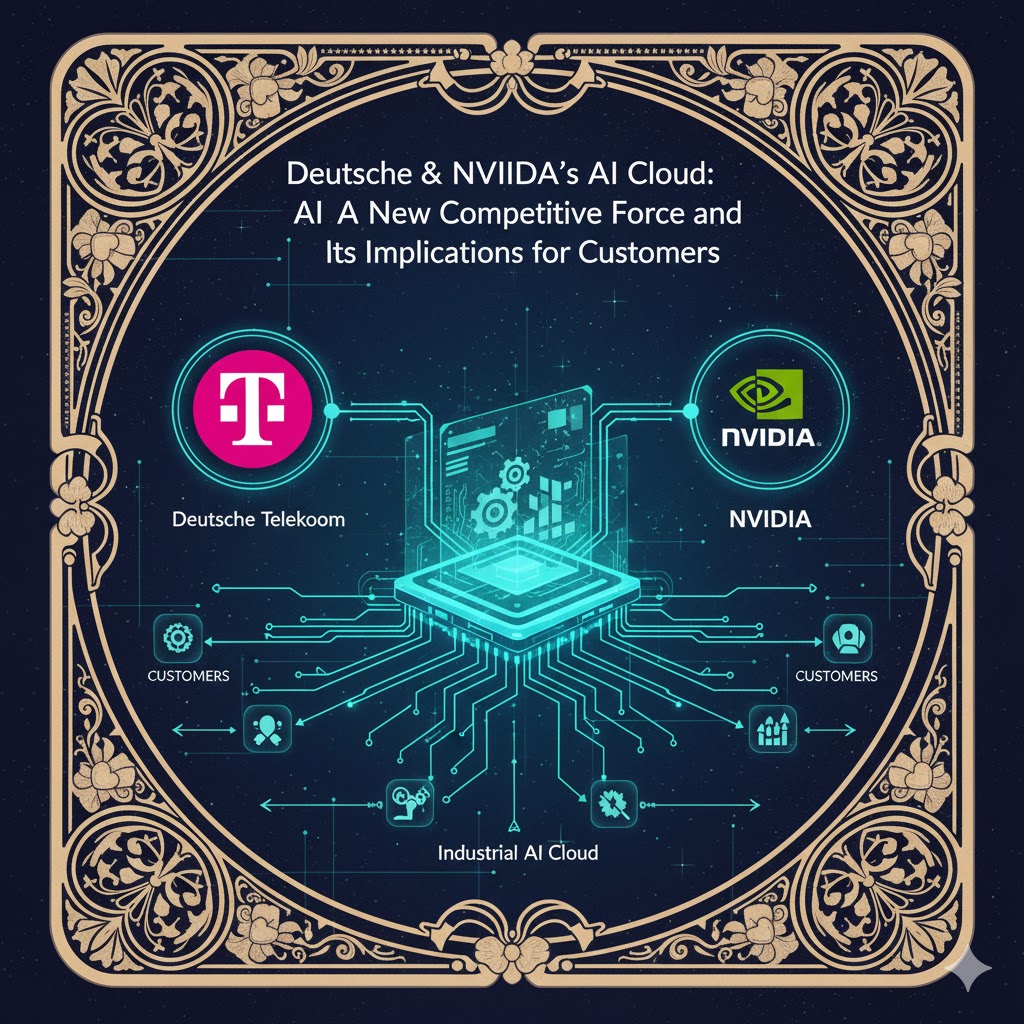
On 4 November 2025, Deutsche Telekom (DT) and NVIDIA announced a €1 billion partnership to build the world’s first Industrial AI Cloud. Located in a refurbished data‑centre outside Munich, the facility will go live in Q1 2026, hosting up to 10,000 NVIDIA Blackwell GPUs and delivering roughly 0.5 exa‑floating‑point operations per second (0.5 EFLOPS) of compute power. DT provides the physical infrastructure while SAP’s Business Technology Platform (BTP) supplies the software stack, forming the so‑called “Deutschland Stack.” The joint venture is part of the “Made 4 Germany” initiative and aims to give European enterprises sovereign access to high‑performance AI computetelekom.com. Early customers include Siemens, Mercedes‑Benz, BMW, Agile Robots, Wandelbots, Quantum Systems, PhysicsX and Perplexityblogs.nvidia.com.
The announcement is significant because Europe’s AI infrastructure lags behind the U.S. and China. In comparison with U.S. projects housing hundreds of thousands of GPUs, the Munich facility’s 10,000‑GPU capacity illustrates both ambition and the gap in capacitydatacentremagazine.com. Europe’s push for digital sovereignty—keeping sensitive data and compute inside the region—has gathered momentum: 62 % of European organisations plan to adopt sovereign solutions in response to geopolitical uncertainty and 60 % intend to increase investments in sovereign AI during the next two yearsmorningstar.com. DT and NVIDIA’s partnership is therefore a strategic move to capture this emerging market, estimated by Oppenheimer at US$1.5 trillion globally and about $120 billion in Europeinvestopedia.com. This report assesses the initiative’s impact on the competitive landscape and on customers across key verticals.
Industrial AI Cloud: Technology, Scope and Partnerships
Key technical features
| Feature/metric | Details (with source) | Significance |
|---|---|---|
| Location | Refurbished data centre near Munich, Germanytelecoms.com | Being located in Germany ensures data residency within the EU and is central to digital sovereignty. |
| Investment | About €1 billion; partnership financed by DT and NVIDIAtelekom.com | Demonstrates strong private‑sector commitment without direct government subsidy. |
| Hardware | Up to 10,000 NVIDIA Blackwell GPUs (DGX B200 systems and RTX PRO servers)telekom.com | Equivalent to ~0.5 EFLOPS; one of Europe’s largest GPU deployments. |
| Infrastructure | 20 petabytes of storage and 400 Gbps network capacitytelecoms.com | Supports data‑heavy industrial workloads and low‑latency connectivity. |
| Software | NVIDIA AI Enterprise, Omniverse, Isaac robotics, CUDA‑X accelerationblogs.nvidia.com | Provides software stack for training, simulation, digital‑twin and robotics workloads. |
| Sovereignty & governance | Data processed according to European standards; operations handled by DT; SAP BTP integrated into Deutschland Stacktelekom.com | Ensures compliance with EU data‑protection laws and fosters trust among public‑sector and regulated industries. |
| Launch & availability | Early access from early 2026; customers can book compute capacity on demandreuters.com | Flexible consumption model lowers barrier for SMEs and start‑ups. |
Ecosystem partnerships
- SAP acts as the technological backbone, providing the BTP and applications that integrate AI into enterprise workflowsblogs.nvidia.com. SAP CEO Christian Klein emphasised that Europe’s AI market could exceed €20 billion by 2030 and that meeting demand for 22 GW of data‑centre capacity will require partnershipsnews.sap.com.
- Siemens will accelerate industrial AI adoption and use the platform to offer AI‑powered services to customers; automakers Mercedes‑Benz and BMW plan to run complex simulations with AI‑driven digital twins to speed vehicle developmentblogs.nvidia.com.
- Robotics companies like Agile Robots and Wandelbots will use the cloud to generate and curate large datasets, train robotics foundation models and implement digital‑twin‑based factory optimisationblogs.nvidia.com.
- Quantum Systems will leverage the cloud to develop AI‑powered air‑ and sea‑based drones for surveillance and defensereuters.com.
- The platform is part of Made 4 Germany, an initiative of more than 100 companies pledging €735 billion to strengthen Germany as a business hublightreading.com.
Impact on the Competitive Landscape
1. Challenge to U.S. hyperscalers
The global AI compute market is dominated by Amazon Web Services (AWS), Microsoft Azure and Google Cloud. These providers deliver hyperscale infrastructure but host most of their AI capacity outside Europe. This has raised concerns that European companies’ sensitive industrial data could be subject to extraterritorial access under U.S. laws. The DT‑NVIDIA venture offers a sovereign alternative by keeping data and compute within Germany. Early customers can book GPU capacity “as needed” and the platform is designed for public services and defence sectorsreuters.com—areas where data sovereignty is critical.
The move intensifies competition in several ways:
- Market differentiation through sovereignty – While Orange and Capgemini launched Bleu, a sovereign cloud targeting French public sector, their reliance on Microsoft services has raised concerns about dependence on U.S. providerslightreading.com. DT’s Industrial AI Cloud is more vertically integrated, using NVIDIA hardware and running within DT’s network, thereby appealing to customers that require strict data control.
- Pressure on hyperscalers to localise – With 62 % of European organisations seeking sovereign solutions and 60 % planning to increase investment in sovereign AImorningstar.com, hyperscalers may need to build more local AI infrastructure or partner with European operators. EU policymakers have pledged €200 billion over the next decade to boost AI computing capacitydatacentremagazine.com, so more partnerships may follow.
- GPU demand locks in NVIDIA’s dominance – Oppenheimer estimates that sovereign AI demand could be worth US$1.5 trillion globallyinvestopedia.com. The 10,000‑GPU order underscores how sovereign projects can drive sales of high‑end chips. Competitors like AMD and the upcoming AI chips from Intel may struggle to match NVIDIA’s entrenchment in this vertical.
- Telco diversification – DT’s entry into AI infrastructure challenges other European operators such as Telefónica and Vodafone to develop similar offerings. DT CEO Tim Höttges called the AI factory “the next industrial revolution” and said Germany’s industrial heritage would be “supercharged by AI”telecoms.com. Such rhetoric positions the telco as more than a connectivity provider, potentially capturing higher‑margin compute revenue.
2. European sovereign cloud ecosystem
Competition is also emerging among European sovereign-cloud players. Aside from Bleu and DT’s initiative, Nebius (formerly Yandex Cloud) offers an AI cloud with data centres across Europe and the Middle Eastmorningstar.com. Hyperscale projects—like those proposed by SoftBank and Oracle in the U.S.—are still larger in scaledatacentremagazine.com, but Europe is catching up. The Accenture report noted that 65 % of European companies admit they cannot remain competitive without non‑European technology providers, showing that sovereign clouds must balance local control with access to global innovationmorningstar.com. DT’s partnership with NVIDIA—an American firm—illustrates this hybrid approach: European infrastructure with U.S. technology.
3. Implications for AI chip makers and software vendors
The Industrial AI Cloud reinforces NVIDIA’s dominance in the AI‑accelerator market. Competitors like AMD’s MI300X may find it harder to win large European deployments without similar sovereign partnerships. Software vendors (SAP, Siemens, PhysicsX) can differentiate by providing vertical‑specific AI applications, while start‑ups like Perplexity gain access to GPU resources they cannot otherwise afford. This may stimulate a European ecosystem of AI models, digital twins, and robotics applications that depend on the platform.
Impact on Customers Across Key Verticals
The Industrial AI Cloud is explicitly designed for industrial and manufacturing sectors. However, its sovereign infrastructure and flexible consumption model will affect several verticals.
Manufacturing and Industrial Automation
The partnership aims to “turbocharge Industry 4.0” by providing compute for digital‑twin and robotics workloadsblogs.nvidia.com. Manufacturers can simulate entire production lines using NVIDIA Omniverse and Isaac robotics, then deploy AI‑controlled robots in physical factories. Siemens plans to use the cloud for digital twins that speed product development and offer AI‑powered solutions to customersblogs.nvidia.com. The ability to book capacity as neededreuters.com will be particularly attractive to small and medium‑sized manufacturers that cannot build their own supercomputers.
Benefits for manufacturing clients:
- Digital twins & simulation – Complex manufacturing processes (e.g., car assembly) can be simulated to optimise production and detect issues earlyblogs.nvidia.com.
- Predictive maintenance – Real‑time sensor data can feed into AI models predicting equipment failures, reducing downtimeblogs.nvidia.com.
- Robotics training – Robotics providers like Agile Robots and Wandelbots will train foundation models for entire fleets of robots using the cloud’s large compute capacityblogs.nvidia.com.
- Quality control & machine vision – In the photonics and machine‑vision sector, the cloud enables AI‑powered defect detection and advanced optical design simulation, speeding R&D and improving yieldsnovuslight.com.
Automotive and Mobility
Automotive firms such as Mercedes‑Benz and BMW will leverage AI‑driven digital twins to run complex vehicle simulations, dramatically accelerating design cyclesblogs.nvidia.com. The high‑fidelity simulation environment can model aerodynamics, battery performance and manufacturing processes. Access to sovereign compute also addresses concerns about sharing proprietary vehicle data with foreign hyperscalers.
Robotics and Smart Factories
Robotics start‑ups will benefit from scalable GPU resources to train foundation models for robots and to test them in simulated environments. Agile Robots will generate large datasets and use Omniverse libraries to validate robot behaviourblogs.nvidia.com. Wandelbots’ NOVA platform will run on the Industrial AI Cloud, bringing AI‑driven testing, optimisation and deployment directly to factory floorsblogs.nvidia.com. The ability to scale up compute without building new hardware lowers barriers for robotics innovation.
Aerospace, Defence and Drones
Quantum Systems, a German drone maker, will use the cloud to develop air‑ and sea‑based drones for surveillance and military operationsreuters.com. The sovereign nature of the platform is crucial for defence applications because it ensures sensitive data do not leave national borders. Additionally, digital‑twin simulations can model drone performance in complex environments, improving safety and mission success.
Pharmaceuticals & Life Sciences
Although not a primary focus, the Industrial AI Cloud’s compute capacity allows molecular simulation and drug discovery. NVIDIA’s announcement noted that the platform can handle molecular simulation at scale and train next‑generation foundation models using real production datablogs.nvidia.com. Pharmaceutical companies could use the sovereign environment to train models on proprietary chemical and genomic data while complying with EU data‑protection regulations.
Energy & Utilities
Predictive maintenance and digital‑twin modelling apply equally to energy plants and utilities. Accenture’s study highlighted that utilities (70 %) and public services (69 %) are among sectors most likely to adopt sovereign AImorningstar.com. DT’s platform offers them a secure way to develop AI models for grid optimisation, smart metering and infrastructure planning, reducing reliance on U.S. hyperscalers and aligning with national energy‑security policies.
Public Sector and Defence
The cloud will serve public services and defence sectors, as stated by DT CEO Tim Höttgesreuters.com. Applications could include AI‑assisted logistics, digital‑twin models for infrastructure planning, and secure collaboration tools. Sovereign control over data will help governments comply with strict data‑residency laws and reduce the risk of foreign interference.
Strategic Implications for Customers
- Lower barrier to entry – The pay‑as‑you‑consume model allows SMEs and start‑ups to access GPU‑class compute without capital‑intensive infrastructure, democratising AI adoption in Europe.
- Interoperability via SAP – The integration of SAP BTP means enterprises can embed AI capabilities into existing workflows and ERP systems, accelerating time‑to‑valuenews.sap.com.
- Compliance and risk mitigation – Customers operating in regulated industries (banking, utilities, defence) can develop AI models on European soil and avoid potential conflicts with U.S. data‑request laws. The platform’s adherence to EU data standards and security measures reduces risktelekom.com.
- Ecosystem advantage – By concentrating compute resources and software stacks, the Industrial AI Cloud fosters an ecosystem where hardware vendors, software companies and start‑ups can co‑innovate. This cluster effect could boost local job creation and encourage further investment in adjacent technologies (e.g., semiconductor manufacturing, green data‑centre power).
- Energy and sustainability concerns – High‑performance data centres consume significant energy. Policymakers and customers will need to ensure that the facility uses renewable energy sources or implements heat‑recovery systems. Public remarks by Germany’s Digital Minister emphasised that government aims to present a data‑centre strategy by the end of the yeartelekom.com.
Conclusion
Deutsche Telekom and NVIDIA’s Industrial AI Cloud marks a major turning point in Europe’s AI landscape. By establishing a sovereign, industrial‑grade AI factory within Germany, the partnership offers European enterprises and governments access to high‑performance compute without ceding control over sensitive data. With 10,000 GPUs, 20 PB of storage and integration with SAP, the platform provides robust infrastructure for digital twins, robotics, simulation, predictive maintenance and moreblogs.nvidia.com. The initiative not only promises to accelerate Industry 4.0 for manufacturers but also has implications for automotive, robotics, defence, life sciences and public sectors.
From a competitive standpoint, the Industrial AI Cloud challenges U.S. hyperscalers and catalyses a broader movement toward sovereign AI solutions. It underscores how telcos can diversify into compute services and highlights NVIDIA’s strategic push into sovereign AI demand. For customers, the platform reduces barriers to adopting AI, ensures compliance with European data laws and fosters a collaborative ecosystem that could transform the continent’s industrial base. As Europe seeks to triple its computing capacity over the next decadedatacentremagazine.com, projects like this one may serve as templates for balancing competitiveness with digital sovereignty.