
Yesterday this publication argued that Europe should specify the legal tests for a Canadian AI alliance while the drafting is live. Two days ago it argued the alliance is strategically sound. Both pieces leaned, as almost all the coverage does, on a comfortable assumption:

Get business pricing on tech for your team
- Business-only prices and quantity discounts
- Tax-exempt purchasing
- Multiple users, one account, clear invoices
Canada has abundant cheap clean power, and Europe doesn’t.
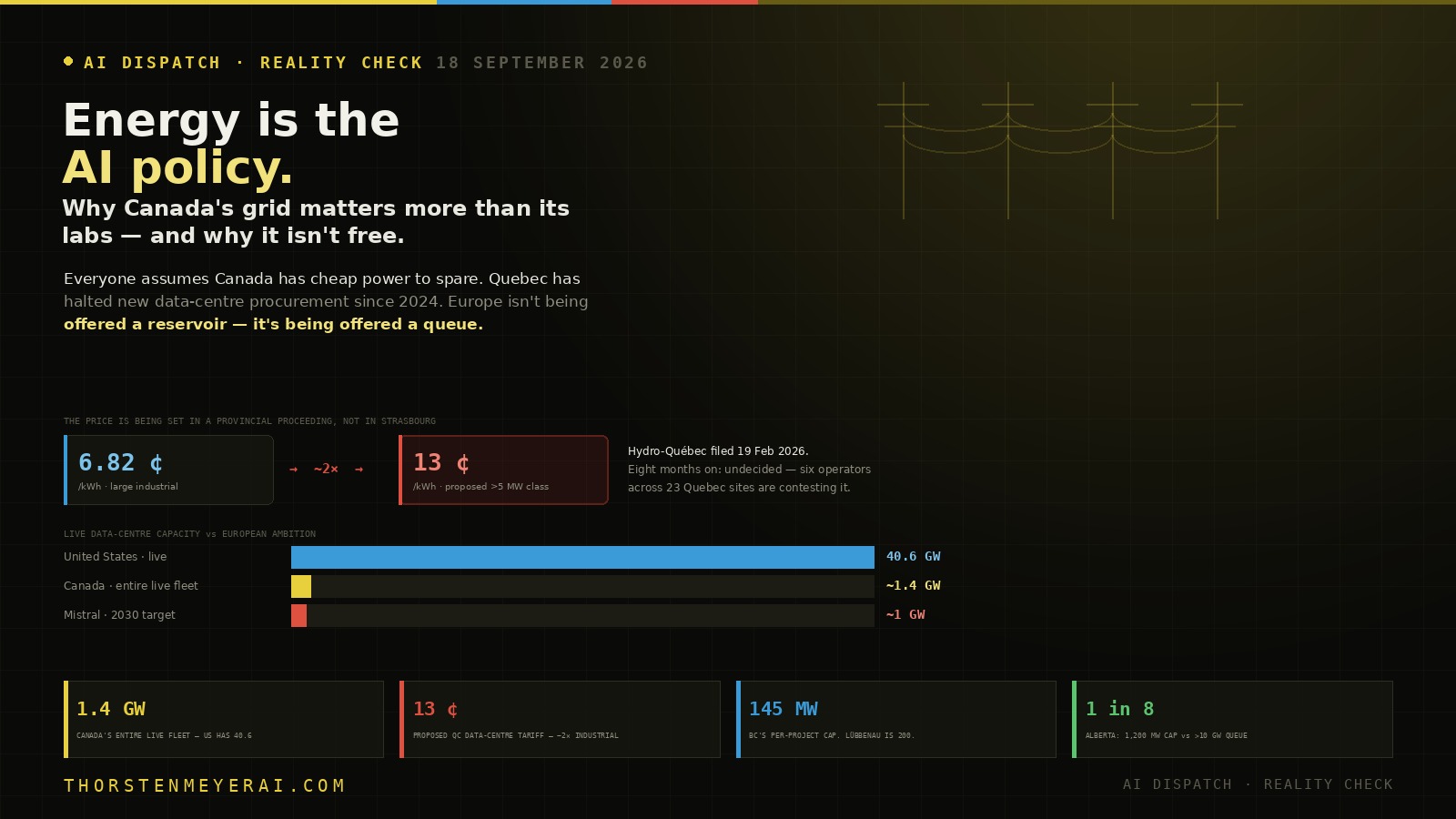
That assumption is about to be wrong, and the evidence is already public. Quebec has been restricting new power procurement for large data-centre projects since 2024. Hydro-Québec has asked its regulator to create a separate consumer class for data centres above 5 MW at roughly 13 ¢/kWh — about double the current large-industrial rate of 6.82 ¢. British Columbia is allocating 400 MW over two years, capped at 145 MW per project. And Canada’s entire live data-centre fleet stood at roughly 1.4 GW in late 2025, against 40.6 GW in the United States.
Europe is not being offered an energy surplus. It is being offered a queue — one that is already contested, already being repriced, and already the subject of a regulatory fight.
That is a more useful thing to know than the brochure version, and it changes what Europe should actually negotiate for.
Energy is the AI policy: why Canada’s grid matters more than its labs — and why it isn’t free
Almost all the coverage leans on one assumption: Canada has abundant cheap clean power and Europe doesn’t. That assumption is about to be wrong, and the evidence is already public. Europe isn’t being offered a reservoir. It’s being offered a queue — already contested, already being repriced.
- >78 GW installed hydro; ~60% of national generation
- Lowest unit system costs: Quebec C$76/MWh, Manitoba C$91, BC C$100
- Cold climate cuts cooling load; Ontario nuclear expanding
- Ottawa: double capacity by 2050, non-emitting, plus an intertie programme
- Quebec has halted new large data-centre power procurement since 2024
- BC: 400 MW over two years, capped at 145 MW per project
- Alberta: 1,200 MW cap vs a >10 GW queue — a 1-in-8 hit rate
- Canada live capacity ~1.4 GW vs the US 40.6 GW
Procurement restricted since 2024. Data centres are the largest new line item in the supply plan; consumption forecast to rise ~7× by 2035 (200 MW → >1,000 MW).
Capped at 145 MW per project from Feb 2026. For scale: Lübbenau’s first phase alone is 200 MW.
Connection-asset payments, expansion deposits, locational marginal pricing. Shifts the cost — doesn’t remove the constraint. Nuclear expanding.
Federal MoU suspends Clean Electricity Regulations obligations; encourages made-in-Canada data centres. But 1,200 MW capped through 2028.
Energy economics push European AI compute out of Europe. Sovereignty rules push it back in. SecNumCloud requires EU-only storage; CADA’s assurance levels turn on data residency; the Digital Trade Agreement would prohibit “unjustified” localization. Three instruments, three directions. The workable answer is to tier the workloads: classified and DORA-bound work stays on EU soil regardless of price; pre-training runs and synthetic-data generation with no personal or classified data can sit where the electrons are cheap. Not all compute is sovereign compute — treating it as one undifferentiated resource is what makes the trade-off look impossible.
The sovereignty debate has been conducted as a legal argument — ownership caps, adequacy, assurance levels. All of it matters. But the binding constraint of the next five years is physical, measured in megawatts and queue positions. On that measure Canada is genuinely the best partner on offer: real hydro, a nuclear programme, cold climate, critical minerals, a government building sovereign compute. The alliance logic holds — at a smaller scale and higher price than the enthusiasm implies. Buy queue position, co-finance generation, put the sovereignty-bound workloads at home and the rest where the electrons are cheap, and tie it to interties and SMRs rather than one campus. Because Lübbenau’s lesson crosses the Atlantic: the scarce thing was never the model — it was the connection to the grid.
Why energy became the AI policy question
Start with why this dominates everything else.
Models require chips. Chips require data centres. Data centres require electricity — and increasingly they require it in very large single blocks, in one place, on a schedule. That last part is what breaks grids. A 200 MW campus is not 200 MW of diffuse demand; it is one interconnection request that the local network may not be able to absorb for years.
The consequence is visible on both continents. Globally, data-centre installed power demand went from 59 GW in 2020 to 96 GW in 2024. In hotspots like Virginia’s data-centre alley, grid-connection waitlists have reached seven years. Europe’s own hubs — Frankfurt, Dublin, Amsterdam — are already congested with limited growth potential, and analysts warn AI investment will simply divert to markets where power access is easier. Germany carries the continent’s largest data-centre load at 4.26 GW, with E.ON working to connect a further 6 GW by 2030, mostly around Frankfurt.
So when von der Leyen’s proposal puts AI, energy, critical minerals and advanced manufacturing in the same sentence, that is not rhetorical tidiness. It is the correct causal model. AI policy is energy policy, industrial policy and security policy simultaneously — and the binding constraint of the next phase is not model quality or even chip supply. It is grid interconnection and who pays for new capacity.
Products Worth Considering

Samsung 27-inch Odyssey G5 QHD Gaming Monitor (G51F)

Samsung 34-Inch Odyssey G5 Ultra-Wide Curved Gaming Monitor

LG UltraGear 32GX850A-B 32-inch 4K UHD Glossy OLED Gaming Monitor
As an affiliate, we earn on qualifying purchases.
What Canada actually has
The underlying resource is real, and it should not be dismissed.
Canada has over 78 GW of installed hydro across Quebec, BC, Ontario, Manitoba and Newfoundland & Labrador, with hydroelectricity supplying roughly 60% of national generation. Quebec recorded the lowest unit system cost in the country at C$76/MWh in 2023, followed by Manitoba (C$91) and BC (C$100). Add a cold climate that cuts cooling load, proximity to US demand, and Ontario’s nuclear expansion and refurbishment programme, and the fundamentals are genuinely strong.
Ottawa’s ambition matches: double electricity capacity by 2050 while keeping a predominantly non-emitting mix, with a coordinated intertie strategy — Alberta–BC, Alberta–Saskatchewan, Saskatchewan–Manitoba, Atlantic links — to move power between provinces that currently can’t share it.
This is a better starting position than Europe’s. It is not, however, spare capacity.
The part the brochure leaves out
Four constraints, all documented, all current.
Quebec has been saying no. Despite the hydro-rich reputation, Quebec instituted restrictions on new power procurement for large data-centre projects, effectively halting new development since 2024. Hydro-Québec identified data centres as the largest new line item in its supply plan, and expects data-centre consumption to rise roughly sevenfold by 2035 — from about 200 MW to over 1,000 MW. Its answer has been to propose a dedicated, higher tariff rather than to open the taps.
And the industry is fighting it. Hydro-Québec filed its 13 ¢/kWh proposal with the Régie de l’énergie on 19 February 2026. Eight months later it remains undecided, partly because a Coalition of Data Centres — six operators running 23 sites in the province, including QScale, Equinix, eStruxture, Vantage and Cologix — is contesting the increase. Whatever Europe negotiates at the political level, the price of Canadian power for AI is currently being set in a provincial regulatory proceeding, not in Strasbourg.
British Columbia is rationing explicitly. 400 MW made available over two years from February 2026, capped at 145 MW per project. For comparison: Schwarz’s Lübbenau campus is a 200 MW first phase. BC’s entire two-year allocation would not accommodate one and a half Lübbenaus, and no single project could be one.
Ontario and Alberta shift the cost, not the constraint. Ontario requires proponents to bear marginal system costs through connection-asset payments, expansion deposits and locational marginal pricing. Alberta is the most openly welcoming — its federal MoU suspends Clean Electricity Regulations obligations and explicitly encourages data-centre access — but capped large-load connections at 1,200 MW through 2028 against a queue of over 10 GW of proposed projects. That is roughly a one-in-eight hit rate.
The honest summary: the cheap power exists because the infrastructure was paid off decades ago. New load requires new capital, and new capital raises unit costs. Canada’s own Climate Institute has been explicit that without careful design, data-centre growth can crowd out other electrification or push retail prices up — which is precisely why the provinces are rationing and repricing rather than welcoming.
The scale problem nobody sizes properly
Put the numbers side by side and the ambition gap is stark.
Mistral’s stated target: ~1 GW of compute by 2030. Schwarz’s Lübbenau: 200 MW first phase, up to 100,000 GPUs, €11 billion. Against that: Canada’s total live data-centre capacity of ~1.4 GW, a national market projected to reach only about 1.16–1.4 GW by 2029 on some forecasts, and provincial allocations measured in the low hundreds of megawatts.
One European champion’s 2030 compute target is comparable to Canada’s entire current data-centre fleet.
That doesn’t make the alliance pointless. It makes the framing wrong. Canada is not a place to which Europe can offload its compute demand. It is a place where incremental, well-sited, well-negotiated capacity can be added — probably in Alberta on a bring-your-own-power model, possibly in Quebec if the tariff fight resolves, at a scale that supplements rather than substitutes.
Anyone selling this as “Europe’s compute problem, solved in Quebec” is selling something that does not exist.
The sovereignty question this forces
Now the part that connects to yesterday.
Suppose it works. Suppose European AI workloads run on Canadian compute — cheaper, cleaner, genuinely allied.
Whose law governs that data centre?
Canadian. Not because anyone is acting in bad faith, but because compute has a physical location, and location determines which authority can compel access. A European defence contractor training on a model hosted in Quebec is subject to Canadian jurisdiction over that data, whatever the partnership text says about cooperation. This is the conflict-of-laws question from yesterday’s Test 5, and energy is the reason it stops being hypothetical: the cheapest place to put the compute is, by definition, somewhere else.
Which produces the sharpest tension in the whole alliance. Energy economics push European AI compute out of Europe. Sovereignty rules push it back in. SecNumCloud requires EU-only storage. CADA’s assurance levels turn on data residency. And the Digital Trade Agreement now being negotiated is intended to prohibit unjustified data-localization requirements — which is to say, the three instruments that would govern this are pulling in three different directions.
There is no clean answer, but there is a workable one, and it follows the pattern Europe has already used elsewhere: tier the workloads. Classified and DORA-bound work stays on EU soil regardless of price, because the law says so and the premium is the cost of compliance. Commercial and research workloads — pre-training runs, synthetic data generation, large-scale experimentation with no personal or classified data — are exactly the kind of compute that can sit in Quebec or Alberta, because the sovereignty exposure is low and the cost saving is real.
Not all compute is sovereign compute. Treating it as one undifferentiated resource is what makes the trade-off look impossible.
What Europe should negotiate for
Five things, none of which appear in the current framing.
Interconnection priority, not price. The scarce good in Canada is not cheap electricity; it is a grid connection. A partnership that secures preferential or expedited interconnection treatment for jointly-designated projects is worth more than any tariff concession. Ask for queue position.
A transmission dimension. Canada’s grid is fragmented by provincial boundaries, and hydro strength in Quebec doesn’t solve load growth elsewhere. Ottawa’s intertie programme — Alberta–BC, Alberta–Saskatchewan, Saskatchewan–Manitoba, Atlantic — is the thing that turns provincial surplus into national capacity. European co-investment in interties buys future headroom more directly than co-investment in any single campus.
Nuclear and SMRs as the actual long game. Hydro is largely allocated. Ontario’s nuclear expansion and refurbishment programme, and the SMR pipeline behind it, are where genuinely new firm clean capacity comes from — and they are a domain where European industrial capability (EDF, Framatome, Siemens Energy, Rolls-Royce SMR) is a real contribution rather than a request. This is the most obvious win-win in the entire energy chapter and it is barely discussed.
Critical minerals tied to the same instrument. Von der Leyen named critical minerals and batteries alongside AI, correctly. Grid buildout, storage and the transformers and cabling that constrain interconnection all run through the same supply chains. Treating them as one negotiation is the right instinct; it should survive contact with the drafting.
And the political economy, honestly. Data centres generate relatively few jobs and modest GDP against the electricity they consume, and Canadian regulators are visibly weighing whether existing ratepayers should subsidize them. Projects that bring Canadian ownership, Indigenous participation, waste-heat reuse, grid investment and efficient cooling will clear; projects that simply request a large block of power will not. A European partnership that arrives asking for megawatts will meet the same resistance the Coalition of Data Centres is currently meeting. One that arrives financing generation will not.
The take
The AI sovereignty debate has been conducted as a legal argument — ownership caps, adequacy decisions, assurance levels. All of that matters, and this publication has spent a year on it. But the binding constraint of the next five years is physical, and it is measured in megawatts and interconnection queue positions.
On that measure, Canada is genuinely the best partner on offer to Europe: real hydro, a nuclear programme, cold climate, critical minerals, and a government explicitly building sovereign compute. The alliance logic holds.
But it holds at a smaller scale and a higher price than the enthusiasm implies. Quebec is rationing. BC is capping. Alberta’s queue is eight times its allocation. The 6.82 ¢ industrial rate is being contested toward 13 ¢, in a proceeding that has already run eight months. Europe is not tapping a reservoir. It is joining a line, alongside hyperscalers with deeper pockets and a decade’s head start.
Which suggests the useful European posture is neither dependence nor dismissal, but something more specific: buy queue position, co-finance generation, put the sovereignty-bound workloads at home and the rest where the electrons are cheap, and tie the whole thing to interties and SMRs rather than to a single campus.
Because the lesson of Lübbenau applies across the Atlantic too. The scarce thing was never the model. It was the connection to the grid — and that is bought with capital and patience, not with communiqués.
Sources: Hydro-Québec’s February 2026 proposal to the Régie de l’énergie for a >5 MW data-centre class at ~13 ¢/kWh against a 6.82 ¢ large-industrial rate, the eight-month pendency, and the Coalition of Data Centres challenge (six operators, 23 sites, incl. QScale, CSquare, Equinix, eStruxture, Vantage, Cologix) via The Concordian and ConstructConnect; Quebec’s restriction on new large data-centre power procurement since 2024, and Hydro-Québec’s ~200 MW current / >1,000 MW by 2035 projection, via the same; British Columbia’s 400 MW over two years from February 2026 capped at 145 MW per project, Ontario’s marginal-cost and locational-marginal-pricing requirements, Alberta’s federal MoU and AESO’s 1,200 MW cap through 2028 against a >10 GW queue, and Canada’s ~1.4 GW live capacity vs the US 40.6 GW, via BLG’s data-centre market overview and NES Fircroft; Canadian provincial unit system costs (Quebec C$76/MWh, Manitoba C$91, BC C$100, 2023) via the C.D. Howe Institute; Canada’s >78 GW installed hydro and ~60% hydro generation share, and the double-capacity-by-2050 and intertie strategy, via NES Fircroft and Data Center Frontier; Canadian Climate Institute analysis on crowding-out and rate impacts; global data-centre installed demand (59 GW 2020 → 96 GW 2024) and the seven-year Virginia interconnection waitlist via TD Economics and the Canadian Climate Institute; European data-centre load (Germany 4.26 GW, UK 3.69 GW, France 1.72 GW), Frankfurt/Dublin/Amsterdam congestion, E.ON’s 6 GW-by-2030 programme and Ember’s diversion warning via S&P Global; Mistral’s ~1 GW-by-2030 target and Schwarz’s Lübbenau campus (200 MW, ~100,000 GPUs, €11 billion) as previously reported here. The Régie de l’énergie proceeding is unresolved at time of writing and the tariff figure is a proposal, not a rate in force. Not investment advice. Analysis and framing are the author’s.