
By Thorsten Meyer

Get business pricing on tech for your team
- Business-only prices and quantity discounts
- Tax-exempt purchasing
- Multiple users, one account, clear invoices
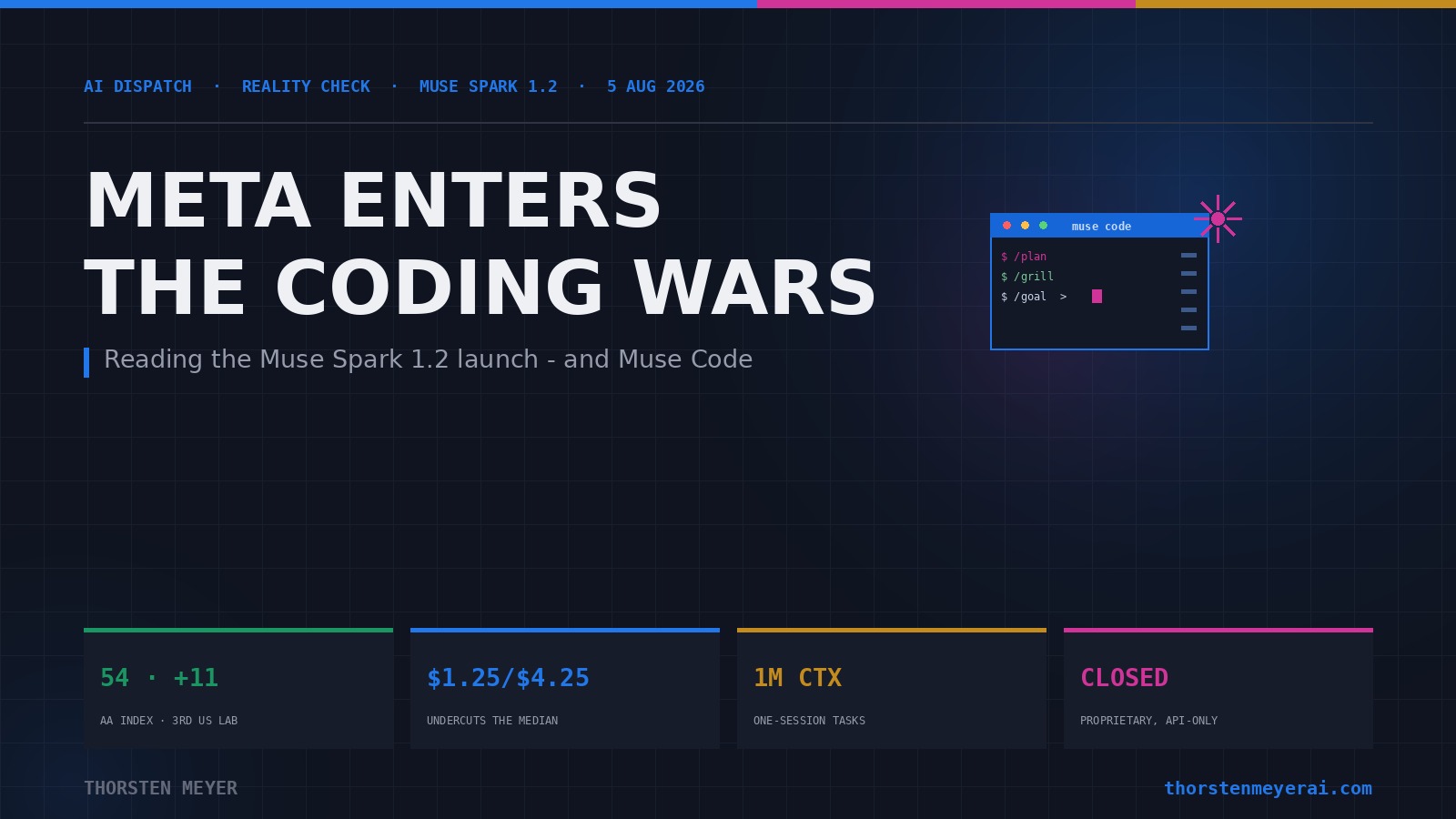
Meta just shipped a coding model and its first coding agent on the same day, and the pairing is the actual story.
Muse Spark 1.2 is a coding-focused update to Meta’s frontier model line. Muse Code is the terminal agent it was built to drive. Meta co-trained the two — the harness and the model together — and released both, with Zuckerberg posting the beta announcement himself. This puts Meta into direct competition with the tools a lot of professional developers now live in: Claude Code, OpenAI’s Codex, and the agentic harnesses that have quietly become the primary way software gets shipped.
For me this one is worth a careful read rather than a hype-or-dismiss reflex, because parts of it are genuinely strong, one part cuts directly against how I build, and the marketing line hides the more interesting engineering. Let me separate them.
Meta shipped a coding model and its first coding agent on the same day, co-trained together. The pairing is the story — and it puts Meta straight into competition with Claude Code and Codex. Parts are genuinely strong; one part cuts against how I build.
▲ Capability claims are Meta’s own · benchmarks independentMuse Code and Muse Spark 1.2 were co-trained — harness and model together — for better tool use and fewer retries than a generic wrapper. Three default skills ship with it.
Vendor benchmarks are worth nothing until someone independent runs the model. Artificial Analysis already has, on a coding- and agent-heavy index.
One finding a launch post will never tell you — and it matters more than the headline score.
The pricing has a tell. Below the standard tier sits a contributor tier at a tenth of the price — in exchange for one thing. (The two-panel pattern below mirrors §03 by design.)
The choice here isn’t “sovereign or not” — it’s which frontier vendor’s pipeline your code flows into.
- Frontier-adjacent coding model, co-trained with a crash-safe agent
- Priced below the competition; one-command install on macOS + Linux
- The event-log runtime is a genuinely good idea
- Closed, API-only, from a company whose model is data harvesting
- Same hosted tradeoff as Claude Code / Codex — pick your pipeline
- Thin track record: replaced Llama months ago; 1.2 is a fast follow on a weeks-old 1.1
The cheapest number on the pricing page is the one that costs the most.
What's actually new
The headline capability is the co-training. Meta's claim is that because Muse Code and Muse Spark 1.2 were trained together rather than the agent being a generic wrapper around a general model, the pairing produces better tool use, fewer retries, and higher-quality output. The model was trained on long-horizon coding work — whole-repository generation, large end-to-end projects — using planning, goal conditioning, and context compaction to hold direction across a long task. That is a real architectural bet, and it is the right one: the agents that work best are the ones where the model knows the harness it lives in.
The independently interesting piece — the part the "higher first-attempt accuracy" marketing line buries — is the runtime. Muse Code keeps a local event log in which every model call, tool run, approval, and edit is appended, and Meta calls this replay-exact and restart-safe: after a crash, the agent resumes precisely where it stopped. For long-running tasks that is the difference between a tool you can trust with an hour of autonomous work and one you have to babysit. It ships with three default skills — /plan turns a task into an approval-gated plan, /grill stress-tests that plan until it holds, /goal drives toward a stated objective — and it runs persistent background agents, parallel workers implementing while reviewers run behind them. This is a serious agent design, not a me-too wrapper.
And the "1M context, long tasks in one session" line the launch leads with is real — the context window is a genuine 1M tokens — but as I have argued at length, context you can fit and context the model actually uses well are different claims. The compaction machinery is Meta's answer to that, and whether it holds up across a genuinely long session is exactly what independent testing will show.
As an affiliate, we earn on qualifying purchases.
Where it actually lands
Here is the part I care about, because vendor benchmarks are worth exactly nothing until someone independent runs the model. Artificial Analysis already has — Meta gave them pre-release access — and the detail is more interesting than the headline number.
On their Intelligence Index the model scores 54, up 3 points from Muse Spark 1.1 and 11 from the April 1.0 — Meta's third release in four months, a genuinely fast climb. That puts it effectively tied with GPT-5.5 and Grok 4.5, and third among US labs, narrowly behind the current frontier of Claude Opus 5, GPT-5.6 Sol, and Kimi K3. Frontier-adjacent, not frontier — but closing.
The gain is concentrated in exactly the place Meta aimed: agentic work. On GDPval-AA v2, the benchmark for realistic agentic knowledge tasks, Muse Spark 1.2 jumped 260 Elo points to 1631 — fifth of every model tested, and ahead of Claude Opus 4.8. Terminal-Bench for agentic coding rose to 80%, tool use ticked up too. When a model's biggest gains land squarely on the coding-agent axis and it was co-trained with a coding agent, that is coherent engineering rather than benchmark-chasing.
The pricing stays pointed. At an unchanged $1.25 per million input tokens and $4.25 per million output, Artificial Analysis puts it at about $0.40 per benchmark task — among the most cost-efficient models at its intelligence level, cheaper per task than Kimi K3 and GPT-5.5. Meta is undercutting the frontier on price, deliberately: subsidize access, win developer share, close the gap on someone else's dime. One honest caveat from the same data — the per-task cost rose from 1.1's $0.29, driven by roughly 50% more input tokens and a third more output, concentrated in the agentic runs. The model earns its higher agentic score partly by thinking harder and longer, and you pay for every token of that thinking.
As an affiliate, we earn on qualifying purchases.
The benchmark line that should give you pause
There is one finding in the independent data that I want to pull out, because it is the kind of thing a launch post will never tell you and it matters more than the headline score.
Muse Spark 1.2's hallucination rate improved — on Artificial Analysis's knowledge-reliability test it fell ten points, from 38% to 28%. That sounds like straightforward progress. Look closer and it isn't quite: the model achieves the lower hallucination rate mainly by answering fewer questions. Its attempt rate dropped from 82% to 67% — it now declines to answer far more often — and its actual accuracy slipped from 41% to 38%. It hallucinates less because it abstains more, not because it knows more.
I am genuinely of two minds about this, and I think both halves are true. For a coding agent, this is arguably the right trade — a model that says "I'm not sure" instead of confabulating a plausible-looking API call is safer to hand autonomous work, and my own testing has taught me that the most dangerous outputs are the fluent, confident, wrong ones. Abstention is a real virtue in an agent. But it is not the same thing as capability, and a launch narrative that presents a falling hallucination rate as pure progress is quietly hiding a drop in how much the model will actually attempt. Know which one you are buying: a more careful model, not necessarily a more knowledgeable one.
As an affiliate, we earn on qualifying purchases.
The part that cuts against how I build
Now the line I will not paper over, because it is the whole reason I run a local-first operation in the first place.
Muse Spark 1.2 is proprietary — no open weights, no self-hosting, Meta has not even disclosed the parameter count. It runs through the Meta Model API, full stop. And the pricing has a tell buried in it. Below the standard tier sits a contributor tier at roughly a tenth of the price — about $0.10 per million input tokens — in exchange for one thing: letting Meta use your prompts and code to train its models. The standard tier keeps your data out of training; the cheap tier is cheap because you are paying with your codebase.
That tradeoff is the classic pattern stated plainly — subsidize access, harvest data at scale, use it to close the gap — and it is precisely the arrangement I build to avoid. For anyone with a proprietary codebase, or anyone operating under DSGVO where sending client code into a foreign training pipeline is not a casual choice, the cheap tier is not cheap at all; it is the most expensive option, priced in a currency that does not show up on the invoice. The contributor tier also carries far tighter rate limits — on the order of 60 requests a minute versus 3,000 — which tells you exactly who it is for: individuals and experiments, not production. Read the two tiers together and the strategy is unambiguous. The default on-ramp sends your work into Meta's pipeline; staying out costs 12× more.
As an affiliate, we earn on qualifying purchases.
The honest bull and bear
The bull case is straightforward and real: a frontier-adjacent coding model, co-trained with a genuinely well-designed crash-safe agent, priced below the competition, installed with one command, running natively on macOS and Linux. If you are already sending your code to a hosted coding agent, Muse Code is now a credible option on capability and a cheap one on price, and the event-log runtime is a legitimately good idea I would like to see everyone copy.
The bear case is the lock-in and the data posture. It is closed, API-only, from a company whose business model has always been to make the data-harvesting option the path of least resistance. It competes against Claude Code and Codex, which carry their own versions of the same closed-hosted tradeoff — so the choice here is not "sovereign or not," it is which frontier vendor's pipeline your code flows into. And Meta's track record on this model line is short: it replaced the disappointing Llama models only months ago, and 1.2 is a fast follow on a 1.1 that is weeks old. Fast iteration is a good sign; a thin track record is a reason to test before you trust.
Where I land
Muse Spark 1.2 is a real and strong entry — I would not wave it away, and the co-trained agent plus crash-safe runtime is the most genuinely interesting part, more than the benchmark number. But nothing about it changes the calculus I actually operate by. It is one more hosted, closed, frontier coding option competing on price and capability, with a data-for-discount tier engineered to pull your codebase into the training set. For the fraction of work that already goes to a hosted agent, it earns a place on the shortlist to test. For everything I can keep local, it is a reminder of exactly why I do — because the cheapest number on Meta's pricing page is the one that costs the most.
The right response to a launch like this is not excitement or dismissal. It is a shadow test: run it against your real tasks, on your real metric, next to what you already use, and let the numbers decide. I will do exactly that, and report what the harness actually shows rather than what the launch post claims.
Reality Check and analysis from a builder, founder, and post-labor economist running a local-first inference operation. Sources: Meta AI Research (Muse Code + Muse Spark 1.2 announcement), Meta developer documentation, VentureBeat, Unite.AI, 9to5Mac, MarkTechPost, and Yahoo Finance (5 August 2026); independent benchmarks and pricing from Artificial Analysis. Benchmark figures are Artificial Analysis's Intelligence Index for the reasoning "xhigh" variant; capability claims about co-training and the agent runtime are Meta's own and await independent verification. Pricing and tiers are point-in-time and may change. Not investment or purchasing advice. Point-in-time as of 5 August 2026.
Fall Picks
fall essentials
As an affiliate, we earn on qualifying purchases.