Assessing NVIDIA’s CES 2026 announcements (Vera Rubin, AI-native storage, and Alpamayo) and the impacts on consumers, enterprises, and jobs
Executive Summary
NVIDIA’s CES 2026 messaging emphasized a shift from single-turn chatbots toward long-horizon “agentic” systems and “physical AI” (AI that acts in the real world). While the headline announcements were largely infrastructure-facing, they are still “consumer-relevant” because infrastructure changes determine the cost, latency, and capability ceiling of the AI that shows up in apps, PCs, cars, and services.
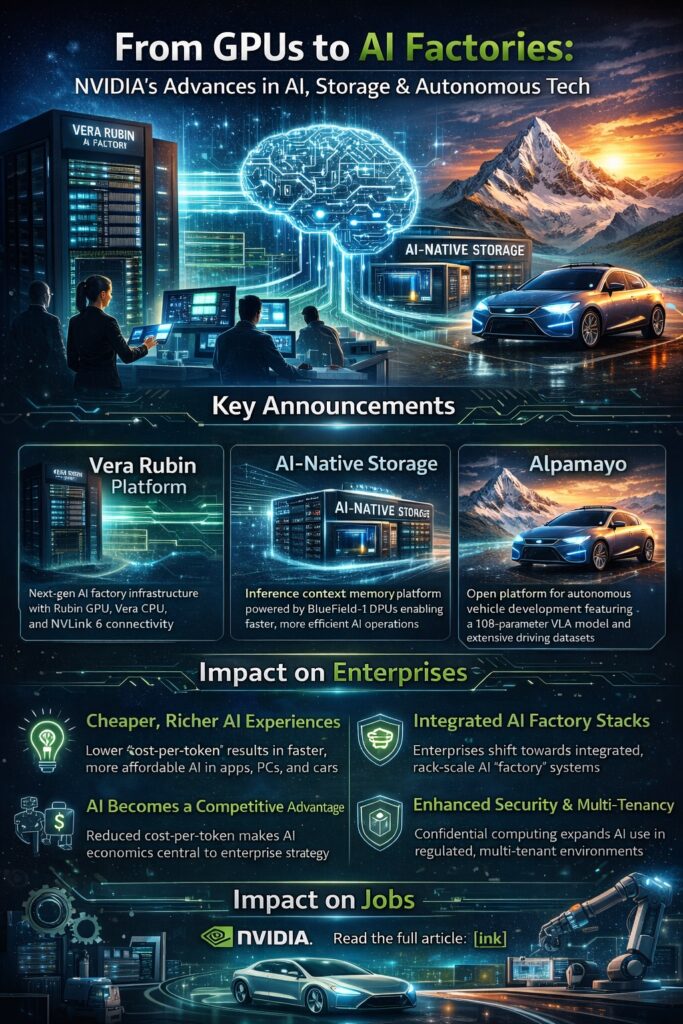
Three CES-linked announcements are especially consequential:
- Vera Rubin platform: NVIDIA describes Rubin as an “extreme codesign” platform spanning six chips (Vera CPU, Rubin GPU, NVLink 6, ConnectX-9, BlueField-4, and Spectrum networking), targeting large-scale “AI factory” deployments. NVIDIA claims up to ~10x lower cost per inference token for mixture-of-experts inference vs. Blackwell and up to ~4x fewer GPUs to train certain MoE models vs. Blackwell. NVIDIA also said Rubin is “in full production,” with partner availability starting 2H 2026.
- AI-native storage infrastructure (Inference Context Memory Storage Platform): NVIDIA introduced a new storage/memory tier powered by BlueField-4 to store and share inference context (KV cache) at scale for long-context, multi-agent systems. NVIDIA claims up to ~5x higher tokens/second and ~5x better power efficiency than traditional storage approaches for this specific workload.
- Alpamayo: NVIDIA released an open portfolio of autonomous vehicle (AV) models, tools, and datasets aimed at long-tail safety scenarios. The release includes a 10B-parameter chain-of-thought vision-language-action (VLA) “teacher” model (Alpamayo 1), an open simulation framework (AlpaSim), and an open dataset described as 1,700+ hours of driving data. NVIDIA positions Alpamayo as improving explainability and trust for safety-critical systems, underpinned by its “Halos” safety system.

Download the white paper (PDF):
Bottom line: if NVIDIA’s “cost-per-token,” “tokens/sec,” and efficiency claims translate broadly, advanced AI becomes cheaper to deploy and operate—accelerating enterprise adoption and increasing the pace of workforce change. (Performance figures are vendor-stated and can vary by workload and configuration.)
1. Why NVIDIA at CES matters in 2026
CES has traditionally showcased consumer devices, but NVIDIA’s CES 2026 narrative centered on industrial-scale AI infrastructure and “physical AI,” including Cosmos (simulation foundation model), Alpamayo (AV), Rubin (compute platform), and a Siemens partnership.
This signals an industry transition: the unit of innovation is moving from “a GPU” to “a rack-scale system” and “AI factory.” Rubin (compute + network + security), AI-native storage (context memory tier), and Alpamayo (autonomy tooling) are all consistent with that shift.
2. Technology recap
2.1 Vera Rubin platform (compute + networking + security co-design)
NVIDIA frames Rubin as a six-chip platform designed to scale AI training/inference at rack level. Key details include:
- Two product lines: Vera Rubin NVL72 (rack-scale system) and HGX Rubin NVL8 (server form factor).
- NVLink 6 bandwidth claims: 3.6 TB/s per GPU and 260 TB/s for an NVL72 rack.
- Vera CPU: 88 custom “Olympus” cores (Arm-compatible) with NVLink-C2C.
- Security posture: third-generation confidential computing across CPU, GPU, and NVLink domains (positioned as a rack-scale trusted computing platform).
- Performance/cost claims vs Blackwell:
- Rubin GPU: “~5x” AI training compute vs Blackwell (as reported by The Verge).
- Platform-level MoE training: same time with ~¼ the GPUs and ~1/7 the token cost (as reported by The Verge).
- “Up to 10x lower cost per token” for MoE inference vs Blackwell (NVIDIA-stated).
Interpretation: Rubin is about industrializing AI throughput. That tends to push AI deeper into products and processes because it lowers the “tax” of running AI at scale (compute, network, security, and power).
2.2 AI-native storage infrastructure (Inference Context Memory Storage Platform)
NVIDIA’s BlueField-4 announcement is notable because it elevates inference context (KV cache) into a first-class infrastructure layer.
NVIDIA’s argument:
- KV cache is essential for inference, but keeping it on GPUs long-term is expensive and becomes a bottleneck as context windows and multi-agent workloads grow.
- The solution: a dedicated tier that extends GPU memory capacity and enables high-speed KV-cache sharing across nodes, powered by BlueField-4 DPUs.
NVIDIA-stated impact claims for this workload:
- Up to ~5x tokens/second and ~5x power efficiency vs traditional storage approaches.
Interpretation: If KV-cache sharing becomes mainstream, you should expect:
- more long-context AI applications,
- more stateful assistants (session continuity),
- higher utilization of expensive GPUs (less idle time waiting on memory/context).
2.3 Alpamayo (open, reasoning-based autonomous vehicle development)
Alpamayo is positioned as an open ecosystem for AV developers to tackle “long-tail” scenarios.
Key elements NVIDIA described:
- Alpamayo 1: a 10B parameter chain-of-thought VLA model (video in, trajectories + reasoning traces out), available with open weights and scripts, intended as a teacher model rather than deployed directly in-vehicle.
- AlpaSim: open-source simulation framework for closed-loop evaluation.
- Open datasets: described as 1,700+ hours across geographies and conditions, including rare edge cases.
Interpretation: Alpamayo attempts to shorten the path from “rare scenario discovered” → “model learns” → “validated in simulation” → “safely deployed.” If successful, it can accelerate AV timelines in specific operational domains (fleet, logistics, mapped regions).
3. Impact on consumers
3.1 Cheaper inference tends to show up as “more AI everywhere”
If cost-per-token drops substantially (Rubin claim: up to ~10x vs Blackwell for some MoE inference), consumer-facing AI can become:
- more available (lower subscription prices or more generous tiers), and/or
- more capable (bigger models, longer context, more tool-using agents per user session).
Likely consumer-visible changes over 12–36 months:
- “assistant” features that can sustain longer tasks (planning, multi-step workflows) rather than just answering queries,
- more multimodal AI (voice + image + video) in mainstream apps (because throughput and cost constraints soften).
3.2 Persistent context and long-memory assistants raise privacy stakes
AI-native storage is explicitly about inference context persistence and reuse (KV-cache tier). If consumer products adopt “memory” more aggressively, consumers should expect:
- more personalized experiences,
- but also greater sensitivity around retention, deletion, and access controls.
Consumers benefit most when products add:
- clear “what’s remembered” transparency,
- fine-grained memory controls,
- strong defaults for sensitive domains (health, finance, minors).
3.3 Autonomous driving: potential for better assistance, but timelines vary
Alpamayo’s “reasoning + simulation + dataset” approach targets safety and long-tail scenarios. Consumers may see:
- incremental improvements in advanced driver-assistance (ADAS),
- faster validation cycles for edge cases (weather, unusual maneuvers).
But “full autonomy everywhere” remains constrained by validation, regulation, and liability. Even optimistic industry timelines typically phase rollouts by geography and use case (robotaxi zones, freight corridors, etc.).
4. Impact on enterprises
4.1 AI economics becomes a core competitiveness lever
For enterprises, Rubin’s central promise is not just performance—it’s economics:
- lower cost-per-token (compute + networking efficiency),
- reduced infrastructure footprint for certain model classes (MoE training claims), and
- improved throughput via context-memory architecture.
What this enables:
- moving AI from pilots to production (customer operations, document intelligence, developer tools),
- heavier day-to-day usage per employee (AI as a utility, not a demo),
- greater viability for multi-agent orchestration (toolchains, RPA, analytics workflows).
4.2 Infrastructure architecture shifts toward integrated “AI factory” stacks
Rubin’s rack-scale systems (e.g., NVL72) and the surrounding networking/security components suggest that:
- more buyers will evaluate validated, integrated racks rather than assembling “best-of-breed” parts.
- networking and storage become first-order performance bottlenecks and differentiation points (not afterthoughts).
Enterprise implications:
- Procurement: more platform decisions, fewer component decisions.
- Operations: stronger need for standardized observability, reliability engineering, and capacity planning around tokens/sec, memory tiers, and power.
- Vendor concentration risk: potential lock-in if the ecosystem consolidates around integrated platforms.
4.3 Security and multi-tenancy could expand regulated adoption
NVIDIA emphasizes confidential computing and DPU-based infrastructure controls, positioning Rubin as a rack-scale trusted computing platform.
If mature and validated, this could help:
- regulated sectors (finance, healthcare, government),
- multi-tenant internal platforms (“enterprise AI cloud”),
- secure data usage patterns (but governance and identity controls remain essential).
4.4 Mobility and autonomy: enterprise platform effects
Alpamayo’s open models/tools can:
- reduce R&D costs for AV stacks (via open baselines and shared datasets),
- improve scenario coverage via simulation loops.
Sectors to watch:
- automotive OEMs and suppliers,
- freight and logistics,
- mapping and insurance,
- municipalities/smart infrastructure.
5. Impact on jobs
5.1 Macro context: AI exposure is broad
Multiple institutions forecast widespread labor-market exposure to AI:
- The IMF has estimated ~40% of global employment is exposed to AI (with higher exposure in advanced economies).
- The World Economic Forum’s Future of Jobs work projects significant job churn through 2030, with large numbers of roles created and displaced in parallel (net increase in some scenarios).
- The ILO’s analyses emphasize that near-term impacts often skew toward task changes and augmentation rather than immediate full automation, though exposure varies substantially by occupation and country.
NVIDIA’s CES announcements matter because they are designed to reduce AI deployment costs and expand AI from purely digital workflows into the physical world (robots, vehicles).
5.2 Job growth areas likely to accelerate
As AI factories expand, expect demand growth in:
- AI infrastructure buildout: data center construction; power, cooling, and grid integration; networking and storage engineering; hardware operations.
- AI engineering & operations: MLOps, evaluation, observability, retrieval/data engineering, incident response.
- Security and compliance: AI security, confidential computing operations, model risk management.
- Simulation and safety (especially in autonomy/robotics): scenario design, validation, safety cases.
5.3 Pressure zones and timing risks
Areas of pressure are most plausible where AI meaningfully accelerates tasks and where AI can be productized into repeatable workflows:
- Routine knowledge work: documentation, basic analysis, report drafting, repetitive content variants.
- Entry-level “training ground” roles: some employers may reduce hiring while they redesign workflows around AI (this shows up in some recent labor market analyses).
- Driving and transport roles: longer-term risk if autonomy scales in logistics and ride-hailing; timing depends heavily on regulatory permission, safety performance, and economics.
A useful nuance from OECD research: early adoption does not always immediately reduce staffing—many organizations report limited headcount impact in the short run while they experiment.
5.4 Skills that become more valuable
Across scenarios, “durable” skills tend to combine technical fluency with domain judgment:
- systems thinking (end-to-end workflows),
- data literacy (retrieval, quality, monitoring),
- security and privacy engineering,
- human factors and operations design,
- domain expertise paired with AI evaluation capability.
6. Practical recommendations
For enterprises
- Budget tokens like you budget cloud spend: model cost-per-token, latency, and energy as explicit constraints; validate vendor claims on your workloads.
- Design governance for “memory”: define retention, deletion, access control, audit logging for persistent context systems (AI-native storage makes this more operationally relevant).
- Update your reference architecture: treat networking and storage as AI performance levers, not support systems.
- Build workforce programs for real workflows: train teams on redesigned processes, not just “how to prompt.”
For consumers
- Expect more AI embedded in products as infrastructure costs drop; demand:
- clear memory controls,
- transparency on what data is stored and used,
- meaningful opt-out options.
- Treat autonomy features as safety-critical: understand limitations, update policies, and the driver’s role.
For policymakers and educators
- Invest in training pipelines for AI infrastructure and operations (including skilled trades that support data centers).
- Modernize safety and liability frameworks for autonomy and robotics while enabling responsible pilots.
- Plan for energy impacts of AI factory buildouts; reward measurable efficiency improvements.