
Executive Summary
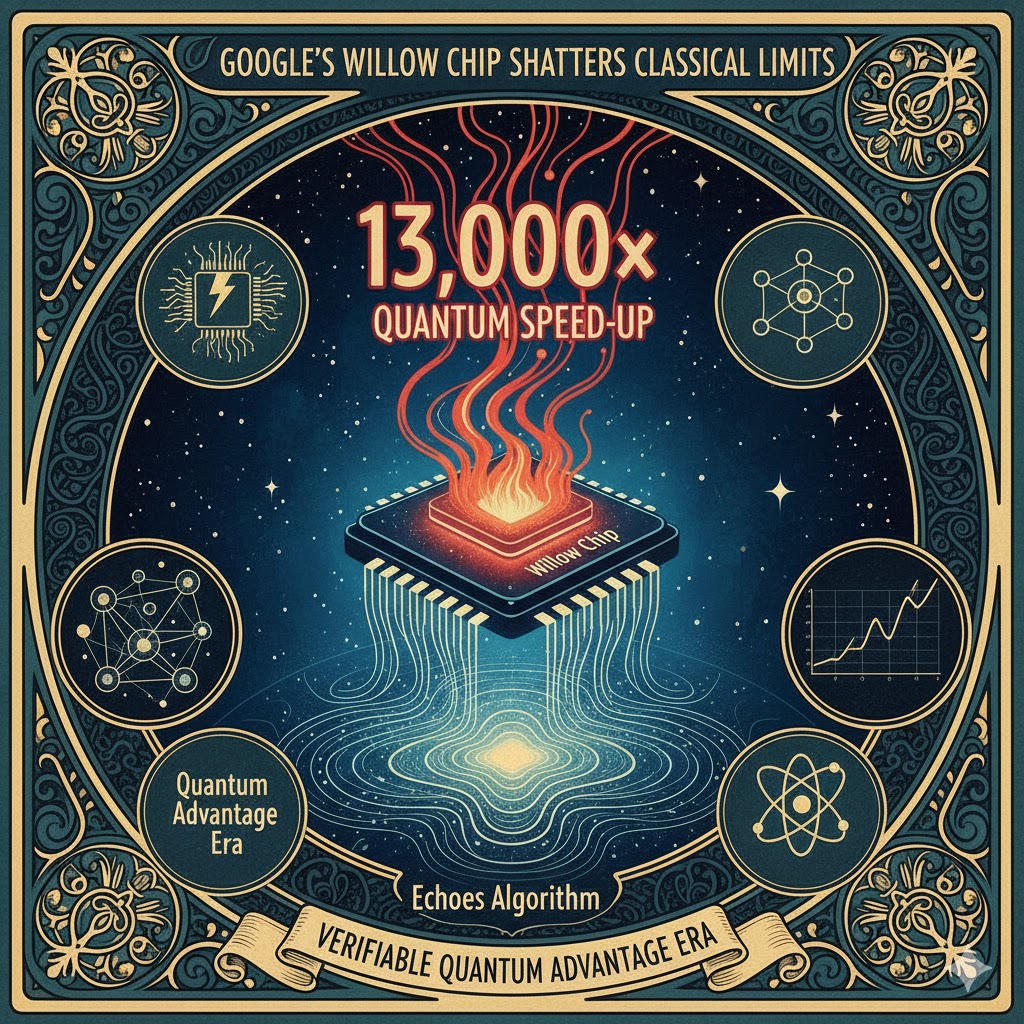
Google Quantum AI recently announced that their Willow 105-qubit superconducting quantum processor executed an algorithm named Quantum Echoes, achieving what they describe as the first verifiable quantum advantage: roughly a ~13,000× speed-up over the best classical algorithm for a specific physics-style task. Science News+3blog.google+3IEEE Spectrum+3
Key points:
- The algorithm measures out-of-time-order correlators (OTOCs) via forward evolution → small perturbation → backward evolution. Google Research+1
- The task is physics / molecular geometry oriented (using nuclear-spin echo techniques) and not yet a broadly commercial application. Live Science+1
- The claim is “verifiable” in that the result can in principle be checked (or reproduced) by another quantum device of comparable power, addressing a major prior criticism of quantum advantage demonstrations. IEEE Spectrum+1
- Yet, despite the major technical milestone, there remain significant caveats: scaling to fault-tolerant, broadly useful quantum computing remains years away; classical algorithms may still catch up; this is a proof of concept rather than a turnkey commercial solution. The Guardian+1
In this white paper we review the underlying technology, the algorithmic advance, the business and scientific implications, the risk landscape, and future outlook for quantum computing following this milestone.
Top picks for "google willow chip"
Open Amazon search results for this keyword.
As an affiliate, we earn on qualifying purchases.
1. Background & Context
1.1 Quantum computing progress to date
Quantum computing has been an area of intense research for decades, with the primary goal of solving problems (e.g., molecular simulation, optimization, cryptography) that are intractable for classical computers. One key concept is quantum supremacy/advantage — the moment when a quantum computer outperforms a classical one on a well-defined task. Wikipedia+1
In 2019, Google’s earlier 54-qubit device (the Sycamore processor) claimed such a supremacy milestone, albeit on a highly artificial benchmark (random circuit sampling) that drew criticism for its practical relevance. Wikipedia+1
1.2 The Willow processor
The Willow chip is a 105-qubit superconducting transmon quantum processor developed by Google Quantum AI. Wikipedia+1 According to Google, Willow achieved significantly reduced error rates and improved fidelity across qubits and gates, enabling more complex and deeper quantum circuits. blog.google
1.3 The challenge of verifiable quantum advantage
One of the major issues in prior quantum advantage claims was verification — ensuring that the quantum result is correct, reproducible, and meaningful rather than simply “we couldn’t simulate it classically so we’ll claim victory”. The new work emphasises that the algorithm’s result can be verified (by another quantum device or experiment) and pertains to an expectation value rather than a sampling distribution, which is more meaningful. IEEE Spectrum
2. The Quantum Echoes Algorithm
2.1 Overview of the algorithm
The algorithm, called Quantum Echoes, is built on the concept of measuring out-of-time-order correlators (OTOCs). Briefly, one evolves a quantum system forward (U), then applies a small perturbation B to a qubit, and then evolves backward (U†). One then probes a measurement M. The result reveals how the perturbation propagates through the system (a quantum “butterfly effect”). Google Research+1
2.2 Why it’s hard classically
The forward/backward evolution of a large entangled quantum system with a perturbation creates exponential complexity for classical simulation: the many-body interference and entanglement mean classical simulation becomes intractable. Google Research+1
2.3 Demonstrated performance
Google reports that when run on Willow the algorithm achieved a ~13,000× speed-up relative to the best classical algorithm on one of the world’s fastest supercomputers (for the given task). Interesting Engineering
They also emphasise that the algorithm is “verifiable” in the sense that another device could reproduce the result, and that the output is an expectation value rather than a hard-to-verify sampling distribution. IEEE Spectrum
2.4 Application to molecular geometry proof-of-principle
In one experiment, the team used an echo-type quantum circuit to measure molecular geometry (via many-body nuclear spin echoes) of a small molecule (15 qubits). This points to potential applications in chemistry, albeit at a small scale for now. Live Science+1
3. Implications & Potential Applications
3.1 Scientific / research implications
- Enables simulation of complex quantum dynamics, many-body physics, quantum chaos, and molecular systems that classical computers struggle with.
- Because the result is verifiable, it increases confidence in quantum devices as scientific tools, not just curiosities.
- Could accelerate discovery in materials science, molecular chemistry, catalysts, batteries, pharmaceuticals (e.g., new molecules, novel compounds) where quantum simulation is relevant. Google suggests this explicitly. blog.google
3.2 Commercial / industrial potential
- In the medium term (say 3-7 years) one might expect quantum processors to tackle specialized simulation tasks beyond classical reach: drug discovery pipelines, new materials for energy, molecular modelling, perhaps quantum-enhanced AI data generation.
- This breakthrough helps build confidence among enterprises and investors that quantum computing is advancing from “lab curiosity” toward “useful tool”.
- It may spur ecosystem growth: hardware vendors, quantum software providers, quantum-ready research arms in industry will accelerate their efforts.
3.3 Strategic / competitive implications
- Because Google has demonstrated this advantage, it raises the bar for competitors (e.g., IBM, IonQ, Rigetti Computing) to deliver similar verifiable quantum results.
- It may influence quantum-computing investment flows, partnerships, and national strategy (governments wanting to invest in quantum infrastructure).
- For companies offering quantum-as-a-service or quantum cloud access, the “verifiable advantage” narrative is a potent marketing / milestone tool.
4. Risk, Limitations & Challenges
4.1 Narrow scope of current achievement
- The current task is still highly specialised (OTOC measurement, molecular geometry proof-of-principle) and not yet directly a broad commercial operational use-case.
- Classical algorithms and hardware will continue improving; previous quantum advantage claims (e.g., random circuit sampling) have seen classical catch-ups. Science News
4.2 Scaling and fault-tolerance
- To solve truly large-scale industrial problems (thousands or millions of qubits, fault-tolerant logical qubits) remains a major technical challenge: error rates, coherence times, qubit connectivity, cryogenics, control electronics, etc remain limiting.
- Even Google acknowledges “real-world use” might still be a few years away. The Guardian
4.3 Verification and robustness
- While the algorithm is described as verifiable, in practice independent verification via another quantum device of equal power remains to be demonstrated. Science News
- Quantum devices remain delicate; noise, calibration drift, gate errors could affect reproducibility and reliability in commercial settings.
- The reliability of quantum advantage claims depends on staying ahead of classical simulators — there is risk classical methods will close the gap.
4.4 Commercialization risk
- Even if quantum hardware improves, building end-to-end quantum-software stacks, domain-specific quantum apps, and enterprise workflows remains non-trivial.
- The business models, cost structure, the ecosystem readiness (talent, algorithms, integration) are still nascent.
5. Roadmap & Future Outlook
5.1 Next technical milestones
- Scaling qubit counts with high fidelity, lower error rates, and longer coherence times.
- Building fault-tolerant logical qubits that can perform error-corrected operations at scale.
- Developing domain-specific quantum algorithms that map onto real-world use-cases (chemistry, materials, optimization, finance).
- Building quantum software ecosystems: compilers, high-level languages, hybrid quantum-classical workflows.
5.2 Timeline expectations
- In their announcement, Google estimates that useful applications (ones uniquely suited to quantum) may be 3-5 years away. The Guardian
- Medium-term (5-10 years) may see enterprise quantum services tackling selected simulation/optimization problems, while classical will remain dominant for general workflows.
- Long-term (10+ years) quantum could become a mainstream computational resource in specific domains.
5.3 Strategic advice for organizations
- Begin quantum readiness now: create internal awareness, identify potential quantum-relevant domains (e.g., computational chemistry, materials, optimization), invest in talent/partnerships.
- Monitor hardware and algorithmic progress, but plan multi-horizon: near-term (2-3 years) proof-of-concepts; mid-term pilot programs; long-term strategic plays.
- Collaborate with quantum hardware/software vendors, academic labs, and domain experts to co-design quantum workflows.
- Be realistic about hype: quantum will not replace classical computing wholesale — it will augment it in niche high-value domains.
6. Conclusion
The Google Quantum AI announcement of the Willow chip running the Quantum Echoes algorithm marks a significant technical milestone: for the first time, a quantum processor has demonstrably executed a verifiable algorithm with a claimed massive speed-up over classical methods. Yet, while exciting, it remains a step on a longer journey. The breakthrough validates the promise of quantum computing more strongly than before, but the path to broadly useful, commercially-relevant quantum systems still involves challenges of scale, error correction, software/algorithm maturity, and business integration.
For businesses, researchers, and policy-makers, the message is clear: quantum computing is moving from the purely experimental toward practical relevance. The time to engage, experiment, and prepare is now — those who wait may find themselves playing catch-up. At the same time, caution is warranted: avoid over-investing based purely on hype, and build quantum readiness in incremental, risk-managed fashion.