
Background
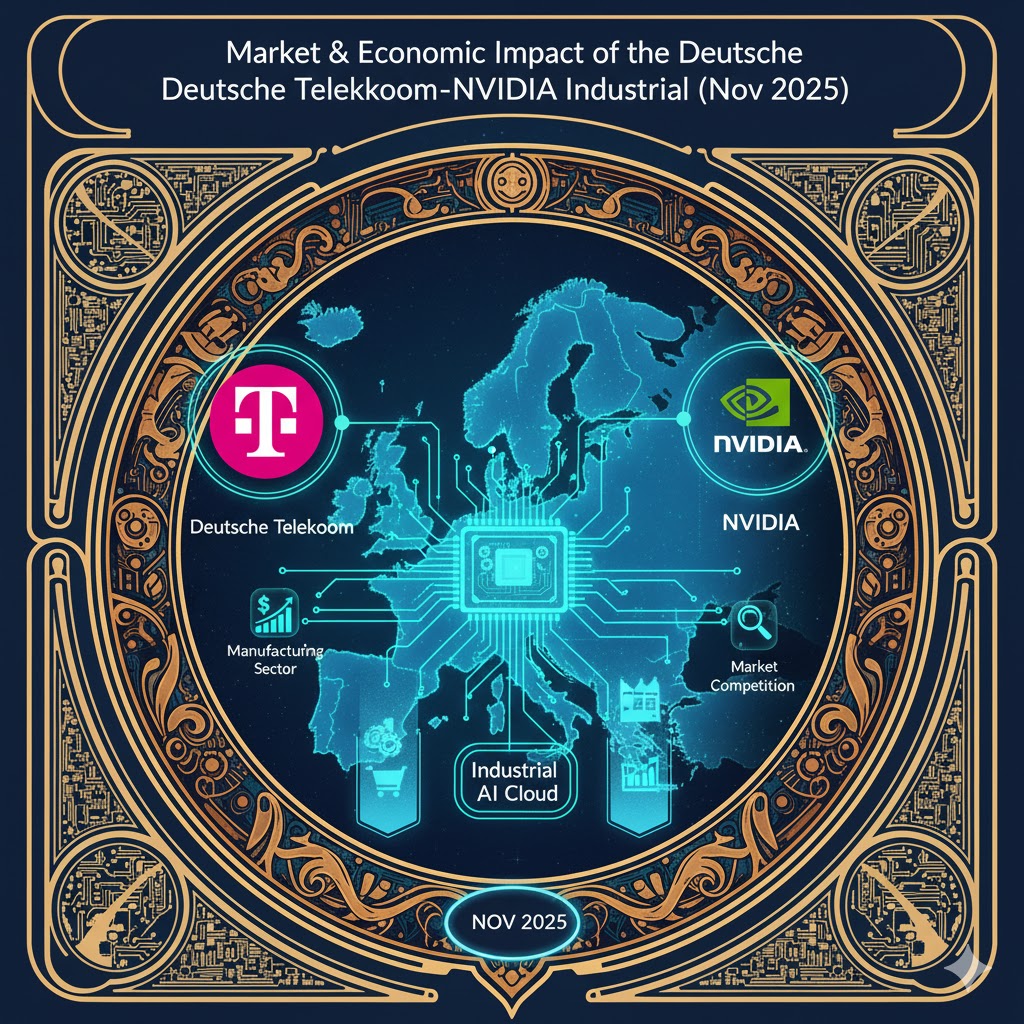
On 4 November 2025, Germany’s Deutsche Telekom and U.S. chip giant NVIDIA unveiled a €1 billion (~$1.2 bn) partnership to build what they call Europe’s first “Industrial AI Cloud.” The facility will be located in a refurbished Munich data centre and house up to 10 000 NVIDIA Blackwell–class GPUs; SAP will supply the software stack and Deutsche Telekom will provide connectivity and data‑centre servicesreuters.com. Customers will be able to book high‑performance compute as needed to build AI models, train autonomous robots and create digital twinsreuters.com. German Digital‑Transformation Minister Karsten Wilderberger said more than 100 companies have already signed up to use the cloud and committed €750 bn in investments under Germany’s “Made for Germany” initiativereuters.com. Early adopters include robotics company Agile Robots and drone maker Quantum Systemsreuters.com.
The joint venture is one of the first major European projects built around NVIDIA’s new Blackwell GPUs and aims to increase Germany’s AI computing power by roughly 50 %tipranks.com. This sovereign cloud comes amid European Union plans to mobilise €200 bn for AI investments and build several AI “gigafactories,” yet Europe remains far behind U.S. and Chinese AI infrastructuremorningstar.com.
Top picks for "market economic impact"
Open Amazon search results for this keyword.
As an affiliate, we earn on qualifying purchases.
Market Reaction
NVIDIA
- Short‑term share price:
• Initial pop: On the trading day before the announcement (3 Nov 2025), NVIDIA’s stock rose 2.17 % to close at $206.88; market analysts attributed part of the momentum to the news of the €1 bn partnershiptipranks.com. TipRanks noted that the announcement deepens NVIDIA’s presence in Europe and investors saw the deal as another driver of AI‑hardware demandtipranks.com.
• Subsequent pull‑back: During intraday trading on 4 Nov 2025, NVDA drifted lower—around $200 (‑≈3 %)—as a broader “risk‑off” sentiment hit AI stocks; Stockminded attributed the decline to macro de‑risking and profit‑taking despite the positive headlinestockminded.com. The article emphasised that the deal still reinforces long‑term demand visibility for NVIDIA’s data‑centre business even if near‑term price action was mutedstockminded.com. - Analyst view: StockInvest, a technical‑analysis site, noted that NVDA was trading near its 52‑week high with an RSI of 82 (overbought) and that the €1 bn industrial‑cloud partnership strengthened growth prospects but that valuation remained stretched; their short‑term expectation was for consolidationstockinvest.us. TipRanks pointed out that analysts continue to rate NVIDIA a “strong buy” with an average target of $237.86, implying further upsidetipranks.com.
Deutsche Telekom
- Share price response: Public information on Deutsche Telekom’s immediate share‑price reaction is limited, but data from Morningstar show the stock trading around €26.78 on 5 Nov 2025, up 0.64 % from the previous closemorningstar.com. TradingEconomics lists a daily change of +0.71 %, suggesting a modest upticktradingeconomics.com. The muted movement reflects the company’s diversified telecom/ICT business where a €1 bn project (roughly 0.8 % of its €132 bn market capitalisationtradingeconomics.com) may not drastically alter fundamentals.
- Investor sentiment: Analysts view the project as an important diversification move; Deutsche Telekom gains a foothold in AI infrastructure and cloud services beyond telecom. Morningstar’s news service noted that the data‑centre initiative boosts the EU’s AI capabilities and positions Deutsche Telekom as a strategic infrastructure partnermorningstar.com. The company has indicated willingness to “double down” on investments if uptake is strongreuters.com.
Broader Market
The announcement occurred during a period when global tech stocks were under scrutiny for high valuations. Reuters and other outlets reported that investors were debating whether an “AI bubble” was forming; shares of various AI leaders (e.g., Palantir, Nvidia) fell in subsequent sessionstheguardian.com. This context muted some of the immediate gains from the partnership. Overall, the reaction suggests that while investors recognise the strategic value of sovereign AI capacity, near‑term stock prices are driven more by broader macro sentiment.
Economic Implications
- Sovereign AI capacity & strategic autonomy – Europe has been reliant on U.S. hyperscalers and Chinese manufacturing for AI computing. By building a local, sovereign cloud with high‑end GPUs, Germany and the EU gain control over industrial data, compliance and security. The facility will allow manufacturers, public agencies and defence providers to deploy AI models without sending sensitive data abroadreuters.com. This reduces geopolitical risk and aligns with EU data‑sovereignty regulations (e.g., GDPR).
- Boost to industrial competitiveness – Access to on‑demand AI compute will enable companies in automotive, machinery, robotics, aerospace and energy to run simulation and digital‑twin workloads at scale. Early adopters like Agile Robots plan to use the cloud to build AI‑powered robots for factory automationreuters.com, while Quantum Systems intends to develop advanced dronesreuters.com. Such projects could raise productivity and spur Industry 4.0 innovations, supporting Germany’s position as a manufacturing powerhouse.
- Investment multiplier – The project’s €1 bn spend is expected to catalyse broader investment. Germany’s digital‑transformation minister said over 100 firms have promised €750 bn in investments under the “Made for Germany” programreuters.com. By offering a common infrastructure, the AI cloud lowers barriers to entry for small and medium enterprises, encouraging innovation ecosystems around robotics, simulation and AI software.
- Job creation & skills development – Construction and operation of the Munich AI factory will create jobs in data‑centre refurbishment, networking, energy management and AI‑software integration. The partnership may stimulate STEM training programs and collaboration with universities as companies seek local expertise in machine learning, GPU programming and digital twins.
- Energy & sustainability considerations – High‑density GPU facilities consume significant power. Deutsche Telekom has emphasised that the facility will adhere to energy‑efficiency and sustainability standards (details not yet disclosed). Balancing AI ambitions with Germany’s energy transition will be critical; local power constraints could cap expansion, while renewable sourcing offers economic opportunity.
- Dependence on NVIDIA & supply‑chain risk – Although marketed as sovereign infrastructure, the cloud heavily depends on NVIDIA hardware and software. This raises questions about technological sovereignty; export controls or supply disruptions could affect operations. Longer‑term, European chip initiatives (e.g., from SiPearl or Graphcore) may seek to reduce this dependency.
What It Means for Customers
- Manufacturers & robotics firms – Customers will be able to rent GPU capacity on demand instead of building their own compute clustersreuters.com. This lowers capital expenditures and shortens time to market. For robotics companies like Agile Robots, the cloud provides the compute power necessary for training autonomous robots and using NVIDIA’s Omniverse digital‑twin platformstockminded.com.
- Mid‑sized enterprises & startups – Many smaller firms lack the budget for high‑end GPUs. The Industrial AI Cloud offers pay‑as‑you‑go access to state‑of‑the‑art AI infrastructure, enabling them to experiment with generative AI, predictive maintenance and simulation. Integration with SAP’s Business Technology Platform will facilitate adoption, as SAP is already embedded in the IT stacks of thousands of European firmstipranks.com.
- Public sector & defence – Deutsche Telekom noted that the cloud would serve public services and defence applications, allowing agencies to develop secure AI solutions with data confined to German soilreuters.com. Quantum Systems, an early customer, plans to develop air‑ and sea‑based surveillance drones using the cloudreuters.com.
- Developers & software vendors – NVIDIA plans to offer its full software stack (CUDA, TensorRT, Omniverse) on the platform, giving developers ready access to digital twin and robotics frameworks. This will accelerate the creation of domain‑specific AI applications and may help build a European ecosystem analogous to those around U.S. hyperscalers.
Conclusion
The Deutsche Telekom–NVIDIA Industrial AI Cloud is a landmark project for Europe’s AI landscape. Although immediate market reaction was mixed—NVIDIA shares oscillated between gains and losses and Deutsche Telekom’s stock moved only modestly—analysts agree that the partnership reinforces long‑term growth visibility for NVIDIA’s data‑centre business and marks a strategic pivot for Deutsche Telekom toward AI infrastructurestockinvest.us. Economically, the project promises to expand sovereign AI capacity, attract significant private investment, and provide manufacturers and SMEs with access to cutting‑edge compute resources. Customers stand to benefit from lower barriers to AI adoption and improved data sovereignty, while policymakers view the cloud as a key step in bolstering Europe’s competitiveness in the AI age.