
The decision that costs you a quarter is almost never a bad idea. Bad ideas are easy; you can feel them die in your mouth as you say them out loud. The expensive ones are plausible — they sound right in your head, earn a few nods from friends, survive a whiteboard session, and then quietly absorb three months of building before anyone checks whether a single buyer will actually pay. By the time you find out, the cost isn’t the idea anymore. It’s the quarter you spent finding out.
Outcome-First Decisions is built to intercept that exact moment — the one before the quarter is gone. It’s not an app you log into; it’s an open-source skill you install into your AI agent, and its entire job is to turn a fuzzy business decision into three hard things: a verdict, a proof test you can run this week, and three actions for today. The premise it runs on is the opposite of almost every productivity tool. Most tools help you do more. This one helps you do less — and then proves that the “less” is the part that earns.
The Friction Is the Feature
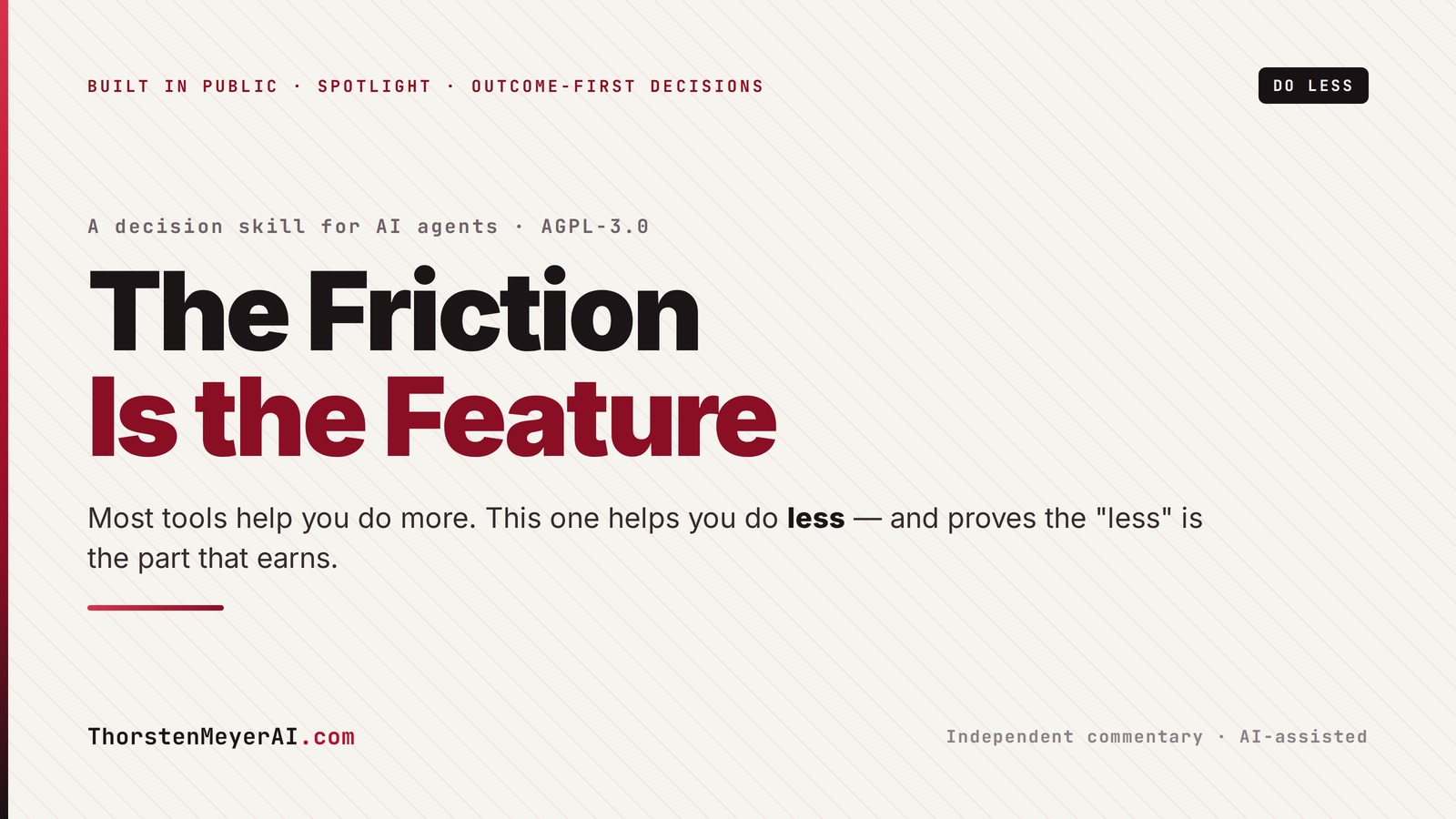
Most tools help you do more. This one helps you do less — and proves the “less” is the part that earns. It turns a fuzzy decision into a verdict, a one-week proof test, and three actions for today.
Missing one? It doesn’t cheer you forward — it asks the smallest question that fills the gap. When the evidence is an opinion, the answer is “test first,” not a 12-week plan. That’s $250 to learn the truth instead of three months.
A click is not a customer. A “great idea” is not revenue. The skill reads where your evidence sits and designs the cheapest test that moves you up exactly one rung.
So your next “80%” gets discounted accordingly — and the rungs you habitually skip get flagged. You’re not just deciding; you’re building a calibrated instrument out of your own track record.
- Triggered by runway, missed payroll, a lost biggest customer.
- A one-line verdict and three actions with hour-level deadlines.
- The dollar number below which the business closes.
- Scoring tables and framework talk disappear — busywork in an emergency.
- Every active bet with its evidence rung, capacity cost, and kill date.
- At most two unproven bets at once. No bet without a kill date.
- Killed capacity reallocated by name, not vaguely “freed up.”
- Numbers carry provenance — no verdict rides on a half-remembered figure.
mkdir -p ~/.claude/skills && unzip outcome-first-decisions.zip -d ~/.claude/skills/
The honest tradeoff: it will not flatter you. Thin evidence, it says so; an idea that should die, it says so plainly. If you want reassurance, it’s the wrong tool. If you want fewer, better-aimed bets and a verdict you can defend — the friction is the feature.
Independent commentary, produced with AI assistance under human editorial oversight. The views are the author’s own and may change. Outcome-First Decisions is a decision-support tool, not business, financial, legal, or investment advice; its verdicts are one input to your own judgment, not a guarantee of outcomes, and dollar figures are illustrative. Software provided under its stated open-source licence, as-is, without warranty. Product, model, and company names are trademarks of their respective owners; mention does not imply endorsement.
What it refuses to do
The skill’s character shows up first as a refusal. It will not bless a plan that’s missing four things: a named buyer, one scoreboard number, a proof test you can run within the week, and a written line that would make you stop. If any of those is absent, it doesn’t cheer you forward with a roadmap. It asks the smallest question that fills the gap, and only then hands back something you can act on.
That refusal is the whole value, and it’s worth sitting with, because it’s the part that’s genuinely rare. Nearly every “validate your idea” tool is built to encourage — to find the version of yes that keeps you engaged. Outcome-First Decisions is built to withhold yes until it’s earned. When your evidence is an opinion or a compliment, the answer isn’t “looks promising, here’s a twelve-week plan.” The answer is “test first.” That single substitution — test first instead of here’s a plan — is the difference between spending $250 to learn the truth and spending three months to learn the same truth.
Think Like A Leader: Tools for Mental Clarity, Decision Making, and Problem Solving
As an affiliate, we earn on qualifying purchases.
As an affiliate, we earn on qualifying purchases.
Five verdicts and a ladder
Every decision you bring gets one of five verdicts — worth doing, test first, change, defer, drop — each with its reasoning in plain language rather than a score you have to interpret. No roadmaps get built for work that hasn’t earned one.
Underneath the verdict sits the part I find most clarifying: the Buyer Evidence Ladder. Demand claims get placed on eight rungs, from opinion at the bottom to repeat purchase at the top. A click is not a customer. A “that’s a great idea” is not revenue. The skill reads where your evidence actually sits, names the strongest and weakest part of your case, and designs the cheapest test that moves you up exactly one rung — so you commit on rung-6-to-8 proof, not rung-1 enthusiasm. The line the whole tool turns on is worth quoting directly: a buyer who pays today is more reliable than a hundred who say they would pay someday.
The ladder is what makes the verdicts honest instead of vibes. “Worth doing” doesn’t mean it sounds good; it means the evidence has climbed high enough to justify the spend. Everything below that gets a test, not a plan.

Workbook & Journal for Becoming Bulletproof: A Practical Guide to Evy Poumpouras’ Book
As an affiliate, we earn on qualifying purchases.
As an affiliate, we earn on qualifying purchases.
Minutes, then your hands move
You bring a specific decision — an idea, a choice between two options, a backlog to triage, an offer to price, a weekly scoreboard to read — and a structured answer comes back in one session: the verdict, the why, a read of your evidence, the proof test, your keep/change/kill thresholds, and three actions. The deliberation that usually eats a week of second-guessing, or a meeting that ends without anyone deciding anything, lands in minutes.
And it always ends with the three actions, because clarity that doesn’t move your hands is just a nicer kind of stuck. Not “think about your positioning” — write the 25-name list, send the first five messages, collect the first deposit. Insight is cheap and the skill knows it; what it optimizes for is the next physical step you can take today.

Decision Sprint: The New Way to Innovate into the Unknown and Move from Strategy to Action
As an affiliate, we earn on qualifying purchases.
As an affiliate, we earn on qualifying purchases.
The benefit that compounds for years
Here’s the feature that pays off long after any single decision: it turns your own track record into an instrument. Decisions get logged with a confidence you stated at the time. Once you’ve made ten or more calls in a category, the skill cites your real hit rate before it accepts your next probability claim. If you habitually call validation bets at 80% and they land at 42%, it says so, and discounts your next 80% accordingly. It also flags the rungs you habitually skip.
That’s a quietly radical idea. You’re not just making better decisions one at a time; you’re building a calibrated instrument out of your own history, one that gets harder to fool the longer you use it. Most tools forget you the moment you close them. This one remembers you specifically, and uses the memory to correct you.
![Express Schedule Free Employee Scheduling Software [PC/Mac Download]](https://m.media-amazon.com/images/I/41yvuCFIVfS._SL500_.jpg)
Express Schedule Free Employee Scheduling Software [PC/Mac Download]
- User-friendly drag & drop planning: Simple shift scheduling interface
- Manage time-off and holidays: Add sick leave, breaks, holidays
- Email schedules to staff: Send schedules directly via email
As an affiliate, we earn on qualifying purchases.
As an affiliate, we earn on qualifying purchases.
It speaks your industry, and it strips down when you’re bleeding
Generic advice is generic because it ignores how money actually moves in a given market. The skill ships twelve industry overlays — SaaS, services, creator, e-commerce, B2B, marketplace, local business, education and coaching, healthcare, fintech, hardware, nonprofit — that swap in vertical-true proof tests and scoreboard defaults. A clinic gets payer-path tests; a marketplace gets liquidity-wedge tests. If your vertical isn’t on the list, an overlay builder derives the same signal structure on the spot and states it as assumptions you can check rather than pretending to certainty.
And when the situation is an emergency rather than a decision, it changes shape entirely. Mention runway, a missed payroll, or a lost biggest customer and it drops into Crisis Mode: a one-line verdict, three actions with hour-level deadlines, and the dollar number below which the business closes. The scoring tables and the framework discussion disappear — because in a cash emergency, those are busywork too. You get the three things that matter and nothing that doesn’t. A tool that knows when to stop being thorough is a rare and useful thing.
From one decision to the whole operation
Single verdicts are the entry point. Above them sits a decision-operations layer that turns the skill into an operating picture of the entire business: every active bet on one Portfolio Command Deck, each with its evidence rung, its capacity cost, and its kill date — governed by rules with teeth. At most two unproven bets at once. No bet without a kill date. Killed capacity reallocated by name, not vaguely “freed up.” Scoreboard numbers carry provenance, so a verdict never rides on a figure you half-remember. Run the portfolio command and the side project that you’ve been telling yourself “isn’t really a project” finally shows up where you can see it costing you something.
This is the part that scales the discipline from a moment to a practice. A verdict tells you what to do with one idea; the command deck tells you whether your whole allocation of scarce, expensive hours is defensible.
The honest tradeoff
I’ll be plain about who this is wrong for, because the tool is plain about it too. It will not flatter you. When your evidence is thin, it says so. When an idea should die, it says so directly and then asks you to reallocate the freed time to something specific. If what you want from a tool is reassurance — the feeling of momentum, the comfort of a plan — this is the wrong one, and it won’t pretend otherwise.
That’s the sense in which the friction is the feature, not a rough edge to be sanded off. The discomfort of being told “test first” when you wanted “ship it,” of being shown your real 42% when you claimed 80%, of being asked for a kill date before you’re allowed to start — that discomfort is the mechanism. A decision tool that felt good would be optimizing for the wrong thing. This one optimizes for fewer, better-aimed bets and a verdict you can defend, and it accepts that the price of that is not feeling cheered on.
Who it’s for, and why it belongs here
It’s for founders deciding what to build, operators deciding what to cut, creators and consultants deciding which offer to sell, and small teams deciding where the next two weeks go — anyone whose real constraint isn’t a shortage of ideas but a shortage of the hours to spend on them.
And it sits at the center of this portfolio rather than the edge of it, because it’s the clearest expression of the idea the whole series keeps circling. When making things gets cheap — which is exactly what agentic AI makes it — the scarce and valuable skill stops being generation and becomes judgment about what to remove. Outcome-First Decisions is that judgment, turned into something you can install. It’s open-source under AGPL-3.0 and runs across Claude Code, Codex, and Cursor rather than welding itself to one provider, which is the no-lock-in principle in another costume. Edit by subtraction was always the discipline underneath everything; this is the discipline handed to you as a tool, friction included.
Try it on something you’ve been circling
Pick one decision you keep turning over without resolving. Install the skill into your agent and ask it for a verdict.
# Claude Code
mkdir -p ~/.claude/skills && unzip outcome-first-decisions.zip -d ~/.claude/skills/
Then: Use the outcome-first-decisions skill to validate this idea. — or reach for a slash command: /validate, /worth-filter, /kill-audit, /sharpen, /weekly-review, /portfolio, /log-decision, /crisis-mode, /stuck-to-shipped. It’s compatible with Claude Code, Codex / OpenAI, and Cursor; current release v1.1.0, licensed AGPL-3.0. The package and a full walkthrough are on the project site.
Independent commentary, produced with AI assistance under human editorial oversight; the views are the author’s own and may change. Outcome-First Decisions is a decision-support tool, not business, financial, legal, or investment advice; its verdicts are one input to your own judgment, not a guarantee of outcomes, and dollar figures used as examples are illustrative. The software is provided under its stated open-source licence, as-is and without warranty. Product, model, and company names are trademarks of their respective owners; mention does not imply affiliation, sponsorship, or endorsement. © 2026 Thorsten Meyer · Powered by Thorsten Meyer AI. See Imprint/Impressum and Privacy Policy.


![SenseTime #KAFD - A #PIF Partner HQ By AMAQ[Interiors] Aja Wilson (zD3RJ9DxZV) - Mshale](https://thorstenmeyerai.com/wp-content/uploads/2026/08/sensetime-kafd-a-pif-partner-hq-by-amaq-interiors-aja-wilson-zd3rj9dxzv-mshale-featured-260x140.jpg)