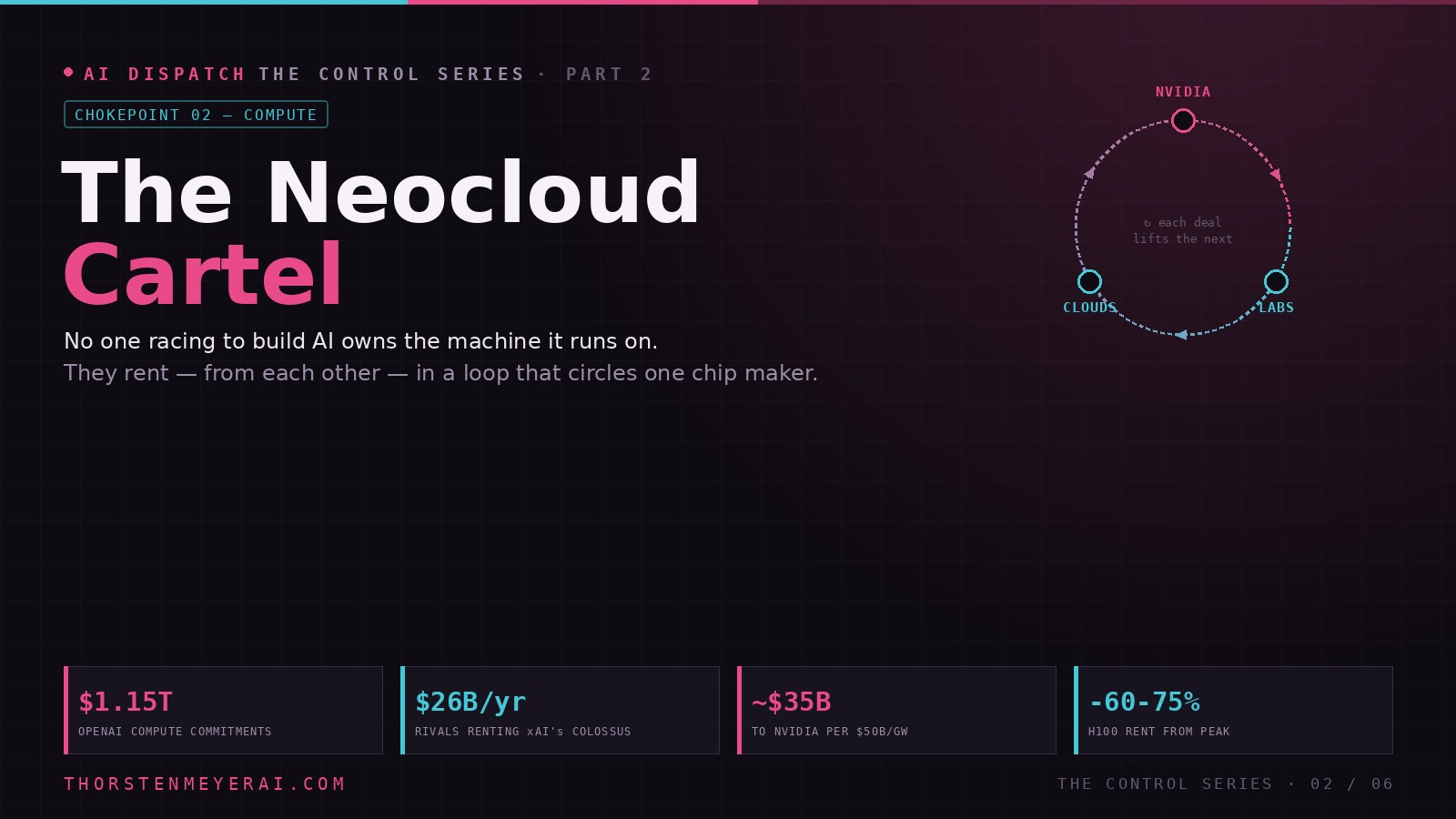

The Control Series, Part 2 of 6 · Chokepoint: Compute. Part 1 mapped the six places power sits in the AI stack. This installment goes deep on the one everyone fights over.

Get business pricing on tech for your team
- Business-only prices and quantity discounts
- Tax-exempt purchasing
- Multiple users, one account, clear invoices
Here is the strangest fact about the companies racing to build superintelligence: almost none of them own the machines they run on.
They rent. They rent from a new class of GPU landlords that didn’t exist three years ago. They rent, increasingly, from each other — Anthropic now trains on xAI’s supercomputer, paying a competitor over a billion dollars a month. And the money they spend renting loops, with remarkable consistency, back to a single chip maker that has quietly become an investor in nearly everyone at the table.
Part 1 of this series called compute a chokepoint. That was the polite version. Up close, the compute layer in 2026 looks less like a market and more like a cartel — a small ring of firms financing each other’s purchases, each deal inflating the next one’s valuation, all of it orbiting one company in Santa Clara.
This is how that ring formed, who actually holds the choke, and why the thing that makes it powerful is also the thing that could make it snap.
The Neocloud Cartel
Almost no one racing to build AI owns the machine it runs on. They rent — increasingly from each other — and the money loops back to one chip maker that’s also an investor in nearly everyone at the table.
The cartel isn’t a conspiracy — it’s the endpoint of extreme capital intensity, real scarcity, and one dominant supplier. But the same circularity that makes it powerful makes it a fuse: each cancelled order is someone else’s missing revenue. Don’t be a price-taker at the bottom of a loop you don’t control — own your inference, keep an open-weight fallback, diversify silicon.
Nobody owns the machine
The category has an ugly name — “neocloud” — and a simple definition: an AI-only hyperscaler, GPU-as-a-service without the legacy baggage of a general-purpose cloud. It exists because the 2024–25 GPU shortage left even well-funded labs on months-long waitlists, and renting was the only way to get to scale without spending four years building.
CoreWeave is the giant of the category, publicly traded since 2025, sitting on a contracted backlog north of $55 billion. Meta has committed something like $35 billion to it across two deals; OpenAI roughly $22 billion. There are a hundred more behind it — Nebius, Crusoe, Lambda, Together, Fireworks, Nscale, IREN — backed by venture, private equity, and sovereign money, all renting out essentially the same Nvidia hardware.
Then, in May 2026, the category gained its most surprising member. xAI — an integrated frontier lab, the kind whose whole strategy argues against handing capacity to rivals — leased its Colossus 1 supercomputer to Anthropic for about $1.25 billion a month and to Google for about $920 million a month, roughly $26 billion a year, because its own Grok training had moved elsewhere and the cluster was sitting at an embarrassing 11% utilization. When even a self-described full-stack lab becomes a landlord, the message is unmistakable: in 2026, compute is something you rent, and ownership has decoupled from use.
As an affiliate, we earn on qualifying purchases.
The loop
Now follow the money, because that’s where “market” turns into “cartel.”
OpenAI alone has committed on the order of $1.15 trillion in compute and hardware over the next decade, spread across a handful of suppliers: Broadcom (~$350B), Oracle (~$300B), Microsoft (~$250B), Nvidia (~$100B), AMD (~$90B), AWS (~$38B), CoreWeave (~$22B). Those are not typos. They presume growth so steep that one analyst flagged the obvious: OpenAI does not have $300 billion to spend, let alone a trillion.
So where does the money come from? Increasingly, from the suppliers themselves.
In September 2025, Nvidia agreed to invest up to $100 billion in OpenAI — financing a buildout that OpenAI would then spend largely on Nvidia GPUs. As one outlet put it, Nvidia is bankrolling its own future sales. Days earlier it had taken a $5 billion stake in Intel; it holds equity in CoreWeave, Nebius, and Applied Digital; it pre-purchased $6.3 billion of CoreWeave capacity as a backstop; and it struck a similar financing arrangement with xAI. OpenAI’s AMD deal hands OpenAI warrants for up to 160 million AMD shares at a penny each, turning a customer into a major shareholder. Nvidia and Microsoft together committed up to $15 billion to Anthropic, which then spends on their compute. Amazon has discussed putting $10 billion-plus into OpenAI alongside a compute deal.
Money, chips, and cloud credits rotate among the same dozen names, and every announcement lifts the stock of everyone in the circle. TechCrunch summarized the design with admirable economy: if it seems circular, it’s because it is.
high performance GPU cloud computing
As an affiliate, we earn on qualifying purchases.
As an affiliate, we earn on qualifying purchases.
Who actually holds the choke
Strip away the press releases and the leverage concentrates in three places.
Nvidia, upstream of everyone. Jensen Huang has pegged the cost of a gigawatt of AI data center at roughly $50 billion — of which about $35 billion flows to Nvidia. That means Nvidia captures the majority of nearly every dollar in the entire buildout, and holds equity in the firms doing the building, and decides who gets chip allocation in a shortage. Allocation is the real lever: in a supply-constrained market, the company that decides who gets GPUs decides who gets to compete. No export-control letter required.
The landlords, and the contracts. Renting means your compute lives on someone else’s terms. xAI’s lease to Anthropic reportedly preserves Musk’s right to reclaim capacity if Anthropic’s AI “harms humanity” — a clause that turns a supply contract into a governance lever held by a competitor. CoreWeave drew 77% of its 2024 revenue from just two customers; dependency runs both directions, and a chokepoint with two customers is itself fragile.
Capital, which Part 6 will take up properly, but which shadows everything here: the only firms that can play are the ones large enough to write ten-figure checks, and the circular financing means they’re increasingly the same firms.
The result is a compute layer where access is gated, repriceable, and revocable — by a chip maker’s allocation desk, by a landlord’s contract, by a financier’s willingness to keep the loop spinning. That is the definition of a chokepoint, and right now a very small number of hands are on it.
As an affiliate, we earn on qualifying purchases.
The fuse
Here’s the part the valuations gloss over: the same circularity that makes the cartel powerful makes it fragile.
A loop where suppliers finance customers who buy from suppliers works beautifully while demand and stock prices rise — each leg validates the next. It works in reverse just as efficiently. Morgan Stanley pegs global data-center spending at roughly $3 trillion between 2025 and 2028, about half of it funded by private credit. OpenAI is reportedly on track for a $74 billion operating loss in 2028; one estimate puts its cumulative losses near $140 billion across 2024–29. And the end demand that’s supposed to justify all of it is thin: by one count, only about 3% of consumers pay for AI, perhaps $12 billion a year, against trillions in committed capex. Meanwhile H100 rental rates have fallen 60–75% from their peak — the clearest possible signal that the scarce thing is commoditizing.
If any major node wobbles — a lab misses, demand softens, a financier blinks — the loop doesn’t gently deflate. Each cancelled order is someone else’s missing revenue, someone else’s impaired collateral, someone else’s stock decline that unwinds the next deal. The cartel that finances itself can de-finance itself just as fast. Compute is simultaneously the industry’s deepest moat and its most likely fuse.
As an affiliate, we earn on qualifying purchases.
My take
I want to be fair to the structure before I’m skeptical of it, because the cartel is not a conspiracy — it’s the natural endpoint of three real conditions: extreme capital intensity, genuine GPU scarcity, and a single dominant supplier. Idle compute is economically irrational, so renting it out is rational. Skipping a four-year buildout by leasing is rational. Even vendor financing has precedent — telecom equipment makers bankrolled carriers in the late 1990s. Each individual deal makes sense.
It’s the aggregate that should give pause. The most strategic input in AI is concentrating into a handful of hands plus one chip maker that sits upstream of all of them and inside the cap table of many of them. That is a control structure, and control structures get used — as Part 1’s kill switch already demonstrated at the model layer.
For anyone building on top of this — which is the position most companies and most countries are in — the lesson is uncomfortable but clear. Do not be a pure price-taker at the bottom of a circular structure you don’t control. Concretely: run your own inference where the economics allow, because owning the box you serve from is the one part of the stack nobody can reprice or reclaim on you. Keep an open-weight fallback you can host yourself. Diversify silicon — TPUs, Trainium, AMD — so a single allocation desk isn’t your single point of failure. None of that lets you escape the chokepoint entirely. All of it buys you optionality when the people holding it decide to squeeze.
The watch items for the rest of 2026 are specific: whether Nvidia’s allocation power draws regulatory attention; whether the circular commitments convert into real end-demand or just keep refinancing each other; whether H100 price declines spread up the stack to the newest chips; and whether any reclaim clause actually gets pulled, turning a theoretical lever into a real one.
Next in the series
If compute is the chokepoint everyone can see, data is the one hiding in plain sight — the scarce, hard-to-collect input that survives even as models and GPUs commoditize. Part 3 goes there: the war’s worth of footage, the proprietary corpus, and data as the new sovereign asset.
Compute taught the industry to rent the machine. The next fight is over the one thing you can’t rent, because no one else has it.
Sources: SpaceX SEC filings; TechCrunch; The Register; Bloomberg; CNBC; Reuters; SemiAnalysis; McKinsey; Morgan Stanley; Financial Times; and analyses by Tomasz Tunguz and others (2025–June 2026). Compute-commitment and investment figures are as reported; several are multi-year commitments, not cash on hand. Analysis and opinions are the author’s.
Evergreen bestsellers Picks
bestsellers
As an affiliate, we earn on qualifying purchases.