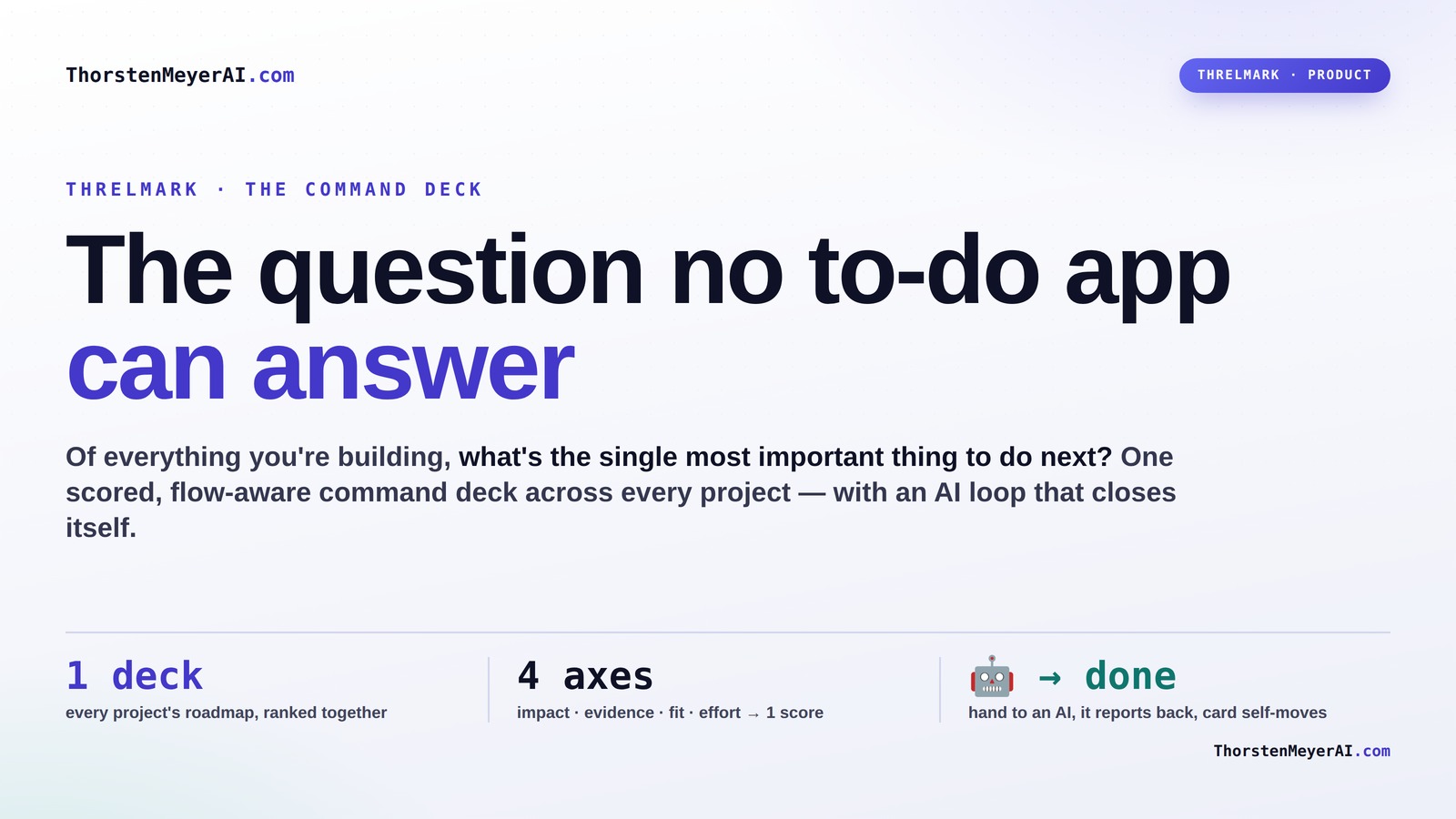

If you build or run more than one thing at a time, you already know the feeling, even if you’ve never named it. Your plans are scattered across too many places. One project’s tasks live in a notes app, another’s in a spreadsheet, a third only in your head. You start things faster than you finish them. Work piles up half-done. And the one question that actually matters — of everything I’m responsible for, what is the single most important thing to do next? — has no good answer anywhere.

Get business pricing on tech for your team
- Business-only prices and quantity discounts
- Tax-exempt purchasing
- Multiple users, one account, clear invoices
That’s not a discipline problem. It’s a tooling problem. To-do apps track tasks. Project boards track status. Neither one ranks the most valuable work across everything you’re building and tells you, honestly, where to point your next hour. Threlmark is built to answer exactly that question — and to do a few things along the way that ordinary tools structurally can’t.
The question no to-do app can answer
Of everything you’re building, what’s the single most important thing to do next? To-do apps track tasks. Boards track status. Neither ranks the most valuable work across every project — and tells you where to point your next hour.
Your plans live in too many places
One project’s tasks are in a notes app, another’s in a spreadsheet, a third only in your head. You start faster than you finish. The honest question has no good answer anywhere.
Priority becomes a number, not an argument
Rate four simple axes 1–5. Threlmark turns them into one priority score — impact weighted heaviest, only effort subtracts. Drag any slider and watch the score move.
The priority score, computed live
Now your backlog is ordered by consistent, visible logic you can argue with — not gut feel or recency.
max(0, rounded)
One honest ranking across everything
Every item from every project, ranked together — so the top is genuinely the most valuable work you could do anywhere right now. In-progress work floats up (finishing beats starting); blockers get nudged up (bottlenecks cost most).
Portfolio · top work across all projects
status-weighted · auto-rankedThe real disease is “too much started, nothing finished”
A tidy board can hide it. Threlmark adds flow signals that quietly tell the truth — no methodology to learn, just the board plus a few honest numbers.
WIP limits
Cap how many items are “in development.” Over the limit, the column turns red.
Aging & stale flags
Every card shows how long it’s sat in its column. Too long in dev (>7d) → flagged stale. No more cards rotting for two months.
Throughput & cycle time
How many items you actually finish per week, and how long things really take. Your real pace, not your optimistic one.
Hand it to an AI — and let it tell you when it’s done
You decide what and when; the AI does the building; the board keeps itself honest about what actually shipped — without you dragging cards around by hand.
The handoff-and-report loop
Generate a brief, paste it into Claude or Codex — and the brief tells the agent to report back automatically.
Generate brief
What to build, files it touches, what “done” means, how to verify.
→Hand to AI
Paste into Claude / Codex. Card optionally moves to Development.
→Agent reports
done / blocked / failed — with a summary & proof checks passed.
→Card self-moves
A “done” report moves the card to Done. Flow counts brief → shipped.
What Threlmark actually is
Threlmark is a command deck for all your projects and their roadmaps. Each project gets its own board where rough ideas become ranked work and move toward done. A single Portfolio view ranks the most important work across every project at once. And because the era of AI coding assistants has arrived, Threlmark is built to hand a piece of work to an AI agent and automatically track whether it actually got finished.
Three things separate it from a generic task list or a typical kanban board, and they’re worth stating plainly because they’re the whole point. It scores and ranks, so priorities stop being a matter of opinion or whoever argues loudest. It manages flow, so you can see what’s stuck, what’s aging, and whether you’ve simply started too much. And your data is genuinely yours — it lives on your own computer as ordinary files, with no cloud account, nothing leaving your machine, and nothing anyone can lock you out of.
Let me walk through what each of those means in practice, because the difference between “another board” and “the thing that finally tells me what matters” lives in the details.
As an affiliate, we earn on qualifying purchases.
A board that decides for you — almost
Every project in Threlmark is a board with four columns: Ideas, anything you might do; Ranked, the things you’ve decided are worth doing, in priority order; Development, what’s actively being built right now; and Done. So far that’s a normal kanban. What changes everything is the scoring.
For each item you give a quick one-to-five rating on four simple questions. Impact: how much does this move the needle? Evidence: how sure are we that people actually want it? Fit: how well does it match the product and our strengths? Effort: how much work is it? Threlmark turns those four numbers into a single priority score, weighting impact most heavily and letting only effort pull the score down. Now your backlog isn’t ordered by gut feel or by whatever you touched most recently — it’s ordered by a consistent, visible logic you can argue with and adjust.
That last part matters more than it sounds. When priority is a number derived from four named axes, disagreements become productive. Instead of “I think this is more important” versus “well I think this is,” you point at the impact rating and discuss that. You change a score, the order updates, and everyone can see why something sits near the top. Two buttons make the whole thing fast: “Rank by score” sweeps your raw ideas into the ranked backlog in priority order, and “Push top 3” promotes the three highest-scoring items straight into active development. Prioritization stops being a recurring argument and becomes a quiet, repeatable habit.
As an affiliate, we earn on qualifying purchases.
The Portfolio: one honest view across everything
Here is the view most tools simply cannot give you, and it’s the reason Threlmark exists. The Portfolio takes every item from every project and ranks them together, so the top of that single list is genuinely the most valuable work you could be doing anywhere right now.
It’s weighted with a couple of instincts that match how building actually works. Work that’s already in progress floats to the top, because finishing beats starting — a half-built feature is worth more finished than a slightly better idea left unstarted. And anything that’s blocking other work gets nudged up too, because bottlenecks are the most expensive thing in any system; clearing them unblocks everything downstream. For a solo founder juggling six side-projects, or a small team spread across a few products, this is the entire difference between feeling busy and being effective. You stop context-switching on instinct and start working the one ranked list that already accounts for everything you’re carrying.
As an affiliate, we earn on qualifying purchases.
Why flow matters more than a tidy board
Most project tools are satisfied the moment your board looks organized. But a tidy board can hide the real disease, which is almost never untidiness. It’s this: too many things started, nothing finished. A neat row of twelve “in progress” cards looks like productivity and is actually the opposite.
Threlmark borrows the modern discipline of flow management and makes it practical, without asking you to learn a methodology. You can cap how many items are “in development” at once — per project, and visible across the whole portfolio. Go over the limit and the column turns red. That little red number is often the single most useful signal in the tool, because it says the one thing founders most need to hear and least want to: stop starting, start finishing. Every card also shows how long it’s been sitting in its current column, and anything that’s been “in development” too long gets flagged, so cards can’t quietly rot for two months while you look away. And a simple Flow view shows how many items you actually finish per week and how long things really take from started to done — your real pace, not your optimistic one, which is what makes planning honest for the first time.
None of that requires adopting a framework or attending a workshop. It’s just the board you already understand, plus a few signals that quietly tell you the truth about how your work is moving.
As an affiliate, we earn on qualifying purchases.
Hand it to an AI — and let it tell you when it’s done
This is where Threlmark looks squarely at how building actually happens in 2026. More and more of the real work is done by AI coding assistants, and Threlmark is designed for that reality rather than pretending it away.
When an item is ready, you generate a handoff brief — a clean, precise instruction packet for an AI agent like Claude or Codex: what to build, which parts of the project it touches, what “done” actually means, and how to verify the work. You paste that into your assistant and it gets to work. The clever part is that the brief tells the agent to report back automatically. When the AI finishes, it sends a short status — done, with a summary of what it changed and proof that the checks passed — and the card moves itself to Done. You get a small live notification on the board: 🤖 claude done. If the agent gets stuck, it reports blocked instead, and you’ll see that too. And if a handed-off task sits unfinished too long, Threlmark surfaces it as stalled, so nothing silently slips through the cracks.
In plain terms: you decide what to build and when, the AI does the building, and the board keeps itself honest about what actually shipped — without you dragging cards around by hand to maintain the fiction that you remembered to.
Where the ideas come from
A roadmap is only as good as the ideas on it, which is why Threlmark connects to a companion tool called IdeaClyst — built specifically to generate good ideas by researching the market, studying competitors, and turning rough concepts into concrete, scored proposals. Because Threlmark’s data is open, IdeaClyst can read one of your project’s roadmaps, see where it’s thin, and propose new work to fill the gaps: fresh features, possible spin-off products, services you could offer, each one scored and backed by real research. The proposals land in that project’s Inbox, where you glance at each and either accept it (it becomes a ranked item) or dismiss it — and you can even route a suggestion into a different project if it fits better there.
That closes a genuinely satisfying loop, which I’ll cover in depth later in this series: IdeaClyst proposes what to build, it lands in your Inbox, you accept and rank it, you hand it to an AI agent, it gets built and reports back, and it’s done — after which IdeaClyst’s next suggestions adapt to the gaps that remain. Ideas in, finished work out, with you making the call at every step. And because the underlying format is open, it isn’t limited to IdeaClyst: any tool can drop suggestions into your Inbox the same way.
Your data stays yours
A quiet but genuinely important point: Threlmark runs on your own computer. There’s no account to sign up for, no cloud service holding your plans hostage, no monthly subscription that can lock you out, and nothing transmitted off your machine. Your roadmaps are saved as plain, readable files in a folder you control. You can back them up, sync them with whatever you already use, or move them anywhere — they are not trapped inside someone else’s system.
For anyone who’s been burned by a tool that got discontinued, jacked up its price overnight, or quietly changed its terms, this is the reassurance that matters: you own the data, full stop. It also means it’s genuinely private. Your strategy, your unreleased ideas, your roadmaps — none of it ever leaves your device. In an era where most software treats your data as the product, a roadmap tool that keeps everything on your own disk is a deliberate, and increasingly rare, stance.
Who it’s for — and who it isn’t
Threlmark is for the solo builder or indie founder running several projects at once, who needs one place that says what to work on next across all of them and helps them finish instead of endlessly starting. It’s for the small product team that wants honest prioritization and a real view of flow without adopting a heavyweight enterprise process. And it’s for anyone working alongside AI assistants who wants the hand-off-and-track loop to be automatic rather than a chore of manual bookkeeping.
It is intentionally not an enterprise program-management suite. There are no sign-offs, no approval chains, no rigid corporate workflows. It’s a sharp, fast tool for people who build a lot and want clarity about what matters — which is a different thing, aimed at different people, than the dashboards built to make work legible to management. Knowing what a tool refuses to be is often the clearest sign it knows what it’s for.
A Monday with Threlmark
Picture the start of a week. You open the Portfolio and the top five items across all your projects are ranked and waiting. Two are already in progress, so you finish those first. You open one project, notice its Inbox has three suggestions from IdeaClyst, accept one — “add competitor price-drop alerts,” because it scores well and fills a real gap — and dismiss the other two. You rank the new item, hand the top item to your AI assistant with a click and a paste, and move on.
An hour later a toast pops: 🤖 the agent finished item X. The card has moved itself to Done, and the Flow view ticks your weekly throughput up by one. One project shows a red WIP number — four things half-built there — so you resist starting anything new and close two out instead. By Friday the Flow view shows you shipped seven items across three projects, with the real time each one took laid out plainly. Nothing got lost. Nothing rotted. And at no point did you have to guess what mattered most.
That’s the entire pitch, and it’s a modest, honest one: one place, honest priorities, real flow, and an AI loop that closes itself — with your data staying entirely yours. Not a system to adopt or a methodology to learn. Just the clearest possible answer to the question you’ve been carrying around unanswered: what should I do next?
Threlmark is developed privately and is not publicly available.
© 2026 Threlmark · Thorsten Meyer · Powered by Thorsten Meyer AI
Fall Picks
fall essentials
As an affiliate, we earn on qualifying purchases.