
Most failed AI implementations don’t look like failures for about a year. The dashboards stay green. The demos land. The board is pleased. The thing that’s actually going wrong is invisible by design: the system has quietly started making the judgment calls your best managers used to make — one decision at a time, none of them alarming on its own — and the results take three or four quarters to catch up with the decisions. By the time they do, you’ve spent a budget and a year, and “execution was off” becomes the tidy story everyone can agree on. Nobody says the real sentence, which is that the organization was never ready for the thing it bought.

Get business pricing on tech for your team
- Business-only prices and quantity discounts
- Tax-exempt purchasing
- Multiple users, one account, clear invoices
That is the expensive way to find out which camp you were in. Readiness exists to offer the cheap way: twenty minutes and a corporate email, before you sign anything, that tells you honestly whether the money you’re about to approve will compound or quietly evaporate. It is, as the diagnostic itself puts it, the cheapest decision you’ll make about AI — and almost nobody makes it first.
This spotlight is about why a tool like that needs to exist, what it actually does in those twenty minutes, and the stance that makes its verdict worth trusting.
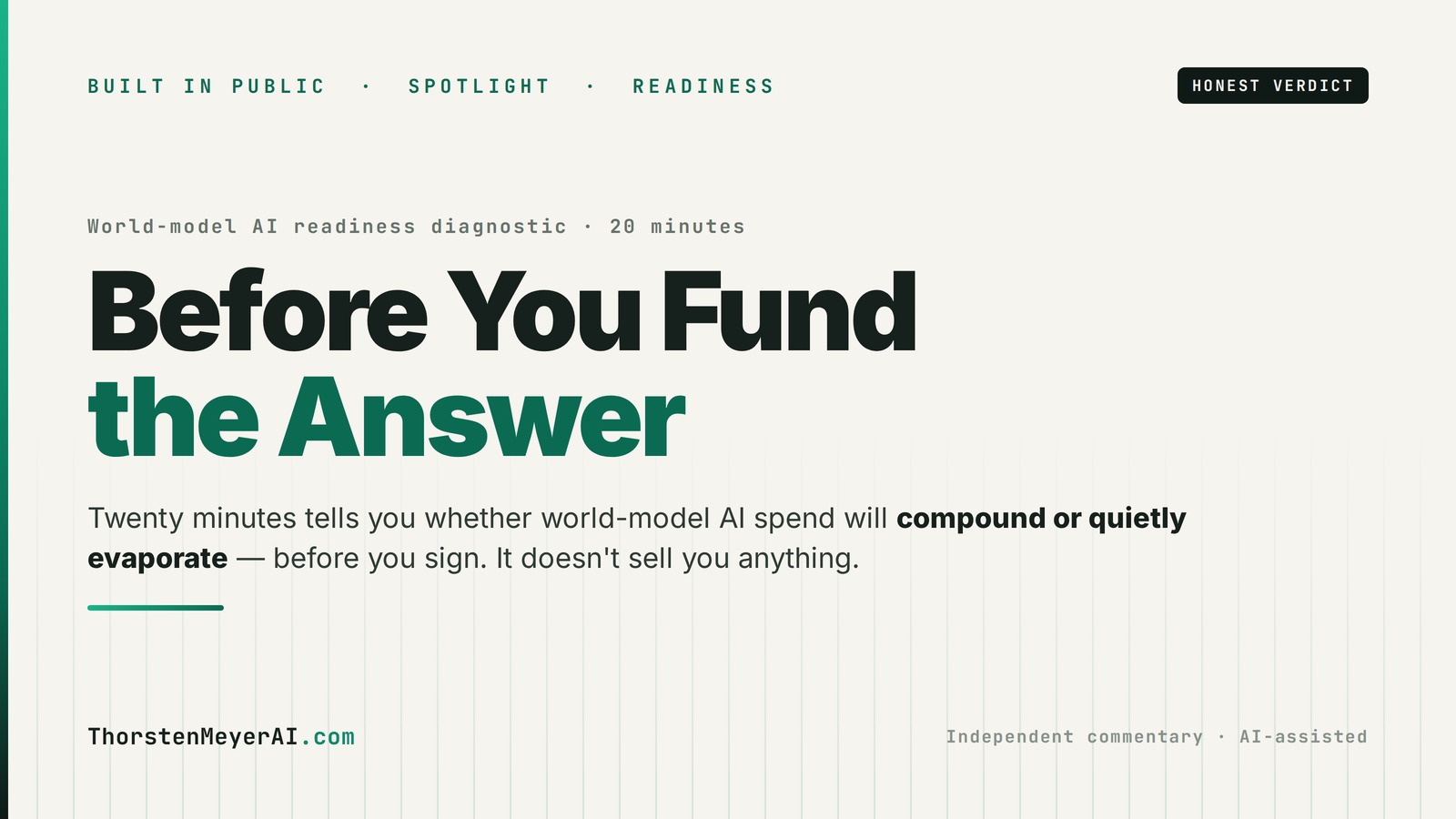
Before You Fund the Answer
Most world-model AI implementations look clean for a year, then decision quality erodes where no dashboard can see it. Twenty minutes and a corporate email tell you — before you sign — whether the money will compound or quietly evaporate.
A clear tier framed in language a CFO will accept — plus your percentile against peers in your sector and size band, so a score becomes a position you can take to the board.
+ twenty minutes
- No follow-up machine — no vendor in your inbox next week.
- No “book a call.” The output is an action you can take without it.
- No vendor scorecard. It doesn’t sell the implementation it assesses.
- No thumb on the scale toward “you’re ready, let’s talk.”
- Subtraction, pointed at a decision. Strip the vendor theater and dashboard-green comfort until the few things that decide success are visible.
- Independence is the product. A diagnostic that deletes your email has nothing to gain from any verdict but the true one — including “not ready.”
- The shift it’s built for. AI is moving from describing to predicting and acting; readiness is a question you answer before deployment, not during it.
- Find out before you fund the answer. The only thing more expensive than this assessment is learning the answer the slow way.
Independent commentary, produced with AI assistance under human editorial oversight. The views are the author’s own and may change. Readiness is a diagnostic tool, not business, financial, legal, or technical advice; its verdict is one input, not a substitute for due diligence. Regulatory references are named as examples, not legal guidance. Product, model, and company names are trademarks of their respective owners; mention does not imply endorsement.
Why “world-model” AI fails so quietly
It helps to be precise about what’s being assessed. The current wave of enterprise AI is mostly descriptive — it summarizes, drafts, answers. The next wave is world-model AI: systems that build an internal model of how your business works and use it to predict and to act. That shift, from AI that describes to AI that decides, is exactly where the failure mode changes character. A descriptive tool that’s wrong is annoying; you notice. A deciding system that’s subtly wrong is dangerous precisely because it’s confident, consistent, and embedded in the flow of work where no one is double-checking it anymore.
The erosion doesn’t trip a dashboard because dashboards measure outputs, and the thing degrading is judgment — the quality of the calls being made upstream of the numbers. By the time the numbers move, the decisions that moved them are months in the past. This is why readiness is a question you have to answer before deployment, not during it. After deployment, the feedback loop is too slow and too expensive to be a diagnosis. It’s just a bill.
As an affiliate, we earn on qualifying purchases.
The sharp part: three businesses, three ways it rots
The most useful thing the diagnostic does is refuse the generic. There isn’t one failure mode for world-model AI; there are different ones for different kinds of business, and most organizations can’t see their own from the inside. Readiness names three.
Data-rich businesses — the ones proud of how much they measure — tend to converge hard on what they already track and go blind to everything they don’t. The model optimizes the visible metrics beautifully and quietly erodes the things that were never instrumented, which are often the things that actually mattered. Their strength becomes the shape of their failure.
Complex regulated businesses face the opposite trap: a world model trained on how the business runs today locks that structure in and can’t adapt when the structure has to change — and in regulated sectors, the structure always eventually has to change. They build a very good model of a world that’s about to stop existing.
Document-driven businesses — where the work product is analysis, memos, advice — have the subtlest failure of all: they mistake a confident answer for an informed one. A fluent, well-formatted output reads as authoritative whether or not anything underneath it is true, and an organization that runs on documents is exactly the one least equipped to tell the difference at a glance.
The point of naming these isn’t taxonomy for its own sake. It’s that you learn which one is yours, and what specifically tends to break, in ten minutes — instead of discovering it across four quarters and a postmortem.
AI decision-making assessment software
As an affiliate, we earn on qualifying purchases.
As an affiliate, we earn on qualifying purchases.
What the twenty minutes actually produces
The output isn’t a vendor scorecard and it isn’t a number floating without context. Six things come back, and each is built to survive contact with a board.
A verdict first: a clear tier — not ready, premature, pilot, or scale — framed in language a CFO will accept, so you walk into the budget conversation with a position rather than a vibe. Then your real exposure, named: which of the three business types you are and the specific way implementations rot in it. Then where you actually stand — your score positioned as a percentile against peers in your sector and size band, so “we scored a 70” becomes “we’re ahead of, or quietly behind, the field.” Then calibration to your world: the report is tuned to your vertical — the data realities that make your metrics honest or distorted, the regulatory constraints that change your build order (MaRisk, HIPAA, the EU AI Act, NIS2, and the rest), and watch-items tied to your actual scores rather than to a generic checklist. Then your own words, reflected back — it quotes your answers where they sharpen the picture, so the result reads as a diagnosis of how your company actually runs, not a template with your logo dropped in. And finally a plan for Monday: three concrete actions tied to your single weakest dimension, things you can start in the next thirty days. Not “book a call.” Something to do.
That last distinction matters more than it looks. Most assessments end at the diagnosis because the diagnosis is the hook and the call is the product. Readiness ends at an action you can take without it, which is a different kind of tool entirely.
organizational AI readiness evaluation
As an affiliate, we earn on qualifying purchases.
As an affiliate, we earn on qualifying purchases.
The stance that makes the verdict trustworthy
Here is the part that I think makes Readiness genuinely unusual, and it’s a stance more than a feature: the diagnostic doesn’t sell you anything, and it’s built so that it can’t quietly try.
The whole price is a corporate email address and twenty minutes. There are no passwords and no social login. Your email is confirmed with a single click, the report is delivered — and then, by design, your email is removed from the records once you confirm. Your answers are anonymized, and if you’d rather they never inform anything beyond your own report, one checkbox keeps them out entirely. There’s no follow-up machine, no vendor sitting in your inbox next week, no funnel.
This isn’t just good manners; it’s what makes the verdict worth reading. An assessment that exists to route you toward a purchase has a thumb on the scale toward “you’re ready, let’s talk.” An assessment that deletes your email and never contacts you again has nothing to gain from telling you anything but the truth — including, especially, not ready. The independence is the product. A board or an investor wanting a second read before a portfolio company commits gets exactly that value precisely because the tool isn’t also trying to be the thing you buy next.
As an affiliate, we earn on qualifying purchases.
Who it’s for
Three audiences, really. CEOs and operators weeks away from approving AI or “intelligence tooling” spend, whose confidence currently rests on a vendor’s demo. Boards and investors who want an independent read before a company commits real money. And the heads of data, operations, and transformation who will personally own the implementation when it lands — and own the erosion if it doesn’t. If you’re close to a six-figure commitment and the case for it is mostly a good demo, this is the twenty minutes that pays for itself fastest, because the only thing more expensive than a readiness assessment is finding out the answer the slow way.
Why it belongs in the portfolio
This series has a throughline, and Readiness sits close to its center. The discipline the whole portfolio keeps returning to is subtraction — when making things gets cheap, the scarce skill becomes judgment about what to remove. Readiness is that idea pointed at a decision: it subtracts the noise, the vendor theater, and the dashboard-green false comfort until you can see the few things that actually determine whether this works. Its independence is the no-lock-in principle in another costume. And its entire reason for being is the last facet — staying ready for what’s next, which right now means the shift, already underway, from AI that describes to AI that predicts and acts.
It’s fitting that the broader work treats the readiness diagnostic as a kind of capstone rather than a footnote. Owning your ground, refusing lock-in, building with AI as an editable tool, removing more than you add — the point of all of it was never any single product. It was staying ready. Readiness just makes that explicit, and offers the same diagnosis to anyone about to write the check: find out which camp you’re in before you fund the answer.
Start the 20-minute assessment →
Independent commentary, produced with AI assistance under human editorial oversight; the views are the author’s own and may change. Readiness is a diagnostic tool, not business, financial, legal, or technical advice, and its verdict is one input to a decision rather than a substitute for due diligence. Regulatory references (MaRisk, HIPAA, the EU AI Act, NIS2, and others) are named as examples and are not legal guidance. Product, model, and company names are trademarks of their respective owners; mention does not imply affiliation, sponsorship, or endorsement. © 2026 Thorsten Meyer · Powered by Thorsten Meyer AI. See Imprint/Impressum and Privacy Policy.
Evergreen bestsellers Picks
bestsellers
As an affiliate, we earn on qualifying purchases.