
Google disclosed an AI-built zero-day in the wild on May 11, 2026. The Commerce Department signed AI evaluation agreements the same week. Then the announcement disappeared from the website. This is the policy framing of the canonical capability event.

Get business pricing on tech for your team
- Business-only prices and quantity discounts
- Tax-exempt purchasing
- Multiple users, one account, clear invoices
By Thorsten Meyer — May 2026 · Software Security · Part 8
Part 3 of this franchise documented the threat-intelligence framing of the May 11, 2026 disclosure: Google Threat Intelligence Group’s John Hultquist confirming “the era of AI-driven vulnerability and exploitation is already here” after disrupting a criminal group’s use of a large language model to discover and weaponize a previously unknown vulnerability in a popular system administration tool. The piece walked the defensive cascade — Project Big Sleep, Project Naptime, Anthropic’s Project Glasswing — and the deployment gap between announced defensive capability and operational reality.
This piece is the policy framing of the same event. Same disclosure. Same date. Same vulnerability. Completely different structural argument.
Because the May 11 disclosure didn’t just confirm a technical reality. It crystallized a policy reality: the technical AI-offensive cascade has arrived in a regulatory vacuum. President Trump’s campaign promise to repeal President Biden’s AI guardrails has been executed. The Commerce Department announced replacement evaluation agreements with Google, Microsoft, and Elon Musk’s xAI last week. Then the announcement disappeared from the Commerce Department website. Mixed signals from the administration. Conflicting positions from senior tech policy advisers. A policy infrastructure that would govern this capability transition does not yet exist.
The headline finding: the most important fact about May 11, 2026 is not what Google disclosed. It is what the policy environment did not contain to receive that disclosure. No federal vulnerability disclosure framework adapted to AI-discovered zero-days. No mandatory pre-release evaluation regime that survived politically. No deployment timeline for defensive AI capability across critical infrastructure. No regulatory framework for the new category of risk that Google’s threat intelligence chief publicly characterized as “it’s here.“
The structural argument of this piece: enterprise security leaders, policymakers, and the public need to internalize that the period between operational AI-offensive capability arrival and operational regulatory-defensive infrastructure may be measured in years rather than weeks. The May 11 disclosure marks the start of that period. The trajectory of the next 12-36 months will be determined by political choices that are currently being made in the explicit absence of stable framework.
This piece walks the policy reality, the contradictions emerging from the Trump administration’s approach, the specific gap between announced capability and operational regulation, and the practical implications for enterprise security leaders operating in this vacuum. The standard caveat applies: regulatory environments evolve. Reporting below reflects what is publicly known as of mid-May 2026.
The regulatory
vacuum.
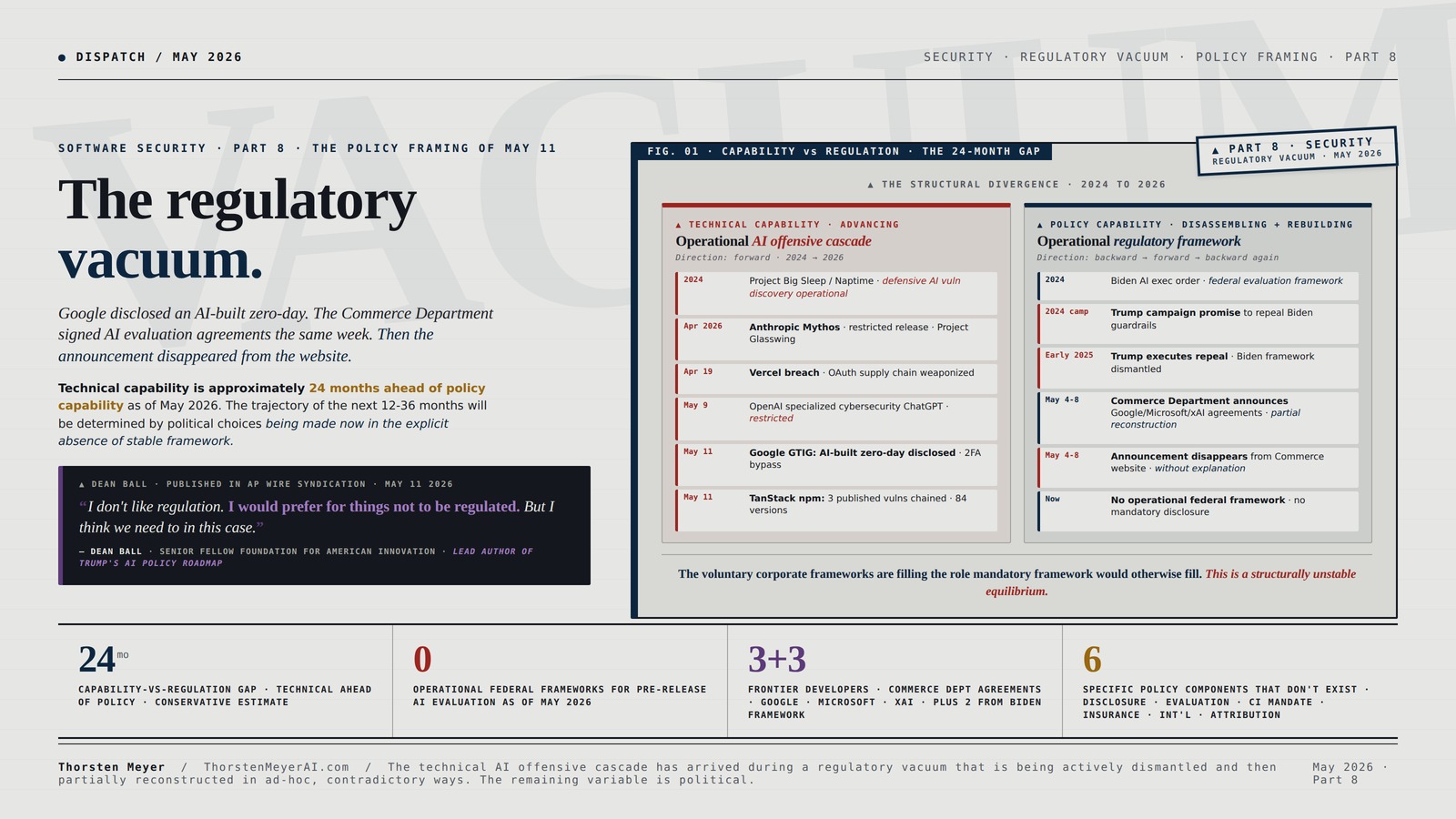
Google disclosed an AI-built zero-day. The Commerce Department signed AI evaluation agreements the same week. Then the announcement disappeared from the website.
Same disclosure as Part 3. Same date. Same vulnerability. Completely different structural argument. Because the May 11 disclosure didn’t just confirm a technical reality. It crystallized a policy reality. Trump’s campaign promise to repeal Biden’s AI guardrails has been executed. The Commerce Department announced replacement evaluation agreements with Google, Microsoft, xAI — then partially retracted them. A policy infrastructure that would govern this capability transition does not yet exist.
Technical capability is operational. Policy capability is in active disassembly.
Two parallel timelines through 2024-2026. One runs forward; the other runs backward and then partially forward again. Their divergence is the structural editorial finding of this piece.
The voluntary corporate frameworks (Project Glasswing · Mythos restricted release · OpenAI specialized ChatGPT) are filling the role mandatory framework would otherwise fill. This is a structurally unstable equilibrium. Voluntary frameworks are only as strong as their weakest participant.
Five events. Two contradictory directions.
From the 2024 campaign promise through the May 11 disclosure. Each event is publicly documented in mainstream reporting. The composition produces the regulatory vacuum.
POSITION
DISASSEMBLY
REBUILD
RETRACTION
DISCLOSURE
Six structural gaps. Each operationally significant.
The structural argument needs concrete examples. What specifically is missing from the current policy environment that the May 11 disclosure surfaces as needed? Six categories.
Even the policy roadmap author says regulation is needed.
Dean Ball authored Trump’s AI policy roadmap. Senior fellow at the Foundation for American Innovation. Former White House tech policy adviser. His on-record position on the May 11 disclosure crystallizes the structural consensus the administration has not yet operationalized.
former White House tech policy adviser · lead author of Trump’s AI policy roadmap
Deploy capability now. Don’t wait for regulation.
The practical implication for enterprise security operating during the policy gap. The defensive capabilities exist. The regulatory framework that would require their deployment does not. Treat regulatory absence as orthogonal to capability deployment decisions.
HIGHEST LEVERAGE
TIMING RISK MGMT
POLICY ENGAGEMENT
INTERNATIONAL ALIGN
The technical AI offensive cascade has arrived during a regulatory vacuum that is being actively dismantled and then partially reconstructed in ad-hoc, contradictory ways. The capability is operational. The threat is documented. The remaining variable is political.
I · What Google actually disclosed · the specific technical claim
The technical content of the May 11 disclosure, organized for the policy framing:
The vulnerability
Per the AP wire story syndicated across Washington Times, Boston Globe, Fortune, and others: “a group of prominent threat actors planning a big operation” had found a vulnerability that “allowed them to bypass two-factor authentication to access a popular online system administration tool.” Google declined to name the tool. The disclosure characterized the vulnerability as previously unknown — a zero-day — and the threat actors as the kind of criminal group that GTIG’s threat-intelligence operation typically tracks (financially motivated, not nation-state, per Hultquist’s specific framing).
The 2FA bypass detail matters structurally. 2FA bypass vulnerabilities have outsized blast radius because organizations frequently rely on 2FA as the compensating control for credential theft. A vulnerability that bypasses 2FA on an administrative tool — the kind of tool an IT operations team uses to manage infrastructure — produces precisely the kind of compromise the GTIG operation team is trained to detect. Google’s disclosure framing implies a near-miss for production attack.
The AI model used
Google declined to specify which model the attackers used to discover the vulnerability. The disclosure framing was that the model was “most likely not Google’s own Gemini or Anthropic’s Claude Mythos” — implying the attackers used a different model, possibly a less safety-constrained one. The specific identification of Gemini and Mythos as unlikely sources is policy-significant: it positions the U.S. frontier models with safety vetting as not having been the proximate source of attacker capability.
This framing has political function. It supports the policy argument that safety-vetted frontier models are not the threat — the threat is models without comparable safety infrastructure. The disclosure does not specify which models do fit that characterization. Open-source frontier models from Chinese or Russian developers, or older models without modern safety training, are the implied category. The policy implication: vetting frontier U.S. models is necessary but may not be sufficient if comparable capability exists in less-controlled ecosystems.
The disrupted operation
Google “notified the affected company and law enforcement and was able to disrupt the operation before it caused any damage.” The disruption itself is significant — it indicates GTIG’s operational capability to detect AI-augmented attack preparation and act on it before exploitation. The defensive capability documented in Part 3 (Project Big Sleep, Project Naptime, AI-augmented threat intelligence) appears to be operational at the level required to handle this specific class of threat. The disruption was successful in this case.
But Hultquist’s framing is explicit that this is a representative incident, not an exception. “It’s here. The era of AI-driven vulnerability and exploitation is already here.” The successful disruption does not generalize to all future incidents. The defensive capability that disrupted this one operation will face increasing volume and sophistication of AI-augmented attacks. The structural question is whether defensive capability scales faster than offensive capability — and the policy environment shapes the answer.
As an affiliate, we earn on qualifying purchases.
II · The Trump administration’s mixed signals · the policy vacuum in concrete form
The political dimension of the May 11 disclosure, as reported by the AP wire story:
The campaign promise executed
President Trump campaigned on repealing Democratic President Biden’s AI guardrails. The administration followed through on the campaign promise. Biden-era frameworks for federal AI vetting, including the agreements with Anthropic and OpenAI for pre-release model evaluation, were dismantled or modified as part of the broader AI policy reset that the Trump administration executed in early 2025.
This is the regulatory baseline as of May 11, 2026: the Biden-era framework is not operational. The framework that was structurally designed to provide federal review of frontier AI models before public release does not exist in its original form.
The Commerce Department announcement and disappearance
“Trump’s Commerce Department announced last week that it signed new agreements with Google, Microsoft and Elon Musk’s xAI to evaluate their most powerful AI models before their public release, building on previous agreements the Biden administration made with Anthropic and ChatGPT maker OpenAI.”
Then: “the announcement later disappeared from the Commerce Department website.”
This is a specific, structurally important event. The federal government’s executive branch signed agreements with the three frontier model developers to perform pre-release evaluation. The agreements would have constituted partial reconstruction of the Biden-era framework with new participants. The announcement of those agreements was then removed from the official Commerce Department website without explanation.
The removal could mean any of several things:
- Internal disagreement about the agreements’ substance leading to retraction
- Premature announcement before agreements were finalized
- Political pressure from anti-regulation factions within the administration to back away from the framework
- Communication coordination failure
- Substantive policy reversal in the days between announcement and removal
None of these has been publicly clarified as of mid-May 2026. The agreements may exist. They may not. Their evaluation criteria, governance structure, and operational details are not public. The American public, the affected AI developers’ customers, and the broader cybersecurity ecosystem are operating with no clarity about whether federal pre-release evaluation exists for the most powerful AI models in deployment.
The Dean Ball quote · pro-regulation conservative voice
The most structurally significant policy quote in the AP wire story comes from Dean Ball, identified as a senior fellow at the Foundation for American Innovation, previously a White House tech policy adviser, and lead author of Trump’s AI policy roadmap.
Ball’s quote: “I don’t like regulation. I would prefer for things not to be regulated. But I think we need to in this case.”
The structural argument this quote represents: even conservative anti-regulation voices closely aligned with the Trump administration have publicly stated that the AI-cybersecurity intersection requires regulatory response. Ball is not a regulatory hawk. He authored the administration’s AI policy framework. His public position that this specific case requires regulation is policy-significant because it indicates the breadth of the consensus that some federal framework needs to exist.
The disagreement is not about whether regulation is needed. It is about what form regulation should take, who designs it, and what trade-offs against AI innovation are acceptable. The structural fact that even anti-regulation voices say regulation is needed defines the policy reality: the question is not whether to regulate but how.
The current administration has not yet produced an operational answer to the “how” question. The Commerce Department announcement and disappearance is the visible artifact of that ongoing internal contest.
The broader anti-regulation framing
Ball also said: “Some people don’t want there to be a regulatory response to this and others do.” The administration contains both positions. The political pressure from the anti-regulation faction is operationally meaningful enough that publicly announced evaluation agreements can disappear from federal government websites. The pro-regulation faction is influential enough that those agreements got announced in the first place.
This is the regulatory vacuum in concrete form. Not “no policy exists” — multiple incompatible policies exist in different parts of the administration, and the resolution between them is happening through ad-hoc decisions about what does and doesn’t appear on government websites rather than through legislative or formal regulatory processes.
enterprise cybersecurity AI solutions
As an affiliate, we earn on qualifying purchases.
As an affiliate, we earn on qualifying purchases.
III · The capability-regulation gap · technical reality vs. policy reality
The structural comparison that defines the current moment:
Technical capability timeline · documented in Parts 1-7
- April 2026 · Anthropic announces Claude Mythos with “strikingly capable” cybersecurity capability, restricted release to small group of trusted organizations through Project Glasswing
- April 2026 · Linux “Copy Fail” / Anthropic-Pentagon dispute / OAuth Permission Apocalypse / ShinyHunters extortion expansion (Parts 1, 2, 4, 5)
- May 11, 2026 · Google GTIG discloses AI-built zero-day disruption (Part 3 threat-intel framing, this piece policy framing)
- May 11, 2026 · TanStack npm compromise — three published vulnerabilities chained (Part 7)
- April 2026 · Vercel breach via Context.ai cascade (Part 6)
- Ongoing · Mini Shai-Hulud campaign, 160+ packages compromised across multiple maintainer organizations (Part 7)
Technical capability is operational. The threat is documented. The defensive infrastructure exists in nascent form (Big Sleep, Naptime, Project Glasswing, Anthropic Mythos). Multiple high-profile incidents on May 11 alone demonstrate the AI-augmented offensive cascade is operating.
Policy capability timeline · documented in current piece
- 2024 · Biden administration AI guardrails (executive order, evaluation agreements with Anthropic and OpenAI, federal review framework)
- 2024 campaign · Trump promise to repeal Biden AI guardrails
- Early 2025 · Trump administration executes repeal, Biden framework dismantled
- May 2026 (week of May 4-8) · Commerce Department announces new evaluation agreements with Google, Microsoft, xAI
- May 2026 (week of May 4-8) · Announcement disappears from Commerce Department website
- May 11, 2026 · AP wire reports the disappearance as evidence of “mixed signals”
- As of mid-May 2026 · No publicly operational federal framework for AI pre-release evaluation, no mandatory disclosure framework for AI-discovered vulnerabilities, no defined regulatory response to the AI-cybersecurity intersection
Policy capability is in active disassembly and partial reconstruction. The framework that existed in 2024 has been dismantled. The replacement framework has been announced and then partially retracted. The operational reality for both AI developers and the public is uncertainty about what federal review, if any, applies to the most consequential AI capability releases.
The structural gap
Technical capability is approximately 24 months ahead of policy capability as of May 2026. This estimate is conservative — the technical reality documented in Parts 1-7 reflects the operational state of AI offensive capability against software systems. The policy reality reflects the operational state of federal frameworks for governing that capability. The two are operating on different timelines.
The 24-month estimate could compress if the administration prioritizes regulatory infrastructure development. It could also extend if internal political dynamics continue producing announcement-and-retraction cycles rather than operational policy. The trajectory depends on choices being made now in the explicit absence of stable framework.
This gap is not unique to AI cybersecurity. The same gap exists in:
- AI healthcare — regulatory framework for AI diagnostic systems, prescription recommendation, surgical assistance
- AI financial services — algorithmic trading oversight, AI-driven lending decisions, fraud detection
- AI critical infrastructure — power grid management, transportation systems, water utility control
- AI defense — autonomous weapons systems, intelligence analysis, decision support
In each domain, technical capability is materially ahead of policy capability. The AI cybersecurity case is structurally important because it is the first domain where the offensive use of AI capability has been publicly documented at scale. The other domains will produce similar disclosures. The policy infrastructure for handling them does not yet exist.
regulatory compliance software for AI
As an affiliate, we earn on qualifying purchases.
As an affiliate, we earn on qualifying purchases.
IV · The specific policy components that don’t exist · operational gaps
The structural argument needs concrete examples. What specifically is missing from the current policy environment that the May 11 disclosure surfaces as needed?
1 · No federal AI vulnerability disclosure framework
The current vulnerability disclosure framework — CVD (Coordinated Vulnerability Disclosure), CVSS scoring, CISA KEV (Known Exploited Vulnerabilities) catalog — was designed for human-discovered vulnerabilities. It has not been adapted to AI-discovered vulnerabilities at the policy level.
Specifically:
- No requirement for AI model developers to disclose vulnerabilities their models discover
- No requirement for AI model deployers to track and report attempted use of their models for vulnerability discovery
- No framework for the dual-use nature of AI vulnerability discovery (defensive Big Sleep / offensive criminal use of same capability)
- No coordination mechanism between AI developer disclosure timelines and traditional vendor disclosure timelines
The May 11 disclosure happened through Google’s voluntary threat intelligence framework. There is no federal mandate or framework that required it. If Google had not chosen to disclose, the public would not know about the operational capability. The policy decision-making about AI cybersecurity rests on a foundation of disclosures that are entirely voluntary.
2 · No mandatory pre-release AI model evaluation
The Biden-era voluntary evaluation framework was the closest precedent. The Trump administration dismantled it. The Commerce Department’s May 2026 reconstruction effort got announced and then partially retracted.
Specifically missing:
- No statutory requirement for pre-release evaluation of frontier AI models
- No defined criteria for “frontier” or “powerful” that would trigger evaluation
- No public reporting framework for evaluation results
- No legal consequences for releasing models without evaluation
- No timeline for any of the above to be developed
Anthropic’s voluntary release restriction on Mythos (small group of trusted organizations via Project Glasswing) is a voluntary corporate choice, not a regulatory requirement. OpenAI’s similar choice with their specialized cybersecurity model (released Friday before May 11, available only to “defenders responsible for securing critical infrastructure”) is voluntary. The structural reliance on voluntary corporate choices for the governance of the most consequential AI capability is the policy gap in concrete form.
3 · No critical infrastructure AI defense mandate
Existing CISA guidance for critical infrastructure (water, power, healthcare, financial services) does not include mandatory AI-augmented defense capability deployment. Critical infrastructure operators face AI-augmented attack capability with traditional defensive tools unless they have voluntarily invested in AI-augmented defensive capability.
The defensive deployment gap I documented in Part 3 — between announced capability and operational reality across critical infrastructure — has no policy intervention requiring closure. The water utility, power utility, or hospital that does not deploy AI-augmented defense will continue to operate in the AI-vs-traditional speed regime documented in Parts 5 and 6.
4 · No federal AI cybersecurity insurance framework
Cyber insurance currently treats AI-related risks as exclusions, rate adjustments, or unknown territory. There is no federal framework for AI cybersecurity insurance parallel to the federal flood insurance program or terrorism risk insurance. The insurance market for AI cybersecurity will develop through private actuarial work; the resulting insurance landscape will produce de facto regulatory effects without democratic accountability for those effects.
5 · No international coordination framework
AI cybersecurity is a fundamentally international problem. The U.S. has no formal multilateral framework for coordinating with allied governments on AI-augmented attack response, intelligence sharing about AI-augmented threat actors, or harmonized regulation of frontier model deployment.
The EU’s AI Act provides one regulatory framework. The UK’s AI Safety Institute provides another. Japan’s framework is different again. The lack of U.S. leadership in international AI cybersecurity coordination is producing a fragmented regulatory landscape where AI developers operate across jurisdictions with conflicting requirements.
6 · No domestic legal framework for AI-augmented attack attribution
Traditional cybercrime statutes (Computer Fraud and Abuse Act, state computer crime laws) were not written for AI-augmented attacks. Specific questions remain unresolved:
- Who is legally responsible when an AI model assists in vulnerability discovery used for criminal purposes — the model developer, the deployer, the attacker, or some combination?
- What is the legal standard for “use” of an AI model in attack execution?
- How do existing wire fraud, computer trespass, and money laundering statutes apply when AI agents perform attack stages autonomously?
- What attribution standards should apply to AI-augmented attacks where the human attacker’s contribution is partially obfuscated by AI agency?
These are not theoretical questions. They will arise in criminal prosecutions emerging from incidents like the May 11 disclosure. The current legal framework leaves them open. Courts will resolve them through case-by-case adjudication unless legislative or regulatory framework provides faster resolution.
As an affiliate, we earn on qualifying purchases.
V · What enterprise security leaders should do · operating in the vacuum
The practical implications for enterprise security operating during the policy gap:
Don’t wait for regulation to determine security posture
The pattern across the franchise’s preceding pieces: organizations that deploy AI-augmented defensive capability ahead of regulatory mandate operate at the AI-vs-AI speed regime against AI-augmented attackers. Organizations that wait for regulation to require deployment continue operating at human-speed against AI-augmented attackers. The defensive deployment timing is independent of the regulatory timeline.
Specifically:
- Deploy AI-augmented detection capability now — Project Big Sleep / Naptime-style capability exists in commercial form (CrowdStrike, Microsoft Security Copilot, Google Security Operations)
- Audit OAuth permission grants and remediate immediately (Part 4 OAuth Permission Apocalypse guidance)
- Implement phishing-resistant MFA across all identity infrastructure (Part 5 ShinyHunters defensive framework)
- Audit CI/CD pipelines for pull_request_target patterns (Part 7 TanStack defensive guidance)
- Establish incident response playbooks for AI-augmented attack scenarios rather than waiting for regulatory frameworks to define them
The defensive capabilities exist. The regulatory framework that would require their deployment does not. The optimal enterprise security posture treats regulatory absence as orthogonal to capability deployment decisions.
Track policy development to manage timing risk
The current policy vacuum will not persist indefinitely. Some regulatory framework will emerge — through Congress, through executive action, through regulatory agency adaptation, or through state-level frameworks. The timing and substance are uncertain. Enterprises that have deployed AI-augmented defense ahead of mandate will be positioned to meet emerging requirements without crisis response. Enterprises that have not will face compressed compliance timelines.
The structural recommendation: operate as if regulatory framework will emerge within 12-24 months and structure security infrastructure investments accordingly. The defensive capabilities documented across this franchise will most likely become regulatory minimums at some point during 2027-2028.
Engage with policy development directly
Enterprise security leaders’ input matters during the policy development process. The current vacuum is partly a function of insufficient operational input from the people who would have to implement any resulting framework. Industry coalitions (Cyber Threat Alliance, MS-ISAC, sector-specific ISACs) provide channels for engagement. Federal stakeholder processes (NIST AI RMF development, CISA AI working groups) provide additional channels.
The structural argument: the policy framework that emerges will reflect the input it receives during development. Enterprises operating in the AI-cybersecurity intersection have direct experience that policymakers need. Engagement during the policy vacuum produces better policy when the vacuum closes.
Build international relationships independent of U.S. framework
Multinational enterprises operate across jurisdictions with different AI cybersecurity frameworks emerging. Building relationships with EU AI Act implementation teams, UK AI Safety Institute analysts, and equivalent counterparts in other jurisdictions allows operational security infrastructure to adapt to the most stringent applicable framework rather than the least stringent.
The U.S. policy vacuum does not exempt U.S.-headquartered multinationals from EU AI Act requirements that apply to their EU operations. The functional regulatory floor for multinational enterprises is the maximum of the frameworks in their operating jurisdictions — and that floor is rising globally even as the U.S. domestic framework is in flux.
VI · The structural close · what this moment represents
The May 11, 2026 disclosure is structurally important not because of its specific technical content (significant but bounded — one disrupted operation, one vulnerability, one notification) but because it crystallizes the simultaneous existence of operational AI offensive capability and absent operational regulatory framework.
This is the moment that cybersecurity policy analysts have warned about for years. It has arrived during a period of active regulatory disassembly rather than during a period of regulatory development. The political environment in which the AI offensive cascade has emerged is structurally hostile to the kind of mandatory framework that would govern it. Voluntary corporate choices (Project Glasswing, Mythos restricted release, OpenAI specialized cybersecurity ChatGPT) are filling the role that mandatory framework would otherwise fill.
This is a structurally unstable equilibrium. Voluntary frameworks depend on corporate incentive alignment. As long as Anthropic, Google, OpenAI, and other frontier developers have commercial and reputational incentives to operate restrictive release programs, the voluntary framework holds. The moment competitive pressure or commercial pressure pushes against restrictive release, the voluntary framework will fail at the developer where it fails. The voluntary framework is only as strong as its weakest participant.
The policy framework that would survive competitive pressure — mandatory pre-release evaluation, mandatory disclosure, federal oversight of frontier model release — does not exist. The current administration has not yet decided whether to build it. Internal contests within the administration (visible in the Commerce Department announcement-and-disappearance) indicate the decision is being made now, in the explicit absence of stable framework.
For enterprise security leaders, the practical implication is clear: operate as if no regulatory framework exists. Deploy AI-augmented defense capability now. Audit OAuth permissions, CI/CD pipelines, identity infrastructure, and supply chain integrations using the guidance from preceding franchise pieces. Build incident response capability for AI-augmented attack scenarios. Treat regulatory absence as orthogonal to security capability deployment decisions.
For policymakers, the structural finding from the May 11 disclosure: the operational reality of AI offensive capability has overtaken the policy capability to govern it. The choice now is whether to close the gap through deliberate framework development or to let it persist while incidents accumulate that demonstrate the cost of the gap. Dean Ball’s position — anti-regulation in general, pro-regulation in this specific case — is the structural consensus the administration has not yet operationalized. Operationalizing it would require choosing among competing administrative factions and producing a framework that survives political contest.
For the public, the structural reality: the cybersecurity infrastructure that protects critical services from AI-augmented attacks operates today through voluntary corporate choices rather than mandatory federal framework. Hospitals, schools, water utilities, power grids, and financial services depend on the continued operation of those voluntary frameworks. The framework’s stability is not federally guaranteed.
The trajectory of the next 12-36 months will determine whether the May 11, 2026 disclosure is remembered as the moment policymakers responded or the moment they did not. The capability is operational. The threat is documented. The defenders’ counter-cascade exists in nascent form. The remaining variable is political.
That’s the read on where we are. The franchise will continue tracking the policy development alongside the technical incidents. The two are inseparable now.
About the Author
Thorsten Meyer is a Munich-based futurist, post-labor economist, and recipient of OpenAI’s 10 Billion Token Award. He spent two decades managing €1B+ portfolios in enterprise ICT before deciding that writing about the transition was more useful than managing quarterly slides through it. More at ThorstenMeyerAI.com.
Related Reading · the software security franchise
- 732 Bytes to Root · the cost-curve collapse · Part 1
- The 90-Day Window Closed · the disclosure collapse · Part 2
- The Defender’s Counter-Cascade · the deployment gap · Part 3
- The OAuth Permission Apocalypse · Part 4
- ShinyHunters · The New APT Model · Part 5
- The Roblox Cheat That Broke Vercel · Part 6
- Three Public Vulnerabilities. Chained. · TanStack · Part 7
Sources
- AP wire story · multiple syndications · “Google disrupts hackers using AI to exploit an unknown weakness in a company’s digital defense” · May 11, 2026
- The Boston Globe · syndicated AP wire · May 11, 2026
- Fortune · ‘It’s here’: Google issues dire warning after catching hackers using AI to break into computers · May 11, 2026
- Washington Times · syndicated AP wire · May 11, 2026
- The Philadelphia Inquirer · syndicated AP wire · May 11, 2026
- New York Times · Google Says Hackers Used A.I. for First Known Such Attack on Company · politics desk · May 11, 2026 (source URL: nytimes.com/2026/05/11/us/politics/google-hackers-attack-ai.html)
- John Hultquist · chief analyst at Google Threat Intelligence Group · “The era of AI-driven vulnerability and exploitation is already here“
- Dean Ball · senior fellow Foundation for American Innovation · former White House tech policy adviser · lead author of Trump’s AI policy roadmap
- Commerce Department · AI evaluation agreements with Google / Microsoft / xAI · announced and partially retracted week of May 4-8, 2026
- Anthropic · Project Glasswing initiative · Amazon / Apple / Google / Microsoft / JPMorgan Chase consortium
- Anthropic Claude Mythos · April 2026 announcement · “strikingly capable” cybersecurity capability · restricted release
- OpenAI · specialized cybersecurity ChatGPT · released Friday before May 11 · available only to defenders of critical infrastructure
- Trump administration · campaign promise to repeal Biden AI guardrails · followed through early 2025
- Mandiant Global Cyberattack Data 2024 · 55% financially motivated · UNC3944 / Scattered Spider documentation
- The Defender’s Counter-Cascade (Part 3) · the threat-intelligence framing of the same May 11 disclosure
- Vulnerability detail · 2FA bypass on popular online system administration tool · Google declined to name
- Threat actor characterization · “prominent threat actors planning a big operation” · financially motivated · not adversarial-government-tied
- Disrupted operation · Google notified affected company and law enforcement · no damage caused
Halloween Picks
halloween
As an affiliate, we earn on qualifying purchases.