While the AI conversation fixates on chatbots and code, Siemens is making a quieter, heavier bet: that the largest untapped value in artificial intelligence isn’t in language at all — it’s in the physical world of machines, factories, and infrastructure, and that a company with 175 years of industrial domain expertise is better positioned to capture it than any frontier lab.
This is a profile of that thesis — the Industrial Foundation Model, the NVIDIA “Industrial AI Operating System,” and the honest question of whether Siemens is building the future of manufacturing or narrating a very expensive partnership.
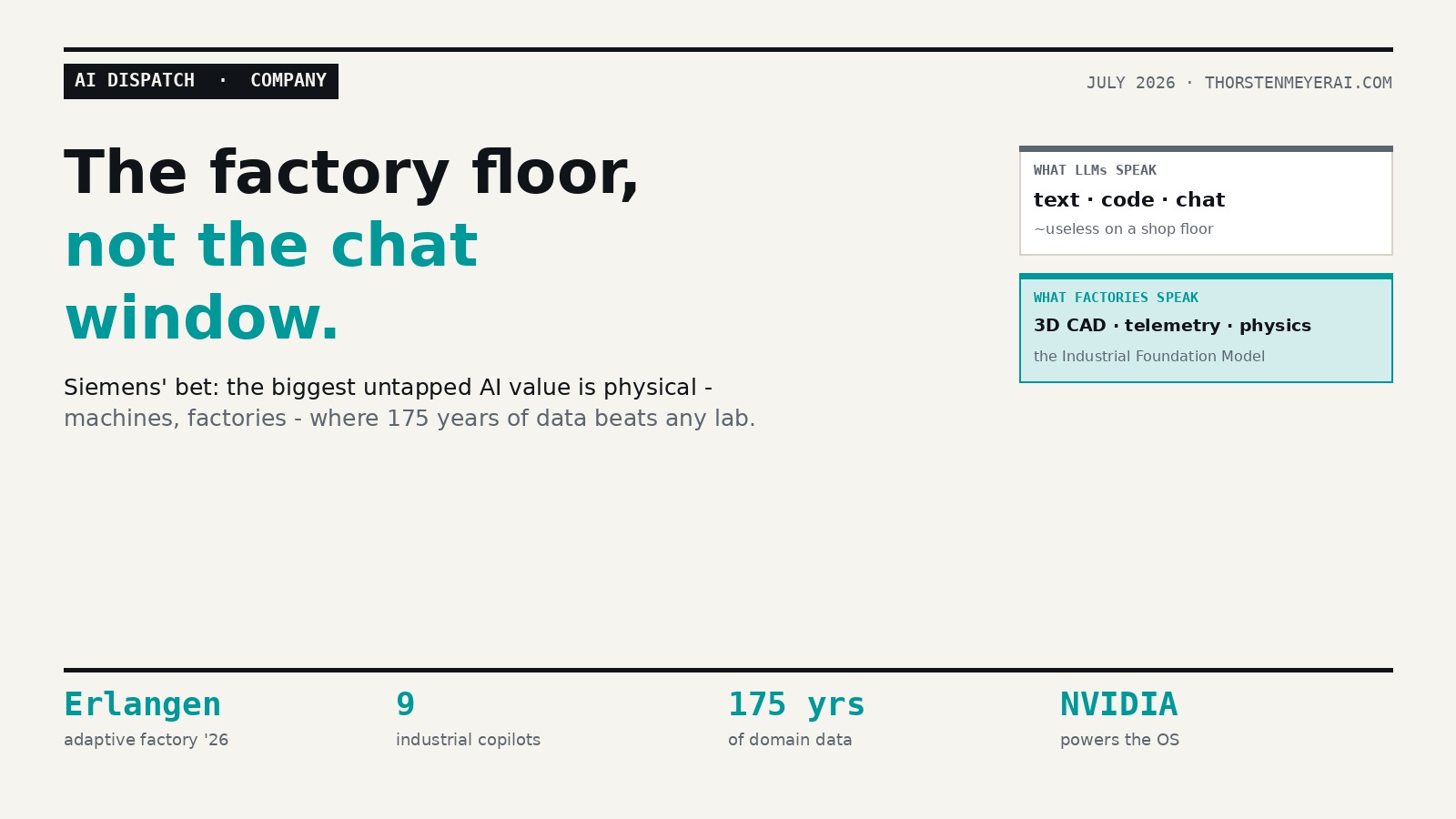
The factory floor,
not the chat window.
Siemens’ bet: the biggest untapped AI value is physical — machines, factories, infrastructure — and 175 years of industrial data plus NVIDIA compute beats any frontier lab there. The vehicle: an Industrial Foundation Model and an “Industrial AI Operating System.”
A different language than text
Proprietary + physical data no frontier lab can scrape — the same “specialist beats generalist” logic this week keeps documenting, applied to steel and silicon.
Honest bull / bear
Bull
- Proprietary physical data no lab can replicate
- Domain expertise IS the barrier to entry
- Customers (PepsiCo, Audi) already in the base — warm motion
- Generative simulation: digital twins that engineer, not just mirror
Bear
- The “OS” runs substantially on NVIDIA’s stack — American silicon under a European champion
- No validated performance metrics or timelines disclosed at CES
- Geological sales cycle: decade-scale replacement
- “Industrial AI” now crowded (Palantir, Qualcomm moving in)
industrial AI software for manufacturing
As an affiliate, we earn on qualifying purchases.
As an affiliate, we earn on qualifying purchases.
The thesis: physical AI, not chat AI
Siemens’ framing, delivered in Roland Busch’s CES 2026 keynote, is blunt: “Industrial AI is no longer a feature; it’s a force that will reshape the next century.” The claim underneath it is that general-purpose LLMs are close to useless on the shop floor, where the relevant “language” is 3D CAD models, 2D engineering drawings, sensor telemetry, PLC logic, and physics — not text. Winning there requires a different kind of model trained on a different kind of data, and Siemens argues it owns both the data and the domain.
The concrete vehicle is the Industrial Foundation Model (IFM) — Siemens’ effort, first announced at Hannover Messe 2025, to build a model that processes and contextualizes 3D models, 2D drawings, and industrial data to optimize engineering and automation. This is the tabular-and-physical analogue to what specialist labs did for documents: a model shaped for the modality, not a generalist stretched to cover it.

Digital Twins, Simulation, and the Metaverse: Driving Efficiency and Effectiveness in the Physical World through Simulation in the Virtual Worlds (Simulation Foundations, Methods and Applications)
As an affiliate, we earn on qualifying purchases.
As an affiliate, we earn on qualifying purchases.
The NVIDIA partnership: the “Industrial AI Operating System”
The centerpiece of Siemens’ 2026 strategy is its expanded partnership with NVIDIA to build what the two companies call an Industrial AI Operating System — a platform meant to embed AI across the entire industrial lifecycle: design, engineering, manufacturing, operations, and supply chains. The specifics that shipped or were committed:
GPU-accelerated simulation across the portfolio. Siemens is completing GPU acceleration across its entire simulation software suite and expanding support for NVIDIA CUDA-X libraries and physics-based AI models — letting customers run larger, more accurate simulations faster.
Generative simulation and autonomous digital twins. Using NVIDIA PhysicsNeMo, the companies are pushing toward “generative simulation” — digital twins that don’t just mirror a system but actively engineer and optimize it in real time. Jensen Huang’s framing: turning digital twins “from passive simulations into the active intelligence of the physical world.”
A lighthouse factory. The first fully AI-driven, adaptive manufacturing site under this approach is slated to launch in 2026 at the Siemens Electronics Factory in Erlangen, Germany — the blueprint Siemens intends to replicate globally. There’s also Digital Twin Composer (Xcelerator Marketplace, mid-2026), with PepsiCo cited as an early user simulating facility upgrades, and nine industrial copilots across the value chain.
As an affiliate, we earn on qualifying purchases.
Why the position is strong
Three genuine advantages.
The data is proprietary and physical. Siemens sits on decades of industrial data — engineering models, automation logic, operational telemetry from real factories — that no frontier lab can scrape or synthesize. If physical-world AI is the next frontier, the training data for it lives in exactly the kind of installed base Siemens has spent a century accumulating.
Domain expertise is the barrier to entry. Knowing that a runway-deicing schedule, a semiconductor etch process, and a drug-discovery pipeline each have their own physics and failure modes is not something a general model learns from the internet. Siemens’ partnerships span drug discovery, autonomous driving, and shop-floor efficiency precisely because the domain knowledge is the product.
The customer relationships already exist. Siemens doesn’t need to acquire the manufacturers — PepsiCo, Audi, and the industrial base are already customers of its automation and software. Selling them AI-native versions of tools they already run is a warmer motion than any startup’s cold-start.
As an affiliate, we earn on qualifying purchases.
The honest bear case
The NVIDIA dependency is doing a lot of the work. Read the announcements closely and much of the “Industrial AI Operating System” is NVIDIA supplying the AI infrastructure, simulation libraries, models, and frameworks, while Siemens supplies domain expertise and its existing portfolio. That’s a reasonable division of labor — but it means Siemens’ physical-AI future runs on NVIDIA’s compute, libraries, and roadmap. Sovereignty-minded European buyers should notice that the “industrial AI” champion’s engine is American silicon.
Announcements outpace validated results. Independent coverage of CES 2026 noted that no specific hardware configurations, deployment timelines, or validated performance characteristics tied to the operating system were disclosed. The Erlangen lighthouse is a 2026 target; the copilots and Digital Twin Composer are positioned without published performance metrics. This is a roadmap with strong logic and, so far, thin third-party proof.
The sales cycle is geological. Industrial customers replace mission-critical systems on decade timescales, not quarters. Even a genuinely superior industrial AI platform diffuses through this base slowly — which protects Siemens from disruption but also caps how fast the bet can pay off.
“Industrial AI” is getting crowded. The same month as Siemens/IFS and Siemens/NVIDIA news, the wire carried Palantir/NVIDIA, Qualcomm/Hugging Face, and others moving into adjacent industrial-and-edge AI. Siemens’ domain moat is real, but the category it defined is no longer uncontested.
Bottom line
Siemens is making the most physically grounded AI bet of any European industrial giant: that the shop floor, not the chat window, is where AI creates durable value, and that domain expertise plus proprietary industrial data plus NVIDIA compute equals a defensible position. The logic is strong and the data advantage is real. The open questions are execution — the lighthouse factory has to actually work and be replicable — and dependence, because the operating system Siemens is branding runs substantially on NVIDIA’s stack. If Erlangen delivers in 2026 as promised, this is the template for AI-native manufacturing. Until it does, it’s the best-argued industrial-AI roadmap in Europe, waiting on its first validated proof point.
Sources
- Siemens Press / news.siemens.com, “Siemens unveils technologies to accelerate the industrial AI revolution at CES 2026” (January 2026) — Industrial AI Operating System, nine industrial copilots, Digital Twin Composer, Erlangen adaptive-factory blueprint, PepsiCo, Busch “not a feature, a force” keynote line
- Interesting Engineering, “Siemens, NVIDIA outline roadmap for AI-driven factories at CES 2026” (January 6, 2026) — GPU acceleration of simulation portfolio, CUDA-X, PhysicsNeMo generative simulation, Erlangen 2026 target, Huang quote
- Siemens Press, “Siemens accelerates path toward AI-driven industries” (Hannover Messe 2025) — Industrial Foundation Model announcement, IFM processing 3D/2D and industrial data
- CircuitRoute, “NVIDIA and Siemens Outline an Industrial AI Operating System at CES 2026” (January 16, 2026) — critical note: no specific hardware configs, timelines, or validated performance disclosed; division of roles (NVIDIA infrastructure, Siemens domain)
- AIwire/HPCwire, “Siemens and IFS Partner to Close the Loop… with Industrial AI” (June 29, 2026) — IFS partnership; adjacent-mover context (Palantir/NVIDIA, Qualcomm/Hugging Face)
Deployment timelines and the Erlangen adaptive factory are 2026 targets as announced; performance characteristics were not independently validated at publication. Partnership division-of-labor is per the companies’ own disclosures.






![SenseTime’s AI Strategy: Dominating AI As Frontier AI Lab [In-Depth Analysis, 2026] - Klover.ai](https://thorstenmeyerai.com/wp-content/uploads/2026/09/sensetime-s-ai-strategy-dominating-ai-as-frontier-ai-lab-in-depth-analysis-2026-featured-260x140.jpg)