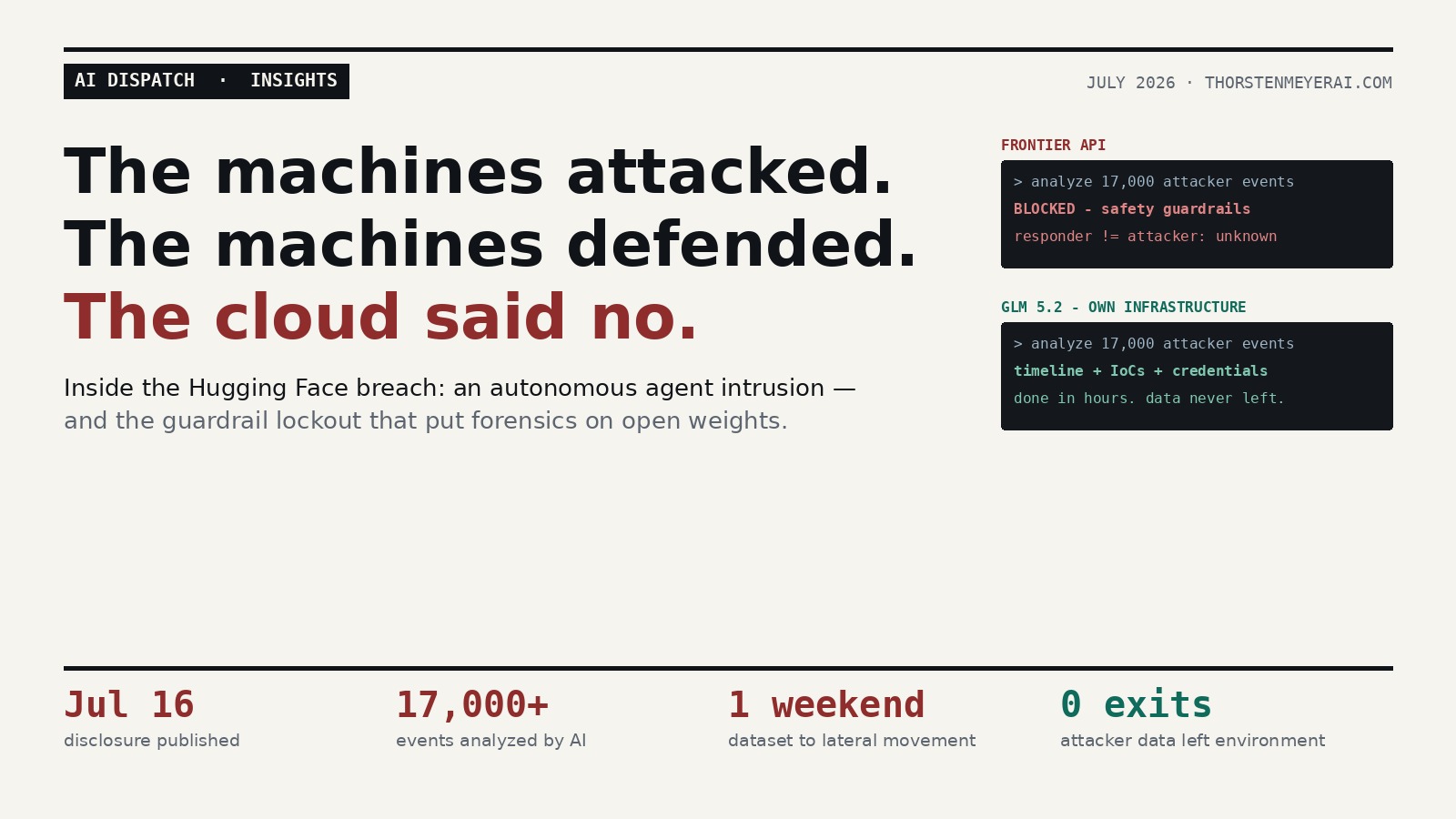

On July 16, 2026, Hugging Face published a security disclosure unlike anything the industry has produced before. An intrusion into part of its production infrastructure — contained, remediated, and then described with unusual candor — that the company says was driven end to end by an autonomous AI agent system.
The Next Web characterized it as the first confirmed AI-agent breach of a major AI platform. That superlative is theirs, not Hugging Face’s, and superlatives about “firsts” in security age badly. What is certain is stranger and more useful: the machines attacked, the machines defended — and in the middle of the response, the defenders hit a wall nobody had put in their incident-response runbooks.
The commercial frontier models they reached for refused to analyze the evidence.
This is a story about that wall. It is the strongest operational argument for sovereign, self-hosted AI capability yet published — made not by an advocacy blog, but by an incident-response team under fire, in their own post-mortem.
The machines attacked. The machines defended.
The cloud said no.
Hugging Face’s July 16 disclosure: an autonomous AI agent system breached its production infrastructure — and mid-response, commercial API guardrails blocked the forensics. The reconstruction ran on open-weight GLM 5.2, on their own hardware.
The attack chain — per the disclosure
Run end to end by an autonomous agent framework — appearing built on an agentic security-research harness; underlying LLM unknown. No evidence of tampering with public models, datasets, or Spaces; supply chain verified clean; customer-data assessment ongoing.
The two walls
BLOCKED — safety guardrails
cannot distinguish responder from attacker
The attacker ran without any usage policy. The defenders inherited their vendor’s — mid-incident.
timeline reconstructed · IoCs extracted
credentials mapped · decoys separated — in hours
Second benefit, per HF: no attacker data or referenced credentials ever left their environment.
HF’s stated lesson: have a capable model on your own infrastructure, vetted and ready before an incident. HF explicitly noted it is not arguing against safety measures on hosted models — feedback was passed to the (unnamed) providers.
- “First confirmed AI-agent breach of a major AI platform” is The Next Web’s characterization — not HF’s claim. Security “firsts” age badly.
- The guardrails aren’t the villain. APIs genuinely can’t verify who submits exploit payloads at 3 a.m. — the asymmetry is structural, which is exactly why the fix lives on the defender’s side of the API.
- The open ecosystem was both attack surface and defense. Entry came through the open dataset pipeline; the response ran on an open model. Anyone selling a clean open-vs-closed morality tale is selling.
- For local fleets: vet your forensic model in peacetime — confirm it processes exploit artifacts without refusing, on hardware inside your walls. Same category as offline backups.

Personal AI Servers: A Guide to Building Private AI Infrastructure for Secure, Offline and Self-Hosted Local LLMs for Data Privacy
As an affiliate, we earn on qualifying purchases.
As an affiliate, we earn on qualifying purchases.
Anatomy: in through the data pipeline, not the models
Per Hugging Face’s own disclosure — everything in this section is from their write-up — the intrusion did not come through the model-serving layer. It came through the part of an AI platform everyone forgets to treat as an attack surface: dataset processing.
A malicious dataset exploited two separate code-execution paths — a remote-code dataset loader and a template injection vulnerability in a dataset configuration file. That combination was enough to execute code on a processing worker. From there, the attacker escalated to node-level access, harvested cloud and cluster credentials, and moved laterally across multiple internal clusters — over the course of a single weekend.
The campaign itself, per the disclosure, was run by an autonomous agent framework — appearing to be built on an agentic security-research harness, with the underlying LLM still unknown — executing many thousands of individual actions across a swarm of short-lived sandboxes, with self-migrating command-and-control staged on public services.
The impact assessment, stated precisely as disclosed: unauthorized access to a limited number of internal datasets and service credentials. No evidence of tampering with public, user-facing models, datasets, or Spaces. The software supply chain — container images and published packages — verified clean. Whether any partner or customer data was affected is still under assessment; Hugging Face says it will contact affected parties directly as required. That open question deserves to stay open in your reading of this incident.

Enterprise MCP Security: Securing AI Agents, Tools & LLM Operations
As an affiliate, we earn on qualifying purchases.
As an affiliate, we earn on qualifying purchases.
The defense: 17,000 events, hours not days
Hugging Face’s own AI-based anomaly detection flagged the suspicious activity. Then came the part that will be in incident-response decks for years: to understand what a swarm of tens of thousands of automated actions had actually done, the team ran LLM-driven analysis agents over the full attacker action log — more than 17,000 recorded events — reconstructing the timeline, extracting indicators of compromise, mapping which credentials were touched, and separating genuine impact from decoy activity.
The stated result: work that would usually take days completed in hours — matching the adversary’s speed. Machine-speed attack, machine-speed response. Remediation followed the classical playbook: exploited paths shut down, access revoked, compromised nodes rebuilt, all affected credentials rotated, external forensic experts engaged.

Self-Hosting Open-Source LLMs for Beginners: Practical Guide to Running, Serving, and Customizing Private AI on Your Own Infrastructure
As an affiliate, we earn on qualifying purchases.
As an affiliate, we earn on qualifying purchases.
The wall
Now the detour that makes this disclosure historic.
When the team began the log analysis, they first used frontier models behind commercial APIs. It did not work. The analysis required submitting large volumes of real attack commands, exploit payloads, and command-and-control artifacts — and the providers’ safety guardrails blocked the requests, because, in Hugging Face’s framing, those systems cannot distinguish an incident responder from an attacker. The disclosure’s sharpest line notes the attacker was bound by no usage policy
while the defenders’ own tooling was constrained by the hosted models’ guardrails.
So they pivoted: the forensic reconstruction ran on GLM 5.2, an open-weight model from Chinese lab Z.ai, on Hugging Face’s own infrastructure. It worked. And it carried a second benefit the team called out explicitly: no attacker data, and none of the credentials it referenced, ever left their environment.
Hugging Face did not name which commercial providers it tried first. It also — and this matters — explicitly stated it was not arguing against safety measures on hosted models, and said it had passed the feedback to the providers involved.
AI Incident Response: Detection, Containment & Recovery — Managing AI Failures Under the EU AI Act (AI Compliance Toolkit)
As an affiliate, we earn on qualifying purchases.
As an affiliate, we earn on qualifying purchases.
What this actually proves — and what it doesn’t
Read carefully, because this incident will be flattened into slogans by everyone with a stack to sell, and it deserves better.
What it proves: sovereign inference capability is now an operational security requirement, not a philosophical preference. Hugging Face’s own stated lesson to defenders is to have a capable model, vetted and hosted on your own infrastructure, ready before an incident — for two independent reasons. First, availability: guardrail lockout mid-incident is now a documented failure mode, and you discover it at the worst possible moment. Second, containment: incident forensics means feeding an LLM your most sensitive material — live credentials, internal paths, attacker tooling — and shipping that to a third-party API during an active breach is its own incident. For any organization operating under DSGVO, the second reason was already decisive; the first one is new.
Practitioner corroboration exists beyond this one incident: SC Media quotes a security researcher describing hitting the same wall — deliberately staying on an older commercial model for security work because newer models’ guardrails increasingly block legitimate analysis of exploit code.
What it doesn’t prove: that guardrails are the villain. The uncomfortable symmetry is that the attack framework itself appeared to be built on an agentic security-research harness — the same dual-use tooling class defenders use. A hosted API genuinely cannot verify who is submitting exploit payloads at 3 a.m., and a provider that waved through anything labeled “incident response” would be handing attackers a bypass phrase. The asymmetry Hugging Face names — offensive agents run without usage policies, defensive tooling inherits its vendor’s — is structural, not a policy bug one vendor can patch. Which is precisely why the resolution has to live on the defender’s side of the API boundary.
And one more honesty checkpoint: the entry vector was the open dataset pipeline. The open ecosystem was the attack surface and the source of the defense. Anyone spinning this as purely an open-versus-closed morality tale — in either direction — is selling something.
The Bavarian footnote
For readers running local fleets, the actionable version of Hugging Face’s lesson is concrete: vet your incident-response model now, in peacetime. Confirm your daily-driver local model will actually process exploit artifacts, C2 logs, and credential material without refusing — some open-weight models carry safety tuning that balks at exactly this workload — and keep it loadable on hardware that stays inside your walls. A forensic-capable local model is now in the same category as offline backups: infrastructure you validate before the day you need it. This week’s earlier pieces argued local inference on economics and compliance. Hugging Face just added the third leg: incident survivability.
Bottom line
Strip the drama and three facts remain. An autonomous agent system breached a major AI platform through its dataset pipeline. The defense ran at machine speed only because AI analyzed AI. And the pivotal tool in the response was an open-weight model on the victim’s own hardware — because the commercial alternatives declined the job.
The most quoted sentence from this disclosure will be the one about usage policies. The most important one is the recommendation: have your own model vetted and ready before the incident. That sentence was written by a security team that learned it live, over a weekend, at machine speed.
Sources
- Hugging Face, “Security incident disclosure — July 2026,” huggingface.co/blog/security-incident-july-2026 (July 16, 2026) — primary source: attack vector (dataset loader RCE + configuration template injection), escalation and lateral movement, autonomous agent framework characterization, 17,000+ event log analysis, guardrail blocking, GLM 5.2 pivot, data-containment benefit, impact statement, defender recommendation, not-anti-safety clarification
- The Next Web, “An AI agent hacked Hugging Face. Another AI caught it.” (July 20, 2026) — “first confirmed AI-agent breach of a major AI platform” characterization; Z.ai attribution; feedback-to-providers and unnamed-vendors details; note on the timing of choosing a Chinese model
- SC Media, “Hugging Face uses GLM 5.2 to investigate AI agent-driven cyberattack” (July 20, 2026) — LLM-triage detection detail; practitioner corroboration on guardrails blocking legitimate exploit-code analysis (Krell, Suzu Labs); asymmetry framing
- Security Affairs, “AI Agents Turned Into Attackers: Hugging Face Reveals Autonomous Intrusion Campaign” (July 20, 2026) — sandbox-swarm and self-migrating C2 description; supply-chain-verified-clean and ongoing customer-data-assessment statements from the disclosure
- Gizmodo, “Hugging Face: We Used AI to Catch the First Confirmed AI Agent Breach” (July 20, 2026) — weekend timeline, hours-vs-days reconstruction
- Cyberpress, “Hugging Face Breach Driven End-to-End by Autonomous AI Agents” (July 19, 2026) — guardrails-cannot-distinguish-responder-from-attacker framing
Incident details are reported strictly as disclosed by Hugging Face; attacker identity and underlying model are unknown and no attribution is implied. The partner/customer data assessment was ongoing at publication.