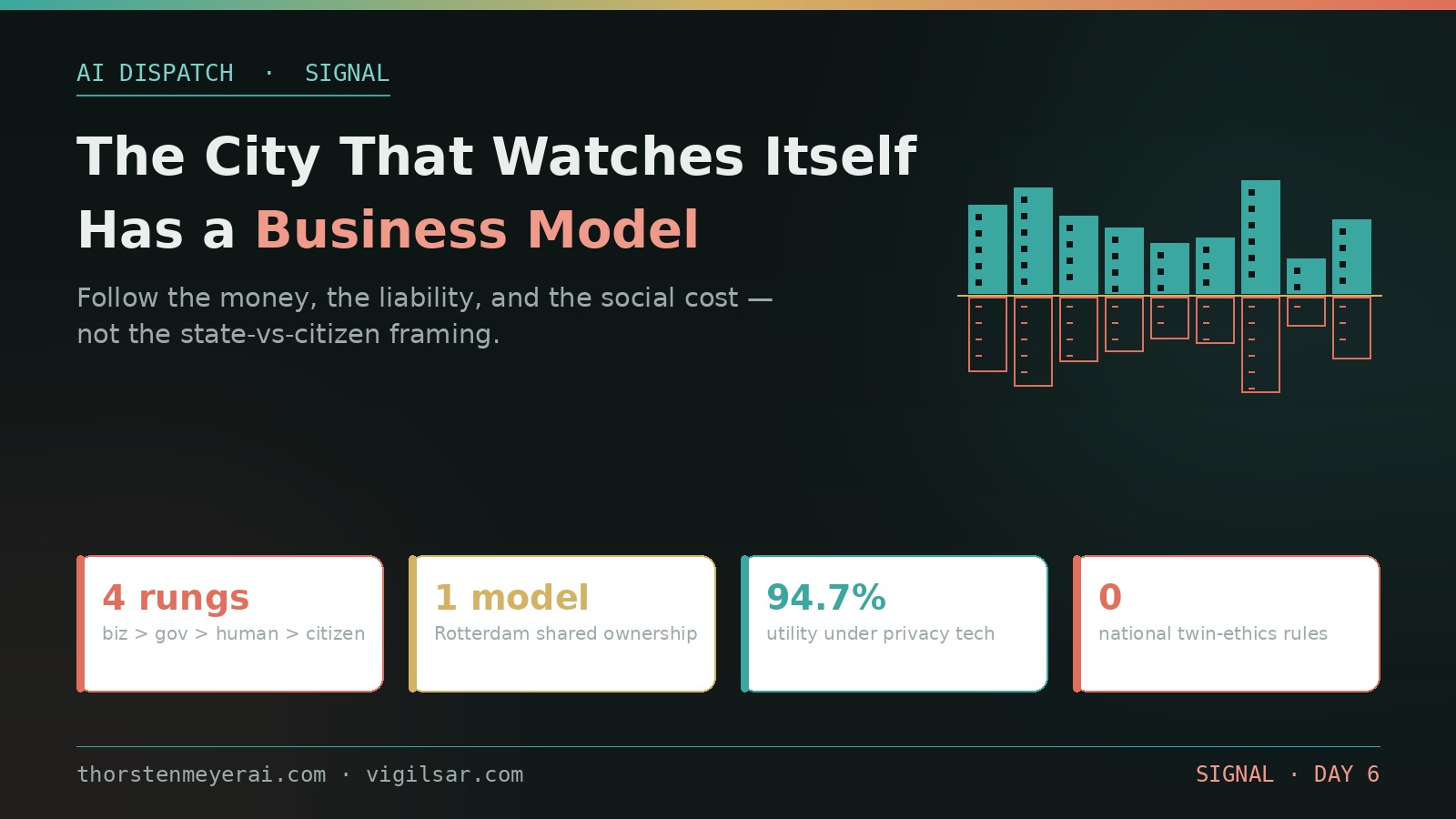

The digital-twin surveillance debate is usually staged as state versus citizen: the watching government, the watched public. That framing misses where the money flows, who carries the liability, and how the social costs actually arrive. Follow those three threads instead, and the governance problem looks different — and more tractable.
Quick grounding for new readers: a living urban digital twin is a continuously-updated virtual replica of a city, fed by sensors, mobility data, satellite and aerial imagery. I covered the technology arc in “The City That Watches Itself” — this Signal is about who profits, who’s exposed, and who pays socially.
The City That Watches Itself Has a Business Model —
That’s the Governance Problem
Same-day-verified · follow the money, the liability, and the social cost — not the state-vs-citizen framing
Three layers the privacy headlines skip
- Lock-in is the quiet scandal: once planning, flood response & traffic run through one vendor’s replica, exit costs are civilizational-grade
- Real service economy downstream: architects speed compliance, developers expedite approvals
- Counter-model: Rotterdam’s shared ownership — twin as governed infrastructure, not licensed product
- You’re in the twin whether you signed or not: logistics, energy signatures, employee movements become someone else’s data layer
- Unsettled GDPR joint-controller questions; Barcelona already criticized for opaque citizen-data processing
- Upside: compliance-grade twin infrastructure as a European market position — jurisdiction as feature
- Chilling effects on assembly & expression; algorithmic mediation can automate inequality into planning
- Function creep is the mechanism: drainage model → crowd model → protest model — each an upgrade ticket, not a political decision
- Contestability erodes: you can argue with a planning officer, not with a simulation’s false objectivity
The ladder nobody voted on — Gartner hype-cycle history
STEELMAN: BUILD THE TWINS ANYWAY
Refusing has social costs too: flood twins demonstrably cut emergency costs, traffic twins cut emissions and improve ambulance access. The honest position isn’t twin-or-no-twin — it’s that the same replica serves radically different ends depending on governance.
Watch three indicators, not the headlines: does Rotterdam-style shared ownership spread; does purpose limitation get enforcement teeth; do enterprises demand contractual standing in the twins that ingest them. Those three decide whether the city that watches itself answers to anyone.

Geodesign, Urban Digital Twins, and Futures
As an affiliate, we earn on qualifying purchases.
As an affiliate, we earn on qualifying purchases.
The business layer: lock-in is the quiet scandal
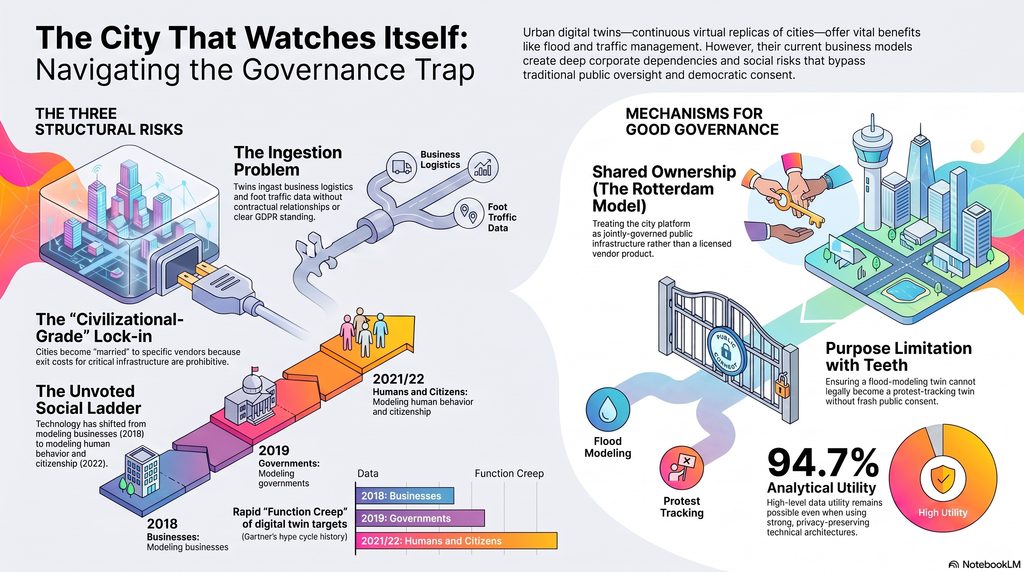
Urban twins are not bought like software; they’re married like infrastructure. The academic governance literature has warned for a decade that pervasive digital platforms cement corporate dependency on a monopoly that cannot easily be undone — and city twins are the purest case yet: once a municipality’s planning, flood response, and traffic control run through one vendor’s replica, the exit costs are civilizational-grade. The commercial winners are the platform vendors, and downstream, a whole service economy — architects already use twins to speed planning compliance, property developers use model-based submissions to expedite building approvals. Real value, real revenue — and a procurement structure where the vendor’s leverage compounds annually.
The counter-model worth watching is Rotterdam, which is developing a shared ownership structure for its core city platform rather than a classic vendor relationship. If that works, it’s the template: the twin as jointly-governed public infrastructure instead of a licensed product. If it doesn’t, expect a decade of cities negotiating with their own nervous systems.

Industrial Sensor Systems: Environmental Monitoring Sensors | Industrial Data Collection | Smart City Sensor Systems | IoT Smart Devices | Sensor Data Analytics | Sustainable Sensor Technologies
As an affiliate, we earn on qualifying purchases.
As an affiliate, we earn on qualifying purchases.
The enterprise layer: you’re in the twin whether you signed or not
Here’s the exposure most companies haven’t priced: a city twin ingests your business. Your logistics flows, your facility’s energy signature, your customers’ foot traffic, your fleet’s movements — all of it becomes someone else’s operational data layer, often without any contractual relationship between you and the twin operator. Under European law that raises genuinely unsettled questions: when municipal mobility data identifiably includes your delivery patterns or your employees’ movements, who is the controller, and where does GDPR joint-responsibility land? Barcelona’s twin initiative has already drawn criticism for opaque processing and storage of citizen data — and researchers note bluntly that privacy-by-design in operational twin platforms remains “superficial or ad hoc,” with no national-level standardization of how consent and ethics enter twin governance anywhere.
There’s an upside column too. Privacy-preserving twin architectures — differential privacy, secure multi-party computation — are maturing; one recent implementation study reports retaining roughly 94.7% of analytical utility under strong privacy guarantees (a single study, so treat the precise figure as indicative). For European vendors, that’s a familiar playbook: compliance-grade twin infrastructure as a market position, the same jurisdiction-as-feature logic this week’s dispatches keep finding — and the reason my own exploitation-stack work ships with custody editions rather than one cloud.

Protecting Your Privacy in a Data-Driven World (ASA-CRC Series on Statistical Reasoning in Science and Society)
As an affiliate, we earn on qualifying purchases.
As an affiliate, we earn on qualifying purchases.
The social layer: the ladder nobody voted on
The clearest way to see the societal trajectory is Gartner’s own hype-cycle history: digital twins of business (2018), of government (2019), of a human (2021), of a citizen (2022). That’s a ladder, and each rung was climbed for locally sensible reasons — flood modeling here, traffic optimization there — without anyone deciding, as a polity, that the destination was a persistent behavioral replica of the population.
The ethics literature names the costs precisely: chilling effects on assembly and expression when tracking integrates with the twin; algorithmic mediation that can automate existing inequalities into planning decisions; and the erosion of contestability — you can argue with a planning officer, but a simulation’s output arrives with false objectivity. Function creep is the mechanism throughout: the drainage model becomes the crowd model becomes the protest model, each step an upgrade ticket rather than a political decision. And this week’s context makes the dual-use point unavoidable: the exploitation technology that reads a city twin and the technology that reads a WAMI feed are cousins. Anyone building in this space — I am — owes the debate that acknowledgment.
The steelman for building twins anyway is strong, and refusing it has social costs of its own: neighborhood-scale flood twins demonstrably cut emergency response costs; traffic twins reduce emissions and improve ambulance access. A city that declines these tools pays in floods and fumes. The honest position isn’t twin-or-no-twin; it’s that the same replica serves radically different ends depending on governance.
Smart as a City: The Politics of Test-Bed Urbanism
As an affiliate, we earn on qualifying purchases.
As an affiliate, we earn on qualifying purchases.
What good governance would actually take
Three mechanisms, all boring, all decisive: purpose limitation with teeth (the flood twin may not become the crowd twin without a fresh public decision), ownership structures with an exit (Rotterdam’s shared model over vendor licensing), and a public register of what the twin ingests — because you cannot contest a data layer you cannot see. None of this requires new technology. All of it requires deciding before the lock-in compounds.
The signal, compressed
Watch three indicators, not the privacy headlines: whether Rotterdam-style shared ownership spreads or dies; whether any jurisdiction gives purpose limitation enforcement teeth; and whether enterprises start demanding contractual standing in the twins that ingest them. Those three will determine whether the city that watches itself answers to anyone.
Sources: ScienceDirect smart-city digital-twin review (Barcelona criticism, standardization gap, Dec 2025); Cambridge Data & Policy on smart-city governance and corporate lock-in; Springer Nature on urban twin governance (Rotterdam model, Gartner hype-cycle history); sustainability-directory ethics scenarios (chilling effects, algorithmic mediation); privacy-preserving twin implementation study via ResearchGate (utility figure, single study); prior dispatch: “The City That Watches Itself” at thorstenmeyerai.com.