
A 3-billion-parameter model — 500 million active — that parses an entire multi-page document in a single forward pass, inside a standard 32K context window, on your own hardware, under an MIT license.
That is a real engineering result, and it deserves attention.
But the viral framing — “China just killed the OCR business” — is doing what viral framing does. The download figures circulating are wrong. The “state of the art” claim is only true against one specific baseline. And the most interesting comparison isn’t Unlimited-OCR versus the cloud giants — it’s Unlimited-OCR versus Baidu’s own other OCR model, which scores higher on the same benchmark.
This is a Reality Check. We’ll go through what shipped, what the numbers actually say, where it beats Mistral, Azure, Google, and Gemini — and where self-hosting is the wrong call, because sometimes it is.
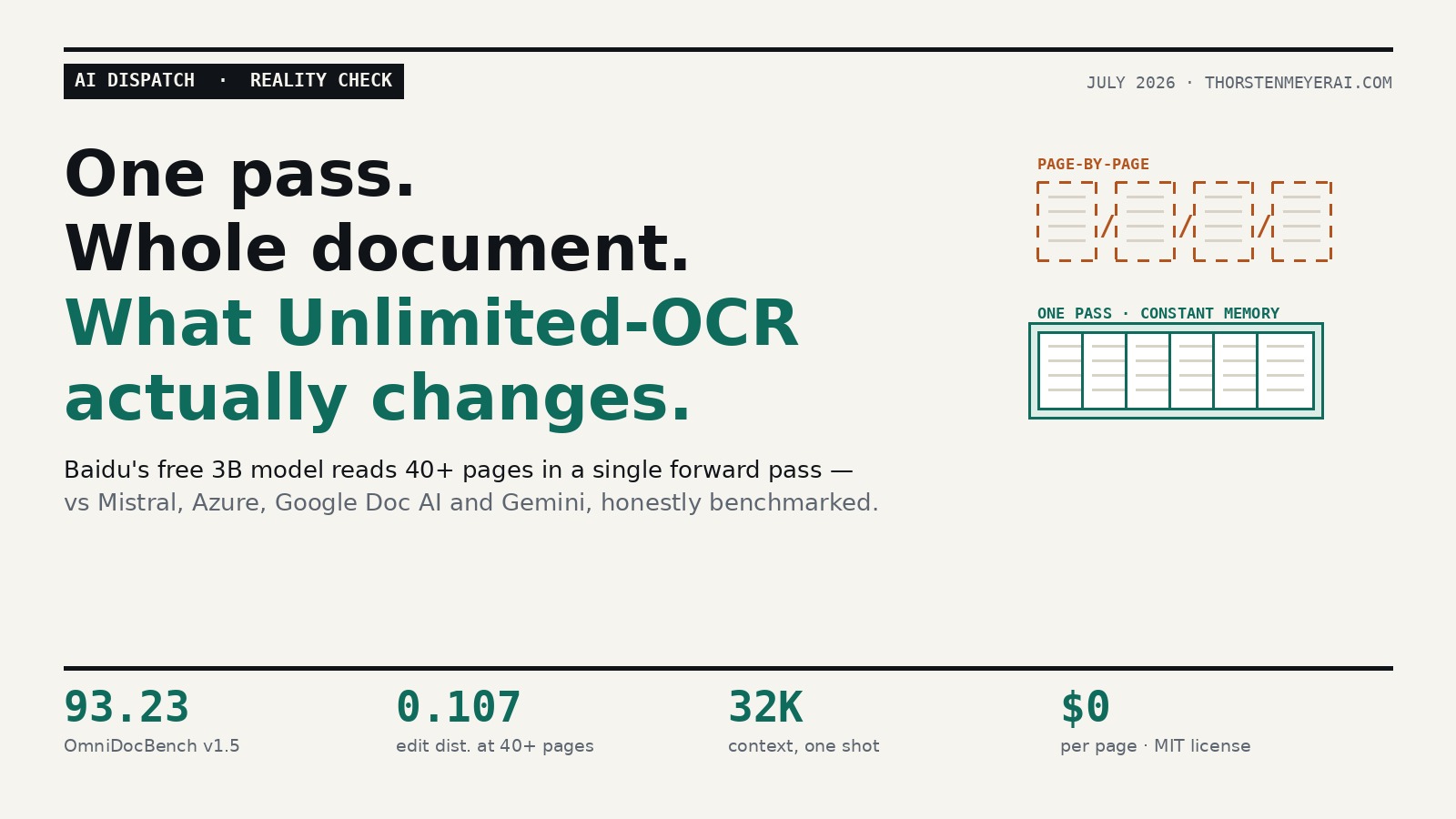
One pass. Whole document.
What Unlimited-OCR actually changes.
Baidu’s MIT-licensed 3B model (0.5B active) parses 40+ pages in a single forward pass inside a 32K context. The breakthrough is memory architecture — not peak accuracy, and not the download numbers going around.
Split → OCR each page → stitch. Cross-page tables break. References die. KV cache grows every token.
One forward pass, constant KV cache, flat latency. “Soft forgetting” via a sliding window over its own output.
OmniDocBench v1.5 — where it really sits
Cost at 1M pages / month (plain OCR tier)
| Option | List price / 1K pages | Monthly | What you’re buying |
|---|---|---|---|
| AWS Textract (forms) | $65.00 | $65,000 | Forms + tables extraction |
| Azure prebuilt / Google prebuilt | $10.00 | $10,000 | Typed fields, schemas, SLA |
| Mistral OCR 4 (batch) | $2.00 | $2,000 | Bounding boxes, confidence, self-host option |
| Azure Read | $1.50 | $1,500 | Plain OCR, MS ecosystem |
| Google Doc AI Read | $0.65 | $650 | Plain OCR, GCP ecosystem |
| Unlimited-OCR, local | $0 + watts | hardware amort. | Markdown out, DSGVO-clean, zero data transfer |
List prices, June 2026 (Parsli, AI Productivity, Mistral). Real cloud bills run 25–35% above list once storage + orchestration land. Local wins on cost only above meaningful volume.
- “1.9M+ downloads”: the Hugging Face model card showed ~8,400 downloads/month in late July 2026. Popular, yes. 1.9M, no.
- “SOTA”: only vs its own DeepSeek-OCR baseline. Baidu’s own 0.9B PaddleOCR-VL 1.5 (94.5) and GLM-OCR (94.6) score higher — page-by-page.
- “Unlimited”: it’s a 32K context with a sliding output window. Book-length inputs still get chunked. Brand name, not spec sheet.
- “Killed the OCR business”: it outputs markdown. No key-value extraction, no bounding boxes, no SLA. Cloud APIs sell those, not OCR.
- Apple Silicon: reference tooling is CUDA-first. GGUF quants exist, but verify one-shot multi-page mode survives the llama.cpp port before building on it.
Bull — self-host when
Volume >100K pages/mo · documents you cannot send to a US cloud (DSGVO, legal, medical, due diligence) · long documents where cross-page tables and references matter. Then the one-shot pass is a quality edge no page-splitting pipeline matches.
Bear — pay the API when
You need structured JSON, not markdown · volume is low ($20/mo beats a week of engineering) · inputs are crumpled phone photos (DeepSeek-family models drop to the low 70s on degraded scans) · someone must be contractually accountable.
As an affiliate, we earn on qualifying purchases.
What actually shipped
Baidu open-sourced Unlimited-OCR on June 22, 2026, with the technical report (“Unlimited OCR Works,” arXiv:2606.23050) following on June 23. The model card is live on Hugging Face under baidu/Unlimited-OCR, MIT-licensed, with support for Transformers, vLLM, SGLang, and Docker, plus community GGUF quantizations for llama.cpp, Ollama, and LM Studio.
The architecture is candid about its lineage. Unlimited-OCR starts from DeepSeek-OCR — it keeps DeepSeek’s DeepEncoder (a SAM-ViT cascaded with CLIP-ViT, compressing a 1024×1024 page to roughly 256 visual tokens at ~16× compression) and swaps every attention layer in the decoder for a new mechanism called Reference Sliding Window Attention (R-SWA). Reporting around the release notes the fine-tune ran only about 4,000 steps on top of the DeepSeek-OCR base. The acknowledgements section thanks DeepSeek-OCR, DeepSeek-OCR-2, and PaddleOCR by name.
That lineage matters for the “China killed OCR” narrative: this is less a moonshot than a surgical architectural fix applied to an existing open model — which is arguably more impressive, and definitely more reproducible.
As an affiliate, we earn on qualifying purchases.
The actual breakthrough: constant memory, not higher accuracy
Every decoder-based OCR model has the same problem: the KV cache grows linearly with output length. Transcribe a long document and the model gets slower with every token, memory climbs until it hits the wall, and the standard workaround is the one every production pipeline uses today — split the PDF into pages, OCR each page independently, stitch the results back together. Page-by-page amnesia. Tables that span pages break. Cross-references die. Reading order across page boundaries is guesswork.
R-SWA replaces linear cache growth with a constant-size cache — the paper describes it as mimicking the “soft forgetting” of a human copyist: full attention over the visual reference (the page images), a sliding window over the text already produced. The result:
- Latency stays flat as output grows, where DeepSeek-OCR’s per-step latency climbs linearly.
- GPU memory stays fixed, where the baseline grows without bound.
- Dozens of pages parse in one true forward pass — no external scheduler, no loop, no page splitting — within a standard 32K context.
On throughput, the paper reports 5,580 tokens/second on OmniDocBench versus DeepSeek-OCR’s 4,951 (+12.7%), with the gap widening at longer outputs — coverage of the release cites roughly 35% faster at long output lengths, and ~7,847 TPS at 6,144-token outputs.
As an affiliate, we earn on qualifying purchases.
The numbers, dated and sourced
All figures below are from the June 2026 technical report and contemporaneous coverage; OmniDocBench is the de-facto standard end-to-end document parsing benchmark (text edit distance, formula CDM, table TEDS, reading order).
Against its own baseline (DeepSeek-OCR):
On OmniDocBench v1.5, Unlimited-OCR scores 93.23 overall versus DeepSeek-OCR’s 87.01 — the “+6 points” in the viral posts, and that part checks out. Text edit distance drops from 0.073 to 0.038, formula CDM rises from 83.37 to 92.61, table TEDS from 84.97 to 90.93. On the newer v1.6 (296 more test images), it scores 93.92, which the authors position as top of the end-to-end rankings at release.
On long documents — the headline capability:
On the authors’ in-house long-horizon test set (novels, documents, papers, bucketed at 2/5/10/20/40+ pages, ≥10 books per bucket): 20-page documents parsed in a single pass hit an edit distance of 0.0572; even at 40+ pages the edit distance stays at 0.1069 with 96.90% Distinct-35 (a repetition metric). That’s the “error rate below 0.11 after 40 pages” claim — accurate, with the caveat that it’s an in-house test set, not an independent leaderboard.
What the viral posts leave out:
Unlimited-OCR is not the highest-scoring open OCR model on OmniDocBench v1.5. Baidu’s own PaddleOCR-VL 1.5 — a 0.9B model — reports 94.5, and Zhipu’s GLM-OCR reports 94.62, both above Unlimited-OCR’s 93.23. Those two evaluate page-by-page; Unlimited-OCR’s edge is the one-shot multi-page pass, not peak single-page accuracy. That’s the honest framing: it trades a point or two of benchmark accuracy for a fundamentally better memory architecture — and for long-document work, that’s usually the right trade.
And one number circulating is simply wrong: posts claim “1.9M+ downloads on Hugging Face.” As of late July 2026, the model card shows ~8,400 downloads in the last month. Even summing quantized variants generously, the 1.9M figure doesn’t survive contact with the model page. Popular, yes. 1.9M, no.
As an affiliate, we earn on qualifying purchases.
The competitive map: local models
Here’s where Unlimited-OCR sits among the models you can actually run yourself, using OmniDocBench v1.5 overall scores from the PaddleOCR-VL 1.5 technical report and related evaluations (early–mid 2026):
| Model | Params | OmniDocBench v1.5 | One-shot multi-page |
|---|---|---|---|
| GLM-OCR | 0.9B | 94.62 | No |
| PaddleOCR-VL 1.5 | 0.9B | 94.50 | No |
| Unlimited-OCR | 3B (0.5B active) | 93.23 | Yes — the only one |
| DeepSeek-OCR 2 | 3B | 91.09 | No |
| MinerU 2.5 | ~1B | 90.67 | No |
| DeepSeek-OCR | 3B | 87.01 | No |
| Nanonets-OCR-s | 3B | 85.59 | No |
| olmOCR-7B | 7B | 81.79 | No |
| Dolphin-1.5 | 0.3B | 83.21 | No |
The pattern worth noticing: specialized sub-4B OCR models now beat 235B-parameter general VLMs at document parsing. Qwen3-VL-235B scores 89.15 on the same benchmark; Gemini-3 Pro 90.33; GPT-5.2 85.50; Gemini-2.5 Pro 88.03. A 0.9B specialist outruns all of them. If your task is “turn documents into markdown,” a frontier general model is the expensive, slower, worse option.
The competitive map: commercial APIs
Mistral OCR. The original Mistral OCR (March 2025) launched at $1 per 1,000 pages and scored a middling 78.83 on OmniDocBench v1.5 in third-party evaluation. Mistral OCR 3 (late 2025) improved handwriting, forms, and HTML table reconstruction at $2 per 1,000 pages ($1 batch). Mistral OCR 4, released June 23, 2026 — one day after Unlimited-OCR — is the serious competitor: paragraph-level bounding boxes, block-type classification, confidence scores, 170 languages, $4 per 1,000 pages ($2 batch, $5 for schema-driven Document AI), and a vendor-stated 93.07 on OmniDocBench — essentially tied with Unlimited-OCR, though vendor-stated numbers deserve the usual discount. Critically for European buyers: Mistral offers a self-hosted single-container deployment, which keeps documents in your jurisdiction — but self-hosting a commercial model is not open weights, and it’s not free.
Azure Document Intelligence. Four tiers in 2026: Read (plain OCR) at $1.50 per 1,000 pages (dropping to ~$0.60 above 1M pages/month), Layout and prebuilt models (Invoice, Receipt, W-2, ID) at $10 per 1,000, custom extraction at $30 per 1,000, with commitment tiers pushing high-volume rates as low as ~$0.53 per 1,000 at 8M pages/month. Azure’s actual product isn’t OCR — it’s the prebuilt extraction models, the Power Platform integration, and the SLA. Reviews of real deployments consistently find teams spend 25–35% above the listed API rate once storage, orchestration, and integration time land.
Google Document AI. Basic OCR from roughly $0.65–1.50 per 1,000 pages depending on processor and source, prebuilt processors around $10 per 1,000, custom extraction around $30 per 1,000 — structurally the same shape as Azure, with GCP lock-in instead of Azure lock-in. (AWS Textract, for completeness, runs to $65 per 1,000 pages for forms-and-tables workloads — the most expensive mainstream option by a wide margin.)
Gemini as OCR. Gemini-2.0-Flash-001 had a moment in early 2025 as the budget OCR hack — token-priced, absurdly cheap per page, good enough for clean documents. That era is over: the model has been superseded, and its successors — Gemini-2.5 Pro (88.03) and the Gemini-3 line (Gemini-3 Pro 90.33; Gemini-3 Flash leads one independent OmniDocBench leaderboard at 90.1) — are competent but still trail the small specialists on document parsing while costing real money at volume and requiring every page to transit Google’s infrastructure. For a German-market operation under DSGVO, that last clause is not a footnote.
Reality Check: “killed the OCR business” — no
The viral post’s economics (“companies are paying $1.50–$15 per 1,000 pages”) are roughly right, and the arithmetic at volume is real: a million pages a month is $1,500/month on Azure Read, $2,000 on Mistral OCR 4 batch, up to $10,000+ on prebuilt tiers — versus electricity on hardware you own. At archival-digitization scale, local wins on pure cost, decisively.
But cloud document AI doesn’t sell OCR. It sells:
Structured extraction. Azure’s invoice model gives you typed key-value pairs mapped to a schema. Mistral OCR 4 gives you bounding boxes and confidence scores. Unlimited-OCR gives you markdown. If your pipeline needs “vendor name, net amount, VAT ID as JSON,” you’re building that layer yourself on top of the transcription.
Someone to blame. SLAs, compliance certifications, uptime commitments, a vendor to escalate to. In regulated document processing this is frequently the actual purchase.
Zero-ops for low volume. At 10,000 pages a month, Mistral costs you $20–40. The engineering time to stand up, quantize, benchmark, and maintain a local OCR service costs more than a decade of that. Self-hosting is the wrong call below meaningful volume, and pretending otherwise is how self-hosting advocacy loses credibility.
Robustness in the wild. On Real5-OmniDocBench (physically degraded documents — warped, photographed, skewed), the DeepSeek-OCR family that Unlimited-OCR descends from drops to the low 70s while PaddleOCR-VL 1.6 holds 93.19 and the big general VLMs hold high 80s. If your input is phone photos of crumpled receipts rather than clean PDFs, test before committing.
Where it is the right call
The case gets strong when three conditions stack:
Volume. Above roughly 100K pages/month, per-page pricing compounds into real money, and the local model’s marginal cost is watts.
Data sensitivity and DSGVO. Local inference means no Auftragsverarbeitung agreement, no third-country transfer analysis, no vendor DPA to audit for the OCR step. For legal documents, medical records, dealflow due-diligence material — anything where “we sent it to a US cloud” is itself the problem — a 3B MIT-licensed model running on hardware you own removes an entire category of compliance work. This is the same logic that makes local inference a sales argument rather than a hobby.
Long-document structure. If your documents are books, contracts, technical reports — anything where tables span pages and section references matter — the one-shot pass is a genuine quality advantage no page-by-page pipeline matches, cloud or local.
One honest caveat for Apple Silicon shops. The reference inference paths are CUDA (Transformers on NVIDIA, SGLang with FlashAttention-3). GGUF quantizations exist and single-image parsing works through llama.cpp-family tooling — but the one-shot multi-page mode depends on a custom no-repeat n-gram logit processor with specific window parameters (n-gram size 35, window 1024 for multi-page), and whether that behavior survives the port to llama.cpp/MLX cleanly is something to verify on your own hardware before building a pipeline on it. Budget an evaluation session; don’t assume. Version-pinned setup commands live in the companion repo, not here — model tooling this young rots in weeks.
Pipeline notes
For a production ingestion queue, this model slots into the pattern that already works: a narrow, single-purpose CLI (PDF in, markdown out) invoked as a subprocess by the orchestrating service, jobs claimed from PostgreSQL with SELECT … FOR UPDATE SKIP LOCKED, results written back as structured rows. Python stays confined to the ML boundary; the model is an appliance, not a framework. The 32K context comfortably covers most business documents in one job; genuinely book-length inputs still get chunked at chapter boundaries — “unlimited” is a brand name, not a spec sheet.
Bottom line
Unlimited-OCR didn’t kill the OCR business, and it isn’t even the most accurate open OCR model of 2026 — Baidu’s own 0.9B PaddleOCR-VL 1.5 and Zhipu’s GLM-OCR edge it on the standard benchmark. What it did is solve a real architectural problem — linear KV-cache growth — that every long-document pipeline has been engineering around for years, and it gave the solution away under MIT.
The honest bull case: for high-volume, privacy-constrained, long-document workloads, a free 3B model that parses 40 pages in one pass at sub-0.11 edit distance makes the $1.50–$15-per-thousand-pages cloud tier very hard to justify.
The honest bear case: no structured extraction, no bounding boxes, no SLA, CUDA-first tooling, weaker on degraded real-world scans, and below ~100K pages/month the cloud APIs are cheaper than your own engineering time.
The durable takeaway isn’t about Baidu. It’s that the open-source OCR frontier is now sub-4B specialist models beating 235B generalists, released weeks apart, each one MIT- or Apache-licensed. The cloud vendors’ response — Mistral shipping OCR 4 one day after Unlimited-OCR — tells you they’ve noticed. Open source isn’t moving faster than enterprise software. It’s moving faster than enterprise software pricing.
Sources
- Baidu, “Unlimited OCR Works” — model card, baidu/Unlimited-OCR, Hugging Face (released June 22, 2026; download counter checked July 21, 2026)
- Yin et al., “Unlimited OCR Works,” arXiv:2606.23050 (June 23, 2026) — R-SWA architecture, OmniDocBench v1.5/v1.6 scores, long-horizon test set methodology, throughput figures
- Pandaily, “Baidu Unveils Unlimited-OCR: Constant KV Cache Delivers SOTA Performance on Long Documents” (June 2026) — v1.6 93.92, edit distance 0.038, formula CDM 92.61, table TEDS 90.93, 20-page 0.0572 / 40+-page 0.1069, TPS 5,580 vs 4,951
- The Decoder, “Baidu’s ‘Unlimited OCR’ processes dozens of document pages in one pass” (July 2026) — DeepSeek-OCR 2 at 91.09, sub-0.11 long-horizon error rate
- BigGo Finance, “Baidu Open-Sources Unlimited OCR, Claims SOTA” (June 2026) — release date, 93.23 v1.5, staffing background
- PaddleOCR-VL 1.5 technical report, arXiv:2601.21957 (2026) — OmniDocBench v1.5 comparison table: PaddleOCR-VL 1.5 94.50, Qwen3-VL-235B 89.15, Gemini-3 Pro 90.33, Gemini-2.5 Pro 88.03, GPT-5.2 85.50, Mistral OCR 78.83, olmOCR-7B 81.79, Nanonets-OCR-s 85.59, MinerU2-VLM 85.56, Dolphin-1.5 83.21
- GLM-OCR technical report, arXiv:2603.10910 (March 2026) — GLM-OCR 94.62, MinerU2.5 90.67
- Real5-OmniDocBench, arXiv:2603.04205 (2026) — degraded-document robustness: PaddleOCR-VL-1.6 93.19, DeepSeek-OCR ~73–74, general VLMs 86–89
- IDP Leaderboard, OmniDocBench v1.5 (accessed July 2026) — Gemini-3-Flash 90.1 across 29 models
- Mistral AI, “Mistral OCR” (March 2025), “Introducing Mistral OCR 3” (2025), “Mistral OCR 4” (June 23, 2026) — pricing $1 → $2/$1 batch → $4/$2 batch, $5 Document AI; OCR 4 feature set
- Digital Applied, “Mistral OCR 4: Document AI for Business Automation” (June 2026) — vendor-stated 93.07 OmniDocBench, self-hosted container, Azure price comparison
- Parsli, “Azure Document Intelligence Pricing 2026” and “Google Document AI Pricing 2026” (updated June 12, 2026) — Azure Read $1.50/1K, prebuilt $10/1K, custom $30/1K; Google Read ~$0.65/1K, prebuilt $10/1K, custom $30/1K; 25–35% overhead finding
- AI Productivity, “Document AI Cost Comparison 2026” (verified June 2026) — AWS Textract $65/1K forms pricing, Azure commitment tiers to $0.53/1K at 8M pages