
The plan for this column was a light one: Gemini 3.5 Pro reportedly slipped from June to July, note what a late flagship means in contract season, move on.

Get business pricing on tech for your team
- Business-only prices and quantity discounts
- Tax-exempt purchasing
- Multiple users, one account, clear invoices
Then the verification pass turned up what actually happened this month, and the light column became the week’s starkest market lesson. Absence has been priced. Publicly. Twice.
The cost of absence
now has a number: ~$425B.
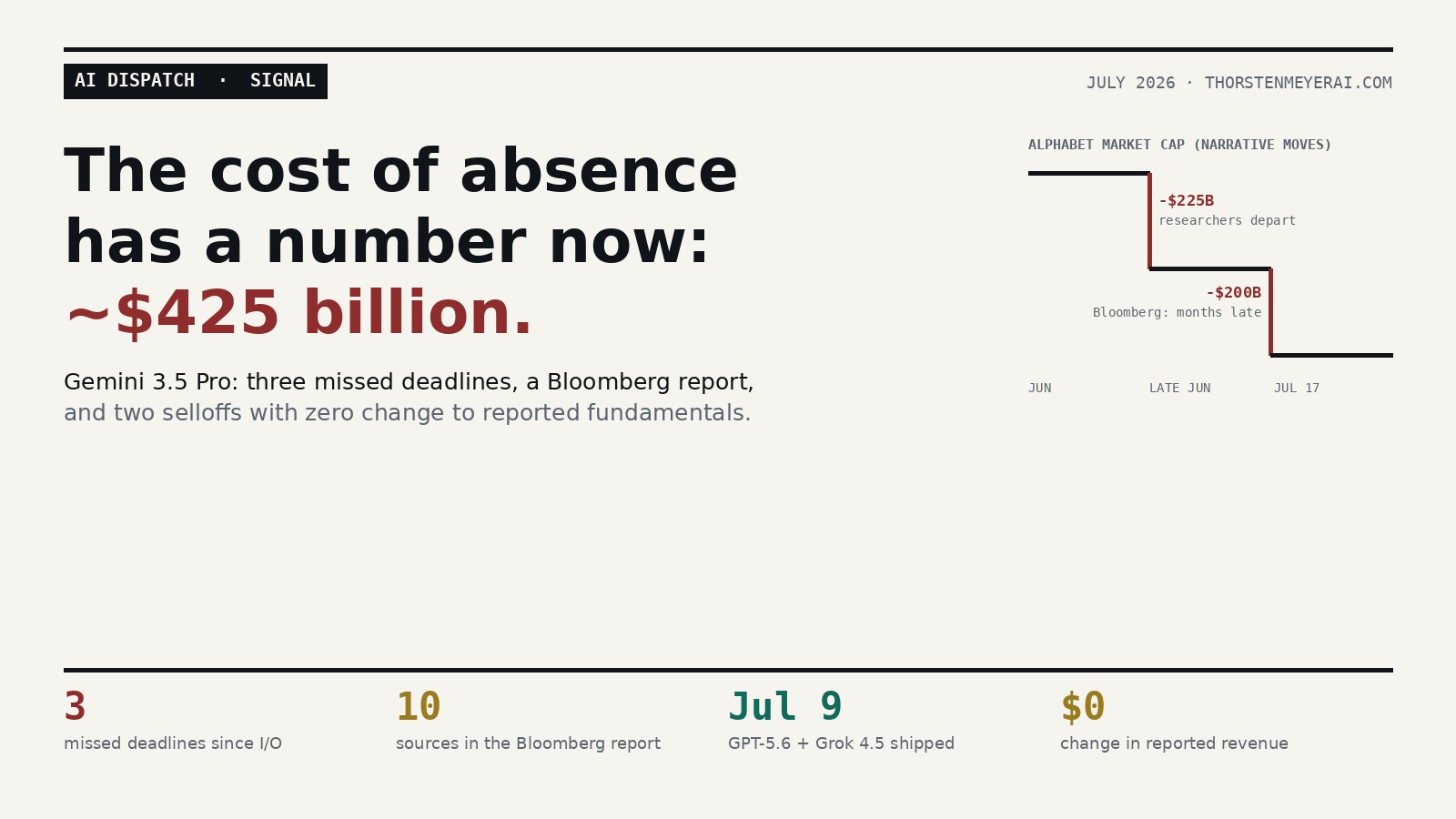
Gemini 3.5 Pro has missed three deadlines since Google I/O. Bloomberg (Jul 16, ten sources): months behind, coding the sticking point. The market’s verdict came in two selloffs — with zero change to reported fundamentals.
Two selloffs, one story
That’s what absence costs when a market prices it: not countable lost deals — a repricing of whether the company still sets the pace.
Three deadlines, zero launches
Rebuild, hallucination, and stopgap-Flash details rest on third-party reporting Google has not confirmed — labeled accordingly.
Contracts sign on schedules, not roadmaps. Pressure from above (shipped flagships) and below (monthly open-weight cadence): the floor rises whether or not the ceiling does.
- Holding may be right: if the reliability reporting is even directionally true, shipping broken costs more than shipping late. Restarting a failed model is judgment, not weakness.
- Narrative cuts both ways: $425B evaporated on story; Google’s distribution didn’t shrink. A strong launch restores on story too.
- Watch what shipped: Gemini Flash-class models are out — and topping at least one independent document-parsing leaderboard. Small-and-available beating large-and-promised is this week’s thesis wearing a Google badge.
Products Worth Considering

Samsung 32 Odyssey G55C QHD 1000R Curved Gaming Monitor

Samsung 32-inch Odyssey OLED G8 (G80SH) 4K Gaming Monitor

LG 32GX870A-B 32-inch UltraGear 4K UHD OLED Gaming Monitor
As an affiliate, we earn on qualifying purchases.
Confirmed, reported, unconfirmed — in that order
Confirmed. At Google I/O on May 19, 2026, Sundar Pichai told developers Gemini 3.5 Pro would arrive the following month. It didn’t. Gemini 3.5 Flash shipped as the family’s first model; the Pro remains in internal testing and limited enterprise preview as of this week. On July 16, Bloomberg reported — Julia Love and Davey Alba, drawing on ten current and former Google employees — that the model is months behind schedule, primarily over efforts to improve its coding capabilities, the area where Anthropic and OpenAI have built their leads, and that a late-June training-data update aimed at coding produced disappointing results. Google declined to comment on the schedule.
Confirmed, and the reason this column exists: the market’s response. Alphabet closed down 4.4% the day after the Bloomberg report — roughly $200 billion in market capitalization. That followed an estimated $225 billion selloff in late June when senior DeepMind researchers departed for Anthropic and OpenAI. Combined: approximately $425 billion in market value shed in under a month, against Q1 fundamentals that were strong — $109.9B revenue, Google Cloud up 63% year-over-year to $20B. Nothing in the reported financials changed. The narrative did. That’s what the cost of absence looks like when a market prices it: not lost deals you can count, but a repricing of whether the company still sets the pace.
Reported, not confirmed. Multiple third-party outlets describe something more drastic than polish: DeepMind allegedly discarding a near-ready model and restarting pre-training on a native Gemini 3 foundation, with reliability problems — including hallucination rates — behind the repeated misses, and stopgap Flash releases under consideration. Google has confirmed none of this; treat it as the reporting it is. Likewise every circulating spec — the 2-million-token context window, pricing, dates — remains unconfirmed. Three deadlines have now come and gone: the June promise, a restated July window, and a widely-reported July 17 target that passed four days ago.
Why absence compounds in this particular month
Timing is the multiplier. In the weeks Gemini 3.5 Pro didn’t ship: GPT-5.6 Sol launched publicly July 9. Grok 4.5 opened to the public the same day. DeepSeek’s V4 family targeted mid-July. Enterprise evaluations running this quarter are choosing among shipped models — and contracts sign on schedules, not roadmaps. By the reporting’s own framing, Google is currently the only major frontier lab without a 2026 flagship in general production on the timeline its own CEO promised.
And the pressure isn’t only from above. This week’s Thursday dispatch featured GLM 5.2 doing forensic work a frontier API refused — the same open-weight model that coverage now credits with matching proprietary models on coding benchmarks at a fraction of the cost. A delayed flagship in 2023 competed against other flagships. A delayed flagship in 2026 competes against other flagships and an open-weight cadence shipping monthly underneath them. The floor rises whether or not the ceiling does.
The honest counterweights
Three of them, because a pile-on would be lazy.
First: shipping an unreliable model would cost more than the delay. If the hallucination reporting is even directionally right, the decision to hold is the correct one — the 2026 market punishes broken launches harder than late ones, and a lab that diagnoses its own model’s failure and restarts is exercising judgment, not weakness. The question is only whether the fix takes as long as they think.
Second: narrative selloffs cut both ways. $425 billion evaporated on story alone; a strong launch can restore it on story alone. Nothing about Alphabet’s distribution — Search, Android, Cloud, Workspace — got smaller this month. Absence is expensive precisely because presence, when it arrives through channels that size, monetizes instantly.
Third, the one this site keeps having to relearn: watch what shipped, not what slipped. Gemini 3.5 Flash is out and, per earlier coverage this month, a Gemini-3-class Flash model tops at least one independent document-parsing leaderboard. The cheap-and-shipped tier of Google’s lineup is quietly competitive while the flagship tier makes headlines for not existing. That inversion — small and available beating large and promised — is this week’s thesis wearing a Google badge.
Monday’s dispatch will make that argument in full. Google just spent $425 billion of other people’s money illustrating it.
Sources
- Bloomberg, Love, J. and Alba, D., “Google Gemini Launch Delayed as Tech Falls Short of Internal Goals” (July 16, 2026) — primary: months behind schedule, coding-capability focus, ten current/former employees, engineer frustration
- Memeburn, “Why Gemini 3.5 Pro Is Delayed and When It Actually Ships” (July 20, 2026) — Alphabet −4.4% (~$200B) post-report; ~$225B June selloff on DeepMind departures; ~$425B combined; Q1 2026 fundamentals ($109.9B revenue, Cloud +63% to $20B); late-June training-data update outcome via 9to5Google; I/O announcement date; unreleased as of July 17
- TechTimes, “Gemini 3.5 Pro Targets July 17 After Full Rebuild” (July 13, 2026) and “Rebuilt Gemini 3.5 Pro Misses Third Deadline” (July 16, 2026) — reported rebuild on native Gemini 3 foundation (unconfirmed); GPT-5.6 Sol and Grok 4.5 public July 9; DeepSeek V4 mid-July targeting; only-lab-without-2026-flagship framing; all specs unconfirmed
- Geeky Gadgets, “Gemini 3.5 Pro Delay: Why Google Postponed Its AI Again” (July 2026) — third postponement; reported reliability/hallucination issues (unconfirmed); stopgap Flash discussion; researcher departures
- Analytics Insight (June 2026) — original June→July delay report; Google spokesperson declined comment; Flash-first release sequence
- ThorstenMeyerAI.com, “When the Cloud Says No” (July 23, 2026) — GLM 5.2 context
Confirmed, reported, and unconfirmed claims are labeled as such throughout; the rebuild, reliability, and spec details rest on third-party reporting Google has not confirmed. Market-cap figures are as reported and reflect narrative-driven price moves, not changes to stated financials.