
Part 1 of a five-day series on the 2026 memory crunch — what’s driving it, who pays, and how to build through it.
A year ago, a 32GB DDR5 kit cost about $80 to $120. In early June 2026, the cheapest in-stock 32GB kit on Tom’s Hardware’s daily tracker was $374.97. A 64GB kit that sat near $150–200 for most of 2025 now routinely lists at $600 or more.
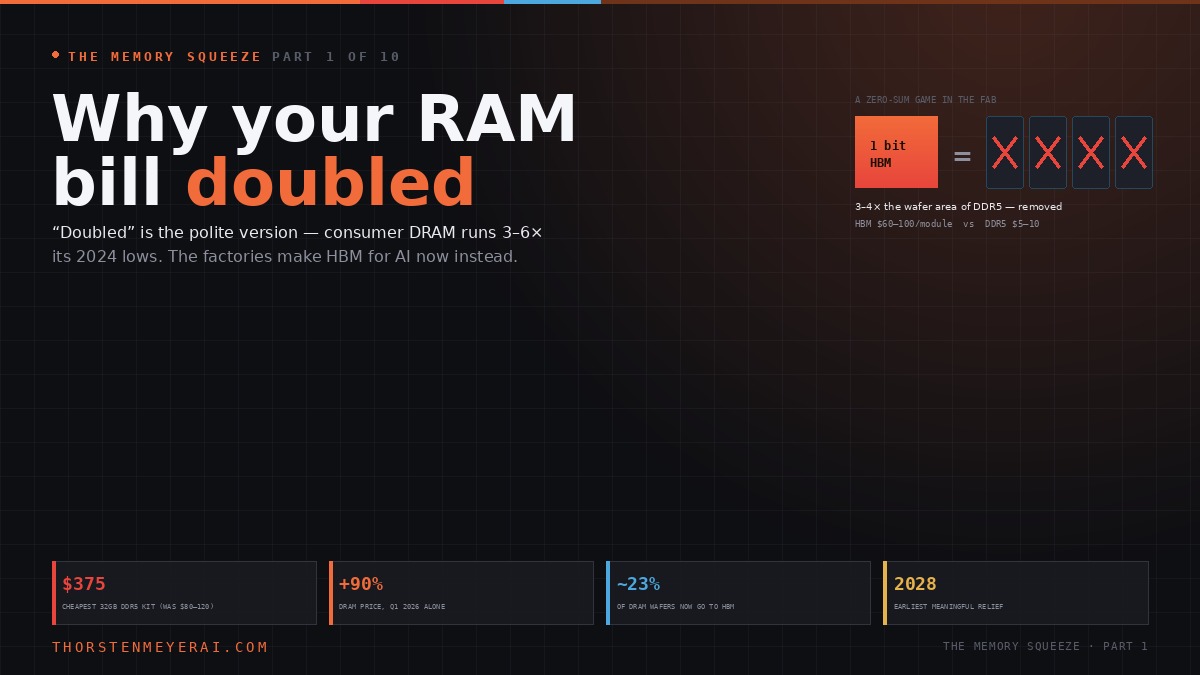
“Doubled” is the polite version. Depending on the configuration, consumer DRAM is running three to six times its 2024–2025 lows — and in the first quarter of 2026 alone, DRAM prices jumped roughly 90% in a single quarter. RAM is now the single most expensive item in many PC builds: HP told investors memory had ballooned to about 35% of build materials, up from 15–18% a quarter earlier.
This is not the memory cycle you grew up with. The boom-bust pattern that always, eventually, gave you cheap RAM back is not coming to the rescue this time — because the thing driving prices isn’t a temporary supply hiccup. It’s a permanent reallocation of the world’s chip-making capacity toward AI. This series unpacks what that means front by front. Start here, with the mechanism.
Why your RAM bill doubled
“Doubled” is the polite version — consumer DRAM is running 3–6× its 2024 lows. The boom-bust cycle that always brought cheap RAM back isn’t coming this time, because the factories that make your RAM now make something far more profitable instead.
HBM
This is the quiet tax on the whole AI era. Relief isn’t forecast before 2028, and even then prices may settle 30–50% above pre-crisis levels. Buy what you genuinely need now; don’t panic-buy capacity you won’t use. You can’t out-wait the fab math — but, as this series will show, you can shrink what you need. Next: HBM Ate the Fab.
The zero-sum game inside the fab
Here is the entire crisis in one sentence: the factories that make your RAM now make something far more profitable instead.
Three companies — Samsung, SK Hynix, and Micron — produce nearly all of the world’s DRAM. The same cleanrooms and wafers that yield the DDR5 in your PC can be redirected to make High Bandwidth Memory (HBM) — the stacked, specialized DRAM that sits next to AI accelerators like Nvidia’s GPUs. And the economics are not close. A single HBM module reportedly sells for $60 to $100; a comparable amount of standard DDR5 fetches $5 to $10. When a manufacturer can earn three-to-five times the revenue from the same silicon, the rational choice makes itself.
It gets worse, because of a brutal piece of physics. HBM is wildly inefficient in wafer terms: stacking eight to twelve DRAM dies, linking them with thousands of microscopic vias, and accepting the yield losses that come with it means one bit of HBM consumes roughly three to four times the wafer area of one bit of DDR5. So every wafer a manufacturer shifts to HBM doesn’t remove one wafer of consumer DRAM from the world — it effectively removes three or four. HBM now eats around 23% of total DRAM wafer output, up from 19% a year earlier, and AI is on track to absorb about a fifth of all DRAM capacity in 2026.
That is why this shortage is different. Past memory crunches eased when someone built more fabs and flooded the market with bits. This one is a deliberate, ongoing choice to make a higher-margin product that doesn’t scale linearly — and no amount of waiting changes the arithmetic.
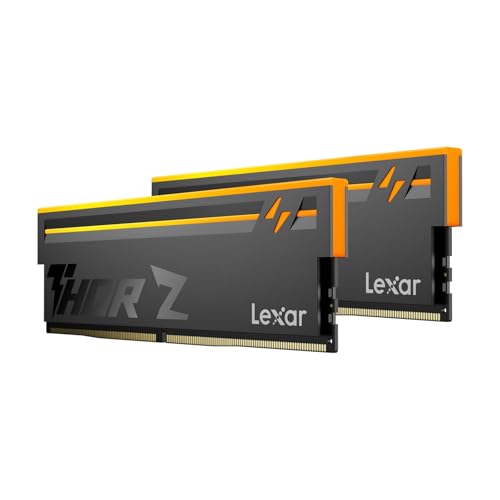
Lexar Thor Z RGB DDR5 RAM 32GB Kit (2x16GB) 6000MHz CL38 DRAM 288-Pin UDIMM
- High-Speed Performance: 6000MHz DDR5 RAM with low latency
- Large Capacity: 32GB (2x16GB) kit for multitasking
- Robust Thermal Design: Sandblasted aluminum heatsink for cooling
As an affiliate, we earn on qualifying purchases.
As an affiliate, we earn on qualifying purchases.
Why it won’t fix itself on the old timeline
Every previous shortage carried its own cure: high prices lured in capacity, capacity became glut, glut crashed prices. The release valve is jammed this time, for three reasons.
First, supply growth is running below historical norms precisely when demand is exploding. IDC expects 2026 DRAM bit-supply growth of only about 16%, and NAND about 17% — well under the 20–30% the market delivered for years. Second, new capacity is years out: the marquee fab expansions don’t reach meaningful volume until 2027–2028, and cleanroom build times are now measured in years, not months. Third — and this is the part the industry says quietly — the manufacturers don’t seem to be in a hurry to end it. As one supply-chain analysis put it, suppliers are managing scarcity, not racing to solve it: holding capacity discipline, favoring high-margin product, and preserving record margins rather than reopening the release valve.
That last point deserves a careful flag, not an accusation. The same three firms control on the order of 95% of DRAM, and all three pleaded guilty to a price-fixing conspiracy in the 2000s that drew over $646 million in US fines. No antitrust case has been filed this time, and the documented cause of today’s prices is genuine, explicable AI-driven wafer reallocation — not collusion. But the market concentration that once enabled coordination is still a structural feature of the thing every buyer depends on. Whether today’s prices reflect pure scarcity or also a comfortable, disciplined restraint is a question worth holding open, even if it can’t be answered cleanly.
And on the demand side, the largest buyers have removed any incentive for suppliers to compete on price. Hyperscalers reportedly placed open-ended orders — send as much as you can make, at whatever price — and Micron has locked roughly a fifth of its DRAM and a third of its NAND into multi-year, take-or-pay contracts through 2030, with customers paying billions in deposits up front. The supply that used to slosh back to consumers when a glut hit is now contractually spoken for.

Crucial 64GB DDR5 RAM Kit (2x32GB), 4800MHz CL40 Laptop Memory – SODIMM 262-Pin – Compatible with 12th Intel Core – CT2K32G48C40S5
- Memory Capacity: 64GB DDR5 RAM Kit (2x32GB)
- Operating Speed: 4800MHz for fast performance
- Performance Boost: Enhances multitasking and responsiveness
As an affiliate, we earn on qualifying purchases.
As an affiliate, we earn on qualifying purchases.
The casualties are already visible
You can read the squeeze in the things companies have quietly done.
In February 2026, Micron retired its consumer-facing Crucial brand to concentrate on enterprise AI customers — the consumer memory market didn’t just get pricier, it lost a first-party supplier outright. Framework raised DDR5 upgrade prices on its laptops by 50%. Apple — which had insulated itself with long-term DRAM contracts — announced across-the-board price hikes on Macs, iPads, and more on June 25, and the stock fell over 6% the same day. Lenovo’s CFO called the cost surge “unprecedented”; Dell is reportedly planning hikes of hundreds of dollars; Valve delayed its second Steam Machine. DDR4, the supposed budget escape hatch, has been driven to end-of-life and now costs roughly the same per gigabyte as DDR5 — on a platform with no future. And as always when scarce parts command premiums, counterfeit DDR5 modules have started appearing.
The structural cruelty is in who gets served. Suppliers are running allocation-only frameworks that prioritize hyperscalers and large OEMs. If you’re a giant cloud buyer, you get your chips. If you’re a small system builder, a workstation shop, or an individual buying memory for a local AI rig, you’re at the back of a line that keeps getting longer.
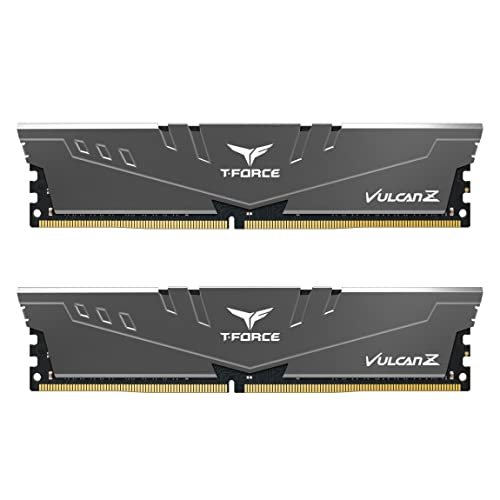
TEAMGROUP T-Force Vulcan Z DDR4 DRAM 16GB Kit (2x8GB) 3200MHz Desktop Memory Module (PC4-25600) CL16 Ram (Gray) – TLZGD416G3200HC16FDC01
- Design for Cooling Protection: Simple design with thermal adhesive
- Compatibility: Supports Intel and AMD motherboards
- High-Quality IC: Selected premium memory chips
As an affiliate, we earn on qualifying purchases.
As an affiliate, we earn on qualifying purchases.
Two wildcards, pointing opposite ways
Honesty requires naming what could move this in either direction.
It could get worse: the AI buildout is still accelerating. One report suggested OpenAI’s Stargate project alone could consume up to 40% of global DRAM output at full scale. If that demand materializes, today’s prices are a floor, not a peak.
It could get better, though not the way past cycles did: the pressure valve this time may be software, not fabs. In March 2026, Google announced a memory-compression technique it claimed cut memory use in tested local LLMs by around 6×. If compression and quantization meaningfully reduce how much memory AI workloads need, some of the demand driving the squeeze could soften — which is exactly why memory-maker shares wobbled on the news. For builders, that’s the most actionable hope in the whole story, and it’s where this series ends up: you can’t out-wait the fab math, but you can shrink what you need.

DDR4 RAM 32GB (2x16GB) 3200MHz 1.35V XMP 288-pin Desktop PC Memory Module
- High-Speed Multitasking: 3200MHz DDR4, 32GB kit for demanding tasks
- One-Click Overclocking: Supports XMP 2.0 and EXPO profiles
- Premium Aluminum Heatsink: Black Grey heat spreader for thermal dissipation
As an affiliate, we earn on qualifying purchases.
As an affiliate, we earn on qualifying purchases.
What this means for you
For most buyers, the takeaways are blunt. Cheap memory is not coming back on the old schedule; forecasts put any meaningful relief in 2028 at the earliest, and even then prices may settle 30–50% above pre-crisis levels. If you need memory for a working machine, the conventional wisdom has flipped: buying what you genuinely need now is usually safer than waiting, because the next quarter is more likely to be dearer than cheaper. And panic-buying capacity you won’t use — 128GB “to be safe” — just locks today’s worst prices into hardware that may outlive the shortage.
But the deeper point, the one this series is built around, is that the memory squeeze is the quiet tax on the entire AI era. Every front — server RAM, HBM, the DDR5/DDR6 transition, enterprise SSDs, high-end PCs and workstations, the cloud bill, and the memory-heavy local-inference rig you might be planning — is being reshaped by the same wafer arithmetic. Over the next five days we’ll take each one in turn, and end where it matters most for builders: how to get the capability you want without paying the full ransom.
Next in the series: HBM Ate the Fab — a closer look at the technology that turned your RAM into collateral damage.
Sources: Tom’s Hardware RAM price tracker; IDC (2026 DRAM/NAND supply-growth estimates); TrendForce and Counterpoint (HBM wafer share, QoQ price moves); Micron fiscal Q3 2026 earnings; Wikipedia “2025–present global memory supply shortage” (compiling Apple, Lenovo, Framework, Valve, Crucial, Stargate, and Google TurboQuant reporting); Sourceability and Tech Times (concentration, antitrust history, allocation frameworks). Figures reflect reporting as of late June 2026 and are fast-moving; price specifics are point-in-time. Analysis and opinions are the author’s.