
Every major computing paradigm has created a governance layer worth billions. AI agents are next.
In January 2026, a viral open-source project called OpenClaw crossed 100,000 GitHub stars. That same month, security researchers found 341 malicious “skills” — plugin-like capability packages — in its public registry. Credential stealers, backdoors, exfiltration scripts, all disguised as helpful automations.
The timing was almost poetic. At the very moment OpenClaw hit critical mass, the security incident exposed how dangerous that success could be without governance.
But the demand didn’t go away. If anything, it sharpened. Every VP of Engineering who blocked OpenClaw still has the same problem: alert-fatigued SRE teams drowning in 500 alerts a day, $200K burned annually on L1 incident response, and runbooks that exist but nobody executes.
The question is no longer whether enterprises will deploy AI agents at scale. It’s who will make it safe enough to do so.
The Playbook Is Already Written
The history of enterprise software follows a predictable arc. A powerful open-source technology achieves developer adoption. Enterprises want it but can’t use it without governance, security, and compliance. A company builds the enterprise layer and captures enormous value.
Kafka became Confluent ($3.8B market cap). Git became GitLab ($8B). Elasticsearch became Elastic ($6B). Terraform became HashiCorp ($5B, acquired by IBM). MongoDB took the same path to $15B.
The pattern is so consistent it’s almost boring. But it keeps working because the underlying dynamic never changes: developers adopt the best tools, and enterprises need guardrails around them.
OpenClaw is the next instance of this pattern. And right now, nobody is building the enterprise layer.
Why OpenClaw Matters
OpenClaw isn’t just another chatbot framework. It lets users control their computers via natural language through the messaging apps they already use — WhatsApp, Slack, Telegram. Its 3,000+ community-built skills cover everything from incident response to email triage to infrastructure automation.
For DevOps and SRE teams, the promise is transformative: 85% auto-resolution of routine incidents. Runbooks that actually execute. 24/7 coverage without the 3am pages.
But talk to the people who actually have to approve these tools — the CISOs, the VP of Engineering, the compliance leads — and you hear a different story:
“I love what OpenClaw can do, but my CISO won’t approve it without audit trails.”
“We need to prove who ran what commands and when, or we fail our SOC2.”
“341 malicious skills in the public registry? That’s a non-starter.”
The gap between what OpenClaw can do and what enterprises will allow it to do is the governance gap. And it’s growing wider as adoption pressure increases.
The Five Blockers
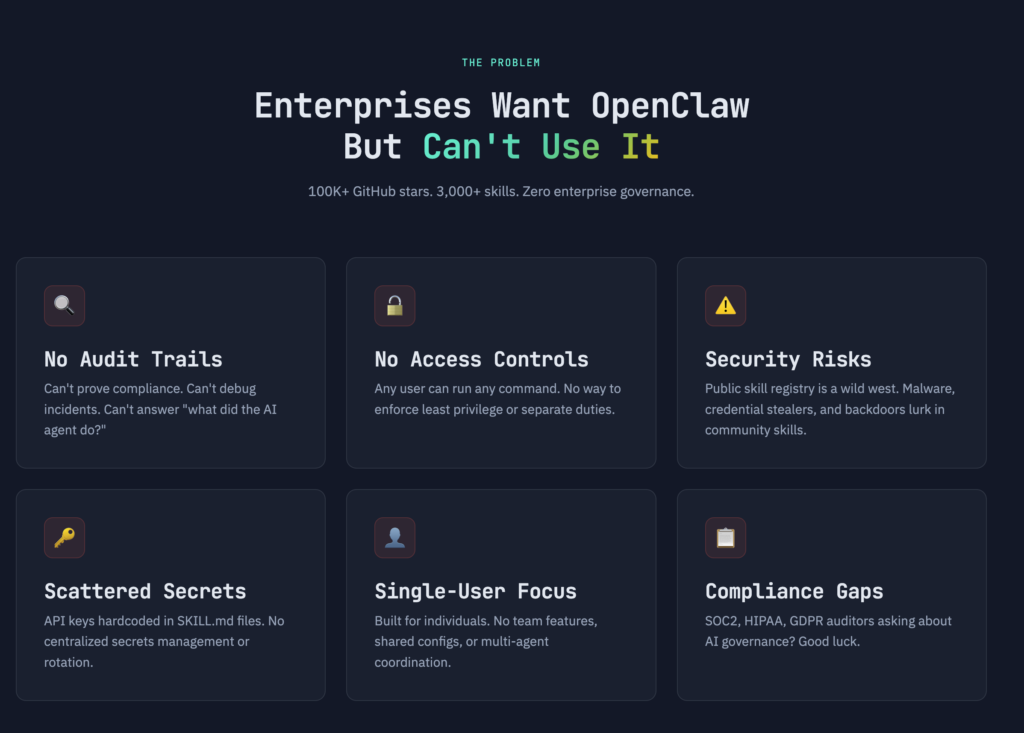
When we talk to enterprise engineering and security leaders, the same five objections come up in nearly every conversation:
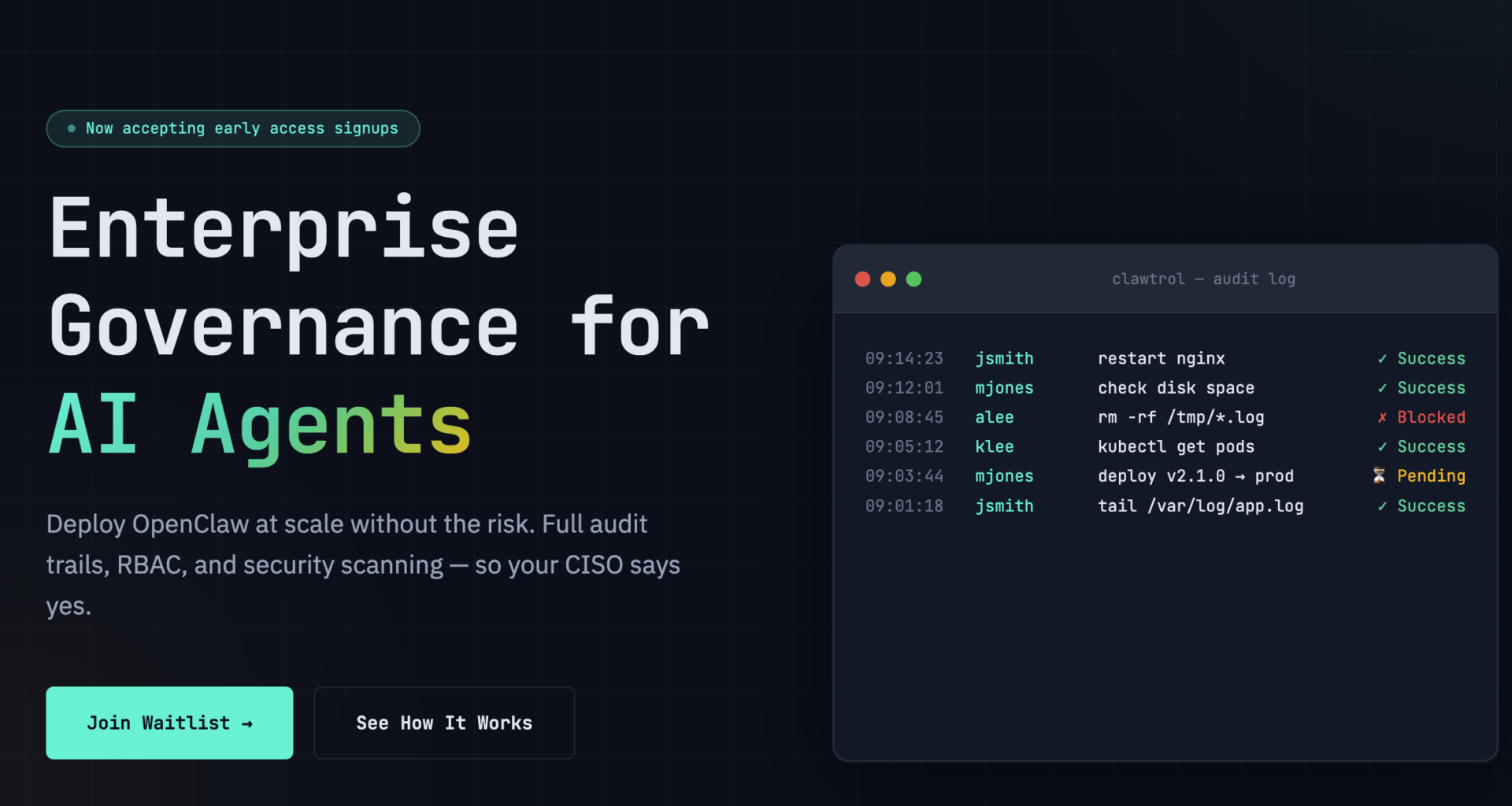
No audit trails. Every action an AI agent takes — every shell command, every file access, every API call — needs to be logged with full context. User, timestamp, input, output, result. Without this, you can’t debug incidents, you can’t prove compliance, and you can’t hold anyone accountable.
No access controls. In its current form, OpenClaw makes no distinction between a junior engineer and a senior SRE. There’s no role-based access, no principle of least privilege. The same person who should only be reading logs can restart production databases.
No security scanning. The public ClawHub registry is the npm of AI agent skills — powerful, vast, and dangerously trusting. The 341 malicious skills discovered in January were just the ones that got caught.
No secrets management. API keys and credentials are scattered across skill files, environment variables, and Slack threads. There’s no centralized vault, no access scoping, no rotation.
No team features. OpenClaw was built for power users, not organizations. There’s no concept of teams, no approval workflows for sensitive actions, no multi-agent coordination.
Each of these is a hard blocker for enterprise adoption. Together, they form a wall.
What the Governance Layer Looks Like
The solution isn’t to rebuild OpenClaw from scratch. That would throw away the 100K-star community, the 3,000+ skills, and the momentum that makes the platform valuable in the first place.
The solution is a governance layer that wraps OpenClaw — adding enterprise capabilities without sacrificing the flexibility that developers love.
This is what we’re building at Clawtrol.
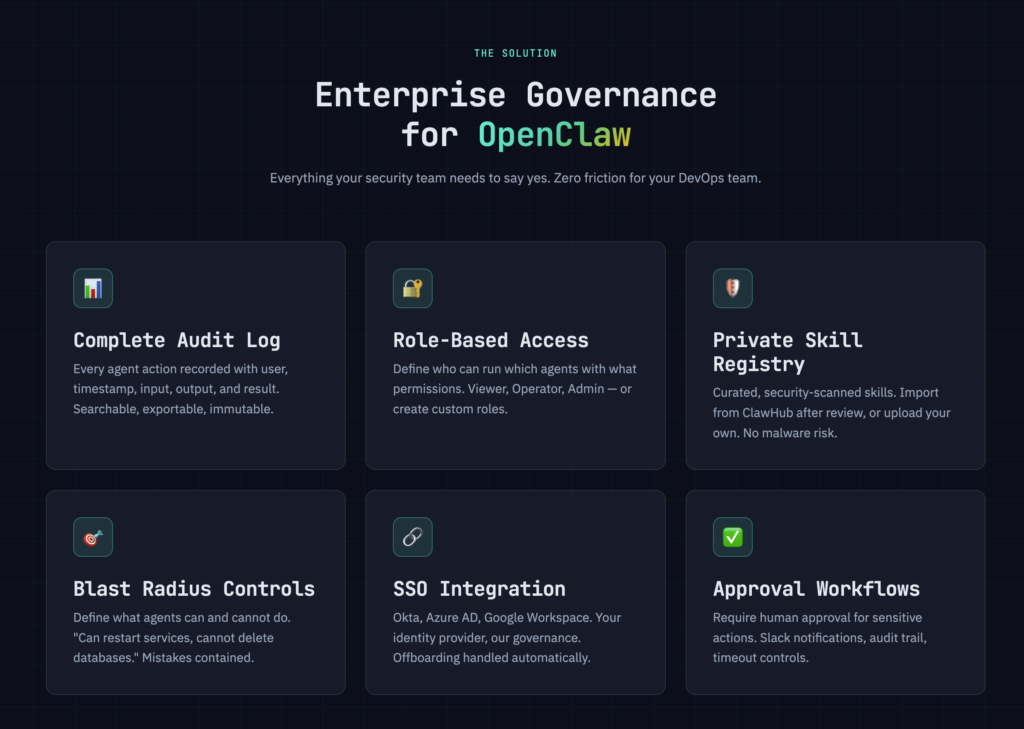
Clawtrol sits between the enterprise and OpenClaw’s core. When an agent receives a command, our SDK intercepts it, checks the user’s permissions, validates it against blast radius policies, and logs the full action — all in under 50 milliseconds. If the action is allowed, the agent executes normally. If it’s blocked, the denial is logged and the user gets a clear explanation. If it requires escalation, the approval workflow kicks in.
The key insight: zero friction for the happy path. Agents work exactly as before. They’re just governed now.
The core capabilities:
- Full audit logging — every agent action recorded with complete context, searchable, exportable, immutable
- Role-based access control — define who can run what agents with what permissions, synced with SSO groups
- Private skill registry — curated, malware-scanned repository replacing the public ClawHub free-for-all
- SSO integration — Okta, Azure AD, Google Workspace — enterprise identity from day one
- Blast radius controls — policy-defined boundaries for what agents can access and modify
- Approval workflows — human-in-the-loop for sensitive actions, with Slack notifications and configurable escalation
Setup takes 30 minutes. Install the SDK, connect to Clawtrol, assign policies. Done.
The Market Is Enormous — And Accelerating
The global AI agent market is projected to grow from $7.84 billion in 2025 to $52.62 billion by 2030 — a CAGR of 46.3%. Enterprise AI agents represent roughly 30% of that total, putting the serviceable addressable market at $15.8 billion by 2030.
But the more interesting number is the adoption pressure. 78% of enterprises plan to deploy AI agents by 2027. AI spend is increasing 40% year-over-year. Remote work has made async automation not just nice-to-have but essential. And compliance pressure from SOC2, HIPAA, and GDPR means every one of these deployments needs governance.
The enterprise demand for AI agents is a tidal wave. The governance layer is the seawall.
Why Now — Not Later
Timing windows in enterprise software are measured in months, not years.
OpenClaw has just crossed critical mass. The security incident has created urgency. Enterprise AI budgets are unfreezing. And critically, no funded competitor has moved into this space yet.
That last point is the one that should give investors pause — but in the right direction. There’s a narrow window, perhaps 6 to 12 months, where a focused team can establish category leadership before well-funded incumbents or new entrants arrive.
The companies that built enterprise layers on open-source projects all share one trait: they moved fast during the window and locked in design partners before the market got crowded. Confluent did it with Kafka. Elastic did it with Elasticsearch. The playbook is clear.
The risk of waiting isn’t that the opportunity disappears — it’s that someone else takes it.
The Business Model
Clawtrol follows the proven SaaS subscription model with per-seat pricing, benchmarked against the DevOps tools it complements or replaces: PagerDuty ($21-49/user), Datadog ($15-34/host), Snyk ($52-98/dev).
The unit economics are compelling. Target average contract value of $8,000, customer acquisition cost of $4,000, lifetime value of $24,000 — giving a 6:1 LTV:CAC ratio with 85% gross margins and a 6-month payback period. Net revenue retention targets 120% as customers expand seats and upgrade tiers.
The Path to $5M ARR
The math starts with the problem Clawtrol solves.
A mid-size engineering organization spends $200K per year on L1 incident response alone. Alert fatigue costs another $150K in wasted engineer time. A failed SOC2 audit can delay an enterprise deal by six months or kill it entirely. These aren’t hypothetical costs — they’re line items that engineering leaders track quarterly.
Clawtrol eliminates the governance gap that prevents enterprises from deploying AI agents against these problems. When OpenClaw can auto-resolve 85% of routine incidents but can’t get past the CISO’s desk, the cost of not having governance isn’t the subscription fee — it’s the $350K+ in operational waste that persists every year the organization waits.
The enterprise AI agent market is growing at 46% annually, from $2.35 billion today to $15.8 billion by 2030. Clawtrol needs to capture a fraction of one percent of that market to reach $5M ARR. Given that 78% of enterprises plan to deploy AI agents by 2027 and every one of those deployments will need governance, the question isn’t whether the demand exists — it’s how fast Clawtrol can meet it.
The go-to-market starts where the ROI is most obvious: DevOps and SRE teams with $50K+ tooling budgets and immediate pain around incident response. From there, it expands naturally into security teams demanding compliance visibility, then platform engineering organization-wide. Each new team inside a customer deepens the integration and raises the switching cost.
The Competitive Moat
In enterprise software, first-mover advantage isn’t about the technology — it’s about the relationships, the integrations, and the switching costs that compound over time.
Clawtrol’s competitive moat has five layers:
Community leverage. 100K+ GitHub stars and 3,000+ skills represent years of community building that no new entrant can replicate.
Trust and security brand. “The secure way to use OpenClaw” is a positioning that, once established, becomes self-reinforcing.
Enterprise feature depth. RBAC, audit, compliance, SSO — these are table stakes for enterprise, but each one is months of engineering work. Head start matters.
Switching costs. Once an organization’s skills, policies, roles, and integrations live in Clawtrol, moving away is painful and expensive. This grows over time.
Data advantage. Aggregate learnings across customers — which policies work, which skills are risky, what patterns indicate compromise — create intelligence that improves the product for everyone.
The Long-Term Vision
Clawtrol starts as enterprise governance for OpenClaw. But the endgame is much larger.
Year 1: Governance for OpenClaw — audit, RBAC, security scanning.
Year 2: Multi-agent orchestration — coordinate workflows across agents, self-hosted deployment for regulated industries.
Year 3: The enterprise AI agent platform — support for any agent framework, full lifecycle management, AI-powered anomaly detection, a curated skill marketplace.
The long-term vision is that Clawtrol becomes to AI agents what Kubernetes became to containers: the universal control plane. Every enterprise running AI agents will need observability, policy enforcement, and lifecycle management. The platform that establishes itself as the standard for OpenClaw governance is perfectly positioned to expand into that broader role.
Strategic acquirers in this space include ServiceNow, Datadog, CrowdStrike, and Microsoft — all of which need AI agent governance capabilities and would prefer to buy category leadership rather than build it.
The Moment
We’re standing at the intersection of three curves: AI agent adoption going exponential, enterprise compliance pressure intensifying, and a community-driven platform that’s captured developer mindshare but can’t yet cross the enterprise threshold.
This isn’t a speculative bet on future technology. OpenClaw exists today. The demand exists today. The 341 malicious skills exist today. The gap between what enterprises want and what they can safely deploy is real, measurable, and growing.
The question for builders and investors is simple: does the open-source-to-enterprise playbook work one more time?
The market caps of Confluent, GitLab, Elastic, HashiCorp, and MongoDB suggest the answer is yes. The timing window suggests the answer needs to be now.
Clawtrol is building the governance layer that makes AI agents enterprise-ready. The infrastructure for the next computing paradigm.
Learn more at clawtrol.com