Free White Paper Download from Thorsten Meyer AI
AI is moving fast—but most organizations are still treating it like “just software.”
That mindset is already becoming a disadvantage.
The organizations that scale AI successfully in 2026 won’t be the ones with the most pilots. They’ll be the ones that can reliably turn energy + compute + data + governance into production-grade outcomes—at the lowest cost, with measurable quality, and with confidence that the system behaves as intended.
That’s the core idea behind The AI Infrastructure Era, a new white paper from Thorsten Meyer AI—and you can download it for free below.
👉 Download the white paper (PDF):
Why this matters right now
AI adoption is entering a new phase. Early wins came from experimenting with chatbots, copilots, and content tools. But the next phase is different:
- AI usage is becoming operational, not experimental
- Compute and energy constraints are now strategic bottlenecks
- Inference economics are changing rapidly (cost per unit of “intelligence” is falling)
- Robotics and autonomy are pulling AI out of the browser and into the physical world
- Regulatory and governance expectations are rising—especially in enterprise and critical systems
In other words: we’re shifting from “Can we use AI?” to “Can we run AI like a factory—with cost control, reliability, throughput, and quality?”

The Age Of Compute Sovereignty
As an affiliate, we earn on qualifying purchases.
As an affiliate, we earn on qualifying purchases.
What you’ll learn in the white paper
The AI Infrastructure Era provides a practical framework for leaders, builders, and operators who need to turn AI into durable advantage—not just impressive demos.
Inside, you’ll get:
1) A clear “AI Factory” mental model
A straightforward way to think about AI as an industrial production system:
inputs (power, silicon, data, policies) → process (training, routing, serving, evaluation) → outputs (tokens, decisions, automation, measurable business outcomes)
2) A five-layer AI stack you can use to plan strategy
A simple stack model to identify where your bottlenecks really are:
- Energy
- Chips
- Infrastructure (data centers, networks, cooling, cloud)
- Models (foundation + domain specialization)
- Applications (workflows, agents, robotics)
When your AI roadmap stalls, it’s often because something in the lower layers isn’t ready.
3) The economics leaders keep underestimating
Many AI strategies are flawed because they ignore cost curves. The paper explains how organizations can think about:
- cost per 1M tokens
- utilization and throughput
- routing and model portfolios
- reliability and measurable quality
…and why lowering unit cost typically increases total AI usage rather than reducing it.
4) A grounded view of workforce impact
The white paper uses a practical lens: tasks vs. purpose.
Tasks can be automated. Purpose tends to expand (more coverage, deeper work, higher expectations, broader reach). The leaders who win will redesign workflows around this reality—rather than getting trapped in fear-driven narratives.
5) Why energy is becoming a board-level AI topic
Scaling AI isn’t only about software talent. It increasingly depends on power availability, data center build-out, and long lead-time physical infrastructure.
If your organization is serious about AI at scale, energy planning becomes strategy.
6) A 12-month action plan for enterprises
This is not theory. The paper closes with a clear implementation path for the next 12 months—covering governance, measurement, model portfolio design, and end-to-end process redesign.

How AI Uses Our Water: When Machines Get Thirst: Cooling Systems, Data Centres, and the Infrastructure Behind Artificial Intelligence
As an affiliate, we earn on qualifying purchases.
As an affiliate, we earn on qualifying purchases.
Who this white paper is for
This is written for people who need to make AI real in the next 6–18 months, including:
- C-suite and business unit leaders responsible for productivity and growth
- CIOs/CTOs, heads of data/AI, and platform teams
- Ops leaders (support, supply chain, manufacturing, logistics, compliance)
- Investors and strategists evaluating infrastructure and compute-driven markets
- Builders working on automation, agents, and robotics rollouts
If you’re trying to move from pilots to production—or from production to scale—this will be immediately useful.
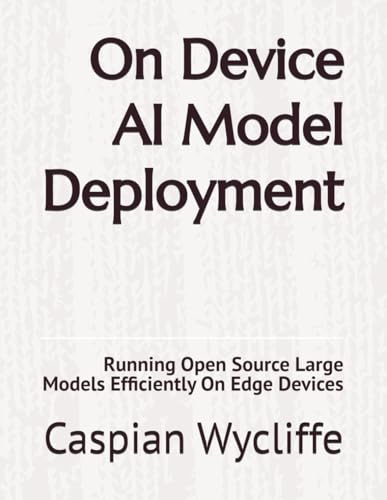
On Device AI Model Deployment: Running Open Source Large Models Efficiently On Edge Devices
As an affiliate, we earn on qualifying purchases.
As an affiliate, we earn on qualifying purchases.
A quick preview: three takeaways you can apply immediately
Takeaway 1: Treat AI like infrastructure, not a feature
If your team doesn’t track cost, latency, reliability, and governance as first-class metrics, AI will remain a set of disconnected demos.
Takeaway 2: The bottleneck is shifting to capacity
As models improve, the limiting factor becomes your ability to deploy compute, power, and operational controls—fast and reliably.
Takeaway 3: The winners will build systems, not prompts
Prompting is a starting point. Durable value comes from systems that include evaluation, monitoring, routing, security, and process integration.

Making Your Data Center Energy Efficient
As an affiliate, we earn on qualifying purchases.
As an affiliate, we earn on qualifying purchases.
Free download
You can download the complete white paper here:
📄 The AI Infrastructure Era (PDF) — Free download
About Thorsten Meyer AI
Thorsten Meyer AI helps organizations move from AI experimentation to scalable, governed, ROI-driven deployment—across workflows, infrastructure strategy, and operating models.
If you’d like a short call to discuss how the “AI factory” approach applies to your organization, add a final CTA here:
Want help applying this to your business?
Reply to this post / contact me at contact@thorstenmeyerai.com to schedule a strategy session.