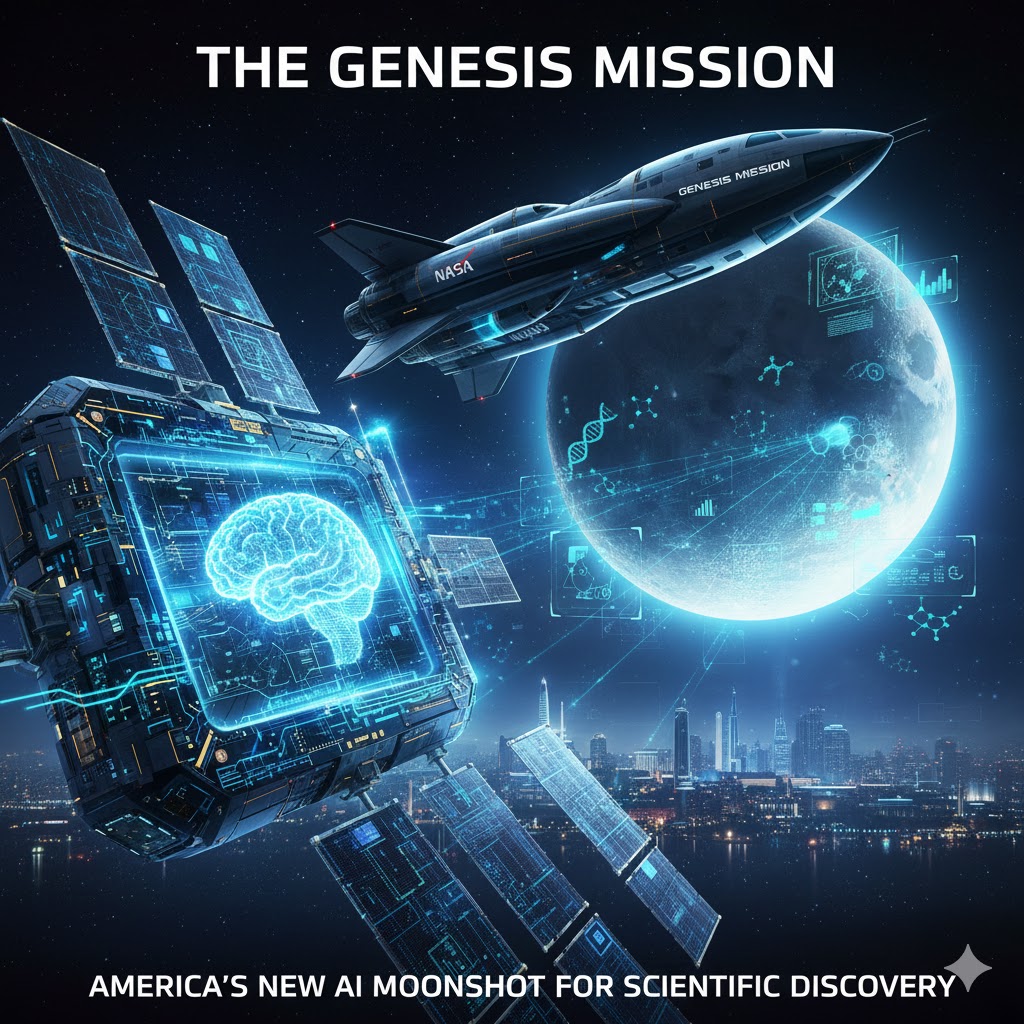

On November 24, 2025, the United States formally launched what may become the most ambitious government-backed scientific computing initiative since the original Apollo program. Known simply as the Genesis Mission, the effort positions the Department of Energy (DOE) at the center of a new era of science—one where foundation models trained on federal scientific datasets drive rapid discovery across physics, biology, chemistry, climate science, materials engineering, and energy innovation.
This initiative isn’t another federal AI policy memo. It is a structural re-architecture of national scientific capability. Where previous generations built particle accelerators, nuclear reactors, and national laboratories to push the boundaries of physics and energy, the U.S. now acknowledges that the next wave of breakthroughs will come from AI-driven hypothesis generation, automated experimentation, and agentic scientific reasoning.
A National AI Backbone for Discovery
The Genesis Mission directs the DOE to create a closed-loop AI experimentation platform. This platform integrates:
- Massive federal scientific datasets (climate, genomic, energy, astrophysics, materials, simulations)
- High-performance compute hosted in national labs
- Robotic laboratories and automation systems
- Scientific foundation models capable of reasoning across modalities
- Agentic AI systems that can design, run, refine, and evaluate experiments autonomously
The ambition: compress the entire scientific cycle—from question → hypothesis → experiment → revision → insight—from years into days or even hours.
Handbook of Research on High Performance and Cloud Computing in Scientific Research and Education
As an affiliate, we earn on qualifying purchases.
As an affiliate, we earn on qualifying purchases.
Why the U.S. Government Is Doing This
The rationale is threefold.
1. Strategic Competitiveness
Nations around the world are accelerating AI-driven research. The U.S. is moving to preserve its edge in:
- Advanced materials
- Biomedical discovery
- Energy transition technologies
- National security applications
- Climate modeling
2. Scientific Bottleneck Relief
Labs generate petabytes of raw data, but human researchers cannot analyze it fast enough. Even elite research groups struggle to interpret complex multidimensional simulations and experimental results.
3. Economic Impact
The next trillion-dollar industries—semiconductors, quantum, biotech, clean energy—are all science-led. Genesis positions America to lead these markets by industrializing AI-assisted R&D.

Efficient 5V to 24V 50W Small Power Motor Speed Controller Board for DIYer Projects and Laboratory Industrial Automation Small Power Motor Pace Regulation Board
Delivers accurate speed from 22, 400 to 74, 000RPM depending on motor poles ( 2 / 6 /…
As an affiliate, we earn on qualifying purchases.
As an affiliate, we earn on qualifying purchases.
What It Means for Industry and Academia
For Research Labs
Expect unprecedented access to compute power previously restricted to national labs. Many labs will integrate with Genesis’s shared research capabilities.
For Enterprises
Private companies—especially in science-heavy verticals—can partner with DOE to train domain-specific foundation models with unprecedented fidelity and depth.
For Startups
The Mission creates openings for:
- Automation tools
- Agent orchestration frameworks
- Specialized data pipelines
- Scientific LLMs
- Robotic lab management software
For Policymakers
Genesis becomes a model for future “national capability platforms”—shared infrastructures that accelerate innovation capacity.

AI Engineering: Building Applications with Foundation Models
As an affiliate, we earn on qualifying purchases.
As an affiliate, we earn on qualifying purchases.
The Big Picture
If successful, the Genesis Mission will redefine scientific research. It marks the moment when the U.S. formally recognized that AI is no longer a tool that assists scientists—AI is becoming a primary engine of discovery.

AI FOR EDUCATORS: Embrace New Technologies to Enrich Curriculum, Improve Teaching Methods, Reduce Burnout, and Save Time and Energy with Strategies That Work
As an affiliate, we earn on qualifying purchases.
As an affiliate, we earn on qualifying purchases.