
By Thorsten Meyer | November 2025
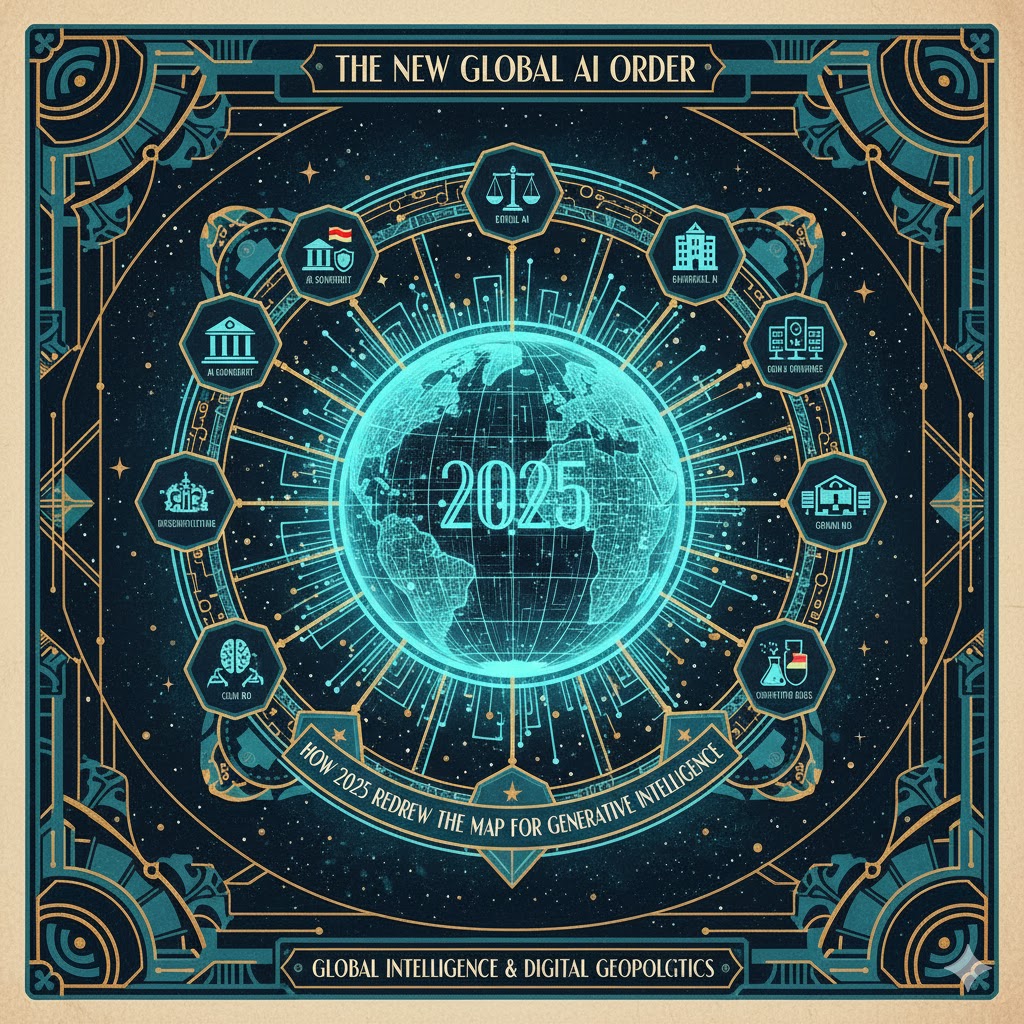
The last weeks of October 2025 may well mark a turning point in how nations deploy, regulate, and compete in artificial intelligence. From Brussels to Tokyo, Washington to London, governments are no longer merely reacting to AI—they are actively architecting its future.
We are witnessing the convergence of three forces: regulatory maturity, sovereign infrastructure investment, and strategic alliances. Together, these shifts define the next era of global AI: one where power is measured not just in compute or models, but in trust, control, and interoperability.
Europe: From Regulation to Application
For years, Europe has been the world’s compliance laboratory. The EDPS’s revised generative AI guidance (October 28, 2025) deepens this position, clarifying roles for controllers and processors while demanding stricter privacy-by-design standards. But for the first time, the European Commission is coupling regulation with deployment.
The “Apply AI” strategy, launched earlier in October, aims to accelerate adoption across 11 key sectors—from mobility and manufacturing to energy and defense—through funding, cross-border sandboxes, and public procurement incentives.
This dual approach—guardrails + growth—signals a European realization: without applied AI, sovereignty is theoretical.

reComputer Super J4012 – Advanced Edge AI Computer with NVIDIA Jetson Orin NX 16GB
Supercharged AI Performance: Powered by NVIDIA Jetson Orin NX 16GB, delivers up to 157 TOPS in MAXN Super…
As an affiliate, we earn on qualifying purchases.
As an affiliate, we earn on qualifying purchases.
United States: Scaling Intelligence Itself
Across the Atlantic, the U.S. Department of Energy’s partnership with NVIDIA and Oracle to build the “Solstice” and “Equinox” supercomputers represents a redefinition of scientific capacity.
Together, these systems will deliver over 2,000 exaflops of AI performance, training agentic systems for climate modeling, material discovery, and next-generation simulation science.
But this is more than a compute story. It’s a policy signal—that public-private alliances now form the backbone of American AI competitiveness. The lesson for others: innovation follows infrastructure.
Generative AI Design Patterns: Solutions to Common Challenges When Building GenAI Agents and Applications
As an affiliate, we earn on qualifying purchases.
As an affiliate, we earn on qualifying purchases.
Asia: The Prosperity Alliance
Japan’s signing of the U.S.–Japan Technology Prosperity Deal extends AI cooperation to semiconductors, quantum computing, and data governance. Tokyo’s alignment with Washington transforms AI from a commercial technology into a strategic asset class, protected by treaties and synchronized export controls.
It also illustrates a wider Indo-Pacific shift—where digital alliances are replacing traditional trade pacts as the measure of influence.

The Confidence Advantage: Optimizing Privacy, Cybersecurity and AI Governance for Growth
As an affiliate, we earn on qualifying purchases.
As an affiliate, we earn on qualifying purchases.
United Kingdom: R&D as a Long Game
The UK’s £55 billion R&D funding boost isn’t a headline grant—it’s a ten-year bet. By strengthening national labs and agencies like the AI Security Institute, Britain is quietly positioning itself as a foundational research hub in an era dominated by application hype.
This long-term capital injection reflects a principle often overlooked in the AI arms race: discovery precedes deployment.
![[Research-Grade] Vabiooth Lab Compound Trinocular Microscopes 40X-2500X Magnification with 7" LCD Screen 5MP E-Eyepiece, Two-Layer Mechanical Stage for Animal Husbandry, Pet Hospitals, Lab, Farms](https://m.media-amazon.com/images/I/41B0xuId-LL._SL500_.jpg)
[Research-Grade] Vabiooth Lab Compound Trinocular Microscopes 40X-2500X Magnification with 7" LCD Screen 5MP E-Eyepiece, Two-Layer Mechanical Stage for Animal Husbandry, Pet Hospitals, Lab, Farms
[Upgrade function]: Vabiooth Biological Microscope has a 5MP Electronic Eyepiece 360 degree 7" large LCD display and an…
As an affiliate, we earn on qualifying purchases.
As an affiliate, we earn on qualifying purchases.
What It All Means
2025 marks the moment the global AI race matured into an AI ecosystem. Each bloc is defining its edge:
| Region | Strategic Focus | Underlying Philosophy |
|---|---|---|
| EU | Ethical deployment & industrial adoption | “Sovereignty through responsibility” |
| US | Infrastructure & scale alliances | “Compute is policy” |
| Japan | Tech diplomacy & standards alignment | “Security through cooperation” |
| UK | Foundational research & resilience | “Innovation through endurance” |
The coming year will determine how these strategies interact—or collide.
The Post-Labor Lens
For policymakers and entrepreneurs alike, this is more than geopolitics. It’s the groundwork for a post-labor economy, where agentic systems perform cognitive work once limited to humans.
Those who control how these systems are trained, audited, and scaled will control not only markets—but the future distribution of human value.
Thorsten Meyer | Munich
Futurist · Author · Post-Labor Economist
https://thorstenmeyerai.com