
By Thorsten Meyer — May 2026

Get business pricing on tech for your team
- Business-only prices and quantity discounts
- Tax-exempt purchasing
- Multiple users, one account, clear invoices
If you have been working in knowledge work for more than five years, you have a quiet suspicion about your own job that you have not said out loud.
Your manager is happy. The numbers look fine. And yet, when you look at the last two weeks of your work — what you actually spent your time on, item by item — there is a feeling you cannot shake. Some part of what you did does not feel like it was pulling weight anymore. You cannot tell which part. You suspect it is bigger than you are admitting.
That feeling is telling you something important, and most of the available career advice is not. The standard framings — develop judgment, build taste, articulate your role — tell you what to do without telling you which part of your current week actually needs it. Your job is not one thing. It is fifty small things packed into one title, and some of them are more yours than others.
The quiet audit.
55–75% of your week is on thin ice. Here’s which part.
If you’ve been working in knowledge work for more than five years, you have a quiet suspicion about your own job that you have not said out loud. Your manager is happy. The numbers look fine. And yet — looking at the last two weeks of your work, item by item — there is a feeling you cannot shake. Some part of what you did does not feel like it was pulling weight anymore. You suspect it is bigger than you are admitting.
15–30% of every senior role is theatre. Nobody says so.
Real work, in the sense that someone does it and someone is upset if it’s not done. Not real work, in the sense that it does not change a decision, ship a product, or move a number that matters. The polite fiction worked when there was no cost to maintaining it. AI absorbs theatre first — because nobody is reading the output substantively. The function is signalling effort, not transferring information.
Status meetings, FYI forwards, slide refresh — the work the system asked you to perform.
- Updating slides for a leadership review where the leadership has already decided
- The status meeting where the status was readable in the Jira board the day before
- Re-summarizing the conclusion in a follow-up email after the meeting that summarized it
- The thank-you email after the Slack message that already said thank you
- Performative responsiveness — being seen replying within 7 minutes
- The all-hands “open Q&A” where every question was pre-vetted
time tracking software for knowledge workers
As an affiliate, we earn on qualifying purchases.
As an affiliate, we earn on qualifying purchases.
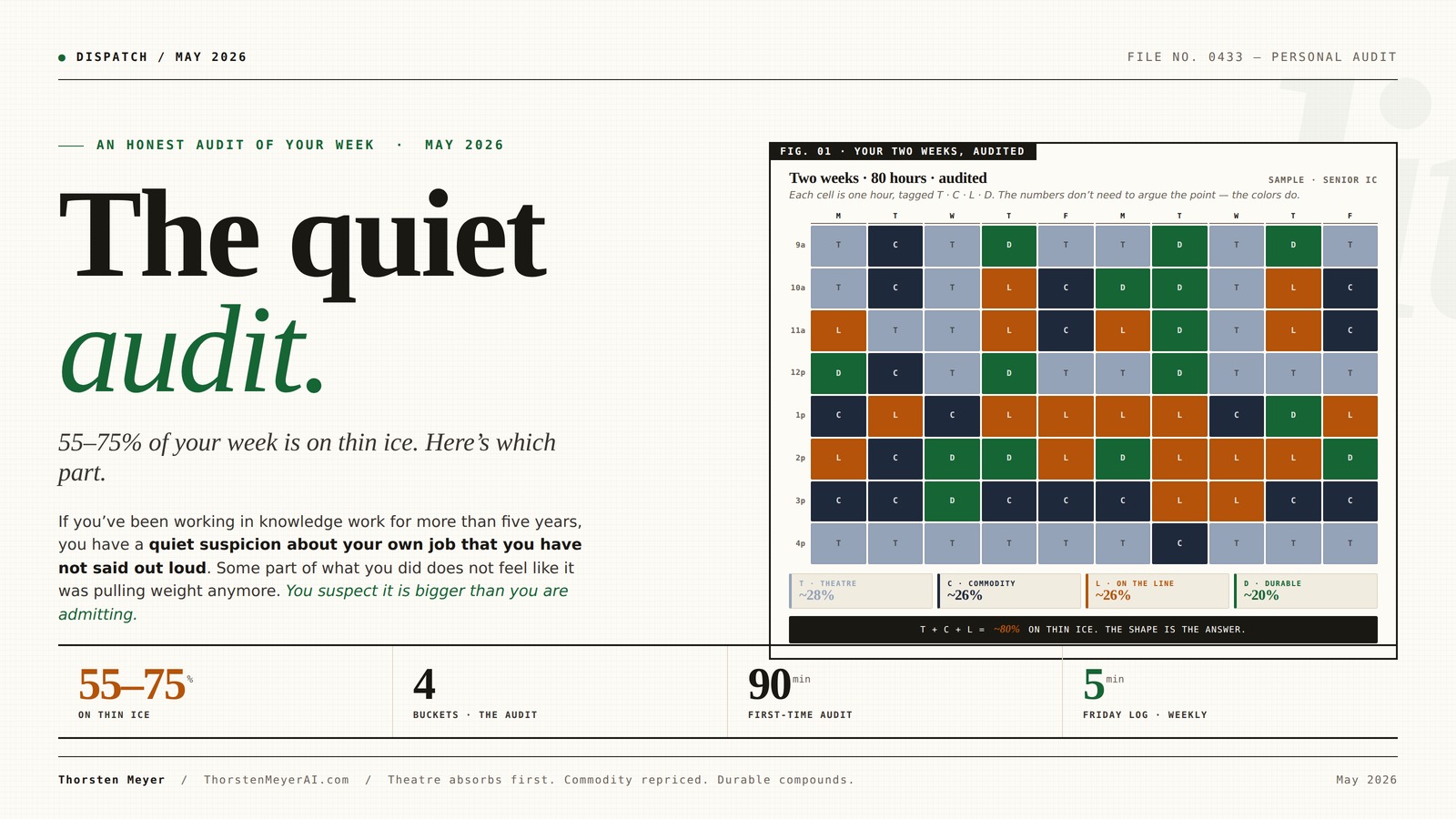
A typical week, after honest tagging.
Eighty hours over two weeks. Each cell is one hour, tagged T, C, L, or D. The numbers don’t need to argue the point — the colors do.
As an affiliate, we earn on qualifying purchases.
Three steps. Coffee optional.
Calendar, Slack, ticket system, and 90 minutes uninterrupted. Simple, not easy. The discipline is not the prompt — it is the inventory. The audit only works if the inventory is honest.
Every distinct item. No summaries.
40–90 items typical. If fewer than 30 you’re aggregating; go back and split. If more than 120, combine. Each item is a thing you spent 15+ minutes on.
One letter per item. T · C · L · D.
This is where most people lie to themselves. The first lie is over-tagging D. Watch for it. The second lie is calling something T when the prep doc was actually C — tag the meeting and the doc separately.
Add the time. Compute four percentages.
Not any single bucket — the shape of your week is the answer. Typical senior IC: ~25 T / ~30 C / ~25 L / ~20 D. If your D is below 10%, the audit has already given you its most important finding.
As an affiliate, we earn on qualifying purchases.
What becomes visible after you tag.
Question-holding beats question-answering.
Most of what gets paid in senior roles is question-answering — analyses, recommendations, code. Almost all of it is C or L. The reliably durable work is question-holding: keeping a question open against pressure to close it. Holding open “is this the right segment?” for three weeks is durable. Producing the analysis is not.
Compounding lives in the unloved adjacencies.
Your D-bucket items are usually not on your job description. They are the introduction you made between two people who are now collaborating. The doc everyone keeps citing. The pushback that turned out to be right. Career systems do not measure these. The audit forces you to.
The legibility paradox.
Theatre is the most legible work in your week — artifacts, deadlines, audiences, visible completion. Durable work is the least legible — conversational, accumulated, contextual, often invisible. This is why theatre is paid and durable work is what survives. Increasingly different things.
Identity is the obstacle, not skill.
The hardest part of the audit is admitting that 25% of your week is theatre — and that you have been performing it for years, telling yourself it was strategic communication, executive presence, organizational leadership. The audit makes you describe it without those words. The piece people refuse to do is usually the piece that would have helped most.
As an affiliate, we earn on qualifying purchases.
From audit to action.
Cut theatre this week.
Decline one recurring meeting. Stop the FYI forwards. Reply with the actual answer instead of the meeting invite. Most theatre is sustained by one person at the top. You probably are not that person — you can stop without anyone noticing.
Push commodity to commodity tools.
The 25–40% C-bucket is the most economically irrational time-allocation at current AI prices. The barrier is rarely tooling — it’s that you are good at the commodity work. The credit is going to evaporate. Move first.
Re-shape on-the-line work toward judgment.
L-bucket items have two parts: the judgment part (~30% of time) and the routine part (~70%). AI inverts this ratio. Do the judgment part well; let the routine part get automated underneath you. The role doesn’t change name — its internal composition does.
Make durable work legible.
The move most senior people skip and most regret. Write down your D-bucket items the day they happen. Most performance reviews run from your manager’s memory of the legible work. Your job is to surface the durable work into the record. If you don’t, nobody else will.
Negotiate the shape of the role.
Once you know your bucket mix, you can have a conversation you couldn’t have before. Not “promote me.” Specifically: “Here is the C I want to hand off, the L I want to reshape, the D I want more of, and the headcount or tooling implication.” A competent manager engages. One who refuses tells you something important by refusing.
Recognize when the honest answer is a different role.
Sometimes the audit produces a result no internal re-shape can fix: the role itself is 70% T+C, the D-bucket is structurally tiny, and there is no path to a higher-D mix. The move is not to fix the role. It is to leave it. Most people do this two years later than they should. The audit accelerates the timeline by exactly that.
Three habits. Five minutes a week.
Three lines. Every Friday. Before you close the laptop.
The week after the audit, you will revert. Theatre fills back in. C-bucket piles up because it’s on the inbox. The D-bucket items go unrecorded. The Friday log is the smallest possible habit that prevents this.
T ▸ One thing I did and shouldn’t have: [meeting I should have skipped, FYI I should have left unsent]
L ▸ One thing I reshaped: [where I did the judgment part and let the routine part get automated]
The polite fiction, when there was no cost to maintaining it, was that all of your week was the work. The cost has arrived. The audit is the conversation with yourself where the fiction ends.
Four assignments. By tier.
Contributors
Run the audit once.
Spend 90 minutes. The first time is uncomfortable; subsequent ones are routine. Most of the value is in the first one — and most of that value is in the items you wanted to skip tagging.
The Friday log. Five minutes weekly.
Highest-leverage habit you can adopt. Compounds across a career. The five minutes you spend each week become the body of evidence at every promotion conversation, every job change, every review you have for the next decade.
Run it on yourself first.
Then offer the framework to your team — but never run it on a direct report without their consent. The audit is private property. What you can offer is the language, the four buckets, and the quiet permission to look honestly.
Reduce the theatre your org creates.
Cancel the status meeting. Kill the report nobody reads. Reducing T-bucket work across an organization compounds in retention, focus, and morale faster than any productivity tooling. The most useful thing you can do for your team is the work only you have authority to do.
This piece is the audit. By the end, you will have a specific method for sorting your last two weeks into four buckets, and a set of moves for redirecting your week toward the work that compounds.
Some of what follows is uncomfortable. I am going to ask you to look at things about your own job that the polite collective fiction of your workplace has agreed not to look at. The fiction worked when there was no cost to maintaining it. There is a cost now.
Executive Summary
| Bucket | What it is | Typical share | What happens to it |
|---|---|---|---|
| T · Theatre | Politically required performance — meetings where nothing is decided, slides updated for review, “FYI” forwards, performative responsiveness | 15–30% | AI absorbs first. Nobody actually reads the output. |
| C · Commodity | Standardized output — routine code, routine analysis, routine documents, anything with a known form factor | 25–40% | Repriced to near-zero by token-cost decline. |
| L · On the line | Judgment work that could be automated next quarter or next year | 20–35% | Currently yours. Increasingly contested. |
| D · Durable | Work that compounds — relationships, context-specific judgment, what you decide not to do, the question you held open against pressure | 10–25% | AI augments. Does not replace. |
The 55–75% figure is the typical T+C+L share. Not all of it is dying. But all of it is moving — and you should be able to name each item under each letter. If you cannot, that is the audit’s first finding.
1. The Polite Fiction Layer
Every senior role contains a layer of work that nobody at the company would describe out loud as the actual job, but which everyone — the worker, the manager, the manager’s manager — implicitly agrees is part of it.
Updating slides for a leadership review where the leadership has already made up their minds. Re-summarizing a conclusion in a follow-up email after the meeting that just summarized it. The all-hands “open Q&A” where the questions are pre-vetted. The status meeting where the status was readable in a Jira board the day before. The thank-you email after the Slack message that already said thank you.
This is the theatre layer. It is real work, in the sense that someone does it and someone is upset if it is not done. It is not real work, in the sense that it does not change the shape of any decision, ship any product, or move any number that matters.
In most senior roles, the theatre layer is 15 to 30 percent of the week. Some weeks it spikes higher — review cycles, performance season, board prep, post-reorg “alignment.” Some weeks it dips lower. But it is never zero. Over a year, the average is uncomfortably close to a full day every week.
The polite fiction worked for two decades because it had no cost. The cost was opportunity cost — what you would have done with that day — and that cost was invisible. Now the cost is visible. Theatre is the first thing AI absorbs, because nobody is reading the output substantively, which means an LLM-generated version is indistinguishable from a human-generated version for the function the work performs. The function is signalling effort, not transferring information.
Once management figures this out — and most large enterprises are figuring it out in 2026 — the theatre work either gets auto-summarized into a one-line digest, or it gets cut entirely. Either way, the share of your week that was performing theatre is no longer counted toward your contribution. If theatre was 25% of your week, the remaining 75% is what your job now is. If your remaining 75% is mostly commodity and on-the-line work, the math gets uncomfortable fast.
The first move of the audit is to look squarely at the theatre layer. Not to feel guilty about it — most theatre is something the system asked you to perform, not something you chose. But to see it. The polite fiction of your workplace is that everything in your calendar is real work. The audit is the conversation with yourself where you stop pretending.
2. The Audit · A 90-Minute Method
The audit is simple. It is not easy.
You will need: your last two weeks of calendar, your last two weeks of Slack/Teams/email, your last two weeks of Jira/Linear/whatever ticket system you use, and 90 minutes of uninterrupted time. Coffee is optional but recommended.
Step 1 (30 min): Inventory. Write down every distinct item of work from the last two weeks. Not summaries. Items. “Drafted Q2 OKR doc.” “Reviewed two PRs for the platform team.” “Took the Tuesday status meeting.” “Wrote the follow-up email after the Tuesday status meeting.” If an item took 15 minutes, it is on the list. If it took two hours, it is one item, not eight.
You will end up with somewhere between 40 and 90 items. If you have fewer than 30, you are aggregating — go back and split. If you have more than 120, you are splitting too fine — combine.
Step 2 (40 min): Tag each item. Next to each item, write one letter:
- T if the item performed status, signalled effort, or produced output nobody substantively reads.
- C if the item produced standardized output — something a competent person could replicate using a template, a checklist, or a competent LLM.
- L if the item required judgment that currently requires you, but where you can name a path by which it could not require you in 12–24 months.
- D if the item required context, relationships, or judgment that compounds — work where the value comes from your specific accumulated knowledge of this company, this product, these people, this market.
This step is where most people lie to themselves. The first lie is over-tagging D. Watch for it. The second lie is calling something T when it is actually C — yes, the meeting was theatre, but the prep document you wrote for it was commodity. Tag the meeting and the doc separately.
Step 3 (20 min): Total. Add up the time spent in each bucket. Compute the four percentages.
The number that matters is not any one bucket — it is the shape of your week. A typical senior IC, audited honestly, comes out around 25% T, 30% C, 25% L, 20% D. The “55–75% on thin ice” figure is the T+C+L share. It is not all dying. But it is all moving.
If your D bucket is below 10%, the audit has already given you its most important answer.
3. Four Insights the Audit Reveals
Run the audit honestly and four things become visible that were not visible before.
Insight 1: Question-holding vs question-answering. Most of what gets paid in senior roles is question-answering — producing analyses, recommendations, documents, code. Almost all question-answering is C or L. The work that is reliably D is question-holding — the discipline of keeping a question open in front of decision-makers who want it closed too quickly. Holding open “are we sure this is the right segment?” for three weeks against pressure to ship is durable work. Producing the segment analysis is not. Most senior people have inverted this in their own self-image.
Insight 2: Compounding lives in the unloved adjacencies. Your D-bucket items are usually not the things on your job description. They are the things you do in the margins — the introduction you made between two people who are now collaborating, the document you wrote that everyone keeps citing, the pushback you gave in a meeting two months ago that turned out to be right. Career systems do not measure these. The audit forces you to.
Insight 3: The legibility paradox. Theatre is the most legible work in your week. It has artifacts, deadlines, audiences, and visible completion. Durable work is the least legible. It is conversational, accumulated, contextual, and often invisible to anyone who was not there. This is why theatre is paid — and why durable work is what survives. The structural problem is that the legibility is what your manager sees, and the durability is what your career compounds on. These are increasingly different things.
Insight 4: Identity is the obstacle, not skill. The hardest part of the audit is not figuring out what is theatre. It is admitting that 25% of your week is theatre — and that you have been performing it for years, telling yourself it was strategic communication, executive presence, organizational leadership. The audit makes you describe it without those words. Some people cannot. The piece of the audit they refuse to do is usually the piece that would have helped them most.
4. Six Moves for Pathing Forward
In order of immediacy.
Move 1 · Cut theatre this week. Decline one recurring meeting that produces no decision. Stop sending the FYI forwards. Reply with the actual answer instead of the meeting invite. Most theatre is sustained by a single person at the top continuing to expect it; the rest of the org follows. You are probably not that person. You can stop without anyone noticing.
Move 2 · Push commodity to commodity tools. The 25–40% of your week that is C-bucket is the most economically irrational allocation of your time at current AI prices. Templates, AI, automation, hand-off — any of these are cheaper than your hourly rate doing routine work. The barrier is rarely tooling. The barrier is that you are good at the commodity work and have been getting credit for it for years. The credit is going to evaporate. Move first.
Move 3 · Re-shape on-the-line work toward judgment. L-bucket items have two parts: the judgment part and the routine part. Routinely, the routine part takes 70% of the time and the judgment part 30%. AI inverts this. Do the judgment part well; let the routine part get automated underneath you. The role does not change name. The internal composition does.
Move 4 · Make durable work legible. This is the move most senior people skip and most regret skipping. Write down your D-bucket items. Maintain a running record. When durable work shows up — the introduction, the long-game decision that paid off, the pushback that proved correct — capture it the day it happens. Most performance reviews are conducted from the manager’s memory of the legible work; the worker’s job is to surface the durable work into the record. If you do not, nobody else will.
Move 5 · Negotiate the shape of the role. Once you know your bucket mix, you can have a conversation with your manager that you could not have before. Not “give me a promotion.” Not “I want more interesting work.” Specifically: “Here is the C-bucket work I want to hand off this quarter, here is the L-bucket work I want to re-shape, here is the D-bucket work I want to spend more of my week on, and here is the headcount or tooling implication.” A competent manager will engage with this seriously. A manager who refuses to engage tells you something important by refusing.
Move 6 · Recognize when the honest answer is a different role. The audit sometimes produces a result that no internal re-shape can fix: the role itself is 70% T+C, the D-bucket is structurally tiny, and there is no path from the current job description to a higher-D mix. When this happens, the move is not to fix the role. It is to leave it. Most people do this two years later than they should. The audit, taken honestly, accelerates the timeline by exactly that amount.
5. Making Durable Work Legible
The hardest part of the audit, after the audit itself, is keeping the audit alive.
The week after you do it, you will revert. The theatre will fill back in. The commodity work will pile up because it is what is on your inbox. The L-bucket will compress. The D-bucket items — the conversation that changed a senior engineer’s decision, the introduction, the question you held open — will go unrecorded.
Three habits keep the audit alive.
Habit 1 · The Friday five-minute log. Every Friday, before you leave the laptop, write three lines: one D-bucket item from the week, one T-bucket item you did and shouldn’t have, one L-bucket item you reshaped. Three lines. Five minutes. Over a year, you have a record.
Habit 2 · The quarterly re-audit. Once per quarter, do the full 90-minute version. The bucket mix shifts as your role shifts. If the D-share is climbing, the trajectory is right. If it is flat or falling, the trajectory is wrong, and you have three months of data to explain why.
Habit 3 · The annual record. Most performance reviews are oriented around the legible work. Bring the durable record. The decisions you held open. The relationships you built. The questions you refused to close prematurely. Most reviews are looking for it but cannot find it. You make it findable.
The prompts that run the audit are simple — any LLM can take a list of work items and apply the four-letter taxonomy with reasonable accuracy if you give it the definitions. The discipline is not the prompt. It is the inventory. The audit only works if the inventory is honest.
What to Do This Quarter
1. Individual contributors: Run the audit once. Spend 90 minutes on it. The first time is uncomfortable; subsequent ones are routine. Most of the value is in the first one.
2. Senior ICs: The Friday five-minute log is the highest-leverage habit you can adopt. Five minutes per week. Compounds across a career.
3. Managers: Run it on yourself first. Then offer the framework to your team — but never run it on a direct report without their consent. The audit is private property.
4. Directors and above: The most useful thing you can do for your organization is reduce the theatre layer the company creates. Cancel the status meeting. Kill the report nobody reads. Reducing T-bucket work across an org compounds in retention, focus, and morale faster than any productivity tooling.
The Strategic Read
The dispatches in this series have described the same underlying force from the executive side: the agent supply chain compromise that put OAuth scope on the security perimeter (File 0426), the open-weight inflection that re-priced the model layer (File 0427), the layoff narrative gap between 47.9% claimed and 9% real (File 0428), the enterprise platform race (File 0429), the productivity-expectation bubble (File 0430), the agent-as-feature trap (File 0431), and the PE channel acquisition that compresses the 9% into 25% inside portfolio companies (File 0432).
This piece is the same force, viewed from inside your week.
The audit does not tell you whether your job is safe. It tells you which parts of your job are safe and which are exposed, in language specific enough to do something about. It separates “I have a vague feeling AI is coming for my work” — which is paralyzing — from “the C-bucket of my week is roughly 30% and I should reshape it by the end of the quarter” — which is actionable.
The 55–75% on thin ice is not a prediction that 55–75% of you will be unemployed. It is a description of the share of the typical knowledge-work week that is structurally exposed to one of three forces — theatre absorption, commodity repricing, or judgment automation — that have all moved from “possible” to “happening” in the past nine months.
The honest read is that some of that 55–75% will move under you regardless of what you do. The question the audit answers is which moves are happening to you, and which moves are yours to make first.
The polite fiction, when there was no cost to maintaining it, was that all of your week was the work. The cost has arrived. The audit is the conversation with yourself where the fiction ends.
Theatre absorbs first. Commodity repriced. Durable compounds. The audit is the conversation with yourself where the polite fiction ends.
About the Author
Thorsten Meyer is a Munich-based futurist, post-labor economist, and recipient of OpenAI’s 10 Billion Token Award. He spent two decades managing €1B+ portfolios in enterprise ICT before deciding that writing about the transition was more useful than managing quarterly slides through it. More at ThorstenMeyerAI.com.
Related Dispatches
- Your AI Vendor’s AI Vendor — agent supply chain compromise
- Single Digits — the April 2026 open-weight inflection
- AI-Washed — the 47.9% / 9% layoff narrative gap
- The 27% Problem — Anthropic’s enterprise lead and Google’s $750M check
- The Bubble Is Not in Valuations — the productivity gap
- The Agent Trap — why 90% of AI “launches” are infrastructure liars
- The Channel Move — the Anthropic × Wall Street PE channel acquisition
Sources
- McKinsey, The Future of Work in Knowledge Roles (2025)
- BCG, Generative AI in the Senior IC Workflow (2026-Q1)
- Slack Workforce Index, Time Allocation in Knowledge Work (2026-Q1)
- a16z, State of Enterprise AI Spending (2026-Q1)
- (Internal series synthesis · prior dispatches 0426–0432)
Fall Picks
fall essentials
As an affiliate, we earn on qualifying purchases.