By Thorsten Meyer AI — May 2026

Get business pricing on tech for your team
- Business-only prices and quantity discounts
- Tax-exempt purchasing
- Multiple users, one account, clear invoices
A strange career trade is spreading through Silicon Valley.
The old move was obvious: become CTO, run a large engineering organization, own the platform, sit near the CEO, manage the roadmap, control the budget.
The new move is stranger: leave the executive seat and join Anthropic as a builder.
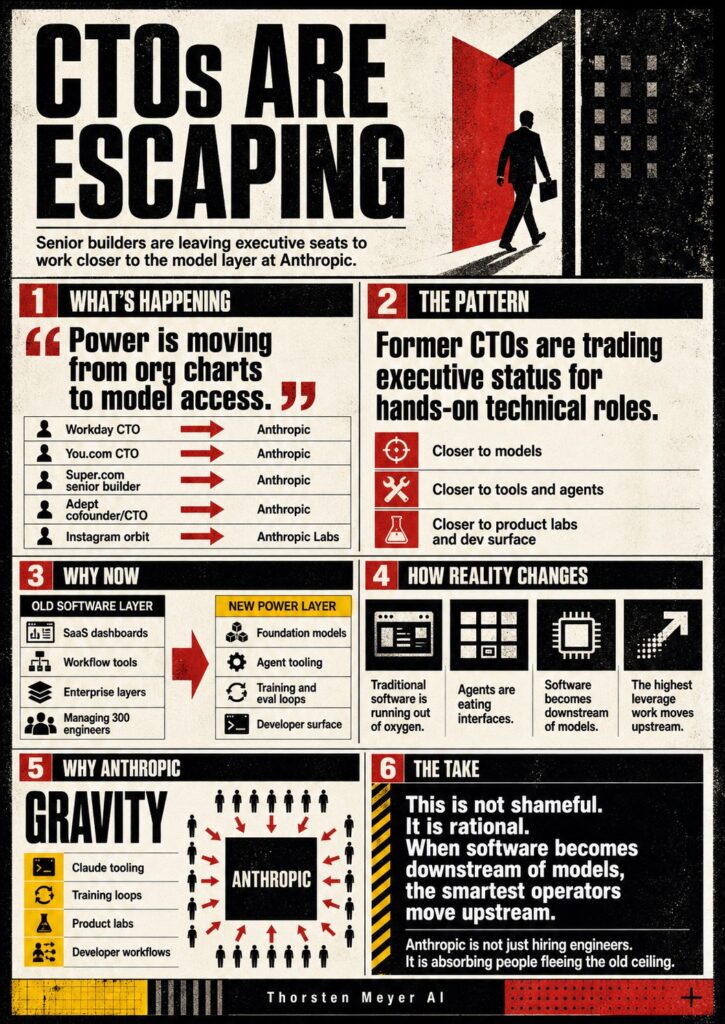
Peter Bailis left Workday’s CTO role in March 2026 to become a Member of Technical Staff at Anthropic, where he is reportedly working on reinforcement-learning engineering. Bryan McCann, co-founder and CTO of You.com, left for Anthropic as a technical staff member. Mike Krieger, Instagram’s co-founder and former CTO, had already joined Anthropic as Chief Product Officer in 2024, then moved in January 2026 into Anthropic Labs, a more hands-on internal incubator focused on experimental Claude products. Henry Shi, co-founder and former COO/CTO of Super.com, says he stepped back from a company doing more than $200 million in annual revenue and joined Anthropic. Niki Parmar, co-founder and former CTO of Adept AI Labs and co-author of the Transformer paper, is now listed as Member of Technical Staff at Anthropic. (TNW | The heart of tech)
The Box example is more ambiguous. Social posts now include “Box CTO → Anthropic” in the pattern, but public Box material still showed Ben Kus as Box CTO in 2026, including Anthropic and Box-related appearances. So the clean version of this trend is not “every CTO has left.” The cleaner version is more interesting: senior product and technical operators are choosing proximity to frontier models over conventional software authority. (Anthropic)
That is the real signal.
This is not a demotion story. It is a power story.
Executive Summary
| Signal | Why It Matters |
|---|---|
| Former CTOs and senior builders are moving into Anthropic technical roles | Prestige is shifting from org-chart authority to model-layer access |
| Workday, You.com, Super.com, Adept, and Instagram’s orbit are part of the pattern | The migration cuts across SaaS, AI search, commerce, consumer software, and frontier AI |
| Anthropic’s MTS role blurs research, engineering, and product | The frontier lab job is not “just coding”; it is access to the core loop |
| Traditional SaaS is under agentic pressure | Dashboards and workflow apps are becoming downstream of models |
| Anthropic is becoming a talent sink for builders fleeing the old ceiling | The lab is absorbing people who want to work where the platform shift is happening |
As an affiliate, we earn on qualifying purchases.
The Career Trade
On paper, a CTO role should dominate a technical staff role.
The CTO owns strategy. The CTO manages hundreds or thousands of engineers. The CTO shapes architecture, hiring, vendor decisions, platform direction, and sometimes product positioning.
But in the AI transition, the old hierarchy is being repriced.
A CTO at a large SaaS company may control a mature software estate. A senior builder at Anthropic may touch model behavior, tool use, reinforcement learning, Claude Code, developer workflows, product labs, and the new interface between human work and machine execution.
That is a different kind of leverage.
Anthropic’s own careers page makes the structure explicit: engineers do research, researchers do engineering, and engineers can have “as much input into Anthropic’s direction as anyone else.” (Anthropic)
That line explains the trade.
At a frontier lab, “Member of Technical Staff” can mean being close to the loop that matters: model capability, training feedback, product surface, evals, infrastructure, enterprise deployment, and agent behavior.
At an old software company, “CTO” can mean managing a layer that the model is starting to abstract away.
reinforcement learning engineering books
As an affiliate, we earn on qualifying purchases.
As an affiliate, we earn on qualifying purchases.
The Old Software Layer Is Losing Oxygen
Traditional enterprise software was built around a simple assumption: work needed applications.
Sales teams needed CRM. HR teams needed HCM. Finance teams needed ERP. Content teams needed document platforms. Customer-support teams needed ticketing systems. Each workflow became a dashboard. Each dashboard became a SaaS company.
Agents change the center of gravity.
If an AI system can read the data, call the tools, reason across context, and execute the task, the dashboard becomes less important. The workflow does not disappear. The interface changes.
That is why the “SaaS is dead” argument keeps returning, even when it is overstated. Deloitte’s 2026 outlook says SaaS applications are likely to become more intelligent, personalized, adaptive, and autonomous, shifting toward a federation of real-time workflow services and disrupting pricing models. Harvard Business Review framed the same pressure more sharply: generative AI is dissolving the economic logic that made standardized enterprise software the default choice for companies. (Deloitte)
The point is not that Salesforce, Workday, Box, ServiceNow, Atlassian, and HubSpot vanish tomorrow.
The point is that their old interface moat is weaker.
A workflow app used to own the user because it owned the screen. In the agent era, the model may own the screen, the action layer, and the reasoning path. The SaaS product becomes a data source, permission system, compliance boundary, or backend tool.
That is still valuable.
But it is no longer the top of the stack.
frontier AI model development kits
As an affiliate, we earn on qualifying purchases.
As an affiliate, we earn on qualifying purchases.
Why Anthropic Is the Magnet
Anthropic is not only selling Claude as a chatbot. It is building the surfaces around Claude: coding, enterprise workflows, internal tools, labs, agents, MCP-style connectivity, and model-adjacent product infrastructure.
That matters because builders do not only chase compensation. They chase surface area.
A senior builder wants to work where small technical changes have large downstream consequences. In old SaaS, that might mean optimizing onboarding, improving search, redesigning permissions, or shipping a new analytics module.
At Anthropic, it might mean changing how an AI agent plans, how a model uses tools, how Claude writes production code, how enterprise data becomes action, or how developer workflows are rebuilt around a model.
That is why the Krieger move is so revealing. Anthropic announced in January 2026 that Krieger would join Labs, a team incubating experimental products at the frontier of Claude’s capabilities, alongside Ben Mann. The stated mission is not to polish an existing dashboard. It is to build new product categories around what Claude can do next. (Anthropic)
This is the new technical gravity.
Anthropic is not just hiring engineers.
It is absorbing people who have already seen the ceiling of the old software stack.
machine learning developer workstation
As an affiliate, we earn on qualifying purchases.
As an affiliate, we earn on qualifying purchases.
The Workday Signal
Peter Bailis is the cleanest example because the trade was so stark.
He joined Workday as CTO in 2025. Less than a year later, he moved to Anthropic as Member of Technical Staff. Reporting around the move says Anthropic confirmed he would work on reinforcement-learning engineering. (TNW | The heart of tech)
That is not a normal résumé optimization.
Workday is not a small company. It is one of the core enterprise software systems of record: HR, finance, planning, identity-adjacent workforce data, organizational structure, compensation, approvals, and compliance.
So why leave the CTO seat?
Because the strategic question is no longer only “How does Workday add AI?”
The sharper question is: What happens when AI agents become good enough to operate across Workday-like systems?
If agents become the workflow layer, then the value shifts upstream. The company that controls the model, tool interface, memory, policy stack, and developer surface can sit above many enterprise applications.
That does not make Workday irrelevant.
It makes Workday downstream.
The You.com Signal
Bryan McCann leaving You.com for Anthropic is a different kind of signal.
You.com is itself an AI company. It is not a legacy SaaS dashboard vendor trying to catch up. It was early to AI search and enterprise AI workflows. Yet its co-founder and CTO still moved to Anthropic as technical staff, according to The Information and follow-on reporting. (The Information)
That suggests the migration is not merely “old software people want to escape old software.”
It is also that smaller AI application companies may be structurally downstream of frontier model labs.
An AI app company can build distribution, workflow, UI, vertical context, and customer relationships. But if the frontier model improves quickly enough, the application layer has to constantly justify why it exists separately from the lab.
That is the pressure.
The model eats the feature. The agent eats the workflow. The lab eats the talent.
The Super.com Signal
Henry Shi’s move adds another dimension.
Super.com was not a pure SaaS company. It was a consumer-commerce and fintech-style business with large-scale revenue, users, and operational complexity. Shi says he grew Super.com from zero to more than $200 million in annual revenue, over $1 billion in annual GMV, and 50 million users, then stepped back and joined Anthropic. (Henry the 9th)
That matters because the frontier-lab pull is not only coming from enterprise software.
It is pulling from operators who understand growth, transactions, consumer behavior, marketplaces, and real-world execution.
Why?
Because frontier AI is moving from model demos to work systems. Labs need people who understand not only research, but distribution, product loops, business operations, reliability, and how messy workflows behave outside a benchmark.
The old frontier was the model.
The new frontier is the model inside the workflow.
The Adept Signal
Niki Parmar’s move is the most symbolic.
Adept was built around the idea of AI that could use software tools on behalf of users. That was the agent thesis before “agents” became the market’s favorite word. Parmar had already been close to the model-action layer as Adept’s co-founder and CTO, and she is one of the co-authors of the 2017 Transformer paper that made the modern LLM era possible. She is now listed as Member of Technical Staff at Anthropic. (LinkedIn)
This is the migration in compressed form.
From inventing the architecture.
To building an agent startup.
To joining the frontier lab.
That is the path of technical gravity.
This Is Not Shameful. It Is Rational.
The lazy interpretation is that CTOs are “giving up” executive status.
The better interpretation is that status itself is being rewritten.
In the old software era, power meant managing the application layer. You owned the roadmap, the headcount, the architecture, and the customer commitments.
In the model era, power means access to capability formation.
Can you influence how the model reasons?
Can you change how it uses tools?
Can you shape its training loops?
Can you build the developer surface everyone else builds on?
Can you compress a workflow from thirty clicks to one instruction?
Can you turn a software category into a capability inside Claude?
That is where the power is moving.
The people closest to that shift are voting with their careers.
The Strategic Take
“CTOs Are Escaping” sounds dramatic. But the better phrase may be this:
CTOs are moving upstream.
They are not fleeing responsibility. They are fleeing layers that look less durable than they did five years ago.
The SaaS dashboard is not dead. But it is no longer sacred.
The workflow tool is not dead. But it is no longer the obvious center of work.
The CTO title is not dead. But it is no longer always the highest-leverage technical seat.
Anthropic’s advantage is not only Claude. It is the gravitational field around Claude: the belief among senior builders that the most important work is now happening at the model layer and the agent surface around it.
That is why this trend matters.
A frontier lab does not win only by having better benchmarks.
It wins when the people who used to run the old software world decide they would rather build inside the new one.
Fall Picks
fall essentials
As an affiliate, we earn on qualifying purchases.