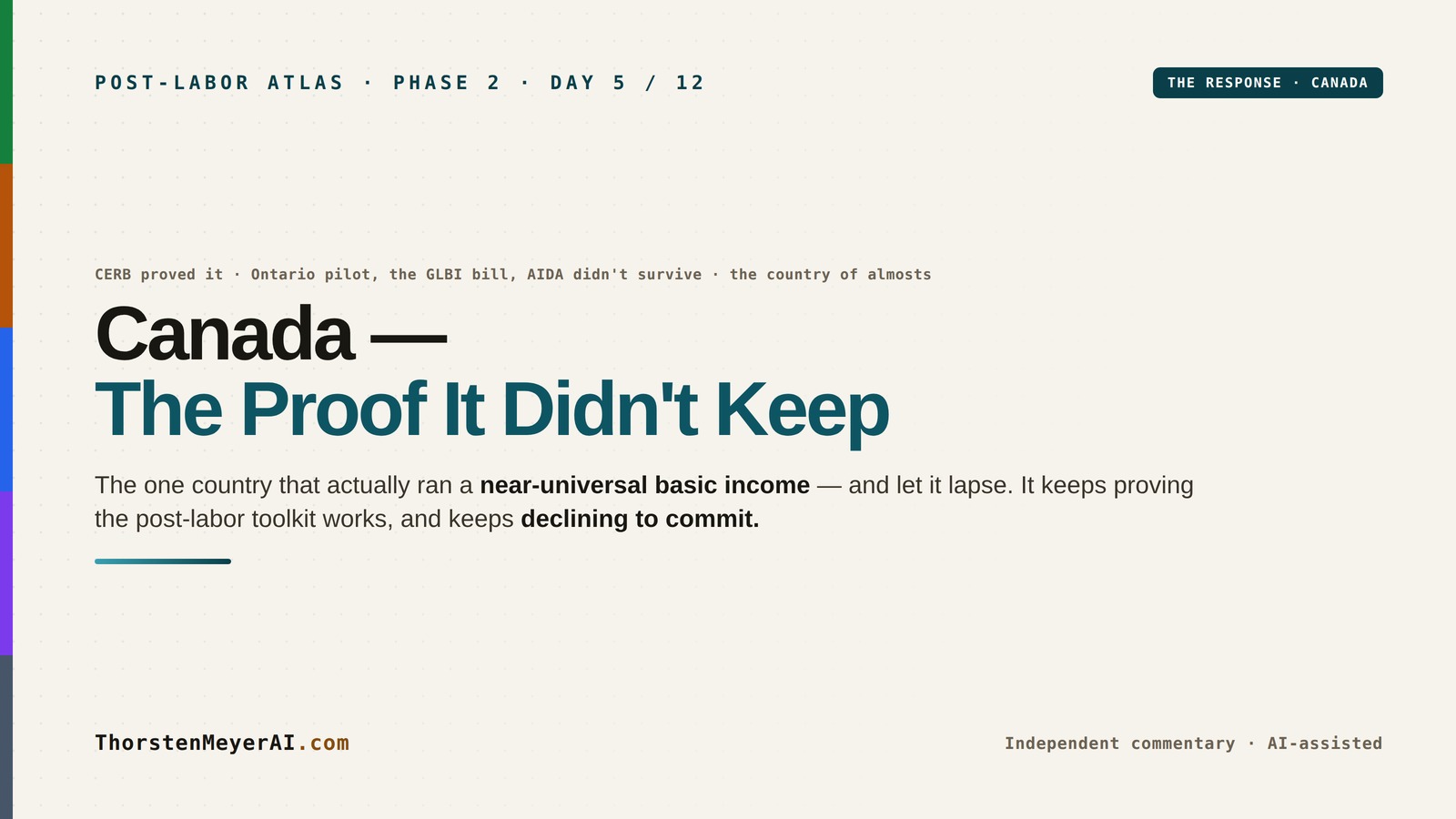
Canada has done something none of its peers have managed: it actually ran a near-universal basic income.
For a stretch of 2020, the Canada Emergency Response Benefit sent $2,000 a month to roughly eight million people, delivered in weeks, with almost none of the usual bureaucratic hurdles. Whatever its flaws, it proved a thing that’s otherwise argued about in the abstract: a rich, federated democracy can stand up fast, near-universal cash support when it decides to. The rails exist. The state can do it.
Then it ended. And that, more than any single program, is the Canadian pattern — because Canada keeps proving the post-labor toolkit works and keeps declining to commit to it.
The proof-then-pause repeats across the board. Ontario ran a basic-income pilot and a new government cancelled it early. A federal guaranteed-income framework has been debated through multiple Parliaments without being enacted. And AIDA — the country’s attempt at a comprehensive AI law — died on the order paper in 2025. On the Matrix, Canada reads as a market-liberal Anglosphere cousin of Britain, but with a more generous categorical floor and, strikingly, even thinner guardrails.
The Proof It Didn’t Keep
Canada is the one country that actually ran a near-universal basic income — and let it lapse. It keeps proving the post-labor toolkit works, and keeps declining to commit.
Independent commentary, produced with AI assistance under human editorial oversight. The views are the author’s own and may change. This is analysis, not policy, economic, investment, or legal advice. Descriptions of CERB, Canadian categorical benefits, the guaranteed-basic-income framework bills, the Ontario pilot, and the status of AIDA reflect publicly reported information as of mid-2026 and may change; cost figures are contested estimates. This phase maps differing approaches and endorses none; contested questions are presented with competing views, not a verdict. Country and program names are referenced for analysis and imply no affiliation.
The model’s logic
It would be wrong to read Canada as simply timid, because the standing model is more generous and more coherent than the cancellations suggest.
Canada is meaningfully more redistributive than the United States, and it does it through categorical guaranteed income rather than a universal one. The Canada Child Benefit — a large, income-tested transfer to families — measurably cut child poverty. The Guaranteed Income Supplement does similar work for low-income seniors. There’s a Canada Workers Benefit for the low-paid and a new Canada Disability Benefit. The through-line is a real philosophy, not an absence of one: rather than pay everyone, Canada builds robust income floors under the groups least able to rely on the labour market — children’s households, seniors, the disabled, the working poor. It’s targeted, it’s far cheaper than a universal scheme, and it’s politically durable in a way universal programs often aren’t.
Layer onto that the fact that Canada is a genuine AI research superpower — it published the world’s first national AI strategy in 2017 and has put billions into research infrastructure and institutes that trained a remarkable share of the field’s leading figures. So the logic hangs together: build categorical floors, lead in the science, keep emergency tools like CERB in reserve, and avoid locking the federation into expensive universal commitments. Caution, here, is a strategy.
universal basic income support kit
As an affiliate, we earn on qualifying purchases.
As an affiliate, we earn on qualifying purchases.
The levers it pulls
The Canadian row is close to the British one, with two telling differences. Income floor: partial — but a more generous partial than the UK’s, thanks to those categorical transfers, with the CERB precedent proving more is deliverable if needed and an active, unfinished debate about going further. Work and time: partial — Employment Insurance plus a flexible Anglosphere labour market. Skills and transition: partial — real federal-provincial training money, fragmented across provinces. Capital and ownership: minimal — no federal wealth fund or citizen dividend.
And institutions: minimal — which is the sharp divergence from Britain. The UK at least made a deliberate choice to regulate AI lightly; Canada tried to regulate it comprehensively and the attempt collapsed, leaving a patchwork of privacy law, provincial rules, and voluntary codes in its place. It is the strange spectacle of an AI research leader with no AI rulebook — all laboratory, no statute.

HP 12C Financial Calculator – 120+ Functions: TVM, NPV, IRR, Amortization, Bond Calculations, Programmable Keys – RPN Desktop Calculator for Finance, Accounting & Real Estate – Includes Case + Cloth
- Industry Standard Since 1981: Trusted by finance professionals for over 40 years
- 120+ Financial Functions: Includes TVM, NPV, IRR, amortization, bonds, and more
- Programmable RPN Entry: Enables faster calculations with fewer keystrokes
As an affiliate, we earn on qualifying purchases.
As an affiliate, we earn on qualifying purchases.
The signature: a pattern of proofs
The defining Canadian artifact isn’t a standing program; it’s a sequence of rehearsals.
CERB is the headline. It was, briefly, the closest any G7 country has come to a basic income — and operationally it worked: fast, near-universal, dignified, delivered without the means-testing apparatus that usually slows these things to a crawl. It was designed as emergency relief, not a permanent program, and it expired as intended. But it left behind a proof that’s hard to un-see: the thing everyone says is impossible to deliver was, in fact, delivered.
Around it sits the pattern. The Ontario basic-income pilot — cancelled before it could finish. The federal guaranteed-livable-basic-income bill — debated across Parliaments, never more than a framework. AIDA — three years in committee, then dead. Each one a rehearsal: the lines learned, the staging blocked, the performance called off. Canada has gathered more real-world evidence about the post-labor toolkit than almost anyone, and committed to less of it.

2010 Ultimate Guide to Federal Grants and Government Benefits: ARRA Stimulus Act, Grant Writing, Proposal Writing, Applications, Forms – Individuals, Non-Profits, Business (Two CD-ROM Set)
As an affiliate, we earn on qualifying purchases.
As an affiliate, we earn on qualifying purchases.
The honest read
The temptation is to call this a failure of nerve, and that would be unfair. The caution is, in large part, rational.
The cost is real. Estimates for a national guaranteed basic income run from roughly $187 billion to over $600 billion a year, against total federal personal income-tax revenue on the order of $217 billion. Without dismantling and rebuilding the existing welfare and tax systems wholesale, the math genuinely doesn’t close — which is why even sympathetic legislators argue for modernizing Employment Insurance rather than leaping to a universal scheme.
The federalism is real too. Income support and AI governance both straddle federal, provincial, and Indigenous jurisdiction, so Ottawa often can’t simply commit the country — the guaranteed-income bill is only a “framework” because a framework is close to the most a federal Parliament can force. And CERB’s own record is honestly mixed: alongside the speed came fraud, administrative error, and real disincentive worries. “It worked in an emergency” is not the same as “it works forever.”
There’s also a serious, non-cynical alternative on the table, and fairness requires naming it. Many of the legislators most sympathetic to income security argue that the right move isn’t a universal basic income at all but a modernized Employment Insurance — the contributory, work-linked system that already exists but has fallen out of step with precarious, gig, and contract work. The case is real: a rebuilt EI could deliver much of the stability and dignity a basic income promises, at a fraction of the cost, without dismantling the existing fiscal architecture, and while preserving the link to contribution that makes the politics durable. Whether that’s enough in a genuinely job-scarce future is exactly the open question — but it means Canada’s caution isn’t only “do nothing.” It’s frequently “fix the thing we have rather than build the thing we can’t afford,” which is a defensible position even if it proves insufficient.
So Canada’s hesitation reflects constraints, not just cold feet. But the cost of perpetual rehearsal has its own shape. When the shock finally comes, a country with proofs and pilots but no standing institution is re-improvising under pressure rather than scaling something already built and trusted. And the categorical model has a hole precisely where the post-labor risk is sharpest: the working-age adult whose job is automated isn’t a child, a senior, or (usually) classified disabled — they fall between exactly the categories Canada has chosen to protect. The floor is strong everywhere except the place the new draft is coming from.
That gap is worth dwelling on, because it’s not a Canadian accident — it’s the structural blind spot of every categorical system, and Canada simply shows it most clearly. Categorical transfers are built on a quiet assumption: that working-age adults are covered by the labour market itself, so the state need only catch the people the market was never going to employ — the young, the old, the unwell. The whole post-labor question is whether that assumption still holds. If automation thins out work for healthy, prime-age adults, the categorical model leaves them facing a means-tested, work-conditional system designed to push them back toward jobs that may be receding — while the generous, dignified, near-unconditional floors sit just out of reach, reserved for categories they don’t belong to. Canada has built excellent shelter for everyone except the people the storm is now most likely to hit.

Teacher Record Book
- Comprehensive record tracking: Attendance and test scores
- Spiral bound design: Easy to flip pages
- Standard size: 8.5 x 11 inches
As an affiliate, we earn on qualifying purchases.
As an affiliate, we earn on qualifying purchases.
What travels
Canada’s most valuable export is the CERB proof itself: any country contemplating an income response to an AI shock now has documented evidence that fast, near-universal cash delivery is operationally feasible at national scale. That’s not a small thing to be able to point to.
The categorical-guaranteed-income approach travels well too — floors under children, seniors, and the disabled are affordable, effective, and durable, and most countries underuse them. And Canada’s federalism lesson is a warning the United States row will echo loudly: in a federated system, the hardest part of any response isn’t designing it but committing to it across jurisdictions — which is why federations tend to pilot endlessly and institutionalize rarely.
Row four
Canada is the country that has proven, more thoroughly than any other on this map, that the post-labor toolkit can actually work — and has committed to less of it than almost anyone. Read uncharitably, that’s timidity. Read honestly, it’s the real difficulty of paying for and coordinating these things in a vast, federated, fiscally cautious country.
But a rehearsal is not a performance, and proofs you decline to keep protect no one when the curtain finally rises. Canada has the evidence, the delivery rails, and the research base that most of this map would envy. What it has conspicuously not done is decide. Row four — and the last stop before the market-led pole itself.
Independent commentary, produced with AI assistance under human editorial oversight; the views are the author’s own and may change. This is analysis, not policy, economic, investment, or legal advice. Descriptions of CERB, Canadian categorical benefits, the guaranteed-basic-income framework bills, the Ontario pilot, and the status of AIDA reflect publicly reported information as of mid-2026 and may change. Cost figures are cited estimates and are contested. This phase maps differing approaches and endorses none; contested questions are presented with competing views rather than a verdict. Country and program names are referenced for analysis and imply no affiliation. © 2026 Thorsten Meyer · Powered by Thorsten Meyer AI. See Imprint/Impressum and Privacy Policy.