Faced with a new force, the European Union’s first instinct is rarely to build it. It is to write the rules for it.
Get ready for Prime Big Deal Days — try Prime free
Exclusive member deals on October 6–7, plus fast free delivery. Cancel anytime.
Start your free trialAs an affiliate, we earn on qualifying purchases.
The clearest example is sitting on the calendar right now. The EU’s AI Act — the world’s first comprehensive law for artificial intelligence, in force since 2024 — reaches its most consequential phase on 2 August 2026, when the bulk of its high-risk rules take effect. And tellingly, one of the categories it designates as “high-risk” is AI used in employment: hiring, screening, and worker management. Before most of the world has decided whether AI in the workplace is a problem, the EU has already classified it as one and written obligations around it.
Underneath that regulatory reflex sits something older: the social market economy, with Germany as its exemplar — a system built on worker voice, job preservation, and a genuine income floor. Put the two together and you get the European bet in a sentence: of the five levers, the EU pulls four of them hard — income floor, work and time, skills, and above all institutions — and barely touches the fifth.
That missing fifth lever turns out to matter a great deal. But start with what the model does, because it does it with real conviction.
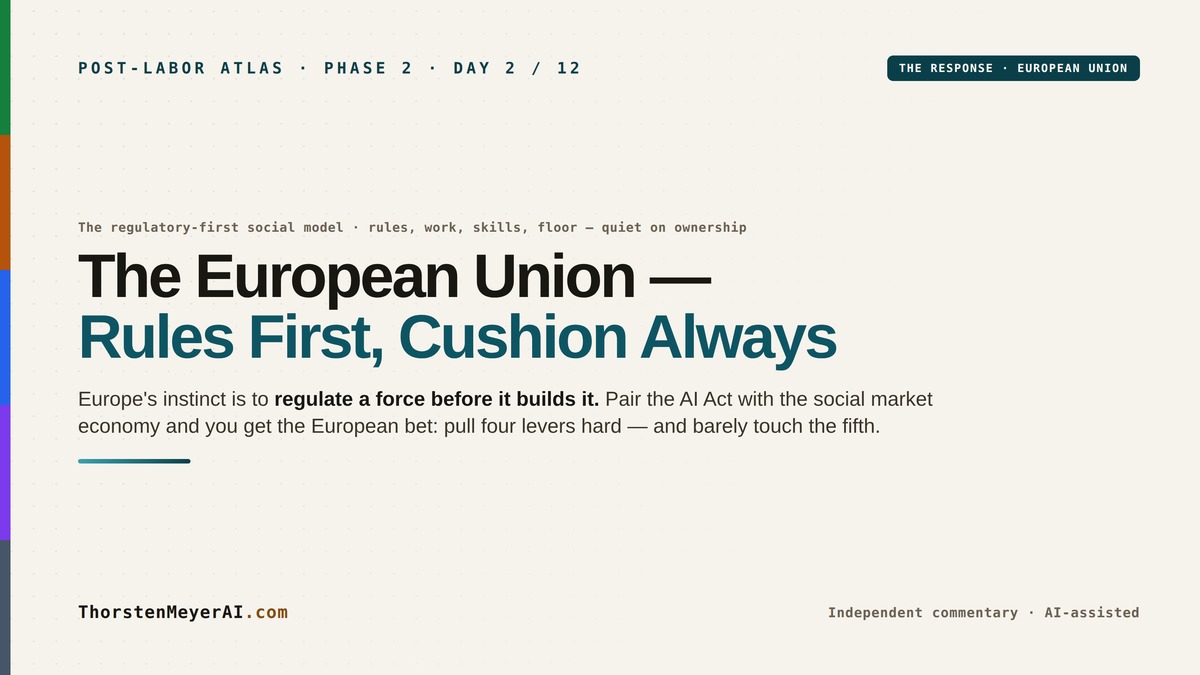
Rules First, Cushion Always
Europe’s instinct is to regulate a force before it builds it. Pair the AI Act with the social market economy and you get the European bet: pull four levers hard — and barely touch the fifth.
Independent commentary, produced with AI assistance under human editorial oversight. The views are the author’s own and may change. This is analysis, not policy, economic, investment, or legal advice. The EU AI Act timeline, Germany’s Neue Grundsicherung reform, Kurzarbeit, and labor data reflect publicly reported information as of mid-2026 and may change as implementation evolves. This phase maps differing approaches and endorses none; contested reforms are presented with competing views, not a verdict. Country and program names are referenced for analysis and imply no affiliation.
The model’s logic
The European answer treats the post-labor transition as something to be shaped and cushioned, not merely adapted to. Three institutions carry most of the weight.
The first is worker voice. Through co-determination — the German practice of seating worker representatives on company boards and works councils — labor has a formal say in how firms restructure, including how they automate. The premise is that if technology is going to reshape work, the workers should be in the room when it does, not merely informed afterward.
The second is job preservation through short-time work — Kurzarbeit, the single most distinctive lever in the European toolkit. Rather than lay people off in a downturn, firms cut everyone’s hours and the state tops up the lost wages. The team stays intact, ready to ramp back up when demand returns. It is widely credited with carrying Germany through the 2008 crisis and the pandemic with far less unemployment than comparable shocks produced elsewhere.
The third is a real income floor plus a famously deep skills system — Germany’s dual vocational training, which braids classroom and on-the-job learning, is admired worldwide. And wrapping all of it is the institutions lever, the EU’s true signature: the AI Act, the GDPR, strong labor protections, and collective-bargaining coverage far above the rich-world norm. Where other jurisdictions ask how to cushion the transition, Europe’s instinct is to regulate its shape before it arrives.
It’s worth being concrete about what that means for a worker, because this is where Europe’s approach is genuinely distinctive. Under the AI Act, an employer using AI to screen applicants, rank candidates, allocate shifts, or evaluate performance is operating a “high-risk” system — which carries real obligations: risk management, documentation, transparency, and meaningful human oversight, with penalties that run as high as €35 million or 7% of global turnover. The premise is that the algorithm deciding whether you’re hired or how you’re managed should be auditable and answerable, not a black box. Whatever one thinks of the compliance burden, it is the most serious attempt anywhere to put legal guardrails directly around AI’s use on workers — not just its effect on the labor market in aggregate.
As an affiliate, we earn on qualifying purchases.
The levers it pulls
On the Response Matrix, the European row is heavy on the left and the right, and conspicuously empty in the middle. Income floor: strong, though nationally administered — the EU sets a floor of floors through its minimum-wage directive and minimum-income recommendations, while member states run the actual welfare systems. Work and time: strong, anchored by Kurzarbeit and tight working-time rules. Skills: strong, led by the German dual model. Institutions: strong — the headline lever.
And capital and ownership: minimal. This is the revealing gap. Europe answers the ownership question — who captures the gains when machines do the work — almost entirely through voice and regulation rather than equity. There is no European citizen-dividend, no continental sovereign wealth fund handing residents a share of the capital. Co-determination gives workers a seat at the table, but not a slice of the upside. The European model is, at its core, a wage-and-rules model, not an ownership model.
As an affiliate, we earn on qualifying purchases.
The honest tradeoffs
Here is where the picture has to get uncomfortable, because the European model is under visible strain in exactly the places it’s strongest.
The income floor is tightening, not expanding. Germany is in the middle of replacing its Bürgergeld “citizens’ income” with a stricter system, the Neue Grundsicherung, taking effect in July 2026. The reform freezes the monthly payment (around €563 for a single adult, held flat a second year running), hardens job-search obligations, and sharpens sanctions — miss enough appointments at the job centre and support, including rent, can be cut entirely. Supporters call it a return to work incentives and cleaner administration; critics call it punishing poverty. Either way, the direction is unmistakable: the floor is being lowered and conditioned, not raised, with more than five million people relying on it.
That tightening isn’t happening in a vacuum. German unemployment has climbed back toward three million; the industrial core that the whole model rests on shed well over a hundred thousand jobs in nine months; and Kurzarbeit, the great job-saver, is increasingly a holding pattern before layoffs that come anyway. A model built to cushion cyclical shocks is being asked to absorb what may be a structural one.
And the celebrated regulatory lever has its own backlash. The AI Act’s rollout has been visibly off track, and by late 2025 the Commission was tabling a “Digital Omnibus” to delay the very high-risk deadlines it had set — a tacit admission that Europe worries it has regulated faster than it has built, and that rules-first can shade into builders-elsewhere. The persistent European anxiety, voiced in report after report on competitiveness, is that it writes the world’s AI rules while America and China write the world’s AI.
That tension is not a detail; it’s the model’s central vulnerability. A regulatory superpower that exports rules through the sheer gravity of its market — the so-called Brussels effect — still has to answer where the value, the firms, and the high-paying jobs of the AI era will actually be created. Rules shape a pie; they don’t bake one. If the productive core that funds the whole social model keeps eroding, as the German industrial numbers suggest it might, then the guardrails protect a shrinking thing, and the cushioning gets more expensive precisely as it becomes harder to afford.
Which loops back to the empty column. A model that answers the ownership question with voice — a seat on the board — rather than equity leaves workers as stakeholders in firms they don’t own, at exactly the moment when the returns may be shifting decisively from labor to capital. Co-determination is a real and valuable thing, but it is not a claim on the upside. If the AI era concentrates gains in capital, the European worker gets a vote on how the machines are deployed and a cushion if they’re displaced — but not a share of what the machines earn. Whether that’s enough is the question Europe has not yet answered, and may not be structurally inclined to ask.
As an affiliate, we earn on qualifying purchases.
What travels
Some of the European toolkit exports cleanly and some doesn’t. Kurzarbeit travels well — it’s a proven, mechanically simple downturn tool that any country with a functioning unemployment system can adopt, and many have studied it. The AI-in-hiring guardrails travel through sheer market size — the “Brussels effect” means firms that want EU access often adopt EU rules globally, so Europe exports its institutions lever whether or not other governments copy it.
Other parts resist transplant. The dual vocational system is admired and rarely replicated, because it needs deep employer commitment and institutions that took generations to build. And the rules-first instinct only works where there’s the state capacity and market gravity to make rules bite; a smaller jurisdiction writing the same law simply gets ignored.
short-time work management software
As an affiliate, we earn on qualifying purchases.
As an affiliate, we earn on qualifying purchases.
Row one
So the European Union opens the Matrix as the regulatory-first social model: humane, coherent, and serious about cushioning and shaping the transition — strong on floor, work, skills, and institutions, and almost silent on ownership. Its wager is that you can civilize the post-labor transition with rules and worker voice without ever having to put the machines into the hands of the people they displace.
It’s a deeply European bet, and right now it’s being stress-tested in real time: a social model designed for cyclical weather, holding its umbrella against what might be a change in climate. Whether voice and regulation are enough when the ownership question is the real one — that’s the doubt the rest of this map will keep circling back to.
Independent commentary, produced with AI assistance under human editorial oversight; the views are the author’s own and may change. This is analysis, not policy, economic, investment, or legal advice. Figures and policy details (the EU AI Act timeline, Germany’s Neue Grundsicherung reform, Kurzarbeit, and labor-market data) reflect publicly reported information as of mid-2026 and are subject to change as legislation and implementation evolve. This phase maps differing approaches and endorses none; characterizations of contested reforms present competing views rather than a verdict. Country and program names are referenced for analysis and imply no affiliation. © 2026 Thorsten Meyer · Powered by Thorsten Meyer AI. See Imprint/Impressum and Privacy Policy.
NFL season / tailgating Picks
team gear
As an affiliate, we earn on qualifying purchases.