The post-labor transition stopped being a forecast a while ago. It’s a daily occurrence now, showing up in earnings calls and layoff notices rather than think-tank PDFs.
Open a free Amazon Business account
Business pricing, bulk buying and tax-exempt orders.
Create a free accountAs an affiliate, we earn on qualifying purchases.
By most serious estimates the exposure is large. Goldman Sachs puts roughly 300 million jobs worldwide within reach of AI automation over the coming decade. The World Economic Forum’s employer surveys find more than 40% planning to reduce headcount because of AI — and, in the same breath, more than three-quarters planning to reskill the workers they keep. The sharpest early signal isn’t in the aggregate at all: it’s the reported double-digit drop in employment among workers in their early twenties in the most AI-exposed entry-level roles, the rungs of the ladder quietly being sawn off first.
So the disruption is real. But here is the thing the headlines almost always skip, and it matters more than any single number: nobody actually knows how far it goes.
That’s not hedging. It’s the honest state of the evidence — and it’s the hinge this entire phase of the Atlas turns on.
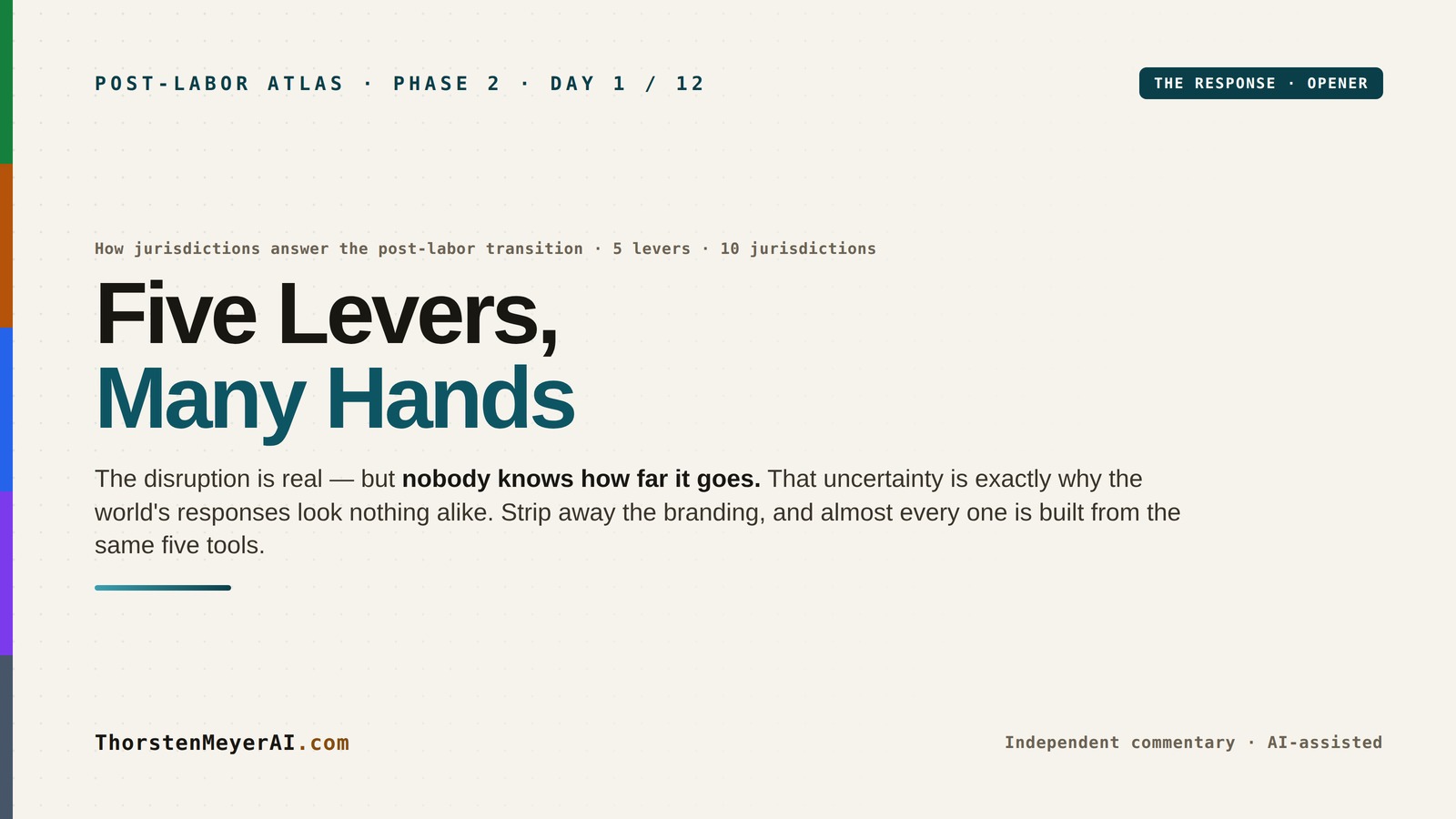
Five Levers, Many Hands
The disruption is real — but nobody knows how far it goes. That uncertainty is exactly why the world’s responses look nothing alike. Strip away the branding and almost every one is built from the same five tools.
Independent commentary, produced with AI assistance under human editorial oversight. The views are the author’s own and may change. This is analysis, not policy, economic, investment, or legal advice. Figures reflect publicly reported estimates and studies as of mid-2026 and may change; the labor-market outlook is genuinely uncertain and contested. This phase maps differing approaches and endorses none. Country, institution, and program names are referenced for analysis and imply no affiliation.
What Phase 1 established, and what it didn’t
Phase 1 of this Atlas mapped the transition itself: the way automation reallocates and, in places, displaces human labor; the pressure that puts on the old wage-for-work bargain; and the ownership question lurking underneath all of it — that whoever owns the machines tends to capture the gains the machines produce. None of that is in serious dispute.
What is in dispute is the endpoint. One camp, well represented by economists at institutions like ITIF, points out that the United States’ labor share of income stayed remarkably stable — bouncing between roughly 57% and 64% — across seventy years of dramatic technological change, from industrial machinery to the internet. Their reading: workers don’t vanish, they reallocate, and AI will reshape work far more than it erases it. The other camp, in formal models by economists such as Korinek and Suh, agrees the wage share can stay stable if automation arrives gradually — but shows it can collapse if automation gets fast and broad enough, in the limit where nearly any task can be done by a machine.
Both can’t be fully right, and the truthful position today is that we don’t know which world we’re heading into. The reallocation story has history on its side. The structural-break story has the unsettling novelty of this particular technology on its side. The responsible stance is to hold both — and to notice that deep uncertainty about a high-stakes outcome is exactly the condition that forces a choice. You cannot wait for the data to resolve before acting, because by the time it resolves, the moment to have acted will have passed.
AI automation job loss mitigation books
As an affiliate, we earn on qualifying purchases.
As an affiliate, we earn on qualifying purchases.
Why this phase exists
Faced with that uncertainty, the world is not waiting. It is responding — unevenly, experimentally, and in ways that look almost nothing alike from one country to the next. This phase of the Atlas is a map of those responses.
And the first useful thing a map can do is give you a shared vocabulary. Strip away the national branding and the political packaging, and almost every response to the post-labor transition is built from the same five tools. Call them the five levers.
reskilling online courses for AI disruption
As an affiliate, we earn on qualifying purchases.
As an affiliate, we earn on qualifying purchases.
The five levers
Income floor. The most direct lever: put a floor under people’s income regardless of the labor market’s verdict on them. This is the family of universal basic income, negative income taxes, guaranteed-income pilots, and unconditional cash transfers. No country has implemented a true nationwide UBI, but the experimentation is now vast — Finland’s rigorous 2017–18 trial became the methodological template; more than 150 US cities have run or committed to guaranteed-income pilots, several now made permanent; and the accumulating evidence quietly undercuts the oldest objection, with large randomized studies showing only modest effects on whether people work, and sometimes slightly positive ones.
Capital & ownership. A different answer to the same problem: if capital captures the gains, give people a claim on the capital. This is the world of sovereign wealth funds, citizen dividends, social wealth funds, and broad-based equity — spreading ownership rather than topping up wages. Some jurisdictions are structurally built for this lever and barely touch the others.
Work & time. The lever that defends the institution of work itself — job guarantees, public employment, and the redistribution of working hours through shorter weeks or short-time work schemes that spread scarce labor demand across more people rather than letting it concentrate into unemployment.
Skills & transition. The bet that the answer is adaptation, not redistribution: reskilling, lifelong-learning accounts, and active labor-market policy designed to move workers from declining roles into emerging ones. It’s the lever every jurisdiction says it’s pulling — the WEF’s three-quarters of employers planning to reskill — though saying and doing are different things.
Institutions & guardrails. The structural lever: the rules of the game. AI and automation regulation, automation or data taxes, labor protections, and the strength of collective bargaining. This is where a jurisdiction decides not how to cushion the transition but how to shape it.
The crucial point is that these are not mutually exclusive, and no serious response uses only one. The interesting question is never “which lever” — it’s which mix, at what intensity, and why that mix and not another.
universal basic income demonstration kits
As an affiliate, we earn on qualifying purchases.
As an affiliate, we earn on qualifying purchases.
Many hands
Which brings us to the divergence, and to the second half of this phase’s title. Why does the same set of five tools produce responses that look so different in Helsinki, Houston, Abu Dhabi, and São Paulo?
Because the response is downstream of who you already are. A jurisdiction with a deep welfare state and high social trust reaches naturally for income floors and active labor policy; one built on market-led individualism reaches for skills and lets prices adjust. A petrostate sitting on a sovereign wealth fund can pull the capital-and-ownership lever in a way a fiscally-strained democracy simply cannot. A high-capacity technocratic state can plan decades ahead; a fragmented federal system experiments city by city because it can’t act nationally. And underneath all of it sits that unresolved bet: a government that reads the transition as a structural emergency builds new floors and new ownership; one that reads it as another reallocation invests in retraining and waits.
In other words, the five levers are universal, but the hands pulling them are shaped by institutions, fiscal capacity, political economy, and values that long predate AI. The response to the future is being written in the grammar of the past.
This is also why borrowing is so treacherous. A lever that works beautifully in one place can fail in another not because the idea was wrong but because the surrounding institutions weren’t there to hold it up. A generous income floor leans on a tax base and an administrative state capable of delivering it cleanly; a citizen-dividend model leans on an asset most countries simply don’t have; a reskilling strategy leans on an education system and employers willing to hire the retrained. Policies don’t travel as free-floating ideas — they travel with their scaffolding, or they don’t travel at all. Keeping that in mind is the difference between learning from another country’s response and cargo-culting it.
public employment program resources
As an affiliate, we earn on qualifying purchases.
As an affiliate, we earn on qualifying purchases.
The Response Matrix
To make that legible, this phase introduces a single recurring device: the Response Matrix — ten jurisdictions scored across the five levers. Over the next ten days it fills in one row at a time, each jurisdiction profiled in its own right: the pressure it faces, the levers it actually pulls and how hard, the internal logic that makes its model coherent, and the honest tradeoffs that logic carries. On the final day the full matrix is read across its columns, so the patterns — what travels between very different countries, and what stubbornly doesn’t — come into view all at once.
A word on what the Matrix is not. It is not a scoreboard, and there is no row at the bottom labeled “winner.” Every one of these models is a set of tradeoffs, not a triumph; each buys something real and pays for it somewhere. The point of mapping them side by side is not to crown an answer but to see the menu clearly — because the most common mistake in this debate is assuming the choice your own country made is the only serious one on offer.
What to watch
The arc runs from the European social models, through the Anglosphere’s market-led variants, into the state-capital and technocratic models of the Gulf and Asia, out to the large-scale cash-transfer experiments of the Global South — and then back, on the last day, to read the whole map together.
The question carried through all of it is deliberately not “what is the answer.” It’s the more useful pair: what fits where, and what travels. A policy that works in a high-trust Nordic welfare state may be unrecoverable in a fragmented federation; a capital-dividend model funded by oil may have nothing to teach a country without it — or it may have everything, if the “oil” of the coming era turns out to be something every country can own a piece of.
That’s the wager of this phase: that the responses to the post-labor transition are diverse enough to learn from, and that the learning starts with refusing to mistake your own reflexes for the only possibility. Five levers. Many hands. One map — drawn, over the next ten days, to be read rather than preached.
Independent commentary, produced with AI assistance under human editorial oversight; the views are the author’s own and may change. This is analysis, not policy, economic, investment, or legal advice. Figures reflect publicly reported estimates and studies (including from Goldman Sachs, the World Economic Forum, and guaranteed-income research) as of mid-2026 and may change; the labor-market outlook described is genuinely uncertain and contested. This phase maps differing approaches and does not endorse any one of them. Country, institution, and program names are referenced for analysis and imply no affiliation. © 2026 Thorsten Meyer · Powered by Thorsten Meyer AI. See Imprint/Impressum and Privacy Policy.
NFL season / tailgating Picks
team gear
As an affiliate, we earn on qualifying purchases.