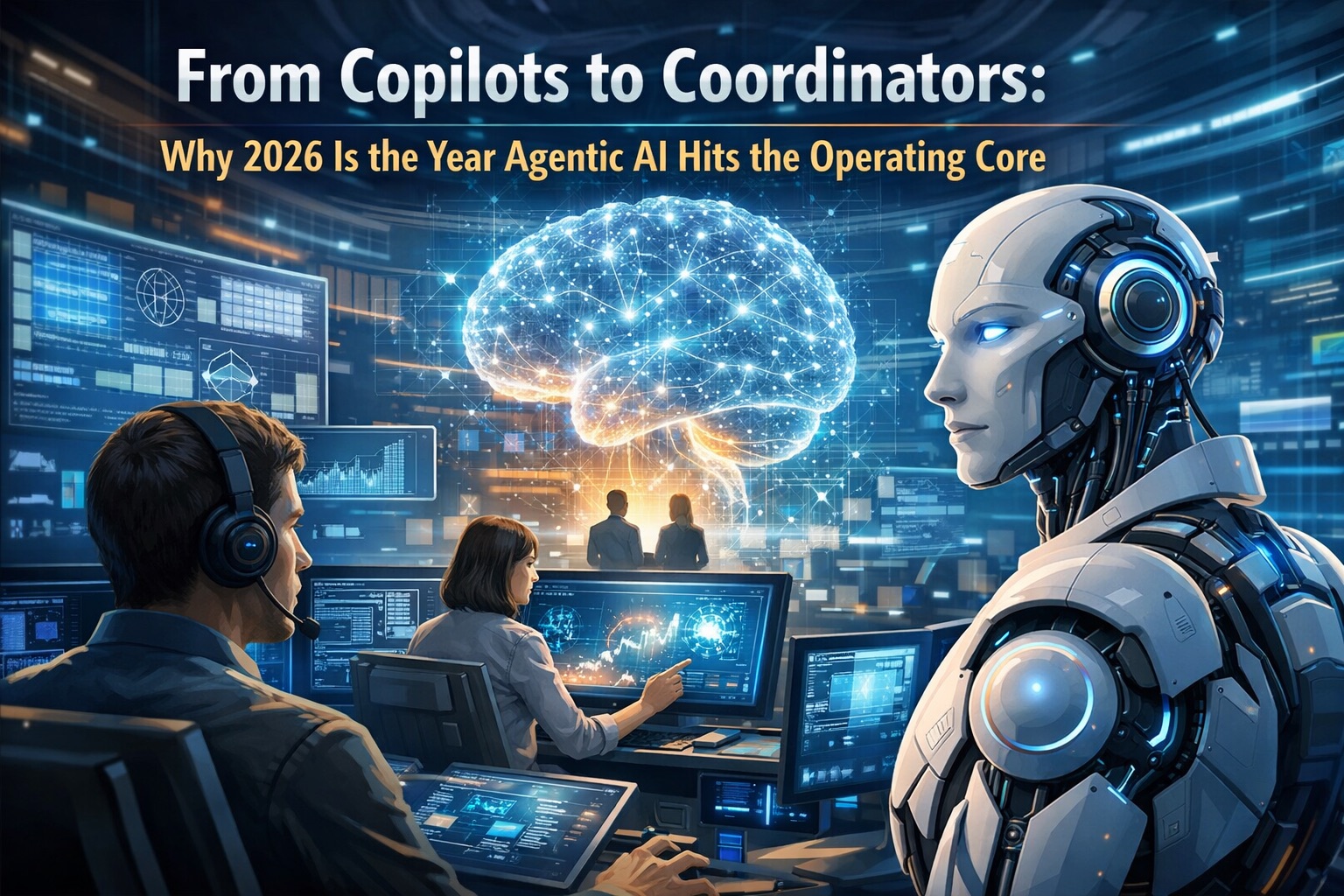

By Thorsten Meyer | ThorstenMeyerAI.com | February 2026
Executive Summary
40% of enterprise applications will feature task-specific AI agents by end of 2026. Up from less than 5% in 2025. That’s not a prediction from a vendor’s marketing deck — that’s Gartner, the same firm telling CIOs that over 40% of those agentic AI projects will be canceled by 2027 if governance and ROI clarity don’t materialize.
Both numbers are correct. That’s the paradox of 2026.
| Metric | Value |
|---|---|
| Agentic AI Market (2026) | $9.14B (up from $7.29B in 2025) |
| Projected Market (2034) | $139.19B (40.5% CAGR) |
| Fortune 500 Agent Deployment | 78% projected for 2026 |
| Enterprise ROI (18-month avg) | 540% |
| Average Implementation Cost | $890,000 |
| Orgs Actively Using in Production | 11% (Deloitte, 2026) |
| Orgs with No Formal Agent Strategy | 35% |
The enterprise world is experiencing a phase transition. Not an upgrade. Not an evolution. A structural change in how work gets done. The copilot — that helpful sidebar whispering suggestions while a human clicks buttons — is giving way to the agent: software that doesn’t advise. It acts.
This article maps the shift, identifies where value is real vs. illusory, exposes the governance architecture gap that will kill most deployments, and provides a concrete action framework for enterprise leaders who want to be on the right side of this transition.
Design Multi-Agent AI Systems Using MCP and A2A: Engineer your own Python-based agentic AI framework with tool use, memory, and multi-agent workflows
As an affiliate, we earn on qualifying purchases.
As an affiliate, we earn on qualifying purchases.
The Shift Underway
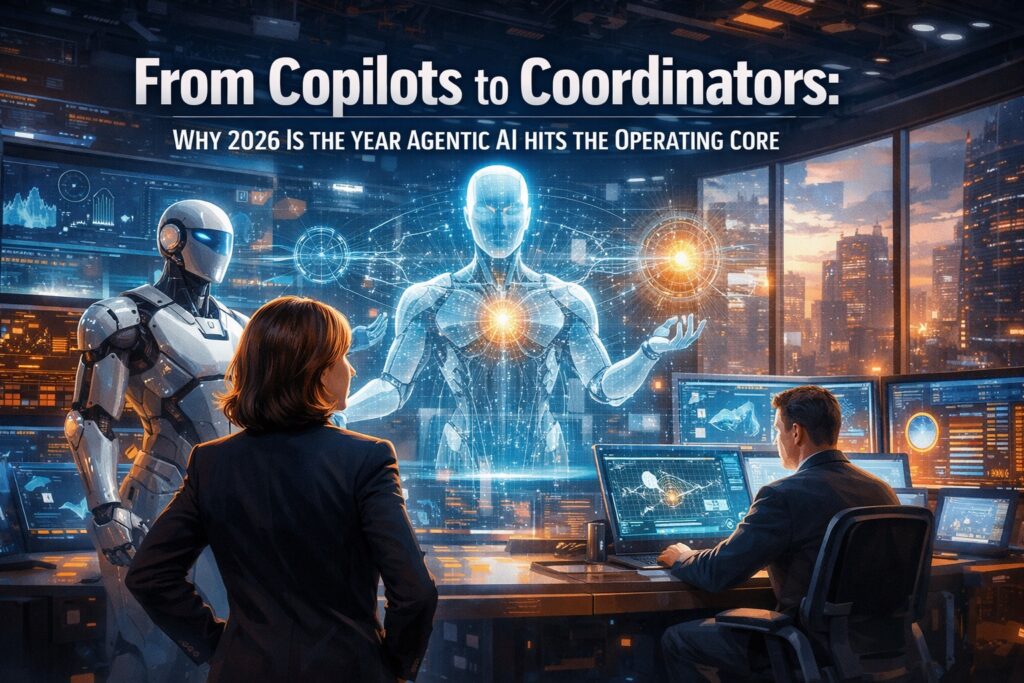
From Sidebar to Operating Core
The evolution is clean and directional:
| Mode | How It Works | Human Role | Example |
|---|---|---|---|
| Copilot (2023–2024) | Suggests; human decides | Approver of every action | GitHub Copilot autocomplete |
| Agent (2025–2026) | Acts within scoped authority | Sets goals, reviews outcomes | Invoice processing agent |
| Multi-Agent (2027+) | Agents coordinate with agents | Designs systems, handles exceptions | Supply chain orchestration mesh |
The copilot era trained enterprises to put AI in the room. The agent era puts AI in the workflow. The multi-agent era puts AI in the operating model.
Microsoft Copilot has hit 15 million paid seats. That’s the largest installed base of enterprise AI in history. But Microsoft isn’t celebrating copilot growth — it’s pivoting to agents. Copilot Studio now supports autonomous agent triggers at $0.25 per execution. The signal is unmistakable: the sidebar was the gateway drug. The operating core is the destination.
What Changed
The copilot was constrained by design. It could suggest code, draft an email, summarize a meeting. Useful. But bounded. It required a human in the loop for every action, making it a productivity tool, not an operating model change.
Agents break that constraint. An agent can:
- Execute multi-step workflows without human intervention at each step
- Access and modify enterprise systems — ERP, CRM, ITSM, procurement platforms
- Make decisions within defined authority — approve expenses under $5,000, escalate anomalies, route tickets by severity
- Learn and adapt from outcomes, improving routing and decision quality over time
This isn’t a feature upgrade. It’s a category change. The copilot augments the worker. The agent augments the workflow.
The copilot was a feature. The agent is an operating model. Confuse the two and you’ll over-invest in the wrong architecture.

GET WORK DONE WITH Claude Cowork: A Complete Beginner's Guide to Anthropic's AI Desktop Agent: Automate Files – Organize Documents – Run Multi-Step Tasks
As an affiliate, we earn on qualifying purchases.
As an affiliate, we earn on qualifying purchases.
Why This Is Accelerating Now
Five forces are converging in 2026 to push agentic AI from pilot to production:
1. Foundation Models Crossed the Capability Threshold
Models can now reliably execute multi-step reasoning, use tools, maintain context across long workflows, and recover from errors. This isn’t about benchmarks. It’s about reliability in production loops where a 2% failure rate means thousands of botched transactions per day.
The shift from GPT-4 to GPT-4o to o1/o3, from Claude 3 to Claude 4, from Gemini 1.5 to Gemini 2.0 — each generation didn’t just get smarter. It got more reliable at tool use, planning, and self-correction. That’s the capability that unlocks agents.
2. Tool and Protocol Infrastructure Matured
Model Context Protocol (MCP) has crossed 97 million SDK downloads. OpenAI launched its competing Responses API and Agents SDK. LangGraph, CrewAI, and AutoGen have emerged as the dominant orchestration frameworks — though all three remain, in Langfuse’s assessment, “exceptional at prototyping but dangerously incomplete for production.”
The infrastructure isn’t perfect. But it exists. Two years ago, connecting an AI model to an enterprise system required custom engineering. Today, it requires configuration.
3. Enterprise Cost Pressure Is Unrelenting
$890,000 average implementation cost for an agentic AI deployment. That sounds expensive until you compare it to the fully-loaded cost of the manual workflows it replaces. Organizations reporting 60–80% reductions in routine task handling time are finding the math compelling enough to move past pilots.
McKinsey estimates agents could contribute $4.4 trillion in productivity growth across business use cases. That’s not a technology forecast. It’s a CFO’s mandate.
4. Vendors Are Forcing the Transition
Every major platform vendor is embedding agents into their core products:
| Vendor | Agent Strategy | Pricing Model |
|---|---|---|
| Microsoft | Copilot Studio autonomous agents | $0.25/trigger + $30/user/month |
| Salesforce | Agentforce platform | Per-conversation pricing |
| SAP | 20+ Joule AI agent use cases | Embedded in S/4HANA |
| ServiceNow | Now Assist agentic workflows | Platform subscription |
| Vertex AI Agent Builder | Pay-per-use compute |
When every vendor ships agents as a core feature, adoption becomes a procurement decision, not a technology decision. The question shifts from “Should we build agents?” to “Which vendor’s agents do we govern?”
5. The Talent Bottleneck Is Forcing Automation
340,000 global AI talent shortage. Enterprises can’t hire enough people to build AI systems. The irony: they’re using AI agents to compensate for the shortage of AI talent. The demand for automation is outpacing the supply of automators.

Applications of Artificial Intelligence for Decision-Making: Multi-Strategy Reasoning Under Uncertainty
As an affiliate, we earn on qualifying purchases.
As an affiliate, we earn on qualifying purchases.
Where Early Value Is Materializing
Not everywhere. Not evenly. Value is concentrating in five domains where the workflow characteristics match what agents do well: high-volume, rules-based, multi-system, and latency-sensitive.
1. Customer Service: The Proving Ground
60–80% ticket deflection in Tier 1 support. This is the most mature agent domain because the feedback loops are tight, the cost savings are immediate, and the failure mode is recoverable — a bad agent response gets escalated to a human, not embedded in a financial filing.
2. Finance and Accounting: The ROI Leader
Invoice processing, payment matching, late payment prediction, financial close resolution. Agents extract, validate, match, and flag — eliminating the manual data entry that consumes 40–60% of accounts payable staff time. The ROI is measurable within 90 days.
3. IT Operations: The Scale Enabler
85% auto-resolution of routine incidents is the benchmark top performers are hitting. Agents triage, diagnose, execute runbooks, and escalate — compressing mean time to resolution from hours to minutes. ServiceNow and PagerDuty are embedding this directly into platform workflows.
4. Supply Chain and Procurement: The Complexity Handler
Agents monitoring inventory, predicting disruptions, automating supplier communications, and routing approvals. Microsoft Dynamics 365 now ships a Supplier Communications Agent that automates routine procurement interactions — follow-ups, confirmations, change orders — freeing procurement teams for strategic sourcing.
5. HR and Talent Operations: The Quiet Revolution
Onboarding workflows, benefits administration, policy Q&A, compliance tracking. High-volume, rules-heavy, and traditionally buried in shared services centers. Agents don’t replace HR judgment. They eliminate the 70% of HR work that never required judgment in the first place.
| Domain | Key Metric | Maturity Level |
|---|---|---|
| Customer Service | 60–80% ticket deflection | Production at scale |
| Finance/Accounting | 90-day measurable ROI | Production in leaders |
| IT Operations | 85% auto-resolution | Production at scale |
| Supply Chain | Real-time disruption response | Piloting to production |
| HR Operations | 70% routine task elimination | Early production |
Value isn’t where agents are smartest. It’s where workflows are dumbest.

Enterprise Process Orchestration: A hands-on guide to strategy, team structures, and technology that will transform your business
As an affiliate, we earn on qualifying purchases.
As an affiliate, we earn on qualifying purchases.
The Real Bottleneck: Governance Architecture
Here’s the uncomfortable truth that vendors don’t put in the keynote: 42% of organizations are still developing their agentic strategy roadmap. Another 35% have no formal strategy at all. That means 77% of enterprises are deploying agents without a governance architecture.
This is the number that should keep CIOs up at night.
The Governance Gap
Gartner’s prediction that 40%+ of agentic AI projects will be canceled by 2027 isn’t about technology failure. It’s about governance failure. Three specific gaps:
1. Audit Trail Deficit
Every action an AI agent takes must be logged: who initiated it, what it did, what data it accessed, what decision it made, and why. Today’s agent frameworks don’t do this natively. Most enterprises are bolting audit capabilities onto systems that weren’t designed for them.
The EU AI Act reaches full enforcement for high-risk systems in August 2026. Organizations deploying agents in HR, finance, or customer-facing roles need audit infrastructure that captures operational evidence — not screenshots and declarations. NIST, ISO 42001, and the EU AI Act all converge on the same requirement: continuous, immutable, queryable audit trails.
2. Authority Boundary Ambiguity
When an agent can approve a $4,999 expense but must escalate at $5,000, who defines that threshold? Who changes it? Who audits that it’s being enforced? Most enterprises have authority matrices for humans. Almost none have them for agents.
3. Multi-Agent Coordination Risk
When agents start coordinating with other agents — the 2027+ horizon — the governance challenge compounds exponentially. Agent A approves a vendor. Agent B places an order. Agent C authorizes payment. No single human approved the full chain. The audit trail exists in three systems with no unified view.
What Governance Architecture Requires
| Component | Purpose | Current State |
|---|---|---|
| Agent Identity Registry | Track every agent: owner, purpose, permissions | <5% of enterprises have this |
| Authority Matrix | Define what each agent can do and can’t | Mostly informal or absent |
| Decision Audit Trail | Immutable log of every agent action | Retrofitted, not native |
| Escalation Framework | When and how agents hand off to humans | Ad hoc in most orgs |
| Performance Monitoring | Track accuracy, drift, and failure modes | Basic at best |
| Compliance Mapping | Map agent actions to regulatory requirements | Manual and lagging |
The organizations that build governance architecture first will deploy agents fastest. The ones that deploy first and govern later will cancel 40% of their projects.
Enterprise Architecture Implications
Agentic AI doesn’t sit on top of the existing enterprise stack. It restructures it. Three layers need to change:
The Orchestration Layer
Traditional enterprise architecture assumes humans as the integration point. The human reads the ERP, checks the CRM, decides, and updates the system. Agents bypass that integration point entirely.
This requires an orchestration layer — what Deloitte calls an “agentic AI mesh”: a composable, distributed, governed architecture that enables multiple agents to reason, collaborate, and act autonomously across systems.
McKinsey frames this as the “agentic organization” — flat decision structures with high context sharing and alignment across agentic teams. The operating model shifts from hierarchical approval chains to parallel execution with governance guardrails.
The Data Layer
Agents need real-time, structured, permissioned access to enterprise data. Most enterprise data architectures weren’t designed for this. They were designed for humans running reports and dashboards.
The shift requires:
- Real-time data pipelines replacing batch ETL
- Fine-grained access controls at the field level, not the table level
- Context-aware data serving — agents need different data views than dashboards
- Data provenance tracking — every data point an agent uses must be traceable to its source
The Security Layer
Every agent is an attack surface. Every tool connection is a potential breach vector. The security model must shift from perimeter-based to identity-based, continuous verification — zero-trust applied to software agents, not just human users.
| Architecture Layer | Before Agents | With Agents |
|---|---|---|
| Integration | Humans bridge systems | Agents bridge systems via APIs |
| Data access | Reports and dashboards | Real-time, permissioned, field-level |
| Security model | Perimeter + human auth | Zero-trust + agent identity |
| Workflow | Sequential approvals | Parallel execution + guardrails |
| Monitoring | Human performance reviews | Agent performance monitoring + drift detection |
Workforce Consequences
Tasks, Not Jobs
The most accurate framing: 60% of jobs will experience significant task-level changes due to AI. Not 60% of jobs eliminated. 60% of jobs restructured around different tasks.
The World Economic Forum projects 170 million new jobs by 2030 alongside 92 million displaced — a net gain of 78 million positions. But the new jobs don’t go to the same people in the same places doing the same things. The transition cost is real even if the net number is positive.
The Compression Effect
Agents compress the task portfolio of every role they touch:
| Before | After | What Humans Do Instead |
|---|---|---|
| 40% data entry and processing | Agent handles 90%+ | Exception handling and quality |
| 25% status checking and routing | Agent handles automatically | Strategic decision-making |
| 20% report generation | Agent generates on demand | Insight interpretation and action |
| 15% complex judgment | Unchanged — human domain | Expanded scope for judgment work |
The result: fewer people needed for the same output, or the same people producing dramatically more. Both outcomes are happening simultaneously across different organizations.
The Skill Shift
The premium shifts from execution skills to orchestration skills:
- Understanding what agents can and can’t do
- Designing agent workflows and authority boundaries
- Monitoring agent performance and intervening on exceptions
- Managing hybrid human-agent teams
Gartner predicts that by 2029, at least half of knowledge workers will be expected to create, govern, and deploy agents on demand. The manager of the future doesn’t manage people or software. They manage systems that include both.
AI doesn’t replace jobs. It replaces tasks within jobs. The question isn’t who loses their job — it’s who redesigns theirs first.
Public Sector Parallels
Government faces the same transition with higher stakes and tighter constraints.
The forces are identical: labor shortages, cost pressure, citizen expectations, and aging infrastructure. The constraints are different: data sovereignty requirements, procurement cycles measured in years, regulatory obligations, and political accountability for AI decisions.
Federal AI use cases doubled year-over-year to 1,700+ in 2025. The demand is there. The governance architecture isn’t.
The playbook from the enterprise sector applies with modifications:
- Sovereignty-first architecture — sensitive workloads require on-premise or GovCloud inference, not public cloud APIs
- Citizen transparency — when an AI agent influences a government decision, the citizen must know, understand, and have recourse
- Policy-as-code — agent authority must be defined in machine-enforceable policy, not PDF manuals
- Audit by design — every agent action in government must be auditable by default, not retrofitted
The public sector organizations that move first will set the governance standards that the rest follow. The ones that wait will inherit frameworks designed by vendors, not by public interest.
Competitive Dynamics
The Platform Lock-In Trap
Every major vendor is racing to make their agent platform the one enterprises standardize on. Microsoft, Salesforce, SAP, Google, and ServiceNow are all embedding agents deep into their core products. The switching cost compounds with every agent deployed.
This creates a familiar dynamic: the agent platform becomes the new ERP. Whoever owns the agent orchestration layer owns the customer relationship for the next decade.
The Framework Fragmentation Risk
LangGraph, CrewAI, AutoGen, and a dozen smaller frameworks are competing for the open-source orchestration layer. The problem: none are production-ready for enterprise-grade workloads. They prototype beautifully. They govern poorly. They scale unpredictably.
Enterprises face a build-vs-buy decision that mirrors the early cloud era:
| Approach | Advantage | Risk |
|---|---|---|
| Vendor-native agents | Integrated, supported, fast to deploy | Lock-in, limited customization |
| Open-source frameworks | Flexible, portable, no lock-in | Governance gaps, support risk |
| Custom-built | Full control, tailored governance | Expensive, slow, talent-dependent |
| Hybrid | Best-of-breed by use case | Integration complexity, multi-vendor governance |
The winning strategy for most enterprises: vendor-native for commodity workflows, custom-built for competitive differentiators, and a governance layer that spans both.
Practical Implications: Eight Actions for Enterprise Leaders
1. Audit Your Agent Landscape
You almost certainly have more agents deployed than you know. Shadow AI agents — built by business units using low-code platforms, Copilot Studio, or open-source frameworks — are proliferating without centralized visibility. Start with an inventory.
2. Build the Governance Architecture Before Scaling
Agent identity registry. Authority matrices. Audit trails. Escalation frameworks. This isn’t bureaucracy — it’s the infrastructure that determines whether your agents are assets or liabilities.
3. Start with High-Volume, Low-Judgment Workflows
Customer service Tier 1. Invoice processing. Incident triage. These are the workflows where agent value is proven, failure modes are recoverable, and the governance requirements are manageable.
4. Define Authority Boundaries in Machine-Readable Policy
Not in documents. Not in email threads. In code that agents can read, enforce, and audit. Policy-as-code isn’t optional for agentic deployments — it’s the foundation.
5. Instrument Everything
Every agent action. Every data access. Every decision. Every escalation. Build the observability infrastructure before you need it for a compliance audit, not after.
6. Plan for Multi-Agent Coordination
Even if your current deployments are single-agent, architect for the multi-agent future. Unified audit trails, cross-agent authority management, and coordinator patterns should be in your architecture now.
7. Invest in Orchestration Skills
The most valuable talent in 2027 won’t be prompt engineers. It will be people who understand how to design, govern, and optimize agent systems. Start building that capability now.
8. Negotiate Agent Governance into Vendor Contracts
When your vendor ships agents as a core feature, your procurement contracts need clauses for agent identity management, audit trail access, authority boundary enforcement, and data governance. If it’s not in the contract, it’s not in your control.
What to Watch Next
Q2 2026: EU AI Act high-risk enforcement approaches. Enterprises deploying agents in HR, finance, or customer-facing roles will need to demonstrate compliance infrastructure — not just policies on paper, but operational evidence.
H2 2026: The first major enterprise agent failures will become public. Not because agents are bad, but because governance was absent. Expect at least one headline involving an agent that exceeded its authority in a financial or HR context.
2027: Multi-agent coordination moves from architecture diagrams to production. The orchestration layer becomes the most strategically important piece of enterprise infrastructure since the data warehouse.
2028: Gartner’s prediction: at least 15% of day-to-day work decisions made autonomously through agentic AI. The organizations that reach this threshold will have fundamentally different cost structures than those that don’t.
The Bottom Line
The shift from copilots to coordinators isn’t a technology upgrade. It’s a restructuring of how enterprises operate. The copilot era proved AI could be useful. The agent era is proving it can be operational. The multi-agent era will prove it can be organizational.
78% of Fortune 500 companies are deploying agents. 77% of enterprises lack governance architecture for them. That gap is the defining challenge of 2026.
The winners won’t be the companies that deploy agents fastest. They’ll be the ones that govern them best — and scale from that foundation.
The copilot whispered suggestions. The agent executes decisions. The coordinator runs the operation. The only question left: who’s governing the coordinator?
The answer to that question will separate the companies that transform from the ones that just automated their existing mistakes.
Thorsten Meyer advises enterprise leaders on AI operating model strategy — because someone has to read the governance architecture docs before the agents start making decisions. Follow his work at ThorstenMeyerAI.com
Sources:
- Gartner Predicts 40% of Enterprise Apps Will Feature Task-Specific AI Agents by 2026 — August 2025
- Gartner Predicts Over 40% of Agentic AI Projects Will Be Canceled by End of 2027 — June 2025
- Fortune Business Insights: Agentic AI Market Size, Share, Forecast 2026–2034 — 2026
- McKinsey: The Agentic Organization — A New Operating Model for AI — 2025
- Deloitte: Agentic AI Strategy — Tech Trends 2026 — 2026
- Deloitte: State of AI in the Enterprise 2026 — 2026
- Microsoft: 6 Core Capabilities to Scale Agent Adoption in 2026 — 2026
- Microsoft: Copilot Hits 15 Million Paid Seats — 2026
- ISACA: The Growing Challenge of Auditing Agentic AI — 2025
- World Economic Forum: Jobs of Tomorrow — 2025
- Gartner: Strategic Predictions for 2026 — 2026
- Langfuse: Comparing Open-Source AI Agent Frameworks — 2025
- CIO: How AI Agents Will Redefine Procurement in 2026 — 2026
- IBM & e&: Enterprise-Grade Agentic AI for Governance and Compliance — January 2026
- SAP: AI Agents Use Cases in the Enterprise — 2026
- Sema4.ai: 10 AI Agent Use Cases Transforming Enterprises — 2026