
Thorsten Meyer | ThorstenMeyerAI.com | February 2026
Executive Summary
56% of CEOs say they have gotten “nothing out of” their AI investments. 89% of managers report no change in productivity over three years. OECD labour productivity growth: 0.6% in 2023, approximately 0.4% in 2024. Euro area productivity declined 0.9%. Yet AI investment exceeded $250 billion in 2024, and worldwide AI spending will reach $2.52 trillion in 2026 (Gartner). The productivity paradox is back — and this time the stakes include the social contract.
The debate has shifted. Not “will AI affect work?” but “how quickly will value and bargaining power reallocate across labour, capital, and platform control points?” Labour’s share of GDP has dropped to 53.8% — its lowest since the 1940s. Corporate profits have surged to 11.55% of GDP, near record highs. The top 10% of households hold 52% of all wealth across OECD countries (79% in the US). Entry-level tech hiring in the UK fell 46% in 2024, with US junior tech postings down 67%.
OECD unemployment remains stable at 5.0%. Youth unemployment at 11.2%. The income gap between top and bottom deciles: 8.4:1. No aggregate collapse — but concentrated transition pressure that AI deployment can amplify if gains flow primarily to those who already hold capital, compute access, and platform control.
The defining strategic question for boards and governments: how to capture AI productivity upside without destabilizing the social contracts that underpin demand, legitimacy, and political stability.
| Metric | Value |
|---|---|
| CEOs: “nothing out of” AI investments | 56% (PwC 2026 Global CEO Survey) |
| Managers: no productivity change (3 years) | 89% (NBER) |
| OECD labour productivity growth (2023) | 0.6% |
| OECD labour productivity growth (2024) | ~0.4% (experimental) |
| Euro area productivity (2023) | –0.9% |
| US productivity (2023) | +1.6% |
| AI investment (2024) | $250B+ |
| Worldwide AI spending (2026) | $2.52T (+44%, Gartner) |
| Labour share of GDP | 53.8% (lowest since 1940s) |
| Corporate profits / GDP | 11.55% (near record) |
| Top 10% households: wealth share (OECD) | 52% (79% in US) |
| Income gap (top/bottom decile) | 8.4:1 (OECD) |
| UK tech graduate roles decline (2024) | –46% |
| US junior tech postings decline | –67% |
| OECD unemployment (Dec 2025) | 5.0% (stable) |
| Youth unemployment (OECD) | 11.2% |
Top picks for "post labor economic"
Open Amazon search results for this keyword.
As an affiliate, we earn on qualifying purchases.
1. The Productivity Paradox, 2026 Edition
Despite high AI deployment intensity, macro-productivity evidence remains subdued. The OECD Compendium of Productivity Indicators 2025 is unambiguous: AI’s impact “is not yet evident in the productivity statistics.”
The Macro-Micro Disconnect
| Level | Evidence | Source |
|---|---|---|
| Macro: OECD average (2023) | +0.6% labour productivity | OECD Compendium 2025 |
| Macro: OECD estimate (2024) | ~0.4% (excl. Turkiye) | OECD Statistics Blog |
| Macro: Euro area (2023) | –0.9% (steepest since 2009) | OECD Compendium 2025 |
| Macro: United States (2023) | +1.6% | OECD Compendium 2025 |
| Macro: Fed cumulative since ChatGPT | +1.9% excess productivity | St. Louis Fed |
| Micro: customer service agents | +14% productivity | Stanford/MIT |
| Micro: coding, consulting tasks | +5% to 25%+ | OECD experimental studies |
| Micro: MIT lab conditions | Up to +40% worker performance | MIT (2023) |
The micro gains are real. The macro translation is not. Why?
Why Task Gains Don’t Become Enterprise Gains
| Barrier | What Happens |
|---|---|
| Workflow absorption | Individual speed gains get absorbed as slack, not output — meetings, reviews, approvals don’t shrink |
| Complementary investment gap | Process redesign, skills, data infrastructure, and org change lag behind tool deployment |
| Measurement lag | National statistics capture productivity with 12–18 month delays; early adoption effects are invisible |
| Coordination overhead | Multi-agent and multi-tool environments create new integration costs |
| Risk management drag | Compliance, audit, and governance requirements consume part of the speed gain |
The NBER finding is striking: 89% of managers see no productivity change despite AI adoption rising from 61% to 71% of firms. Executives use AI only 1.5 hours per week on average. The 56% of CEOs reporting “nothing out of” AI investments are not wrong about their experience — they are describing a gap between tool deployment and operating model change.
“AI capability progress is not automatically macro-productivity progress. Execution quality, not model sophistication, drives realized value.”
What This Means for Boards
| Investor Narrative | Reality Check |
|---|---|
| “AI will drive immediate margin expansion” | 89% firms: no change. 56% CEOs: nothing. 0.4% OECD growth. |
| “Productivity gains are inevitable” | Gains require process redesign, skills, and org change — not just tools |
| “First movers will capture outsized returns” | Only 12% of CEOs saw both revenue growth and cost reduction (PwC) |
| “The macro data will catch up” | Maybe — but projected AI contribution: 0.25–0.6pp TFP annually (OECD) |
Firms that confuse capability deployment with productivity capture will overpromise to investors and underdeliver to operations. The 12% who saw real gains had “embedded AI extensively across products and established responsible AI frameworks” (PwC). The other 56% had bought tools.
2. Distribution Before Abundance
Even if AI expands total output over time, the distribution question is immediate.
The Wealth and Income Landscape
| Distribution Signal | Value | Source |
|---|---|---|
| Top 10% wealth share (OECD) | 52% | OECD Society at a Glance 2024 |
| Top 10% wealth share (US) | 79% | OECD |
| Bottom 60% wealth share (OECD) | 12% | OECD |
| Income gap (top/bottom decile) | 8.4:1 | OECD 2024 |
| Labour share of GDP | 53.8% (lowest since 1940s) | St. Louis Fed / BLS |
| Corporate profits / GDP | 11.55% (near record) | BEA |
| Top 10% income share (OECD) | ~25% | OECD |
Labour’s share of GDP at 53.8% — its lowest since the 1940s — is the macro signal. Corporate profits at 11.55% of GDP is the complement. AI-driven productivity gains risk amplifying this split unless institutional mechanisms redirect some portion of the value.
Where AI Gains Concentrate
| Concentration Point | Dynamic |
|---|---|
| Compute and model access | Cheapest for well-capitalized firms; smaller firms face higher marginal costs |
| Proprietary data assets | Training data advantages compound; first-mover data moats deepen |
| Orchestration platforms | Workflow gateways create new toll-booth economics |
| High-skill coordination roles | Returns to judgment and orchestration rise; returns to routine execution fall |
That concentration can weaken aggregate demand and social cohesion unless offset by policy and institutional redesign. The bottom 60% of OECD households hold 12% of wealth. If AI productivity gains flow primarily to the top 10% — through capital returns, platform fees, and skill premiums — the demand base that sustains consumer markets erodes.
“Productivity is skyrocketing, but the gains aren’t going to workers — they’re going to those who own the algorithm.”
3. Labour Market Signal: Stable Aggregate, Volatile Segments
OECD unemployment at 5.0% says: no aggregate collapse. Youth unemployment at 11.2% says: transition pressure is real and concentrated.
The Entry-Level Crisis
| Entry-Level Signal | Data | Source |
|---|---|---|
| UK tech graduate roles decline (2024) | –46% | Rezi |
| UK projected further decline (2026) | –53% | Rezi |
| US junior tech postings decline | –67% | Rezi |
| Entry-level requiring prior experience | 35% | Rezi |
| Entry-level IT: 3+ years required | 60% | Rezi |
| True entry-level roles (0–2 yr): decline | –29 percentage points | Rezi |
| Entry-level finance decline | –24 percentage points | Rezi |
| Class of 2026 hiring increase | +1.6% (marginal) | NACE |
| Employers rating market “fair” | 45% | NACE |
| Workers expecting AI displacement (18–24) | 2x more likely | Click-Vision |
Entry-level tech hiring in the UK fell 46% in 2024, with a projected further 53% decline by 2026. US junior tech postings dropped 67%. The “missing rung” in the career ladder — AI automating the learning tasks that juniors used to develop on — is creating a structural pipeline problem, not a cyclical downturn.
The Near-Term Trajectory
| Phase | Dynamic | Who Is Affected |
|---|---|---|
| Task compression | AI handles routine sub-tasks within existing roles | Entry-level, mid-skill routine cognitive |
| Role redesign | Jobs restructured with fewer entry pathways | Graduates, junior professionals |
| Coordination premium | Higher returns to judgment, orchestration, exception handling | Senior professionals, managers |
| Mid-skill pressure | Routine cognitive roles face sustained automation | Analysts, processors, coordinators |
60% of jobs will experience significant task-level changes. 49% can already use AI for at least 25% of tasks. 19% of US workers could see more than half their tasks impacted. This is not future prediction — it is current capability deployed into tight labour markets with concentrated demographic effects.
If organizations optimize only for short-term headcount savings, they erode future talent pipelines and adaptive capacity. The 11.2% youth unemployment rate is the early indicator of a structural, not cyclical, problem.
4. Strategic Scenarios for 2026–2030
Three Paths
| Scenario | Description | Key Indicators |
|---|---|---|
| A: Managed transition | Firms reinvest AI gains in mobility and capability. Governments modernize active labour policies. Gains diffuse gradually. | Rising labour share, stable youth employment, growing retraining participation |
| B: Polarized acceleration | Gains concentrate in top firms and high-skill cohorts. Entry-level shrinks faster than reskilling scales. Political backlash rises. | Widening wealth concentration, declining entry-level hiring, regulatory fragmentation |
| C: Administrative stagnation | Tools deployed, operating models unchanged. Productivity weak. Cost pressure persists. Trust erodes. | 56% “nothing” persists, 89% no change, pilot fatigue, political skepticism |
Most advanced economies currently sit between A and C, with local risk of B.
What Determines the Path
| Factor | Toward A (Managed) | Toward B (Polarized) | Toward C (Stagnant) |
|---|---|---|---|
| Corporate investment | AI gains → workforce mobility | AI gains → shareholder returns only | AI investment → tool licenses only |
| Government policy | Portable benefits, wage insurance | Laissez-faire | Status quo |
| Org model change | Process-native AI integration | Bolt-on tools | Pilots that don’t scale |
| Entry-level pipeline | Redesigned apprenticeships | “Experience required” inflation | Ignored |
| Measurement | Task-level tracking, labour share | Aggregate GDP only | No new metrics |
The PwC data is instructive: the 12% of CEOs who saw both revenue growth and cost reduction had embedded AI extensively and built responsible AI frameworks. The 56% who saw nothing had deployed tools without changing the operating model. Path C is the default. Path A requires institutional investment. Path B is the risk if gains concentrate without countervailing mechanisms.
5. Policy and Corporate Design Choices That Matter Most
Five Design Levers
| Lever | What It Means | Who Owns It |
|---|---|---|
| Transition income architecture | Wage insurance, in-work benefits, portable entitlements, targeted training subsidies | Government + employers |
| Capability compacts | Employer commitments linking automation projects to measurable reskilling outcomes | Corporate boards, HR, unions |
| Market structure oversight | Competition policy for orchestration layers and agent infrastructure platforms | Regulators, competition authorities |
| Measurement modernization | Better tracking of task-level automation, quality outcomes, and labour share effects | Statistics offices, corporate reporting |
| Regional execution capacity | Local labour-market institutions (skills agencies, technical colleges, labour offices) must adapt | Subnational government, employers |
The Capability Compact Model
| Component | What Firms Commit To | What Workers Gain |
|---|---|---|
| Automation-linked reskilling | Every AI deployment includes transition budget | New capabilities, not just severance |
| Pipeline protection | Redesigned apprenticeships for AI-augmented work | Entry-level pathways preserved |
| Mobility KPIs | Track transitions, not just savings | Accountability for workforce outcomes |
| Transition timing | Retraining before deployment, not after | Continuity of income and employability |
Labour’s bargaining position, not just AI capability, determines whether productivity gains translate to broad-based welfare improvement. In the US and UK, where union density has declined, AI adoption has coincided with sharper wage polarization. The policy implication: boosting worker bargaining power is as important as boosting AI capability.
6. Practical Actions for Enterprise and Public Leaders
1. Adopt automation-with-mobility KPIs. Every major AI deployment should track worker transitions, redeployment rates, and retraining completion — not just cost savings and headcount reduction. The 12% who saw real gains embedded AI across the operating model. The 56% who saw nothing measured only the tool.
2. Protect entry-level pipelines. Redesign apprenticeships and rotational programs around AI-augmented work. The 67% decline in junior tech postings and 29-point drop in true entry-level roles is a structural pipeline crisis, not a hiring cycle.
3. Segment jobs by task exposure and redeployability. 60% of jobs face significant task changes. 49% can use AI for 25%+ of tasks. Prioritize investments where displacement risk and retraining feasibility align — not where automation is cheapest.
4. Coordinate with local institutions. Skills agencies, technical colleges, and labour offices before scaling automation. Regional execution capacity determines whether national policy translates to local outcomes.
5. Communicate distribution strategy explicitly. To investors: what portion of AI gains is reinvested in workforce capability? To workforce: what is the transition plan? Labour share at 53.8% and corporate profits at 11.55% of GDP are not abstract — they shape consumer demand, political stability, and brand trust.
| Action | Owner | Timeline |
|---|---|---|
| Automation-with-mobility KPIs | COO + CHRO | Q1 2026 |
| Entry-level pipeline redesign | CHRO + business units | Q2 2026 |
| Task-exposure segmentation | Strategy + HR analytics | Q2 2026 |
| Local institution coordination | Regional operations + HR | Q2 2026 |
| Distribution strategy communication | CEO + CFO + Comms | Q3 2026 |
What to Watch
Whether OECD data begins to show sustained productivity uplift beyond isolated sectors. The 0.4% growth in 2024, the 89% no-change finding, and the 56% “nothing” from CEOs are the baseline. If 2026–2027 data does not show improvement, the AI productivity narrative loses macro credibility — even as micro-level task gains remain real.
Early evidence of entry-level hiring compression becoming structural. UK tech graduate roles down 46%, US junior postings down 67%, true entry-level roles declining 29 points. If these trends persist through 2026 hiring cycles, the “missing rung” problem becomes a generational workforce architecture failure.
Policy innovation in transition support. Portable benefits, wage insurance, reemployment acceleration, and capability compacts. The countries and firms that build transition infrastructure will navigate Scenario A. Those that wait will discover whether they are in B or C.
The Bottom Line
56% of CEOs: nothing from AI. 89% of managers: no change. 0.4% OECD productivity growth. 53.8% labour share of GDP — lowest since the 1940s. 52% of OECD wealth held by the top 10%. 67% decline in junior tech postings. 11.2% youth unemployment. 8.4:1 income gap.
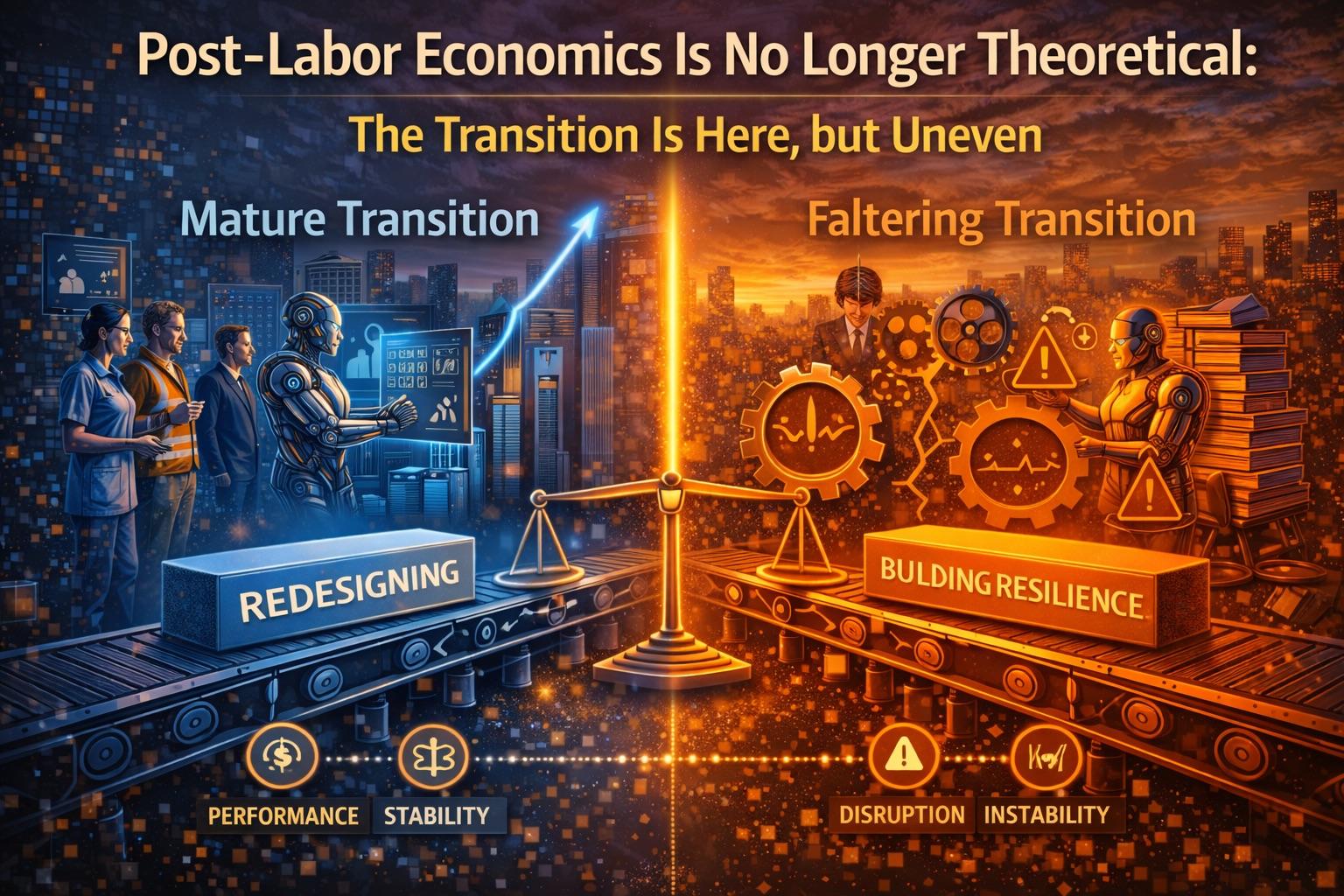
Post-labor economics is no longer theoretical. The transition is here — visible in entry-level hiring compression, in the gap between micro task gains and macro productivity stagnation, in the widening split between labour share and corporate profits. The question is not whether the transition is happening. It is whether institutions — corporate, governmental, and social — will manage it toward broad-based improvement or allow it to concentrate gains in ways that undermine the demand base, the social contract, and the political stability that productivity growth ultimately depends on.
The most important AI metric in 2026 is not tokens per second. It is whether the gains show up in paychecks — not just in profit margins.
The economy that figures out how to distribute AI productivity gains is the one where AI productivity gains actually compound. The one that doesn’t is the one where they don’t matter.
Thorsten Meyer is an AI strategy advisor who has noticed that “record corporate profits” and “record AI investment” and “no productivity gains” appearing in the same sentence is the kind of paradox that usually resolves in a direction nobody budgeted for. More at ThorstenMeyerAI.com.
Sources
- PwC 2026 Global CEO Survey — 56% “Nothing” from AI, 12% Revenue + Cost Gains
- NBER Study — 89% No Productivity Change, 6,000 Executives
- OECD Compendium of Productivity Indicators 2025 — 0.6% (2023), ~0.4% (2024)
- OECD — Euro Area –0.9%, US +1.6% (2023)
- OECD Ecoscope — AI: 0.25–0.6pp TFP Contribution (projected)
- Stanford/MIT — +14% Customer Service Productivity
- St. Louis Fed — +1.9% Excess Cumulative Productivity Since ChatGPT
- ManpowerGroup 2026 — AI Use +13%, Confidence –18%
- OECD Society at a Glance 2024 — 52% Wealth (Top 10%), 8.4:1 Income Gap
- BLS / BEA — Labour Share 53.8%, Corporate Profits 11.55% GDP
- Rezi — UK Tech Grad Roles –46%, US Junior Postings –67%
- Rezi — 35% Entry-Level Requiring Experience, 60% IT Requiring 3+ Years
- NACE Job Outlook 2026 — +1.6% Hiring, 45% “Fair” Market
- WEF Future of Jobs 2025 — 85–92M Displaced, 97–170M Created
- Click-Vision — 60% Task Changes, 49% AI for 25%+ Tasks
- OECD — 5.0% Unemployment, 11.2% Youth (Feb 2026)
- EPI — Unbalanced Bargaining Power as AI Threat to Workers
- Gartner — $2.52T Worldwide AI Spending (2026)
- SignalFire — Entry-Level Tech Hiring –25% (2023–2024)
- InvestorPlace — Labour Share Lowest Since 1940s, Great Decoupling
© 2026 Thorsten Meyer. All rights reserved. ThorstenMeyerAI.com