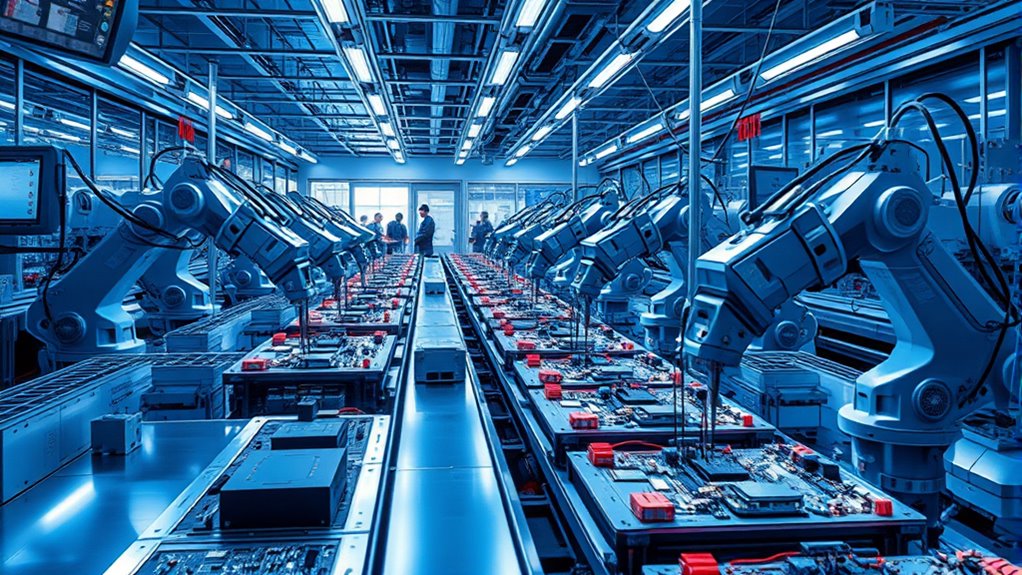

Companies thrive without relying on traditional labor by investing heavily in automation and advanced technology. They boost profits through faster production, lower labor costs, and smarter decision-making powered by AI, robotics, and digital infrastructure. This shift allows them to maximize efficiency and increase shareholder returns while wages stay stagnant. If you want to understand how these strategies reshape the economy and what’s driving this machine-powered growth, there’s more to explore ahead.
Key Takeaways
- Companies increase profits by investing in automation and digital technologies that boost productivity and reduce reliance on human labor.
- Automation leads to higher profit margins as machines produce more efficiently while labor costs stagnate or decline.
- Profits are increasingly allocated to shareholders and investors, widening economic inequality.
- Strategic investments in AI, robotics, and digital infrastructure enable faster decision-making and operational efficiency.
- Balancing automation with workforce reskilling sustains long-term growth and mitigates societal impacts of job displacement.
Top picks for "profit without labor"
Open Amazon search results for this keyword.
As an affiliate, we earn on qualifying purchases.
The Surge in Corporate Profits Post-Pandemic
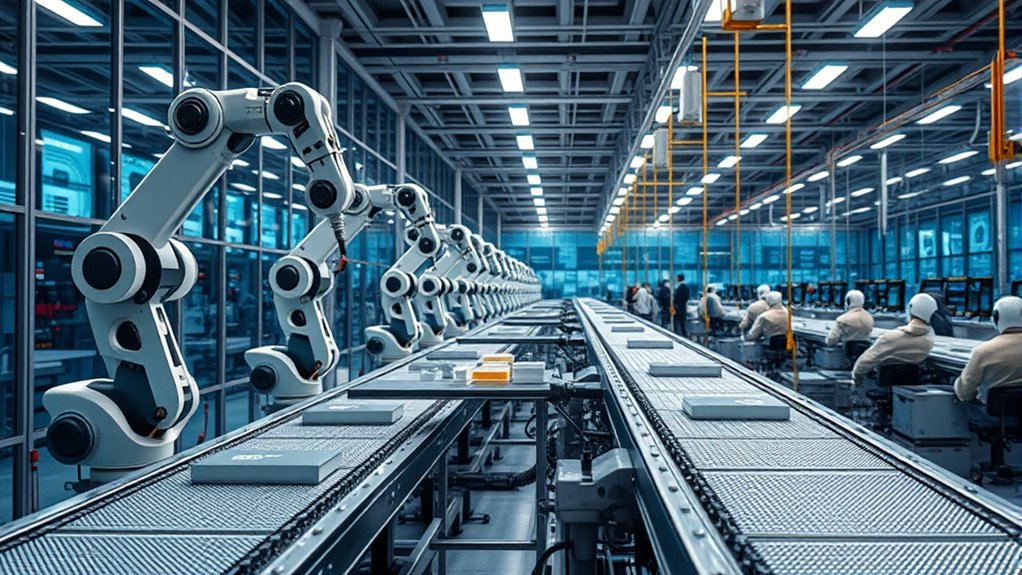
Since the onset of the COVID-19 pandemic, U.S. corporate profits have surged to near record highs, driven by a combination of factors that boost profitability. You’ll notice that most gains come from increased dividends paid to shareholders, accounting for about 76% of profit growth in nonfinancial industries. Meanwhile, corporate savings—undistributed profits—make up roughly 15%, supporting long-term investments, especially in retail, construction, and wholesale sectors. This profit boost isn’t uniform across all industries; tech services and nondurable goods manufacturing emphasize dividend payouts. The overall picture shows companies not only earning more but also prioritizing shareholder returns, often at the expense of wages. This surge reflects broader trends like globalization, tax cuts, and low interest rates, all fostering higher profit margins. Business – Greek Sceptic notes that increased interest in alternative investments, such as gold IRAs, is also part of the shifting landscape.

You’ve likely noticed that corporate profit shares are climbing while wages shrink relative to the economy. This growing gap means more profits flow to shareholders and capital owners, leaving workers with a smaller piece of the economic pie. As this trend continues, it reshapes how economic gains are distributed between labor and capital.
Profit Share Growth
The share of corporate profits in the economy has increased considerably over the past two decades, reflecting a shift in how economic gains are distributed. This growth stems largely from automation, technological efficiency, and expanded corporate savings, which boost profit margins. As companies invest more in machines and infrastructure, profits grow faster than wages, widening the gap between capital and labor income. You’ll notice that even with steady or modest wage increases, corporate profits surge, driven by reduced labor costs and increased productivity. This trend favors shareholders and capital owners, enabling companies to distribute higher dividends and retain earnings for future growth. Additionally, the rise of asset division strategies in divorce cases highlights the importance of understanding asset division laws and their implications for equitable distribution. Ultimately, profit share growth emphasizes how automation and strategic savings have transformed the landscape, allowing firms to generate more profit with less reliance on human labor.
Wage Share Decline
The share of wages in the U.S. economy has fallen steadily as corporate profits have surged, creating a growing gap between the income flowing to workers and that earned by capital owners. This decline reflects the shifting balance of economic gains, where companies increasingly prioritize profits over worker compensation. While employment levels have remained steady, wage growth has lagged behind productivity and inflation, eroding real incomes for many workers. Automation and technological advances allow firms to boost output without proportional increases in wages, further reducing the labor share. As companies accumulate more savings from higher profits, they invest in automation and infrastructure rather than raising wages. This trend intensifies economic inequality, emphasizing how capital owners benefit disproportionately from the current growth model. Additionally, the use of sound design techniques in media production demonstrates how strategic enhancements can influence audience perception and engagement.
Capital vs. Labor
As corporate profits soar, the distribution of economic gains increasingly favors capital owners over workers. You’ll notice that more of the wealth generated flows to shareholders and investors, leaving wages behind. This shift is driven by several factors:
- Companies reinvest profits into automation and technology, boosting productivity but limiting wage growth.
- The share of profits going to labor declines as capital’s share rises, widening economic inequality.
- Low interest rates and deregulation favor investors, making capital more lucrative relative to labor.
This imbalance means you see fewer benefits for workers, even as overall economic output grows. Instead, the gains are concentrated among those who own and control the machines, deepening the divide between capital and labor.
Automation’s Role in Boosting Profit Margins
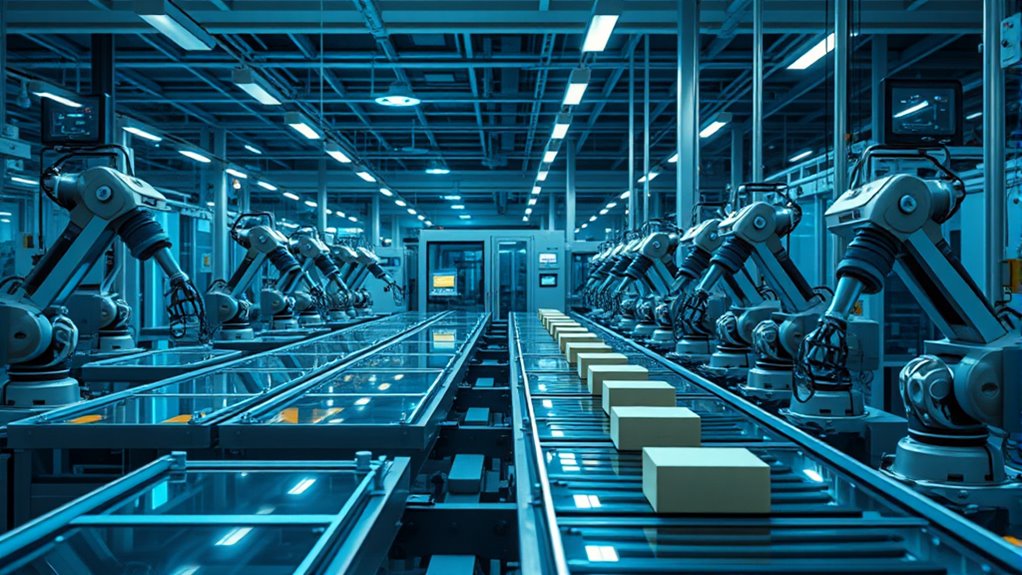
Automation plays a pivotal role in boosting profit margins by increasing productivity and reducing labor costs. When you implement machines and automated systems, you can produce more output with fewer workers, directly lowering expenses. This efficiency allows your company to scale operations without proportionally increasing wages or benefits. This performance tuning can lead to faster production times and higher quality outputs, further enhancing profitability. As productivity rises, the cost per unit decreases, improving profitability even if sales remain constant. Investments in technology often lead to undistributed profits, which can fund further automation or expansion. This cycle creates a structural advantage, enabling your business to stay competitive in a dynamic market. By leveraging automation, you shift the focus from labor-intensive processes to capital-driven growth, boosting margins and ensuring sustained profitability with less reliance on human labor.
How Technology Transforms Business Investment Strategies

Technological advancements have fundamentally reshaped how businesses approach investment decisions. You now prioritize automation, data analytics, and digital infrastructure to boost efficiency and competitiveness. These tools help you identify profitable opportunities faster and allocate resources more effectively. Instead of traditional assets, you focus on areas like AI development, cloud computing, and robotics. This strategic shift allows you to:
- Invest in automation to reduce labor costs and increase output
- Use data analytics for smarter, real-time decision-making
- Upgrade digital infrastructure to support scalable growth
- Incorporate skincare patches into health and wellness products to meet consumer demand for innovative solutions
The Rise of Corporate Savings and Long-Term Growth
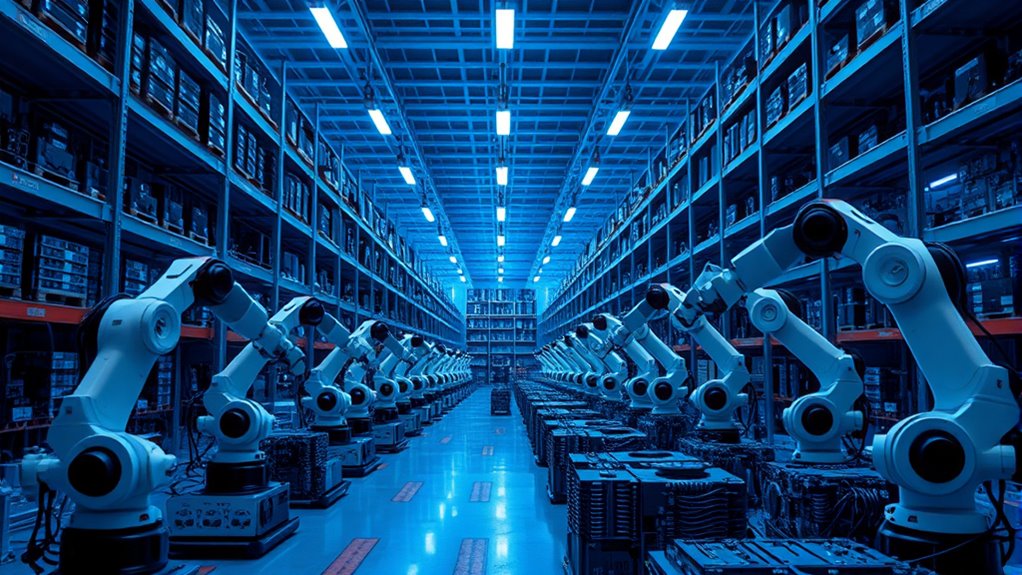
Businesses are increasingly channeling their profits into savings rather than immediate wage increases or expansion. This shift allows companies to build financial reserves that fund long-term investments in automation, infrastructure, and technology upgrades. By prioritizing savings, firms reduce reliance on external capital and gain flexibility during economic fluctuations. Industries like retail, construction, and wholesale trade are leading this trend, reinvesting their surplus profits into growth projects that enhance productivity. These corporate savings support a cycle of sustained innovation and competitive advantage, enabling companies to thrive without expanding their workforce proportionally. As profits are retained rather than distributed, firms strengthen their capacity to weather downturns and capitalize on future opportunities, fueling long-term growth driven by technological advancement and strategic capital allocation. Additionally, maintaining robust cash reserves helps businesses improve their credit scores, making it easier to secure favorable loan terms when needed.
Industry Leaders Investing in Automation and Infrastructure

Industry leaders are actively channeling their increased profits into automation and infrastructure upgrades to stay competitive in a rapidly evolving economy. They recognize that investing in advanced machinery and digital systems boosts productivity and reduces reliance on human labor. This strategic focus enables companies to maintain profit margins amid shifting market demands. Additionally, many organizations are exploring legal processes related to operational changes to ensure compliance and sustainability.
Decoupling Labor Costs From Productivity Gains

As companies invest heavily in automation and digital infrastructure to boost productivity, a growing disconnect has emerged between these efficiency gains and worker compensation. You’ll notice that, while output per worker increases, wages and salaries haven’t kept pace, leading to a widening productivity-pay gap. Machines and automated systems reduce reliance on human labor, allowing companies to expand production without proportionally raising labor costs. This decoupling means profits grow even as worker pay remains stagnant or grows modestly. Instead of sharing efficiency gains, firms often channel savings into dividends, buybacks, or reinvestment in further automation. Consequently, the benefits of productivity improvements flow primarily to capital owners, leaving workers with limited or no wage growth despite rising corporate profits. Additionally, the use of advanced home theatre projectors exemplifies how automation enhances operational efficiency while altering traditional labor dynamics.
The Macroeconomic Environment Supporting Profit Expansion

The macroeconomic environment has played a pivotal role in supporting profit expansion by creating favorable conditions for corporate growth. Low interest rates reduce borrowing costs, making it easier for companies to invest in automation and infrastructure. Strong GDP growth, especially in 2025, indicates an efficient, technology-driven economy that boosts profits. Additionally, policies like corporate tax cuts and globalization have increased profit margins and allowed companies to expand without relying heavily on labor. The adoption of technological innovations such as automation and AI further enhances productivity, contributing to sustained profit growth.
Challenges and Risks of Relying on Machines for Growth
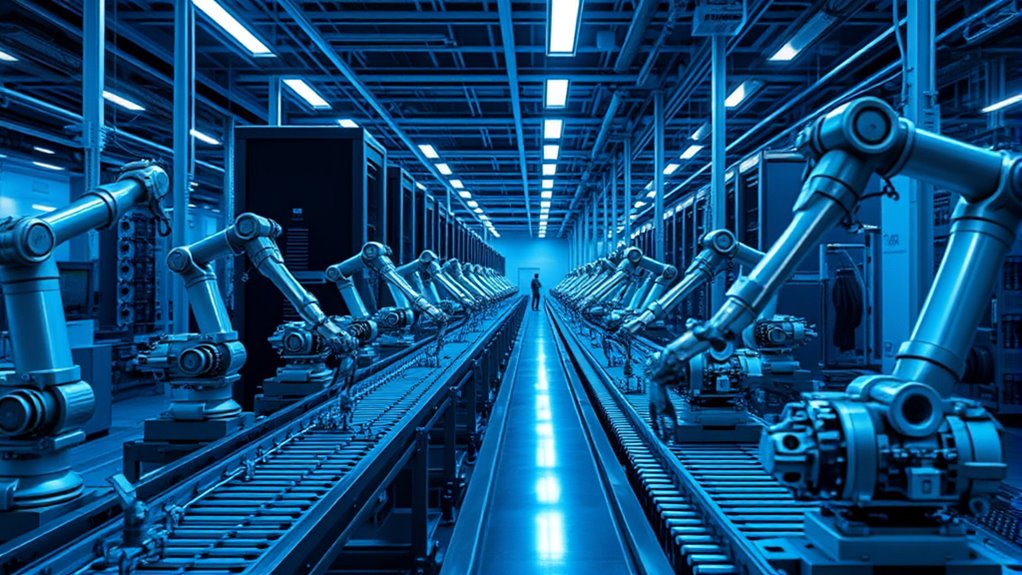
Relying heavily on machines for growth can lead to significant job displacement, leaving many workers without stable employment. As automation becomes more advanced, the economy risks becoming overly dependent on technology, making growth vulnerable to technological failures or shifts. This dependence also raises concerns about long-term sustainability if the benefits of automation aren’t broadly shared. Additionally, overreliance on natural materials like wood and stone can compromise ecological balance if not managed responsibly.
Job Displacement Risks
Although automation drives corporate profits and boosts productivity, it also poses significant job displacement risks. As machines replace human workers, many face unemployment or reduced hours. This shift can lead to economic insecurity and widen income inequality. You might see industries like retail, manufacturing, and logistics shrinking their workforces rapidly. The risks include:
- Job losses in sectors heavily dependent on manual labor, leaving workers stranded without skills for new roles.
- Wage suppression as companies rely more on automation, reducing bargaining power for employees.
- Regional economic decline in areas where automation eradicates traditional employment hubs.
While automation fuels growth, it’s essential to recognize the human cost. Without proper safeguards, displaced workers could face long-term hardship, undermining societal stability.
Economic Dependence on Automation
Automation has become a key driver of corporate profits and productivity gains, but depending heavily on machines for growth introduces significant challenges and risks. If companies rely too much on automation, they become vulnerable to technological disruptions, cyberattacks, and system failures that can halt operations and damage reputation. Overdependence on machines may lead to skill erosion among workers, reducing the human workforce’s ability to adapt or innovate. Additionally, rapid technological obsolescence can require costly upgrades and ongoing investments, straining financial resources. Economic dependence on automation also risks creating a fragile economic structure—if automation falters, overall growth could slow, and unemployment may rise if companies cut jobs swiftly to maintain profits. Balancing automation with human capital remains essential to mitigate these vulnerabilities.
Future Outlook: Sustaining Profitability in a Machine-Driven Economy

As companies continue to integrate machines and advanced technology into their operations, maintaining profitability in a machine-driven economy hinges on strategic investments in innovation and efficiency. To stay ahead, you’ll need to focus on several key areas:
- Prioritize R&D to develop smarter, more adaptable automation tools that boost productivity.
- Optimize supply chains through data-driven insights, reducing costs and downtime.
- Invest in workforce reskilling to complement automation, ensuring human expertise adds value.
Frequently Asked Questions
How Sustainable Is Profit Growth Driven Primarily by Automation?
Profit growth driven mainly by automation can be sustainable if companies balance technological investments with innovation and market demand. You need to contemplate that automation boosts productivity and reduces costs, but over-reliance might limit adaptability. To keep growth steady, you should continually upgrade technologies, expand markets, and invest in workforce skills where possible. Without these strategies, the long-term sustainability of profit growth from automation could face challenges due to market shifts and technological obsolescence.
What Happens to Workers as Companies Focus More on Machines?
You might notice that wages have declined as a share of GDP from 58.5% in 1970 to around 51.7% today. As companies focus more on machines, your job could become more automated, reducing the need for human labor. This shift means fewer opportunities for wage growth, possibly increasing job insecurity. You’ll need to adapt by developing new skills to stay competitive in a machine-driven economy.
Can Increased Corporate Savings Lead to Economic Inequality?
Yes, increased corporate savings can lead to economic inequality. When companies focus on automating processes and boosting profits, they often pay less in wages, widening the income gap. As a result, capital owners benefit more from growth, while workers see stagnant or declining real incomes. This disparity perpetuates inequality, making it harder for many to share in economic gains, especially as automation reduces job opportunities and wage growth for the average worker.
How Do Automation Investments Impact Small and Medium-Sized Businesses?
When you invest in automation, small and medium-sized businesses can boost efficiency and cut costs, helping you stay competitive. Automation allows you to increase production without hiring more workers, which can be challenging for smaller firms. However, it also requires significant upfront costs and technical skills. If managed well, automation can lead to growth and higher profits, but you must balance these benefits against the risks of reduced employment opportunities and investment expenses.
What Regulatory Changes Could Influence the Future of Machine-Driven Profits?
Regulatory changes like stricter labor laws, increased automation taxes, or new data privacy rules could slow down machine-driven profits. You might find compliance costs rising, making automation less attractive. Conversely, policies supporting innovation, such as tax incentives or eased regulations on AI and robotics, could boost profits further. Staying adaptable and advocating for balanced regulations helps you capitalize on automation’s potential while minimizing risks.
Conclusion
As you watch companies thrive with machines whispering behind the scenes, it’s like a silent tide lifting profits higher while workers’ shares drift further away. The landscape shifts beneath your feet, where human effort becomes a whisper compared to the roar of automation. To stay afloat, you’ll need to navigate this evolving ocean carefully—balancing innovation with risks—before the next wave of change reshapes the shore entirely.