Today Anthropic released Claude Fable 5, which it calls the most capable model it has ever made generally available. An independent reviewer — the team at Every, who had a week of early access — went further, calling it the best coding model in the world.

Get business pricing on tech for your team
- Business-only prices and quantity discounts
- Tax-exempt purchasing
- Multiple users, one account, clear invoices
But the capability isn’t the most interesting part of this launch. The more telling story is how Anthropic shipped it.
Fable 5 is the first “Mythos-class” model offered to the public — a tier the company places above its Opus models, and one it previously judged too dangerous to release broadly. The way it made that release safe is genuinely new: on risky topics, Fable doesn’t refuse you. It quietly hands the question to a weaker model, Claude Opus 4.8. And its fully-unlocked twin, Mythos 5, stays behind closed doors with a small set of trusted partners.
For anyone building a business on these models, the launch is as much about economics, safety architecture, and how you actually use something this powerful as it is about raw horsepower.
Fable & Mythos
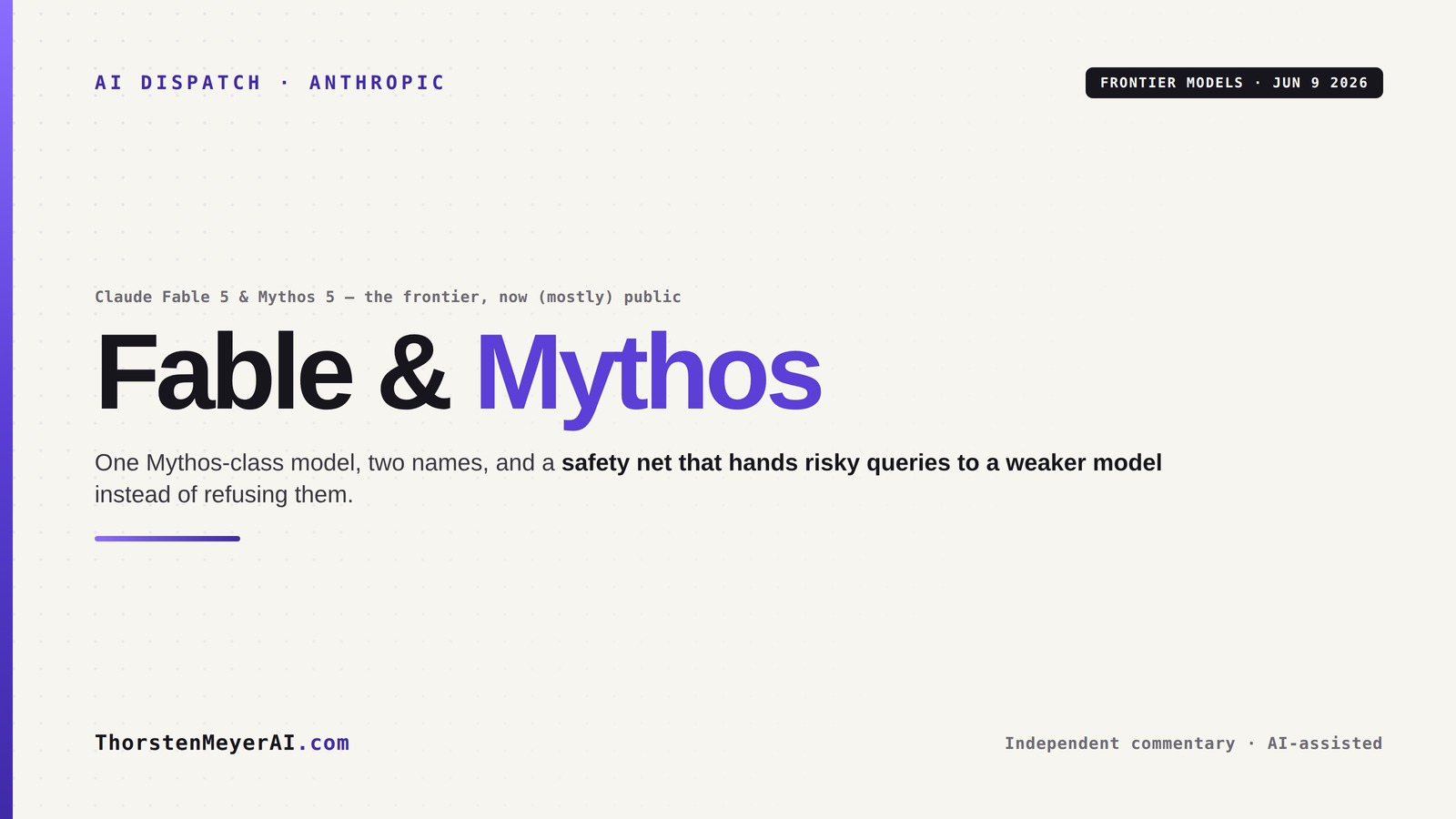
Anthropic just shipped its most capable public model — and the story is how. One “Mythos-class” model, two names, and a safety net that hands risky queries to a weaker model instead of refusing them.
- The best coding model in the world they’ve tested — 91/100, near human-engineer range.
- Paradigm-shifting for power users on their hardest, long-horizon tasks.
- One-shots entire apps; owns a whole job end-to-end over multi-hour runs.
- Overpowered for everyone else — lower-adoption users struggled to find a use.
- Slow & token-hungry; ~2× Opus 4.8 cost, >3× Sonnet 4.6. Mixed for writing.
- Rewards a sharp brief, punishes a loose one — precision in, precision out.
Independent commentary, produced with AI assistance under human editorial oversight. The views are the author’s own and may change. This is analysis, not investment, financial, legal, or technical advice. Details of Claude Fable 5 and Mythos 5 — capabilities, safeguards, pricing, rollout, and figures — are drawn from Anthropic’s launch announcement and Every’s independent “Vibe Check,” both June 2026, and may change as the models and access terms evolve. Benchmarks and testimonials are as reported by their sources. Company and product names are referenced for analysis and imply no affiliation or endorsement.
One model, two names
The cleanest way to understand the release is that Fable 5 and Mythos 5 are the same underlying model. The only thing separating them is the safeguards — which is also why they have different names. Anthropic notes that “Fable” comes from the Latin fabula, “that which is told,” close kin to the Greek mythos; the words mean nearly the same thing, and the distinction lives entirely in what each version is allowed to do.
Fable 5 is the safeguarded version, available everywhere today. Mythos 5 is the same model with the safety classifiers lifted in some areas, deployed first through Project Glasswing — Anthropic’s cyber-defense program run with the US government — as an upgrade to the Mythos Preview model that launched in April. Mythos 5 has, by Anthropic’s account, the strongest cybersecurity capabilities of any model in the world, which is precisely why access stays restricted.
The lineage matters for context. Mythos-class capability isn’t new as of today; it arrived in April, locked to a handful of cyber-defenders and infrastructure providers. What’s new is that Anthropic now believes its safeguards are robust enough to put a Mythos-class model in front of the general public at all. Fable 5 is the proof of that belief.
Launch it here.
Products Worth Considering

Bose QuietComfort Wireless Earbuds with Active Noise Cancellation, Dewdrop Mint

Bose SoundLink Max Bluetooth Speaker

Bose QuietComfort True Wireless Earbuds with Active Noise Cancellation, Black
As an affiliate, we earn on qualifying purchases.
The safety net is the product
Here is the part builders should study, because it signals where frontier releases are heading.
Fable 5 ships with a layer of classifiers — separate AI systems that watch for misuse across three areas: cybersecurity, biology and chemistry, and model distillation. When a query trips one of those classifiers, Fable doesn’t return a refusal. It routes the response to Opus 4.8 instead, and tells the user it has done so. The logic is that a capable fallback is a far better experience than a flat “no,” and Opus 4.8 is no slouch.
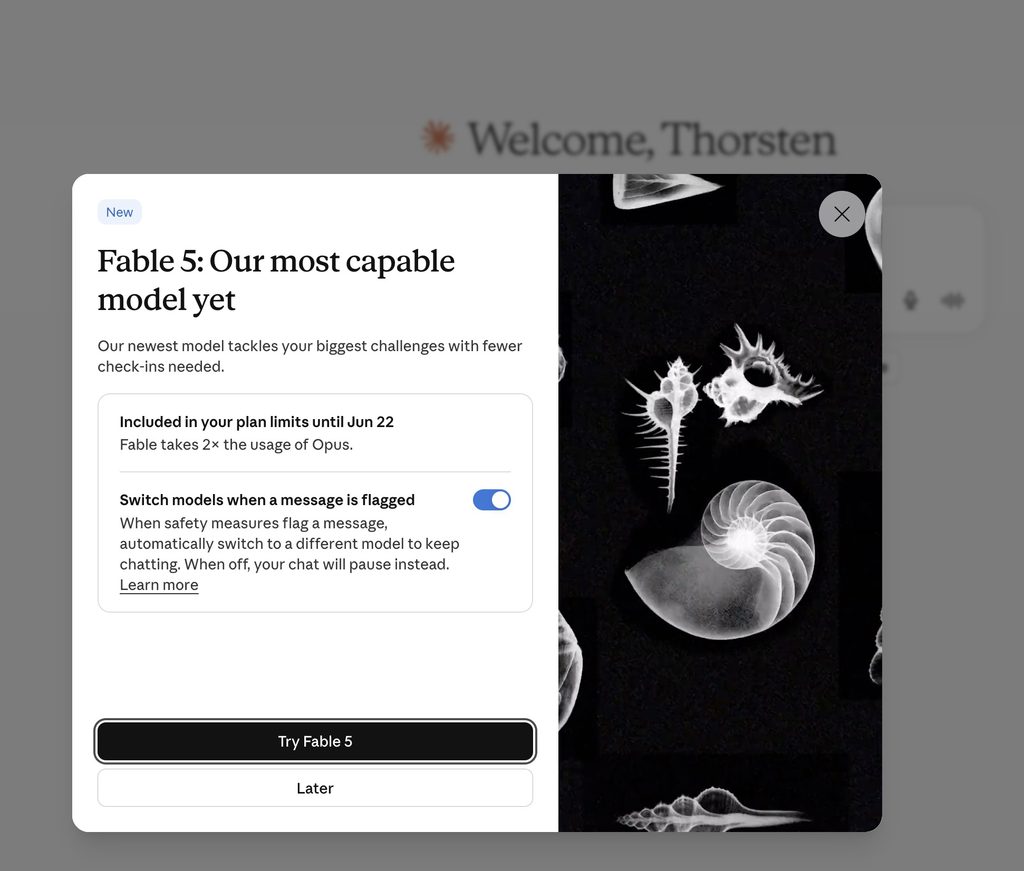
Two numbers frame how often this happens. Anthropic says fewer than 5% of sessions trigger any fallback at all, and more than 95% run on full Fable — meaning for the overwhelming majority of work, you’re effectively using Mythos 5 without the lock. The company also concedes it tuned the safeguards conservatively to ship quickly and safely, so they’ll sometimes catch harmless requests, and it expects to narrow them over time.
The robustness claims are specific: an external bug bounty found no universal jailbreaks in more than 1,000 hours of testing, though Anthropic acknowledges the UK’s AI Security Institute made early progress toward one. There’s also a new 30-day data-retention policy for all Mythos-class traffic — used for safety and abuse-detection, not for training — which is a real compliance consideration for anyone running sensitive or regulated workloads.
Step back and the architecture is the headline. Anthropic has decoupled capability from safety and shipped them as separate layers of the same product: one frontier model, gated by classifiers, that downshifts rather than refuses. Expect “capability behind a fallback” to become a pattern, not a one-off.
What it can actually do
The capability evidence, drawn from Anthropic’s own testing and named customers, is substantial — and the consistent theme is that the lead grows with the length and complexity of the task.
On software engineering, Stripe reported that Fable compressed months of work into days, performing a codebase-wide migration across a 50-million-line Ruby codebase in a single day that would have taken a team more than two months by hand. On knowledge work, it topped Hebbia’s senior-level finance benchmark and aced trading-analysis evaluations at the firm IMC. On vision — now its strongest domain — it rebuilt a web app’s source code from screenshots alone and beat Pokémon FireRed using only raw game frames, where earlier Claude models needed an elaborate helper harness.
The Mythos 5 side is where it edges into science. Anthropic’s protein-design experts reported roughly 10x acceleration on parts of the drug-design process, with the model matching or beating skilled humans on a set of targets. It’s the company’s first model to consistently produce novel scientific hypotheses — its molecular-biology hypotheses were preferred over Opus-class ones about 80% of the time in blinded comparisons — and in a week of largely autonomous genomics work, a model it trained outperformed a recently published Science result despite being a hundred times smaller.
Pricing for both models is $10 per million input tokens and $50 per million output — less than half what Mythos Preview cost. The API model string is claude-fable-5.
The independent reality check
Anthropic’s numbers are Anthropic’s numbers. The more useful counterweight is Every’s hands-on review, because it’s honest about the catch.
The verdict was emphatic on capability: Fable 5 scored 91 out of 100 on Every’s Senior Engineer benchmark — the hardest coding test they run — against 63 for Opus 4.8 and 62 for GPT-5.5, landing near the range of the human engineers who’ve taken it. Every’s testers one-shot entire applications from a single prompt, the kind of multi-hour, end-to-end builds that maxed out previous models.
But their framing was pointed: “a warp drive for power users” that is overpowered for everyone else. Testers high on Every’s AI-adoption curve found it paradigm-shifting on their hardest tasks; testers lower down struggled to find anything to use it for. The model rewards a sharp, well-framed, delegable brief and punishes a loose one — precision in, precision out, as the review put it. It’s slow and token-hungry, especially at high effort; it runs roughly twice the cost of Opus 4.8 and more than three times the cost of Sonnet 4.6; and it’s mixed for writing, where its deliberation works against the fast back-and-forth that drafting depends on.
The practical recommendation that emerged: treat Fable 5 as an asynchronous agent, not a chat partner. Hand it a complete job, let it run, review carefully, and run several in parallel — rather than waiting on one interactive thread. Their one-line summary: a strong closer that wants a clear target.
Why builders should care
For Thorsten Meyer’s audience — people shipping products and publishing at scale — a few implications stand out.
The first is that the usage model is changing. This is not a faster chatbot; it’s a delegation engine. The scarce skill is no longer prompt phrasing but problem-framing and review — the ability to specify a whole job with clean edges and then check the output. If your workflows are built around rapid interactive chat, you’re using a screwdriver as a hammer.

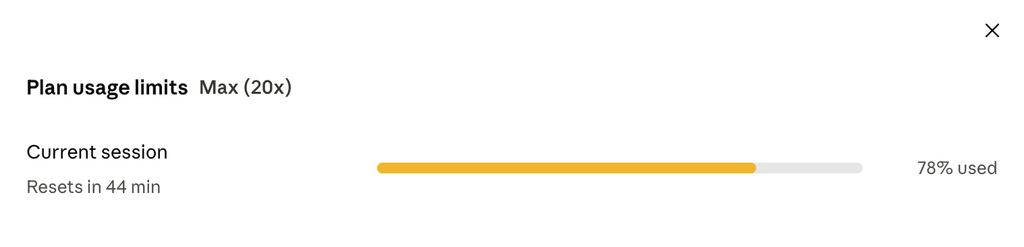
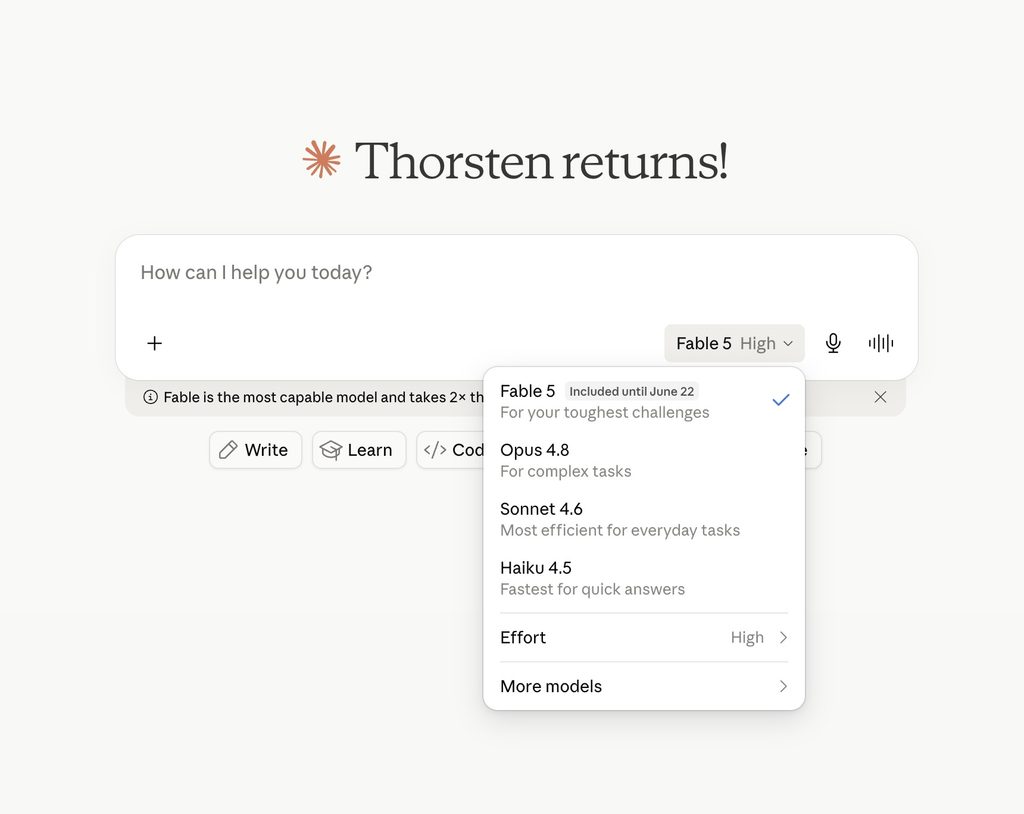
The second is economics and access. At $10/$50, slow, and token-hungry, Fable is not the model you reach for to fix a typo. Match it to big, high-stakes, delegable work; keep cheaper, faster models nearby for everyday tasks. Watch the rollout, too: Anthropic is including Fable on Pro, Max, Team, and seat-based Enterprise plans through June 22, then moving it to usage credits, then aiming to restore it as standard once capacity allows. That staging is a tell that demand is expected to outstrip supply — plan for variable cost and availability rather than assuming flat-rate access.
The third is the safety architecture as a signal. The conservative classifiers mean some legitimate work in security, life sciences, and adjacent fields will get bumped to Opus 4.8 — relevant if you operate in those domains. The 30-day retention policy is a procurement question for regulated workloads. And the fallback-not-refuse design is worth internalizing as the direction of travel: as models cross capability thresholds, the release mechanism — classifiers, downshifting, partner gating, retention — becomes part of the product you’re buying.
The fourth is the overhang. A model that compresses a two-month migration into a day, posits publishable hypotheses, and trains research models that beat the literature changes what a small team can credibly attempt. But the value concentrates among those who can frame and supervise large delegable jobs. The AI-adoption gap Every flagged isn’t a curiosity; it’s becoming a competitive gap.
The honest read
Fable 5 is, on the available evidence, the new ceiling — and the fallback-safety design is a real innovation in how frontier capability reaches the public rather than staying locked to a few labs and partners. That deserves credit on both counts.
It is not, however, a universal upgrade. It’s slow, it’s expensive, it’s wasted on small tasks, and its safeguards will occasionally bump work you intended innocently. The deeper signal is structural: Anthropic is now shipping models capable enough that the way they’re released — gated, fallback-equipped, partner-tiered, logged — is itself a core feature, not fine print.
For builders, the takeaway isn’t “switch everything to Fable.” It’s narrower and more useful: learn to delegate whole jobs to it, point it only at the work that has edges, mind the meter, and watch the safety architecture closely — because that architecture, as much as the benchmark scores, is where frontier AI is heading next.
Independent commentary, produced with AI assistance under human editorial oversight; the views are the author’s own and may change. This is analysis, not investment, financial, legal, or technical advice. Details of Claude Fable 5 and Mythos 5 — capabilities, safeguards, pricing, rollout schedule, and the figures cited — are drawn from Anthropic’s launch announcement and Every’s independent “Vibe Check” review, both published June 2026, and may change as the models and their access terms evolve. Benchmark results and customer testimonials are as reported by their respective sources. Company and product names are referenced for analysis and imply no affiliation or endorsement. © 2026 Thorsten Meyer · Powered by Thorsten Meyer AI. See Imprint/Impressum and Privacy Policy.