By Thorsten Meyer | November 17, 2026 | ThorstenMeyerAI.com

Get business pricing on tech for your team
- Business-only prices and quantity discounts
- Tax-exempt purchasing
- Multiple users, one account, clear invoices
AI and Work Today is our daily video on the news we covered on Tuesday, November 17, 2026, read through one lens: what it means for work, wages, skills and firms. In one line: AI makes the first draft cheap, and the cost moves to the people who check it, to the first rung of the career ladder, and to the teams on call when attacks speed up. The facts below come from our full articles, linked in each section; the labor-economics reading is ours and is marked as such.
The graduate squeeze: the first rung thins out
A Bank of England staff analysis on the Bank Underground blog finds that UK online job adverts fell 15% in the most AI-exposed third of occupations, 10% in the middle third and 6% in the least exposed third. Customer service adverts fell 23%, administrative ones 22%: classic first jobs built on scheduling, correspondence and routine information processing. But the author writes that “confident attribution remains premature”: pandemic over-hiring, a cyclical slowdown, remote work and higher labour costs all hit at the same time. In Australia, Indeed’s Hiring Lab found that graduate job postings fell almost 15% in 2025, and that the fall in graduate postings for highly AI-exposed jobs began in 2023, before AI tools were widely used.
Our reading: the bottom of the career pyramid is where AI would show first. If firms stop hiring juniors now, where do their seniors come from in ten years? For graduates, the skill to show is judgment: spotting when the AI is wrong, and fixing it.
Full article: AI and the Graduate Job Squeeze: What the Data Shows, and What It Doesn’t
Products Worth Considering

DJI Mini 4K Drone Combo with 4K Camera, 3-Axis Gimbal, and Two Batteries

Logitech MX Creative Console with 9 Customizable Keys, Graphite

LG 27GS60QC-B Ultragear 27-inch Curved Gaming Monitor (QHD, 180Hz, 1ms, 1000R)
As an affiliate, we earn on qualifying purchases.
Checking AI’s work: the hidden cost
In a randomized trial by the research group METR, 16 experienced open-source developers worked on 246 real tasks with AI tools of early 2025. With AI allowed, they took 19% longer; afterwards, they still believed AI had cut their time by 20%. Other experiments found large gains: on professional writing tasks, ChatGPT cut the time by 40% and raised quality by 18%. In a study with Boston Consulting Group, AI users finished tasks inside AI’s abilities 25.1% faster, but on one task outside them they were 19% less likely to get it right. Georgia Tech’s Karen Feigh calls the extra work “the verification burden” and says the studies do not establish a universal verification “tax”.
Our reading: the draft got cheap, but knowing whether it is right did not. Measure the whole workflow, review and rework included, not the speed of the first draft. And if workers stay accountable for AI output, as Feigh argues, they need the time and training to check it.
Full article: Checking AI’s Work Has a Hidden Cost. What the Studies Show, and What It Means at Work
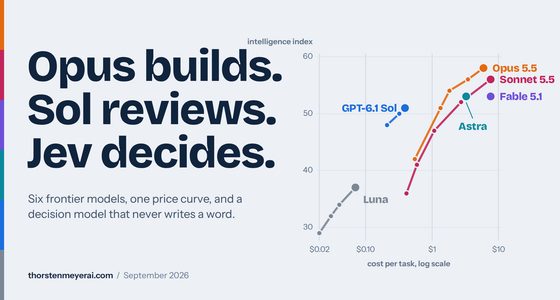
Choosing a model for work: no single winner
A note on a possible conflict of interest: we research and draft with Anthropic’s Claude, and Anthropic makes Claude Fable 5.2, one of the two models compared here. On the independent Artificial Analysis Intelligence Index (accessed November 17, 2026), Anthropic’s Claude Fable 5.2 scores 62 at its High setting and Google’s Gemini 4 Carbon 60. One index task costs $9.08 with Fable 5.2 and $5.48 with Carbon; Carbon’s figure uses Google’s introductory price, which doubles on December 1. Fable 5.2 answers more questions correctly, 77.2% against 58.3%, but when it does not know, it guesses wrong far more often: a hallucination rate of 58.0% against 11.4%. Fable 5.2 leads on coding in real repositories and long documents; Carbon leads on terminal work, professional documents and business workflows. On professional documents, both fail most tasks (GDP.pdf: Carbon 28.4%, Fable 5.2 21.8%).
Our reading: there is no single winner, so send each task to the model that fits it, instead of crowning one. Test 20 to 50 of your own tasks and divide the cost by the ones that pass review. A model that guesses with confidence needs more checking, and that checking is work.
Full article: Claude Fable 5.2 vs. Gemini 4: What Really Changes for Work
Attacks at machine speed: what is proven, what is forecast
Google Threat Intelligence Group says it saw attackers “fully automate vulnerability discovery and exploitation without a human in the loop for the first time”. The evidence is one exposed staging server running a framework Google calls exploit_agent, which compares code before and after a security update, writes an attack and runs it. Google does not say how many sites were broken into. It expects attacks with little to no human interaction within one to three months and fully autonomous attacks within three to six months; nobody outside Google has confirmed that timeline, and Google also sells protection against it.
Our reading: the defenses are not new: patch what is attacked first, cut long-lived keys, lock down admin access. What changes is the clock. If attacks move in minutes, someone needs the authority to cut access at night and on weekends. That is a staffing question, not just a tool question.
Full article: Google Finds AI Attacks With No Human in the Loop. What Is Proven, What Is Only Forecast
Number of the day: 31%
In an experiment with 2,784 people checking AI-style suggestions, published in the Harvard Data Science Review, spelling errors such as two confused digits were corrected 82% of the time. When spotting the error required understanding the task’s rules, accuracy fell to 31%. The suggestions were prepared by the researchers, and the participants were recruited online, not domain experts. Still, the hard part of checking is the meaning, not the typos. Source: Beck, Eckman, Kern and Kreuter, “Bias in the Loop”, Harvard Data Science Review, Spring 2026, as cited in our article on checking AI’s work above.
Also out on November 17: Work After Work, episode 15, Trade and Globalisation: Who Wins, Who Loses.
The bottom line
What ties the day together: AI makes producing cheap, and the scarce work moves to judging, checking and responding, for graduates, reviewers and people on call.
I’m Thorsten Meyer. The full articles, with all their sources, are linked above, and more reality checks are at thorstenmeyerai.com.
Researched and drafted with AI assistance, including Anthropic’s Claude. Anthropic makes Claude, and its model is one of the two subjects of one story summarized here; we report where each model leads and trails, as the independent measurements show. None of the companies, agencies or people named reviewed or sponsored this post. The video uses a synthetic voice. Our own text and graphics contain no affiliate links; offer and product boxes added by the site may contain Amazon affiliate links. This post is for information only. It is not investment, legal, career or security-consulting advice. Statements as published in the linked articles as of November 17, 2026. Images: graphics and video by Thorsten Meyer AI; our own images show no real people or logos. Boxes added by the site may show product photos or people.