29 Sept 2026 · Thorsten Meyer

Get business pricing on tech for your team
- Business-only prices and quantity discounts
- Tax-exempt purchasing
- Multiple users, one account, clear invoices
In four weeks, the AI frontier stopped being a leaderboard and became a price curve. Six models now sit within about 20 index points of each other, while their cost per task differs by roughly 100×. That changes the question from “which model is smartest?” to “which model clears my quality bar at the lowest cost per task?”
Here is how I answer it today, on 29 September 2026:
- Opus 5.5 at high or xhigh is my main model for building.
- GPT-6.1 Sol, released today, is the model I use to dig into details and to review.
- Astra, Fable, Sonnet 5.5 and Luna are alternates for specific jobs, not defaults.
- Jev, a decision model that cannot write a sentence, takes over high-volume yes/no and routing judgements.
All scores below come from the Artificial Analysis Intelligence Index v4.3.x unless noted. That index is a map of general capability, not a verdict on your workload, so shadow-test before you switch anything.
Opus builds. Sol reviews. Jev decides.
One price tape, six models
Score against cost, at every effort setting
The effort dial moves the bill more than the model
Claude Opus 5.5
Claude Sonnet 5.5
GPT-6.1 Sol: near-Astra scores at a fraction of the price
Three published settings
| Setting | Index | Cost per task | Output tokens | First token |
|---|---|---|---|---|
| medium | 48 | $0.21 | 15M | 5.3 s |
| high | 50 | $0.32 | 25M | 57 s |
| xhigh | 51 | $0.39 | 36M | 69 s |
Same score band, very different bill
My stack: who builds, who reviews
Cheaper tokens are not cheaper work
Read the numbers with four warnings
Part 2: Jev, the model that decides instead of writing
One call in, typed answers out
Three question types
Confidence is the superpower
Three uses running in my publishing operation
The fit test, then the shadow test
- Replay 300 to 500 past decisions
- Compare overall and per confidence band
- Read 20 disagreements, decide who was right
- High band at 95% or better?
- Own flag, off by default
- Canary on 5 to 10 units
- Roll out in the confident band only
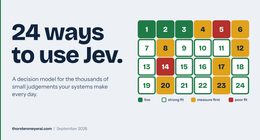
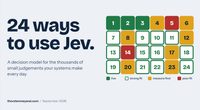
24 use cases, sorted by how well they fit
Proven in production
- 1Relevance gate
- 2Language check
- 3Classifier fallback
Publishing and content
- 4Thin-source detector
- 5Same-event dedupe
- 6Product fits roundup
- 7Disclosure present
- 8Headline quality
- 9Comment moderation
Commerce and support
- 10Support-ticket routing
- 11Return-reason coding
- 12Review to feature complaints
- 13Catalogue taxonomy
- 14Order-fraud pre-triage
Software and AI systems
- 15LLM guardrail
- 16RAG passage filter
- 17Citation check
- 18Tool and intent routing
- 19Log-line triage
- 20PR risk triage
Business ops and home
- 21Inbox triage
- 22Expense categorisation
- 23Lead qualification
- 24Smart-home intent
Limits, cost and one hard rule
Six models, one price curve
Opus 5.5 has the highest score, and GPT-6.1 Sol and Luna are the cheapest ways to get a usable answer. Between them sits a set of models that are hard to justify at their top settings.
| Model | Released | Index (top setting) | Cost per task | Tasks per $100 | Where it fits |
|---|---|---|---|---|---|
| Claude Opus 5.5 | 22 Sep | 58 | $5.98 | 17 | Main builder, knowledge work |
| Claude Sonnet 5.5 | 28 Sep | 56 | $7.60 | 13 | Scoped subtasks, docs and slides |
| Claude Fable 5.1 | 1 Sep | 53 | $7.63 | 13 | Only where your tests say it wins |
| GPT-6 Astra | 3 Sep | 53 | $3.26 | 31 | Agents, computer use |
| GPT-6.1 Sol (xhigh) | 29 Sep | 51 | $0.39 | 256 | Details and review |
| GPT-6 Luna | 22 Sep | 37 | $0.07 | 1,429 | Classification, extraction, routing |
Three things stand out. First, Opus 5.5 now outscores its more expensive sibling Fable 5.1 by 5 points and costs less per task. Second, Sonnet 5.5 at max effort costs more per task than Opus at max for 2 fewer points, so it does not belong at that setting. Third, GPT-6.1 Sol costs about one-eighth of Astra and one-twentieth of Fable per task for a score only 1 to 2 points lower.
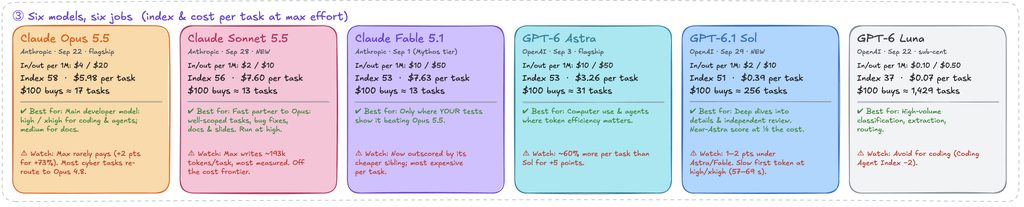
Prices per 1M tokens (input / output): Opus 5.5 $4 / $20 (cache reads $0.20), Fable and Astra $10 / $50, GPT-6.1 Sol $2 / $10, Luna $0.10 / $0.50.
The effort setting is the real cost lever

Choosing the effort level moves your bill more than choosing between most models. On Opus 5.5, going from xhigh to max adds 2 index points and 73% more cost per task. From medium to max, cost rises 4.46× for 7 points.
| Effort | Opus 5.5 index | Opus 5.5 cost per task | Sonnet 5.5 index | Sonnet 5.5 cost per task |
|---|---|---|---|---|
| low | 42 | $0.55 | 36 | $0.41 |
| medium | 51 | $1.34 | 41 | $0.59 |
| high | 54 | $1.82 | 47 | $1.08 |
| xhigh | 56 | $3.46 | 52 | $2.74 |
| max | 58 | $5.98 | 56 | $7.60 |
That is why I run Opus at high or xhigh for development. High delivers 54 points for $1.82. Xhigh adds 2 more for hard problems such as architecture, migrations and trust boundaries. Max is rarely worth it, and Sonnet 5.5 shows why: at max it writes about 193k output tokens per task, the most Artificial Analysis has measured, and its cost jumps from $2.74 to $7.60 for 4 points.
Medium is still the right default for documents and everyday work. Sonnet’s best value is high, at 47 points for $1.08.
GPT-6.1 Sol: near-Astra scores at a fraction of the price
GPT-6.1 Sol launched today at the same $2 / $10 per 1M tokens as its week-old predecessor, and Artificial Analysis already lists three effort levels. Even the medium setting matches the earlier GPT-6 Sol’s score of 48 at one-fifth of its $1.06 per task.
| GPT-6.1 Sol | Index | Cost per task | Output tokens on the index | Time to first token |
|---|---|---|---|---|
| medium | 48 | $0.21 | 15M | 5.3 s |
| high | 50 | $0.32 | 25M | 57 s |
| xhigh | 51 | $0.39 | 36M | 69 s |
Compared with the top of the field, Sol xhigh sits 1 to 2 points under Astra (52 at xhigh, 53 at max) and Fable 5.1 (53), at $0.39 instead of $3.26 or $7.63. It is very concise: the high setting used 25M output tokens on the index, against a median of 82M for comparable models.
The catches are real. High and xhigh take 57 to 69 seconds to produce a first token, so this is not an interactive model at those settings. Opus 5.5 still leads it by 5 points at xhigh (56 against 51). Artificial Analysis has not yet published low or max settings, and one index point is inside the noise.
The practical reading: Sol is not the model I ask to build. It is the model I can afford to run on everything, because a review pass at $0.32 to $0.39 per task is cheap enough to be routine.
My stack: Opus builds, Sol digs and reviews
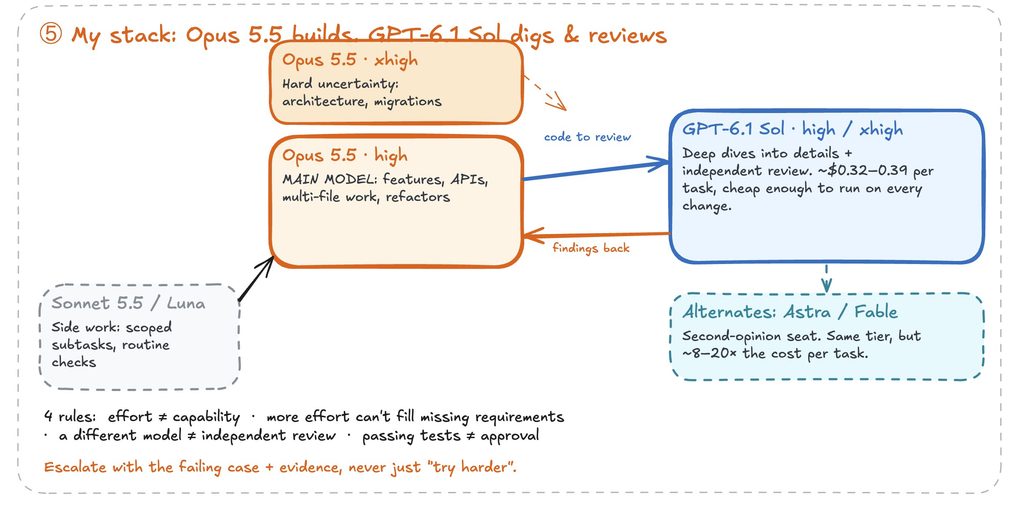
I use Opus 5.5 as my main model and GPT-6.1 Sol as the second pair of eyes. The split follows what each is good at and what each costs.
| Role | Model and setting | Why |
|---|---|---|
| Main builder | Opus 5.5, high | Features, APIs, multi-file work, refactors. 54 points for $1.82 per task. |
| Hard problems | Opus 5.5, xhigh | Architecture, migrations, trust boundaries. 56 points for $3.46. |
| Details and review | GPT-6.1 Sol, high or xhigh | Deep dives into a specific file or diff, and an independent review. $0.32 to $0.39 per task. |
| Second opinion | Astra or Fable | Same tier as Sol but roughly 8 to 20 times the cost per task. Only when Sol and Opus disagree. |
| Side work | Sonnet 5.5 (high), Luna | Scoped subtasks, routine checks, bulk classification. |
The review seat matters most. A different model family reviewing Opus’s output is a better check than Opus reviewing itself, and at $0.39 per task I can afford to run it on every meaningful change. Four rules keep that honest:
- Effort is not capability. Turning up the dial does not make a model smarter.
- More effort cannot fill in missing requirements.
- A different model is not an independent review if both read the same flawed spec.
- Passing tests are not approval to ship.
When something fails review, I hand the failing case and the evidence to Opus, never just “try harder”.
Cheaper tokens are not cheaper work
Halving the model price saves 12.5% of the real cost, and a single extra minute of human review erases it. The example is illustrative, not measured: a task costs $1 of model time plus 4 minutes of review at $45 an hour, so $4.00 in total.
| Scenario | Model cost | Review cost | Total |
|---|---|---|---|
| Baseline | $1.00 | $3.00 | $4.00 |
| Model price cut by 50% | $0.50 | $3.00 | $3.50 |
| Cheaper model, 1 extra minute of review | $0.50 | $3.75 | $4.25 |
So the number to track is cost per accepted result: model, tools, review and rework, divided by the results someone actually uses. That is the figure that tells you whether GPT-6.1 Sol’s low price saved money or just moved the cost to a person.
Four warnings before you quote any of these scores:
- The index keeps moving. Fable 5.1 scored 66 on an earlier version and 53 on v4.3. Compare only within one version, and treat a 1-point gap as noise.
- Anthropic scores include safety fallback. Flagged cyber and biology tasks route to older models, and that now applies to Sonnet 5.5 too.
- Max effort is not how people run models. Production usually runs medium or high, where gaps narrow and costs fall sharply.
- Your workload decides. Shadow-test on your own tasks and budget cost per task, not cost per token.
Part 2: Jev, the model that decides instead of writing
Jev is the opposite of a frontier model: it cannot write, summarise or extract anything. You send it a piece of text or JSON and a set of typed questions, and it returns a probability and an honest confidence that your code can branch on. It takes about 0.3 to 0.9 seconds per call and costs $0.042 per million input tokens, with output free. At roughly 600 tokens per three-question call, 100,000 decisions cost about $2.50.
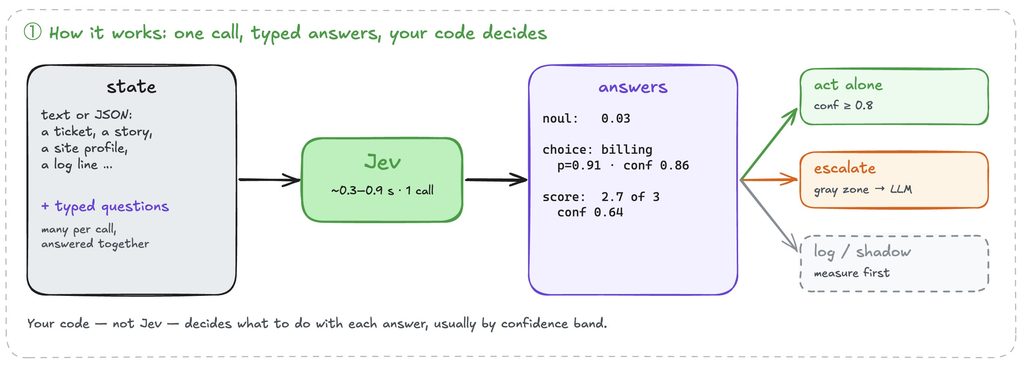
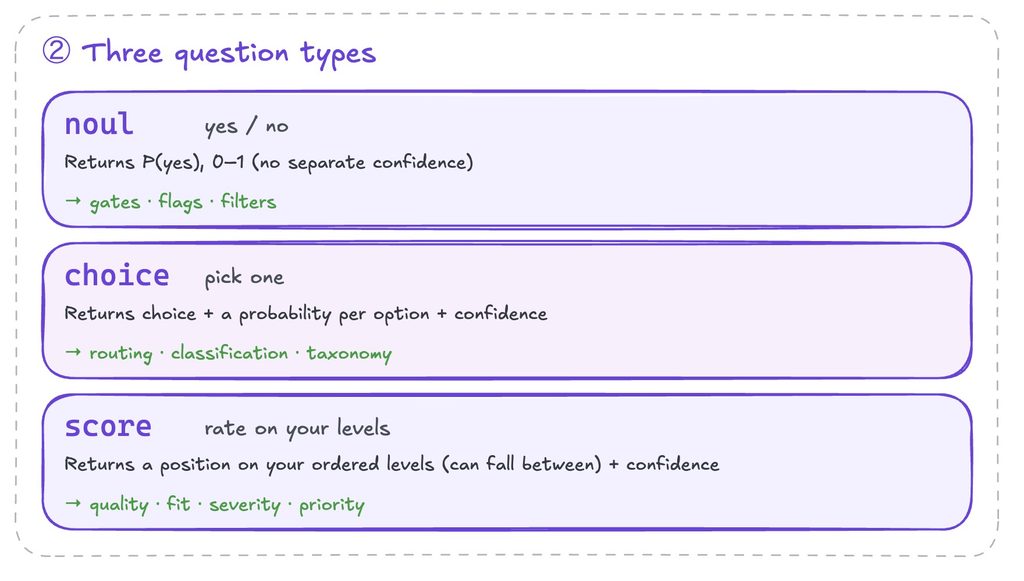
There are three question types:
| Type | You get back | Typical use |
|---|---|---|
| noul | Probability of yes (0 to 1) | Gates, flags, filters |
| choice | One option, a probability per option, and a confidence | Routing, classification |
| score | A position on your ordered levels, plus a confidence | Quality, fit, severity |
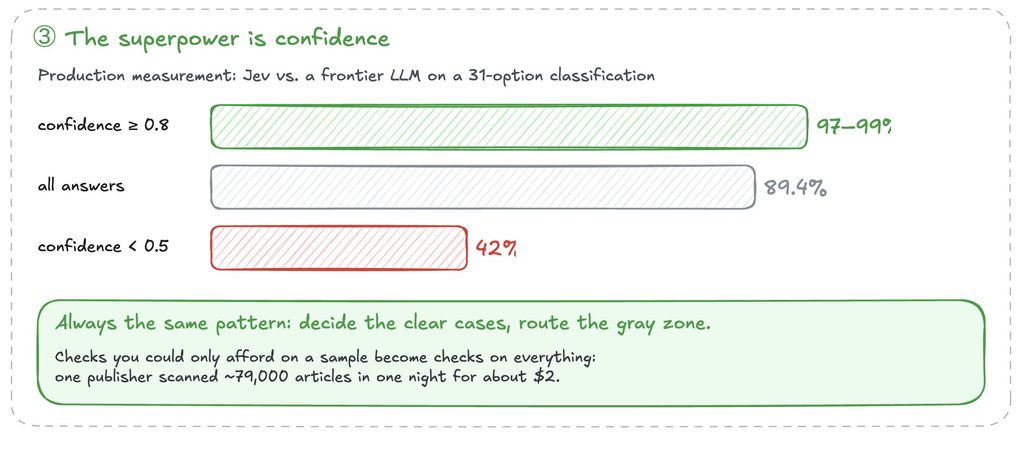
The useful part is the confidence. In my own measurement, Jev agreed with a frontier LLM 97 to 99% of the time when its confidence was 0.8 or higher, and only 42% of the time below 0.5 (89% overall). So the pattern is always the same: act on the clear cases and route the gray zone to something smarter.
Three uses are live in my publishing operation, about 90,000 decisions so far:
| Use | Question asked | Result |
|---|---|---|
| Relevance gate | Is this story relevant to this site’s readers, and how well does it fit? | About 10,000 pairings judged in 3 days; only 22% clearly on-topic |
| Language check | Is this article in the target language? | 78,889 articles scanned for $2.01; 1,576 problems found, 1,553 fixed |
| Classifier fallback | Which of 31 topics does this headline belong to? | 89% agreement with the primary LLM when that LLM errors |
I only use Jev when four conditions hold: the volume is high, the question is narrow, a wrong answer is cheap (or unsure cases go to something smarter), and an existing heuristic visibly fails. Then I prove it in shadow first: replay 300 to 500 past decisions, compare accuracy per confidence band, read 20 disagreements, and only wire it in if the high-confidence band reaches 95%. It gets its own flag, off by default, and a canary on 5 to 10 units before rollout.
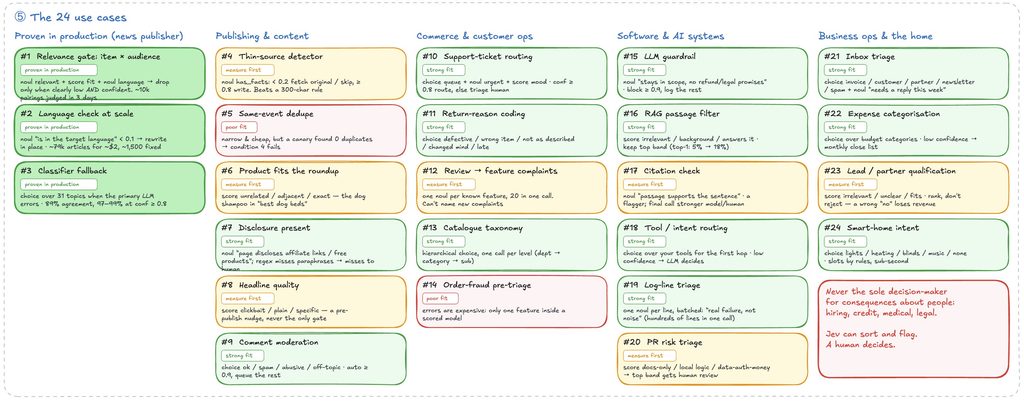
Know the limits. Jev has no world knowledge, so a bare name needs a snippet of context. It is weaker on maths, dates and non-English text. It reads your wording literally: a rewording shifted my results by about 2 points, so freeze the wording and re-measure after every change. It is early access and hosted only. And it should never be the sole decision-maker for consequences about people, such as hiring, credit, medical or legal outcomes. Jev can sort and flag. A human decides.
What to do this week
Fit beats peak intelligence, in both halves of this article. Route each task to the cheapest model that clears your bar, and re-test when the curve moves. It moved four times in four weeks: Fable and Astra, then Opus, Sol and Luna, then Sonnet 5.5, and now GPT-6.1 Sol.
- Set your main coding model to high or xhigh effort instead of max, and compare cost per accepted result for two weeks.
- Add a review pass with a second model family on every meaningful change. Start with GPT-6.1 Sol at high.
- List your ten highest-volume small decisions (routing, tagging, filtering) and run the four-condition test on each.
- Shadow-test one of them against Jev or Luna on 300 to 500 past decisions before you switch anything on.
- Stop quoting max-effort scores as if they were your production setting.
Sources
Scores and prices are from Artificial Analysis pages opened on 29 September 2026, plus my own earlier reviews. Astra and Fable scores come from the Artificial Analysis Intelligence Index v4.3 announcement and model pages as excerpted in search results.
- GPT-6.1 Sol (medium), GPT-6.1 Sol (high) and GPT-6.1 Sol (xhigh), Artificial Analysis
- Artificial Analysis Intelligence Index overview, including the Claude Sonnet 5.5 coverage
- Announcing Intelligence Index v4.3, Artificial Analysis
- Five frontier models, one bill, Opus 5.5: a new benchmark leader and Opus 5.5: the top model just got cheaper to run
- GPT-6 Sol and Luna: cheaper intelligence, same review bill and OpenAI cuts prices in half
- Which model should write your code?
- Jev and the rise of System One AI
- Jev measurements: my own production data, September 2026, rounded
Fall Picks
fall essentials
As an affiliate, we earn on qualifying purchases.