
By Thorsten Meyer AI
For years, large companies have hidden workforce reductions behind familiar phrases: restructuring, cost optimization, macroeconomic headwinds. In late 2024 and now moving decisively into 2025, that language is shifting. A growing number of enterprises are explicitly naming artificial intelligence and automation as direct reasons for job cuts.
This is not just a communications tweak. It is a strategic signal—one that reshapes expectations about work, productivity, and the social contract between employers and employees.
The Data Point That Changed the Tone
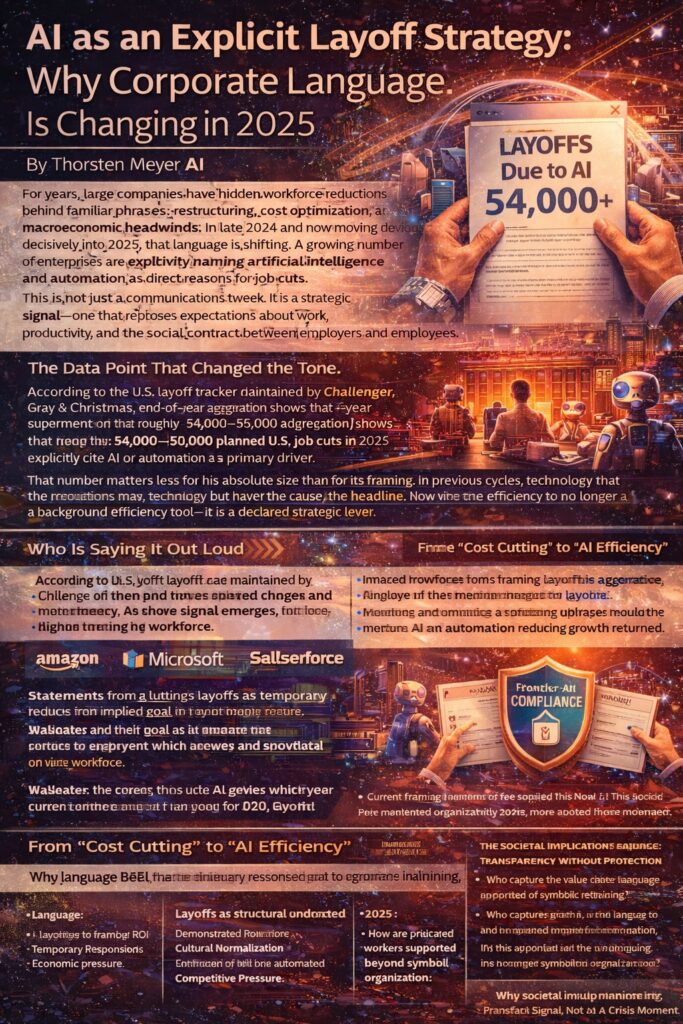
According to the U.S. layoff tracker maintained by Challenger, Gray & Christmas, end-of-year aggregation shows that roughly 54,000–55,000 planned U.S. job cuts in 2025 explicitly cite AI or automation as a primary driver.
That number matters less for its absolute size than for its framing. In previous cycles, technology may have been the cause, but rarely the headline. Now, AI is no longer a background efficiency tool—it is a declared strategic lever.
Who Is Saying It Out Loud
Several major firms have crossed a rhetorical threshold by acknowledging that AI systems are replacing or materially shrinking human roles:
- Amazon has linked automation and AI-driven logistics optimization to workforce reductions in operations and support functions.
- Microsoft has described AI productivity gains as enabling leaner team structures across product and sales units.
- Salesforce has openly discussed AI agents taking over routine customer-facing and internal processes.
- IBM has acknowledged that generative AI and automation are reducing the need for certain back-office and administrative roles.
What unites these statements is not defensiveness, but confidence. The tone suggests leadership teams believe investors—and increasingly the public—will accept AI-driven job reductions as rational, even necessary.
From “Cost Cutting” to “AI Efficiency”
This language shift marks a deeper transformation in corporate storytelling.
Previously:
- Layoffs were framed as temporary responses to economic pressure.
- The implied goal was stabilization until growth returned.
Now:
- Layoffs are framed as structural upgrades.
- The implied goal is a permanently smaller, more automated organization.
AI efficiency is being positioned not as a bridge, but as a destination.
Why Companies Feel Safe Saying This Now
Three forces converge in 2025:
- Demonstrated ROI
AI systems are no longer pilots. They are delivering measurable productivity gains across customer service, software development, finance, and operations. - Cultural Normalization
Employees themselves increasingly use AI daily. The idea that machines can do “knowledge work” is no longer theoretical. - Competitive Pressure
Once one major firm signals it can operate with fewer people thanks to AI, others feel compelled to follow—or risk being seen as inefficient.
In this environment, avoiding the word AI looks less like sensitivity and more like denial.
The Societal Implication: Transparency Without Protection
There is an uncomfortable irony in this moment. Corporations are becoming more transparent about why jobs disappear, while societies remain underprepared for what happens next.
Naming AI as the cause does not automatically create:
- reskilling pipelines at scale,
- income stability during transitions,
- or new ownership models for productivity gains.
Without those, transparency risks becoming a moral fig leaf—honest, but insufficient.
A Post-Labor Signal, Not a Crisis Moment
This is not a sudden collapse of work. It is a controlled, managerial transition toward post-labor economics.
The real signal in 2025 is not the number of jobs lost, but the confidence with which executives say:
“We no longer need as many people because machines now do the work.”
That sentence, once unthinkable in public filings and press releases, is becoming normalized.
What Comes Next
As AI systems scale further, three questions will define the next phase:
- Who captures the value created by reduced labor?
- How are displaced workers supported beyond symbolic retraining?
- And will societies redesign income, ownership, or taxation to reflect a world where productivity is no longer tightly coupled to employment?
AI is no longer just changing how work is done.
It is changing how openly we admit that work is disappearing.
— Thorsten Meyer AI