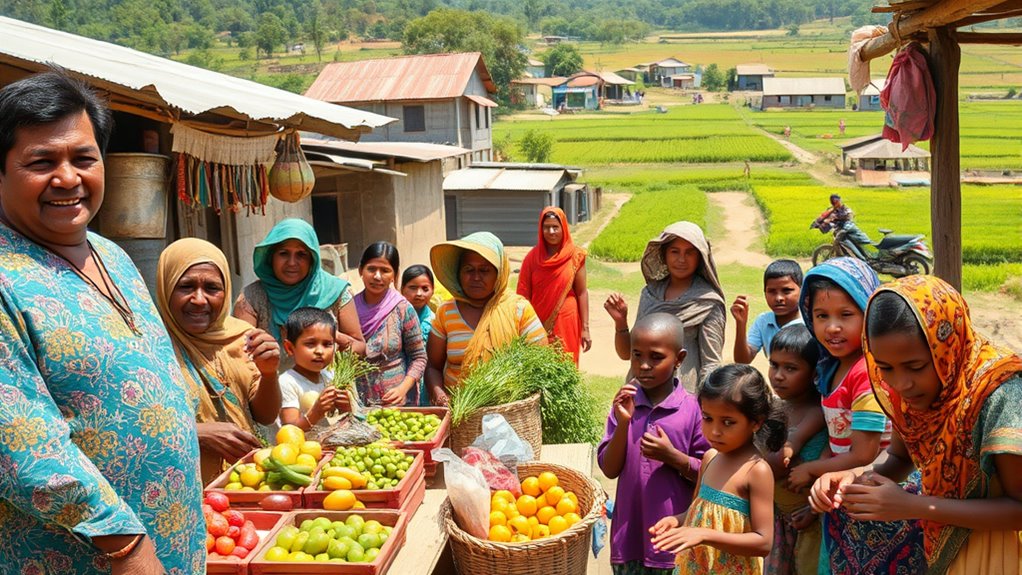

Implementing UBI in developing countries can markedly reduce poverty and boost household well-being by increasing access to food, healthcare, and education. It also encourages entrepreneurship and can support economic growth by helping vulnerable groups participate more actively in the economy. However, funding remains a challenge due to limited tax capacities and large informal sectors. To discover effective strategies and real-world examples, explore how these countries are tackling these issues and what lessons can be learned.
Key Takeaways
- UBI reduces poverty and enhances household welfare by increasing spending on essentials and promoting asset-building.
- Implementing UBI in developing countries faces funding challenges, especially with large informal sectors and limited tax capacity.
- UBI can stimulate economic growth by supporting entrepreneurship, improving health and education, and encouraging formal employment.
- Targeted and universal transfer strategies balance efficiency, administrative feasibility, and social cohesion in resource allocation.
- Lessons from existing pilot programs demonstrate UBI’s potential benefits and highlight the importance of sustainable funding and effective administration.
unconditional cash transfer programs
As an affiliate, we earn on qualifying purchases.
As an affiliate, we earn on qualifying purchases.
Challenges and Opportunities in Funding UBI in Low-Income Settings

Funding UBI in low-income settings presents significant challenges due to limited tax capacity and a large informal sector. You’ll find that relying on labor income taxes isn’t feasible, especially when incomes are low and many workers operate outside formal systems. Consumption taxes appear more practical, but they can suppress economic activity, reducing output, capital, and labor over time. To make UBI sustainable, targeting vulnerable groups rather than universal coverage may be more effective financially. Such focused approaches help stretch limited resources and minimize economic distortions. Additionally, some countries experiment with community or self-targeting methods to improve efficiency. While financing remains complex, leveraging existing social programs or reallocating subsidies can create opportunities to fund UBI without overburdening fiscal systems. Incorporating alternative revenue sources such as resource wealth or international aid could also play a role in supporting UBI initiatives.

SnapHouse Architectural Scale Model Building Kit (452 Piece), Architecture Model Kit for Adults and Kids Ages 13+
Custom Architectural Scale Models: Design and build custom Architectural Scale Models of your own unique house designs at…
As an affiliate, we earn on qualifying purchases.
As an affiliate, we earn on qualifying purchases.
Evidence of Poverty Reduction and Household Welfare Improvements

Unconditional cash transfers have consistently demonstrated their ability to reduce poverty and boost household welfare in low- and middle-income countries. They increase spending on essentials like food, health, and education, improving overall living standards. Evidence from programs shows families can invest in assets and entrepreneurial activities, creating longer-term benefits. To visualize this impact:
| Households | Poverty Reduction | Welfare Gains |
|---|---|---|
| 1 | Reduced income gap | Better nutrition |
| 2 | Increased consumption | Improved health outcomes |
| 3 | Asset accumulation | Enhanced education access |
| 4 | Greater economic stability | Elevated living standards |
These programs lead to measurable improvements in household welfare, demonstrating that direct income support effectively alleviates poverty and enhances quality of life. Vetted – Mother Baby Kids
microenterprise starter kits
As an affiliate, we earn on qualifying purchases.
As an affiliate, we earn on qualifying purchases.
Impacts on Economic Growth and Labor Market Dynamics

Implementing UBI can influence economic growth and labor market dynamics in several ways. When financed through consumption taxes, it might reduce long-term output, capital accumulation, and labor supply, potentially slowing growth. However, UBI can also encourage formal sector employment by reducing reliance on informal jobs, enhancing productivity and compliance. It may motivate individuals to pursue entrepreneurship or further education, fostering innovation. Importantly, cash transfers generally do not cause significant work disincentives; instead, they can increase labor participation, especially among vulnerable groups. The overall impact depends on program size, design, and local economic conditions. While some studies suggest modest shifts towards formal employment, the evidence remains mixed. Carefully structured UBI programs can support economic stability without undermining labor market participation. Additionally, labor market dynamics can be positively affected when UBI enables workers to transition between jobs or sectors more smoothly.

Reforming Foreign Aid: Reinvent the World Bank: Lessons in Global Poverty Alleviation from 40 years of adventures (and misadventures) in International Development
As an affiliate, we earn on qualifying purchases.
As an affiliate, we earn on qualifying purchases.
Balancing Targeting Strategies With Universal Transfers

Balancing targeted transfers with universal payments involves weighing the benefits of directing resources to those most in need against the advantages of broad coverage. You should consider that:
- Targeted transfers deliver higher welfare gains per dollar by focusing on vulnerable populations.
- Universal payments reduce administrative costs and minimize exclusion errors, ensuring no one is left out.
- Targeting can create implicit taxes during phase-out, potentially discouraging work or savings.
- Universal payments promote social cohesion and simplify implementation, especially in settings with weak administrative capacity.
- Incorporating efficient design techniques can further enhance the effectiveness of either approach.
You need to weigh these factors to find a feasible approach. Combining targeted and universal strategies can optimize resource allocation, promote equity, and improve social protection, especially where institutional capacity is limited.
Insights From Existing UBI Pilots and Global Experiences

Existing UBI pilots and programs around the world offer valuable lessons about the potential impacts and practical challenges of universal income schemes. They show that cash transfers can reduce poverty, boost household spending, and improve health, education, and entrepreneurship. However, they also reveal issues like funding difficulties, especially in developing countries with large informal sectors, and mixed effects on labor participation. Different models, such as Kenya’s ongoing experiment, Iran’s nationwide transfers, and Alaska’s oil dividend, demonstrate that universal payments are feasible and beneficial. Here’s a quick comparison:
| Program | Coverage | Key Impact | Challenges |
|---|---|---|---|
| Kenya | Large-scale pilot | Poverty reduction, social welfare | Funding sustainability |
| Iran | Nationwide cash transfer | Improved household income | Targeting accuracy |
| Alaska | Oil revenue dividend | Universal basic income | Fiscal sustainability |
| Developing Countries | Typically targeted | Poverty alleviation, social security | Funding and targeting issues |
Moreover, the administration of these programs is crucial to ensure their effectiveness and sustainability.
Frequently Asked Questions
How Sustainable Are UBI Programs During Economic Downturns in Developing Countries?
You might find that UBI programs in developing countries face sustainability challenges during economic downturns. Reduced government revenues from lower growth and tax bases can strain funding, especially if programs rely on consumption taxes or income sources that decline during recessions. To maintain sustainability, you should consider phased implementations, targeted support for vulnerable groups, or building reserves during better times, ensuring the programs can adapt to economic fluctuations without compromising their core benefits.
What Are the Long-Term Fiscal Impacts of Scaling UBI Nationwide?
Scaling UBI nationwide can strain government finances over the long term, especially if funded by consumption taxes or other revenue sources. You might see increased fiscal pressure, higher deficits, or the need for new taxes. While it can boost household welfare and reduce poverty, you should also consider potential output declines and reduced capital accumulation. Careful planning and phased implementation can help manage these fiscal impacts and make certain the program’s sustainability.
How Can Governments Effectively Target Vulnerable Populations for UBI?
You can target vulnerable populations effectively by using community-based or self-targeting methods that rely on local knowledge and social networks. Focus on identifying those with the greatest need, such as low-income households or marginalized groups, and guarantee transparent criteria to avoid exclusion errors. Combining targeted approaches with simple administrative processes increases accuracy and reduces costs, ultimately maximizing the impact of UBI for those who need it most.
Does UBI Discourage Formal Sector Employment Growth Over Time?
UBI may modestly discourage formal sector employment if the transfer amount reduces the incentive to work, especially for low-income earners. However, evidence shows that cash transfers often don’t create strong work disincentives and can even encourage entrepreneurship and labor participation. The impact largely depends on how the program is designed, its size, and the local economic context. Targeted or phased approaches can help mitigate potential negative effects on employment growth.
How Do Cultural Factors Influence UBI Acceptance and Effectiveness?
Cultural factors are the roots that anchor the acceptance and success of UBI in your community. If your society values collective wellbeing and trust in government, UBI feels like a natural extension, blooming into widespread support. Conversely, if cultural norms emphasize self-reliance or skepticism, acceptance may be fragile, like a delicate plant needing careful nurturing. Understanding these cultural nuances helps tailor UBI programs for deep, lasting growth in your society.
Conclusion
Implementing UBI in developing countries is like planting a seed that can grow into a thriving tree, offering shade and sustenance to many. While challenges exist, the potential to reduce poverty and boost growth is promising. By learning from global pilots and balancing targeted support with universal transfers, you can help shape a future where economic stability blooms for all. Embrace these opportunities, and watch positive change take root.