
By Thorsten Meyer

Get business pricing on tech for your team
- Business-only prices and quantity discounts
- Tax-exempt purchasing
- Multiple users, one account, clear invoices
For three years the AI conversation has been about chips. Who has the most NVIDIA GPUs, who can smuggle them past export controls, who can design a competitive alternative. That was the right constraint to obsess over — until it quietly stopped being the binding one. The constraint has moved, the way it always does in a physical build-out, from the clever thing to the boring thing underneath it. The binding constraint on AI is no longer chips. It’s electrons.
This is the third piece in my cloud-to-AI series, and it’s the one where the analogy to cloud starts to strain in a way worth taking seriously. Cloud scaled on infrastructure that mostly already existed. AI is trying to scale on infrastructure that has to be built, out of concrete and copper and turbines, on timelines measured in years — against demand measured in months. That mismatch is the whole story.
The number that reframes everything
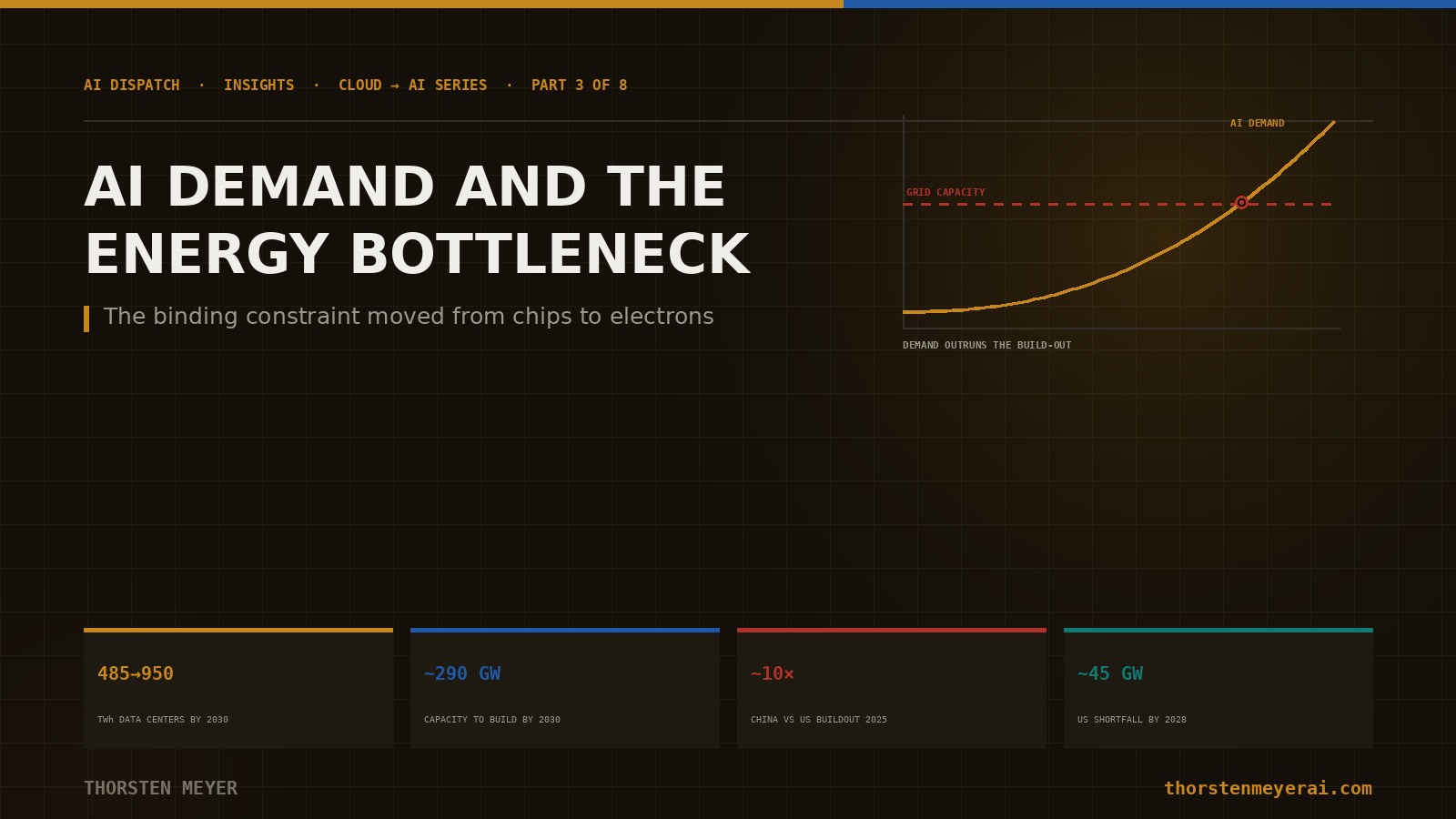
Start with demand, because the scale is genuinely hard to hold in your head. Global data-center electricity consumption is set to roughly double, from about 485 TWh in 2025 to around 950 TWh by 2030 — the IEA’s base case — reaching close to 3% of all global electricity. AI-focused facilities grow far faster than that, roughly tripling over the same window, growing about four times faster than electricity demand from every other sector combined.
For three years AI was a chip story. It quietly stopped being the binding constraint — the way it always does in a physical build-out, from the clever thing to the boring thing underneath.
When someone says AI is “only 3% of electricity,” they’re quoting consumption to make it sound modest. Capacity is where the bottleneck bites.
But here's the reframe that matters, and it's the single most useful idea in this piece: the number to watch is not terawatt-hours consumed. It's gigawatts of capacity. Terawatt-hours measure energy used over a year. Gigawatts measure what the grid must supply at the peak instant — and capacity, not consumption, is what determines whether a data center can be built and connected at all. Global data-center capacity is running around 132 GW in 2026, up from ~104 GW in 2025, headed for roughly 290 GW by 2030. When someone tells you AI is "only 3% of electricity," they're quoting the consumption number to make it sound modest. The capacity number — a specific, enormous amount of power the grid has to deliver at a specific instant, in a specific place, on a specific interconnection — is where the bottleneck actually bites.
high capacity power supply units for data centers
As an affiliate, we earn on qualifying purchases.
As an affiliate, we earn on qualifying purchases.
Why capacity is the wall
In the United States, capital is emphatically not the constraint. The four largest hyperscalers have committed something like $650 billion to AI infrastructure across 2025–2026; the capex of five tech companies now exceeds global investment in oil and gas production. The money is there. What isn't there, at the rate required, is the ability to manufacture transformers, permit transmission lines, and interconnect new generation.
The evidence is stark. The US interconnection queue — projects waiting to connect to the grid — holds on the order of 2,300 GW, with wait times that have doubled to around five years. At the end of 2025, data centers requiring roughly 241 GW were in the US development pipeline, a 159% jump in a single year, into a grid that cannot absorb it. Goldman Sachs flags a US power shortfall of about 9.3 GW in 2026, widening to ~45 GW by 2028; Morgan Stanley pegs a similar 44 GW gap within three years. At CERAWeek this March, grid operators reportedly told data-center developers to "get more flexible" — polite shorthand for throttle during peak hours or don't connect. And much of the grid it's all straining against is at end of life: over half of US coal plants predate 1980, and much of the transmission network dates to around the moon landing.
That is what a bottleneck looks like. Not a shortage of ambition or money — a shortage of the physical, permittable, buildable capacity to turn ambition and money into delivered power.
energy-efficient GPU servers for AI workloads
As an affiliate, we earn on qualifying purchases.
As an affiliate, we earn on qualifying purchases.
The electron gap
Now the part that turns an infrastructure story into a geopolitical one, and it's the sharpest edge of this whole piece.
A structural asymmetry the race under-names: the US leads on chips; China leads, decisively, on power. "Electrons are the new oil." — OpenAI, to the White House.
China deployed more new generation in one year than the US has cumulatively installed since 2008. BloombergNEF: China adds >6× as much as the US over the next five years.
There is a structural asymmetry in the AI race that doesn't get named clearly enough: the US leads on chips; China leads, decisively, on power. In 2025, the US deployed roughly 55 GW of new generation capacity. China deployed around 543 GW — nearly ten times as much, and more than the US has cumulatively installed since 2008. BloombergNEF estimates China will add more than six times as much generation capacity as the US over the next five years. China already generates more than twice the electricity the US does, its data centers pay less than half the US rate for power, and a Chinese project can move from planning to operation in months where a US one takes years. OpenAI put the stakes to the White House in a memo whose framing I keep coming back to: "Electrons are the new oil," calling for the US to build 100 GW of new capacity a year, explicitly because of the gap with China.
But — and this is the nuance that keeps it honest — power is only half the equation. US export controls on advanced chips are a real and biting constraint on China's actual AI compute. Huawei's best inference silicon runs at perhaps 60% of an NVIDIA H100. So the world has landed in a strange equilibrium: America has the compute and a grid that can't feed it; China has the grid and can't fully buy the compute. Whoever closes their gap first — the US on power, or China on chips — moves ahead. That's the race under the race, and it's being run in substations and fabs, not in model benchmarks.
renewable energy solutions for data centers
As an affiliate, we earn on qualifying purchases.
As an affiliate, we earn on qualifying purchases.
The honest bear case
I'd be repeating the exact mistake this series keeps warning about if I handed you "energy is destiny" as cleanly as the alarmists do. So here's the other side, and it's substantial.
The bottleneck is real. But the alarmists are as likely to be wrong as the dismissers — because efficiency, demand softening, and forecast error all cut against the straight line.
Three percent is still three percent. For all the vertigo of the growth rate, data centers reach only about 3% of global electricity by 2030 in the base case. That's real and localized — it overwhelms specific grids in Virginia or Ireland — but it is not, at the global level, civilization-scale. The framing matters: this is a distribution and capacity problem in specific places, not an aggregate generation apocalypse.
Efficiency cuts both ways, hard. Every projection here extrapolates today's energy-per-token. But models keep getting radically more efficient — DeepSeek was the shot heard round the world precisely because it collapsed the compute assumed necessary. Median energy per query has already fallen. The catch is Jevons' paradox: efficiency gains historically increase total demand by making the thing cheaper to use, not decrease it. So efficiency is real and it still might not save the grid — but it makes every confident TWh forecast shakier than it looks.
And the forecasts have a track record of being wrong in both directions. This is the cloud lesson from part one of this series, applied directly. The people projecting smooth exponential curves off 2026 demand are doing the same thing the people who dismissed AWS in 2007 did, and the same thing the people who said AWS would eat everything in 2014 did. The demand could soften — a model-efficiency breakthrough, an AI-capex pullback, a plain old bubble deflating — as easily as it could explode. Bottlenecks across the value chain, the IEA notes dryly, are already making the most aggressive scenarios less likely. Anyone selling you a straight line is selling you the 2007 mistake in new clothes.
electricity management systems for large-scale data centers
As an affiliate, we earn on qualifying purchases.
As an affiliate, we earn on qualifying purchases.
The part that's mine to make
Here's where this connects to everything I build and why I care about it beyond the spectacle. Power is physical and local in a way compute rented through an API is not. You cannot download a gigawatt. And that reintroduces geography into a technology we'd started to think of as placeless — which is precisely the argument for sovereign, local-first capability, and precisely Europe's awkward problem.
Because Europe sits in the worst seat at this table: it has neither America's compute lead nor China's power build-out. European data-center demand is real (~150 TWh and climbing), its grids are old, its permitting is slow, and its energy is expensive. If the AI race is decided by who can deliver gigawatts, a continent that can't build them fast doesn't get to set the terms — it rents them, from whoever can. That is the sovereignty stakes made concrete, and it's why "run it yourself, efficiently, locally" is not just a technical preference but, at national scale, an energy strategy. The most sovereign kilowatt-hour is the one you don't have to spend — which makes efficient local inference, quantization, and right-sized models an energy policy as much as an engineering choice.
Where I land
The bottleneck is real, and it has moved: from chips to electrons, and within electrons, from consumption to capacity. The United States has the money and the models and a grid that physically cannot feed them fast enough. China has the power and a chip constraint that stops it converting that power fully into compute. Everyone else, Europe included, is watching two giants each try to close their own gap, hoping to rent whatever spills over.
But the alarmists are as likely to be wrong as the dismissers, because efficiency, demand softening, and plain forecast error all cut against the straight line — and 3% of global electricity, however dramatic the rate, is not the end of the world. The useful posture isn't panic or dismissal. It's to watch the capacity number rather than the consumption headline, to treat every smooth projection with the humility the cloud era should have taught us, and — if you're building — to treat every watt you don't spend as the most strategic one you have. Next in the series: what happens to the labor market when the intelligence all this power is building gets cheap.
Analysis and opinion from a builder, founder, and post-labor economist running a local-first inference operation. Figures verified at time of writing against the IEA (Energy and AI, 2025–2026 updates), the Atlantic Council, BloombergNEF, Goldman Sachs and Morgan Stanley research, Gartner, and OpenAI's public policy memo; capacity and shortfall estimates are projections that vary by source and will change. Interpretation and the sovereignty framing are the author's own. This is analysis, not investment or energy-policy advice. Part 3 of an 8-part series. Point-in-time as of 13 August 2026.
Fall Picks
fall essentials
As an affiliate, we earn on qualifying purchases.