
By Thorsten Meyer | November 5, 2026 | ThorstenMeyerAI.com

Get business pricing on tech for your team
- Business-only prices and quantity discounts
- Tax-exempt purchasing
- Multiple users, one account, clear invoices
For a year, this looked like a done deal. In October 2025, SoftBank agreed to buy the robotics division of the Swiss-Swedish engineering group ABB for $5.375 billion. Europe waved it through. ABB told investors about two weeks ago that it expected to close before the end of this year. SoftBank had already lined up the loan.
Then, on 5 November 2026, ABB published a short statement. SoftBank had told it that a Chinese security office “has prohibited the acquisition of the ABB Robotics business in China.”
Not a competition problem. A national security problem. And not about chips or social media, but about industrial robots: the big arms that weld car bodies and stack boxes. Here is what was decided, by whom, on what legal basis, what is still open, and what it means if your business buys robots, sells companies or builds the factories of the next ten years.
Key takeaways
- What happened: On 5 November 2026, ABB confirmed that SoftBank had been told China’s Office of the Working Mechanism for Foreign Investment Security Review “has prohibited the acquisition of the ABB Robotics business in China.” The Financial Times first reported the block, saying SoftBank was informed by China’s National Development and Reform Commission.
- Blocked, not withdrawn: ABB’s wording covers the China business. The deal has not been called off. ABB says the two companies “are in close dialogue and are working constructively on the transaction.”
- Not antitrust: The decision came from China’s foreign-investment security review, a separate track from merger control, run by an office at the NDRC and led jointly with the Ministry of Commerce. China has not published a reason.
- The deal: Signed 8 October 2025 for an enterprise value of $5.375 billion. The EU cleared it in March 2026. As late as 20 October 2026, ABB expected closing in the fourth quarter.
- Why China cares: China installed 354,000 industrial robots in 2025, 59% of the world’s total, according to the International Federation of Robotics. Robots are a core part of its industrial strategy. The FT reported that officials worried robotics data could move abroad and train foreign AI models. That is a report, not an official reason.
- What it means: For companies, a robot deal now needs a security plan per country, not only an antitrust plan. For factories that run ABB robots in China, nothing changes today. For SoftBank, its “Physical AI” strategy just hit its first real border.
Products Worth Considering

Sony WH-1000XM4C (M4 2nd Gen) Wireless Noise-Cancelling Headphones, Black

Bose TV Speaker (2nd Gen) Compact Soundbar

LG UltraGear 32GX850A-B 32-inch 4K UHD Glossy OLED Gaming Monitor
As an affiliate, we earn on qualifying purchases.
What exactly was decided
ABB’s statement of 5 November 2026 is three sentences long. The key one: ABB “confirms that it has been informed by SoftBank that the Office of the Working Mechanism for Foreign Investment Security Review in China has prohibited the acquisition of the ABB Robotics business in China.” ABB adds that “the process to obtain the regulatory approvals is managed by SoftBank” and that the two companies “are in close dialogue and are working constructively on the transaction.”
Three words in that sentence matter.
- “Prohibited”. This is not a delay or a request for more documents. Under China’s rules, a prohibition means the investment may not go ahead.
- “In China”. ABB does not say the whole global deal is forbidden. It says the purchase of the China business is. The rest of the world is a separate question, and ABB has not said what happens to it.
- “Informed by SoftBank”. ABB is passing on what its buyer told it. I found no published decision text from the Chinese side.
The Financial Times broke the news early on 5 November, citing several people familiar with the matter. According to the FT, as relayed by Investing.com and others, China’s National Development and Reform Commission (NDRC) told SoftBank it would not allow the acquisition, and SoftBank is now trying to work out what went wrong and whether it can seek approval again. The FT is paywalled, so I cite it only as “reported by”. SoftBank had not published its own statement when this article went live.
At the Chinese foreign ministry’s regular press briefing the same day, an AFP reporter asked about the FT report. Spokesperson Guo Jiakun answered: “I would refer you to the competent Chinese authorities.” No confirmation, no denial.
Infographic 01 · SoftBank × ABB Robotics
What China decided, and what it did not
Three sentences from ABB are the only official text so far. Here is what they say, what was only reported, and what nobody knows yet.
Prohibited in China, not withdrawn. The deal still exists. What ABB describes is a ban on the China business, decided by a security review, not by competition law.
- ABB: SoftBank was told the China security review office “has prohibited” the purchase of ABB Robotics in China.
- Approvals are managed by SoftBank; both sides are “in close dialogue”.
- China’s foreign ministry: “I would refer you to the competent Chinese authorities.”
- FT: the message came from the NDRC.
- FT: officials worried robotics data could move abroad and train AI models.
- FT: SoftBank is checking whether it can seek approval again.
- The decision text and the official reason.
- Whether the deal can close without China.
- The US review. SoftBank’s own statement.
- 8 Oct 2025Deal signedABB drops its spin-off plan; SoftBank pays $5.375B
- 11 Mar 2026EU clears itEuropean Commission, case M.12248
- Aug 2026Loan lined upSoftBank: $1.8B LBO financing
- 20 Oct 2026Closing expected in Q4ABB third-quarter report
- 5 Nov 2026China says noABB confirms the prohibition of the China business
Sources: ABB, 5 Nov 2026 · ABB, 8 Oct 2025 · SoftBank, 8 Oct 2025 · European Commission, M.12248 · SoftBank Q1 FY2026 · ABB Q3 2026, 20 Oct 2026 · PRC Foreign Ministry, 5 Nov 2026. FT reporting (5 Nov 2026) is paywalled and cited only as reported.
Powered by Thorsten Meyer AI
Who decided it: not the antitrust regulator
Many first reports mixed this up, so it is worth being precise. China has two separate gates for a foreign takeover.
- Merger control (antitrust): run by the State Administration for Market Regulation (SAMR). It asks whether a deal hurts competition. SAMR did not issue this decision.
- Foreign investment security review: run by a “working mechanism” whose office sits inside the NDRC and is led jointly by the NDRC and the Ministry of Commerce. It asks whether a deal affects national security. This is the office ABB names.
The legal basis is the Measures for the Security Review of Foreign Investment, issued by the NDRC and the Ministry of Commerce as Order No. 37 of December 2020 and in force since 18 January 2021. I read the Chinese text published by the Ministry of Commerce. In plain words:
- Who must file (Article 4): foreign investors who take control of a Chinese company in sectors listed as security-relevant. The list includes “major equipment manufacturing” and “key technologies”, among others. China has not said which category it applied here.
- How long it takes (Articles 7 to 9): 15 working days to decide whether to review, a general review of 30 working days, then a special review of 60 working days that can be extended.
- Three possible outcomes (Article 9): cleared, cleared with conditions the parties accept in writing, or prohibited.
- What “prohibited” means (Article 12): the investment may not be carried out. If parts were already carried out, the parties must sell the shares or assets and restore the previous state.
- A way back (Article 11): during a review, the parties may change their investment plan, which restarts the clock, or withdraw. Whether SoftBank can refile a changed plan after a prohibition is not spelled out in the text I read.
Think of it like a building permit with two offices. One checks whether your house blocks the neighbours’ light. The other checks whether your house sits on top of a power line. SoftBank, as far as anyone has reported, has the first stamp. It does not have the second.
The deal, in numbers
ABB announced the sale on 8 October 2025, in an ad hoc statement. The key facts from ABB and SoftBank:
- Price: an enterprise value of $5.375 billion (ABB). SoftBank put the total purchase price at $5.375 billion, about 818.7 billion yen at the exchange rate it used, subject to adjustments at closing.
- What changed: ABB dropped its earlier plan to spin off robotics as a separately listed company.
- The business: about 7,000 employees. 2024 revenue of $2.3 billion, about 7% of ABB Group revenue, with an operational EBITA margin of 12.1%.
- Expected proceeds for ABB: about $5.3 billion in cash, net of transaction costs, at the time of signing.
- Approvals needed: SoftBank named the EU, China and the United States.
Then the approvals timeline:
- 11 March 2026: the European Commission cleared the deal in a first-phase decision (case M.12248, SBG / ABB Robotics).
- August 2026: SoftBank says it arranged $1.8 billion in leveraged buyout financing ahead of the acquisition.
- 20 October 2026: ABB’s third-quarter report: “Closing of Robotics divestment expected in the fourth quarter of 2026.”
- 5 November 2026: the China prohibition becomes public.
Neither company has reported a US decision. Several outlets wrote that China had already cleared the deal on competition grounds in February 2026. I could not find a primary source for that, so I leave it out.
Why China cares about one robot division
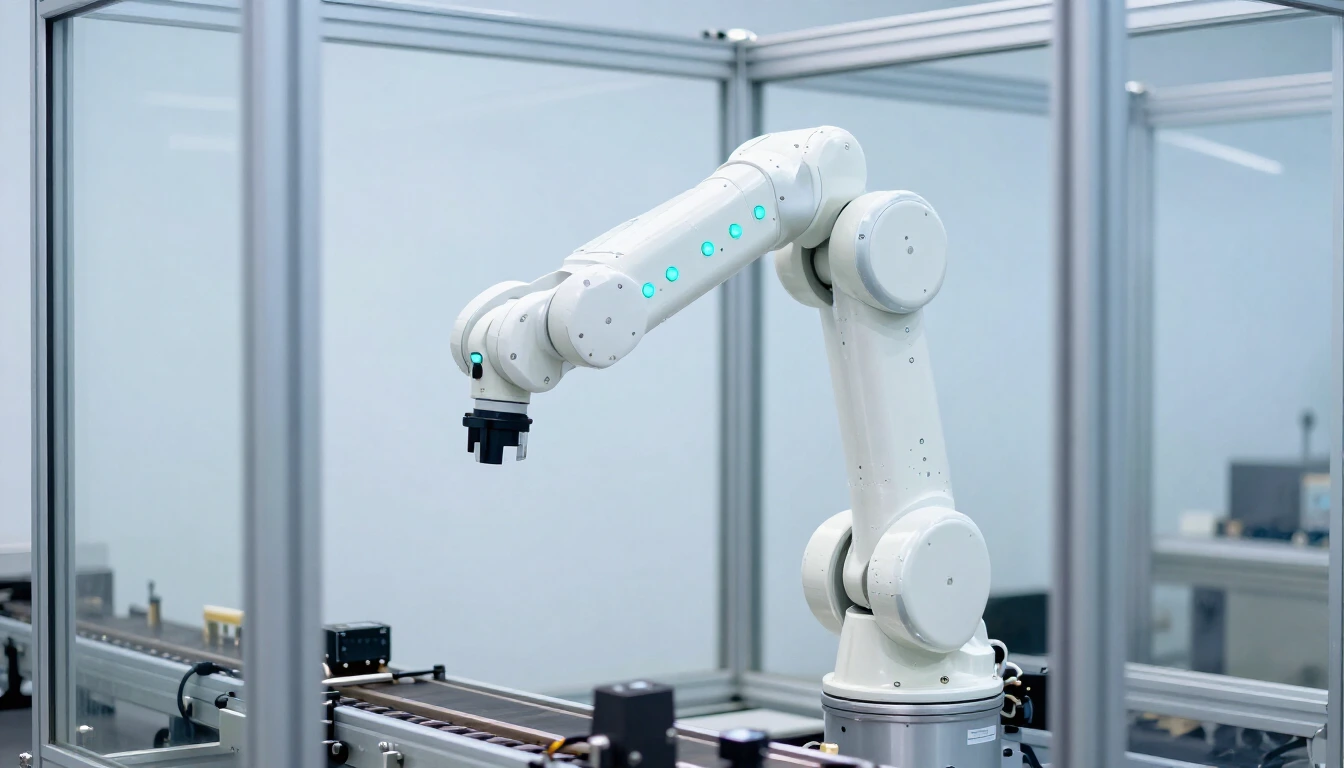
ABB is not a small guest in China. When it opened its robotics “mega factory” in Kangqiao, Shanghai, in December 2022, ABB called it a $150 million investment with 67,000 square metres of space, one of three ABB robotics factories worldwide, supporting more than 90% of its robot sales in China. At the time, ABB said it employed more than 15,000 people across more than 130 Chinese cities. The FT reported that China is the largest market for ABB’s robotics unit.
Now zoom out. The International Federation of Robotics published its World Robotics 2026 figures on 24 September 2026:
- 354,000 industrial robots were installed in China in 2025, a new record.
- That is 59% of all new installations worldwide. Factories everywhere installed more than 600,000.
- Chinese robot makers supplied 55% of China’s installations in 2025, after 57% in 2024. For most of the past decade, it was around 28%.
- The IFR says China’s updated robotics strategy, part of the 15th Five-Year Plan for 2026 to 2030, aims to focus AI research on “physical applications”.
So China is the world’s biggest robot market, a market its own makers now lead, and a market it sees as part of its AI future. A foreign group that buys a leading robot maker there buys more than machines. It buys a factory, an engineering team, a customer base and, increasingly, data.
That last point is the one the FT reported: officials worried that data from robotics operations could be transferred abroad and used to train AI models. Treat that as reported reasoning. China has given no official reason, and the articles of the measures I read do not require it to publish one.
Infographic 02 · The robot market behind the decision
China is the world’s robot factory floor
The country that said no is the biggest buyer of industrial robots by far, and its own makers now lead at home.
of the world’s new industrial robots were installed in China in 2025: 354,000 of more than 600,000 (IFR).
- China’s robotics strategy, now part of the 15th Five-Year Plan, aims AI research at “physical applications” (IFR).
- ABB’s Shanghai factory: $150M, 67,000 m², one of three ABB robot plants, supporting 90%+ of its China robot sales (ABB, 2022).
- The FT reported China is ABB Robotics’ largest market.
Chinese makers’ share of new robots installed in China
Bars scaled to 60%. Shares of China’s annual installations, IFR World Robotics.
- Apr 2026: security review blocks Meta’s ~$2B Manus deal (CNBC).
- Nov 2026: same review, ABB Robotics in China (ABB).
- 28 Oct 2026: Section 232 proclamation on robotics and industrial machinery.
- Trade talks ordered, no tariffs yet (White House).
Sources: IFR, 24 Sep 2026 · IFR World Robotics 2026 · IFR, 25 Sep 2025 · ABB, 2 Dec 2022 · CNBC, 28 Apr 2026 · White House, 28 Oct 2026.
Powered by Thorsten Meyer AI
This is not the first time this year
In April 2026, China used the same security review to block Meta’s roughly $2 billion purchase of the AI startup Manus, which was founded in China and later moved to Singapore. Chinese authorities demanded that the parties withdraw the transaction. CNBC reported on 28 April that this appeared to be the first time China had used the 2020 security review measures this way. Meta told CNBC the deal “complied fully with applicable law.”
Two blocks in one year, both touching AI, both through the same security review. That looks like a pattern, though only China can say whether it is a policy. Coverage of the FT report framed the ABB decision as a blow to Son’s AI ambitions. Some commentary also linked it to tensions between Beijing and Tokyo. No official source makes that link, so I leave it as speculation.
The other superpower is moving too. On 28 October 2026, a week before the ABB news, President Trump signed a proclamation under Section 232 on imports of robotics and industrial machinery. The White House fact sheet says “nearly all modern defense systems and critical infrastructure sectors require the use of robotics or industrial machinery.” It orders trade negotiations rather than immediate tariffs. Both governments now treat industrial robots as a national security matter. They just use different tools.
Physical AI meets the border
Masayoshi Son was clear about why SoftBank wanted ABB’s robots. “SoftBank’s next frontier is Physical AI,” he said in October 2025. In his 2026 annual report message, he wrote that “when ASI connects to robots, it will become physical ASI.” ASI is short for artificial superintelligence, AI that would surpass humans. “Physical AI” means AI that acts in the real world through a body: a robot arm, a mobile robot, eventually a humanoid.
The logic is simple. SoftBank says it invests in four areas: AI chips, AI robots, AI data centers and energy. Its robotics bets so far include SoftBank Robotics, Berkshire Grey, AutoStore, Agile Robots and Skild AI. AI models need hands to do factory work, and ABB has the hands: a global industrial robot business with factories, customers and service teams.
The China decision exposes the weak point of that plan. The more a robot is treated as an AI system, the more governments treat its data, software and factory base as strategic. “Physical AI” sounds global. Physical factories are not. They sit in one country, under that country’s rules.
I covered the hype side of humanoid robots in 52 Companies Now Mention Humanoid Robots in SEC Filings. This story is the opposite: an industrial robot business that is very real, and therefore worth fighting over.
What could happen now
Nobody has announced a plan. These are my own scenarios, not reported intentions:
- Carve out China. The deal could close without the China business, which would stay with ABB or go to another buyer. That would likely change the price and the logic of the deal.
- Refile with conditions. The rules allow conditional approvals. Commitments on local production, local data storage or local management are the obvious candidates. Whether China would accept them is unknown.
- Delay. The Q4 closing date that ABB guided about two weeks ago now looks hard to reach. Neither company has set a new one.
- Walk away. If the deal fails, ABB keeps a robotics division it had already decided to sell. ABB has said nothing about returning to its old spin-off plan.
What this means for companies
- Plan a security review for every country, not only antitrust. This deal passed EU merger control and still failed in China’s security review. If you buy or sell anything with AI, data or advanced manufacturing inside, map every country where the target has a factory, a team or customers, and check each country’s investment screening rules.
- Write the carve-out before you need it. Contracts should say what happens if one country says no: can the deal close without that country, at what price, and who carries the risk.
- Treat robot data as a regulated asset. Factory telemetry, motion data and camera feeds are no longer just engineering logs. Ask your robot suppliers where this data is stored, who can access it, and whether it is used to train models.
- If you run ABB robots in China, nothing changes today. ABB still owns and operates the business. Service, spare parts and support continue under the same owner until something new is announced.
- Do not expect a quick price effect. I found no evidence that this decision changes robot prices. The more lasting shift is in who supplies China: domestic makers already deliver more than half of new installations there.
- Expect more of this on both sides. China’s security office blocked two AI-related foreign deals this year. The US now treats robot imports as a Section 232 security issue. Budget for longer timelines and political risk in cross-border robotics and AI deals.
Infographic 03 · The second gate
Antitrust is one gate. Security is the other.
The EU cleared the deal on competition grounds. China stopped it in a separate national security review. Here is how that review works on paper.
How China’s security review works
- FilingForeign investor takes control in a listed sector, e.g. major equipment manufacturing or key technologies (Art. 4)
- 15 working daysOffice decides whether to review (Art. 7)
- 30 + 60 working daysGeneral review, then special review; can be extended (Art. 8–9)
- OutcomeCleared · cleared with conditions · prohibited (Art. 9)
Prohibited means the investment may not go ahead; parts already done must be undone (Art. 12). During a review the parties may change the plan, which restarts the clock (Art. 11). The office sits at the NDRC, led jointly with the Ministry of Commerce (Art. 3).
What companies should do now
- Map every security reviewNot only antitrust: each country with a factory, team or customers of the target.
- Write the carve-out firstAgree what happens if one country says no: close without it, price change, who bears the risk.
- Treat robot data as regulatedAsk suppliers where telemetry, motion data and camera feeds are stored, and whether they train models.
- Plan for longer timelinesTwo AI-related foreign deals blocked by the same review in 2026.
General information, not legal or investment advice.
Sources: Measures for the Security Review of Foreign Investment (2020) (Arts. 3, 4, 7–9, 11, 12; Chinese text) · ABB, 5 Nov 2026 · CNBC, 28 Apr 2026.
Powered by Thorsten Meyer AI
What this means for workers and users
- Who will build the robots? In China, increasingly Chinese companies. The IFR’s numbers show domestic makers leading their home market. This decision keeps one of the biggest foreign makers in China under European ownership for now, but it also signals that foreign control of robot makers in China will face extra scrutiny.
- The robots still come. Nothing in this story slows factory automation. The IFR expects Chinese installations to keep growing by 5% to 10% a year until 2029. The fight is about who owns the robot makers, their software and their data, not about whether factories automate.
- Uncertainty for the people inside. About 7,000 people work in ABB Robotics. For them, the question of who will own their division stays open longer. Neither company has said anything about jobs.
- If you are a robot user, ask about data. The same question companies ask applies to hospitals, warehouses and restaurants using robots: what does the machine record, and where does it go?
Honest limits: what we don’t know
- The decision itself. No Chinese decision text has been published. We rely on ABB’s statement, which relays what SoftBank was told, and on the FT’s reporting.
- The reason. China has not given one. The data and AI-training concern is reported by the FT, which is paywalled; I could not read the original.
- The scope. ABB says “in China”. Whether the rest of the deal can close separately depends on the contract, which is not public.
- Other approvals. No company statement on the US review. The reported Chinese antitrust clearance in February 2026 is unconfirmed by a primary source.
- SoftBank’s view. SoftBank had not published a statement at the time of writing.
This article reports what happened and what the rules say. It is not legal or investment advice. Share price moves are left out on purpose.
The bottom line
A year ago, SoftBank bought itself the hands for its AI. This week, China reminded everyone that hands have an address. The robot arms in ABB’s Shanghai factory are not just machines. They are a production base, a team and a data stream inside the world’s biggest robot market, and Beijing has decided it gets a say over who controls them.
If you are planning anything that combines AI and physical production across borders, treat the security review as part of the product, not as paperwork at the end.
For another angle on where robots meet reality, see Meta Reportedly Built a Humanoid Robot Called Max in Three Months.
Sources
- ABB, “Update on divestment of ABB Robotics”, press release, Zurich, 5 November 2026: abb.com
- ABB, “ABB to divest Robotics division to SoftBank Group”, ad hoc announcement, 8 October 2025: abb.com
- SoftBank Group, “Acquisition of ABB Ltd’s Robotics Business”, 8 October 2025: group.softbank
- ABB, Q3 2026 results press release, 20 October 2026 (closing expected in Q4 2026): library.e.abb.com
- European Commission, case M.12248 SBG / ABB Robotics, decision C(2026) 1804 of 11 March 2026 under Article 6(1)(b) of the EU Merger Regulation: competition-cases.ec.europa.eu
- SoftBank Group, Q1 FY2026 investor briefing, 6 August 2026 (LBO financing of $1.8 billion): group.softbank
- SoftBank Group, CEO message, Annual Report 2026: group.softbank
- NDRC and Ministry of Commerce, Measures for the Security Review of Foreign Investment (Order No. 37, 2020), Chinese text published by the Ministry of Commerce: mofcom.gov.cn
- Ministry of Foreign Affairs of the PRC, regular press conference, 5 November 2026: fmprc.gov.cn
- International Federation of Robotics, “China Installs 59 Percent of World’s Industrial Robots”, 24 September 2026: ifr.org
- International Federation of Robotics, “Five Million Robots now Operate in Factories Globally”, 24 September 2026: ifr.org
- International Federation of Robotics, World Robotics 2025 press release, 25 September 2025: ifr.org
- ABB, “ABB opens state-of-the-art robotics mega factory in Shanghai”, 2 December 2022: abb.com
- The White House, fact sheet on Section 232 action on robotics and industrial machinery, 28 October 2026: whitehouse.gov
- Reported by the Financial Times, 5 November 2026 (paywalled; details as relayed by Investing.com via Yahoo Finance, The Robot Report and Robotics 24/7): ft.com
- Investing.com via Yahoo Finance, “Softbank’s $5.4 bln takeover of ABB robotics unit blocked by China – FT”, 5 November 2026: finance.yahoo.com
- The Robot Report, “Chinese regulators block SoftBank’s $5.4B acquisition of ABB Robotics”, 5 November 2026: therobotreport.com
- Robotics 24/7, “SoftBank’s proposed $5.4B acquisition of ABB Robotics blocked by China”, 5 November 2026: robotics247.com
- CNBC, “Meta-Manus deal block draws the line in China’s AI race with the U.S.”, 28 April 2026: cnbc.com