
By Thorsten Meyer | November 1, 2026 | ThorstenMeyerAI.com

Get business pricing on tech for your team
- Business-only prices and quantity discounts
- Tax-exempt purchasing
- Multiple users, one account, clear invoices
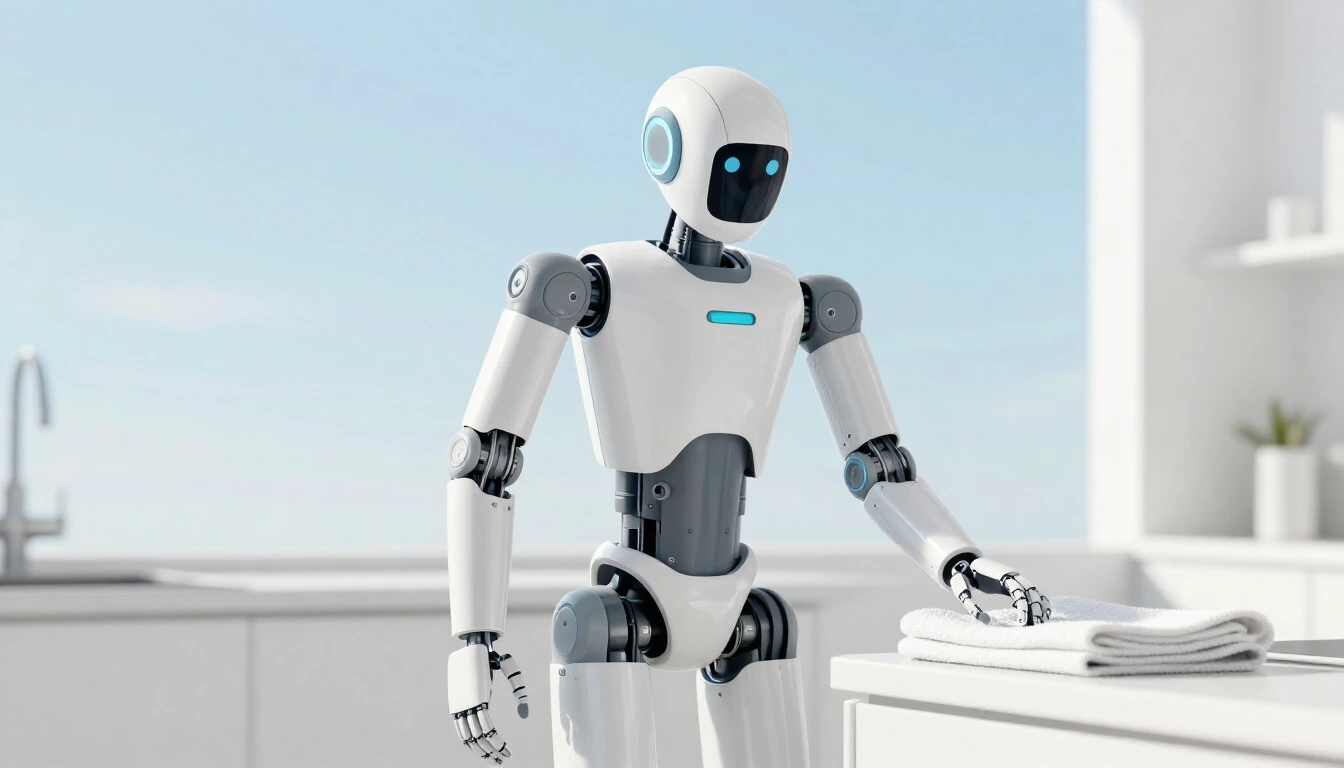
Three months. That is how long it reportedly took Meta and a Chinese robot maker to turn an idea into a prototype humanoid about five feet tall. The robot is called Max. It has a screen for a face, five fingers on each hand and an Nvidia robot computer inside. Meta has not announced it. Everything we know comes from one report, published by The Information on Saturday, 31 October, and picked up by Engadget, The Next Web, Investing.com and Reuters.
The headlines said Max “can do household chores.” The report says something more careful: Max is built to help in homes one day. That gap is the real story. Because if robots really do arrive in our kitchens, the question is not only what they can lift. It is who does the housework today, who gets paid for it, and who doesn’t. Here is what was reported, what holds up, where the rivals stand, and what the numbers say about the work these machines are aiming at.
Key takeaways
- This is a report, not an announcement. The Information reported on 31 October that Meta built a humanoid prototype codenamed Max with the Chinese company Fourier in about three months. Meta has published nothing. Reuters said it “could not immediately verify the report.”
- The specs hold up across outlets. Engadget, The Next Web and Investing.com all carry the same details from the report: about 106 pounds (48 kg), about 1.5 metres tall, Nvidia’s Jetson Thor computer, a display that shows facial expressions, speakers, and hands made for small objects. A second version, Max 2, has reportedly been in the works since September.
- Meta says it is research. According to The Information, Meta said the Fourier work is for internal research and experimentation and that it has no plans to sell the units. No launch date exists.
- The rivals are further along, but not done. 1X sells its NEO home robot for $20,000 and still relies on remote human “experts” for tasks the robot doesn’t know. Figure says its robot finished whole chores in 56% of trials across 30 homes it had never seen. That is Figure’s own number.
- The work at stake is huge and mostly unpaid. The ILO counts 16.4 billion hours of unpaid care work every day, about three quarters of it done by women. Paid domestic work employs 80 million people worldwide, 83% of them informally.
- Realistic timeline: home humanoids that help with a few tasks, often with a human in the loop, before 2030. A robot that replaces a household’s work: not in sight.
Products Worth Considering

DJI Osmo Mobile 8 Standard Combo Gimbal Stabilizer for Phone

Apple MacBook Air 13-inch with M5 chip, 16GB memory, 1TB SSD, and 12MP Center Stage camera (Midnight)

Samsung 27-Inch Odyssey QD-OLED G8 4K 240Hz Gaming Monitor
As an affiliate, we earn on qualifying purchases.
What was reported on 31 October
The original story is by Jyoti Mann at The Information, which sits behind a paywall. We did not read it directly. What follows is what at least two independent outlets reported from it. Where only one outlet carried a detail, we left it out.
- The name and the partner. Inside Meta, the robot is called Max. Meta built it together with Fourier, a robot maker based in Shanghai.
- The speed. The two companies reportedly built it in about three months. Meta’s vice president of product for robotics spent almost two months at Fourier’s factory in Shanghai, according to The Next Web and Investing.com.
- The body. About 106 pounds, or 48 kilograms. About 1.5 metres, or five feet, tall. A screen that mimics facial expressions, built-in speakers, and five-fingered hands designed to pick up small objects.
- The brain. Max reportedly runs on Nvidia’s Jetson Thor, a computer built for robots.
- The audience so far. Some Meta employees saw Max at an internal robotics summit in late August.
- The next step. Work on Max 2 started in September. It is supposed to get a redesigned torso, better hands, a projector and more sensors to handle stairs.
- The plan. Meta sees humanoids as a possible physical form for Muse, its AI agent, with the long-term goal of helping with household tasks.
- Meta’s position. Per The Information, Meta said the work with Fourier is internal research and experimentation, and it has no plans to sell the units.
What we dropped: a widely shared claim that Max can lift “small bottles and toys,” and a quote about humanoids as the “physical embodiment of Muse.” Both appeared only on aggregator sites, and the quote was credited to two different Meta executives. Neither is in this article as fact.
Infographic 01 · Meta’s humanoid, on paper
Max: a humanoid built in about three months
What multiple outlets reported from The Information’s story, and what is not confirmed.
What the report says Max is
From The Information (31 Oct 2026), as carried by Engadget, The Next Web and Investing.com
- Built by Meta with Fourier, a Shanghai robot maker
- Runs on Nvidia Jetson Thor, a computer for robots
- A screen that shows facial expressions, built-in speakers
- Five-fingered hands designed for small objects
- Shown to some Meta staff at an internal summit in late August
- Max 2: new torso, better hands, a projector, sensors for stairs
What you should not take from the headlines
- No Meta announcement. Reuters “could not immediately verify the report.”
- Not for sale. Meta told The Information the work is internal research, with no plans to sell units.
- No chores shown. “Can do household chores” is a goal, not a reported demonstration.
- Dropped: “lifts bottles and toys” and a Muse quote, found only on aggregator sites.
Jetson Thor, per Nvidia: up to 2,070 FP4 teraflops of AI compute, 128 GB memory, 130-watt power envelope; developer kit from $3,499 at launch in August 2025. Meta was named an early adopter.
Sources: The Information (paywalled), reported by Engadget, The Next Web, Investing.com and Reuters, all 31 Oct 2026 · Nvidia, 25 Aug 2025.
Powered by Thorsten Meyer AI
Why three months is the interesting number
Building a humanoid from scratch used to take years. Max reportedly took one season. That is possible because Meta did not start from scratch. Fourier already builds humanoids. In August 2025 it unveiled the GR-3, a 165-centimetre, 71-kilogram robot it calls a “Care-bot,” aimed at nursing homes and rehabilitation centres, according to the company’s release and TechNode. Meta brought the AI ambitions; Fourier brought the factory and the know-how.
The computer matters too. Nvidia made Jetson Thor generally available on 25 August 2025. Nvidia says it delivers up to 2,070 FP4 teraflops of AI compute with 128 GB of memory, inside a 130-watt power envelope, and 7.5 times the AI compute of its predecessor. The developer kit started at $3,499. In plain terms: a robot can now carry a computer strong enough to run large AI models on board, instead of sending every decision to a data centre. Nvidia named Meta among the early adopters back then. The same chip runs 1X’s NEO, according to heise.
So Max is less a sign that Meta invented a new robot, and more a sign of how fast you can assemble one in 2026 if you have money, a partner and an off-the-shelf brain.
Where Meta has been heading since 2025
Max did not come out of nowhere. In February 2025, Bloomberg reported that Meta was forming a new team in Reality Labs, its hardware division, to build humanoid robots, potentially including ones that do household chores. TechCrunch, citing Bloomberg, reported that the group would be led by Marc Whitten, the former CEO of the self-driving company Cruise, and that Meta’s first goal was not a Meta-branded robot but a hardware and software foundation for others, “similar to what Google accomplished with its Android operating system.” Meta also reportedly held talks with Unitree and Figure.
Since then the pieces have kept coming. In May 2026 Meta bought Assured Robot Intelligence, a start-up that makes AI software for robots, as The Next Web and Investing.com reported. And in late October, Nvidia and Meta announced they would expand their work on Muse. Nvidia’s release refers to a proposed investment in Meta; Reuters and Axios put it at $3 billion of Meta stock.
If Muse is the brain Meta wants in your phone and your glasses, a humanoid is the version with hands. That is the bet. It is still a bet.
Where home humanoids actually stand
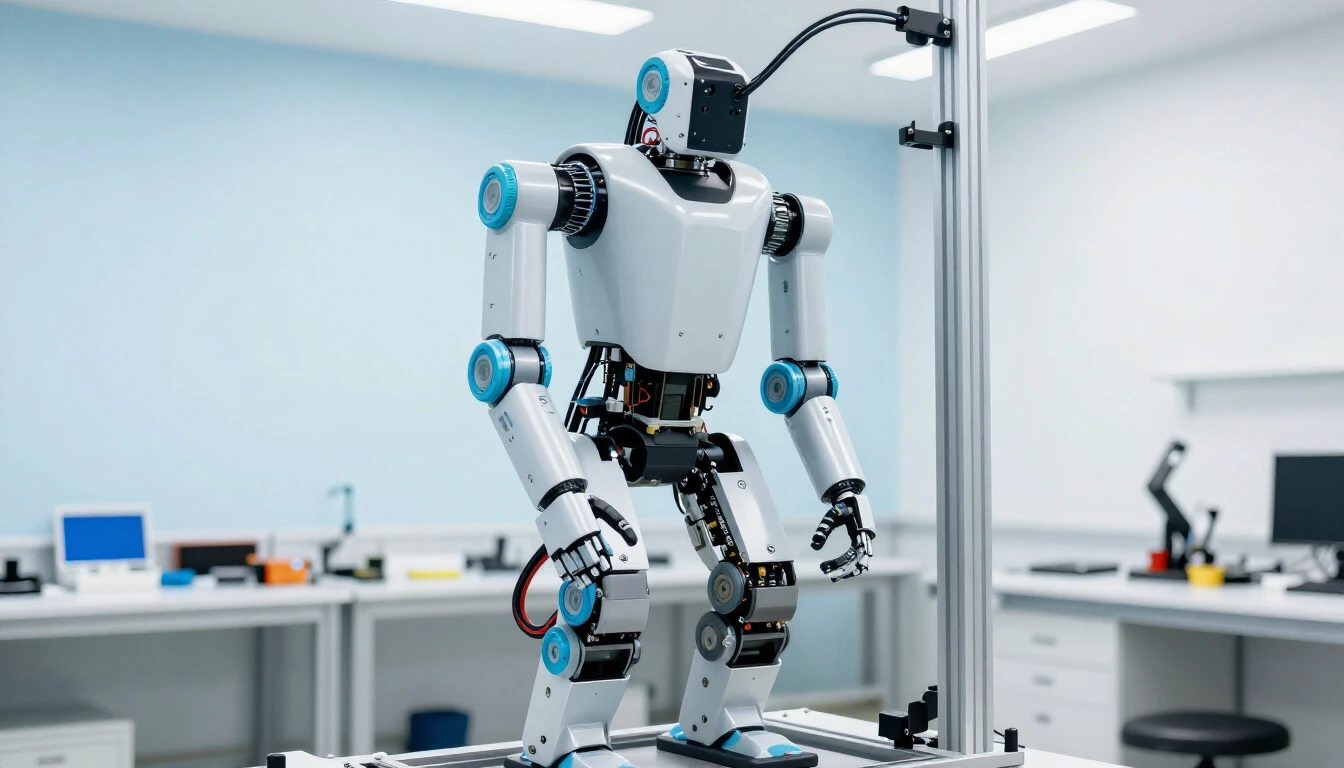
Meta is late to the home. Two rivals have made public, dated claims. Both are worth reading closely.
1X NEO. 1X opened preorders on 28 October 2025: $20,000 to buy, or $499 a month. Its order page still says “US Deliveries start 2026.” 1X says it booked 10,000 units in five days. In April 2026, when its factory started production, 1X told buyers: “Some of you will get your NEO this year, some will get them later.” The catch is on the order page itself. For tasks NEO doesn’t know, “an Expert from 1X can remotely supervise its actions” at scheduled times. In other words: a person somewhere else may be steering the robot in your home. We found no independent report of a paying customer outside 1X’s early-access program using a NEO at home.
Figure 03. Figure introduced its third robot on 9 October 2025, “designed for Helix, the home, and the world at scale.” On 17 September 2026 it published its Helix 2.5 results: Figure took robots into 30 Bay Area homes they had never seen and asked them to tidy toys, fold towels and make beds. Figure says the robots completed the whole task in 56% of trials, against 9% for the same system trained without its large pretraining dataset of recorded human behaviour. Figure counted only full success, no partial credit. These are Figure’s numbers, not independently tested. Figure has announced no consumer price or delivery date.
Put those side by side and a pattern appears. The best public result for a robot doing a full household chore in a strange home is a coin flip, measured by the company itself. The most advanced consumer offer still ships with a human backup. Max is behind both, and Meta says it isn’t for sale. (For how robots learn from video in the first place, see our piece on Nvidia’s Flora and the cost of labelling robot video.)
Infographic 02 · Where the rivals stand
The home robot race, by dated claims
Who has shown what, and when. Meta enters as the latest, with a prototype it says it won’t sell.
- Fourier GR-3Shanghai · Meta’s partnerAug 2025: unveils a 165 cm, 71 kg “Care-bot” for nursing homes and rehab centres.Launched for care settings
- 1X NEOHome robot, USOct 2025: preorders at $20,000 or $499/month. 1X says 10,000 booked in 5 days. Unknown tasks: a remote 1X “Expert” can supervise.US deliveries “start 2026”
- Figure 03Home + commercial, USSep 2026: 30 unseen homes, whole chore done in 56% of trials (9% without its human-behaviour pretraining). Company figure.No consumer date
- Meta MaxPrototype, reportedOct 2026: built with Fourier in about three months, per The Information. Max 2 in development.Not for sale, per Meta
Best public home result
Figure, full task only, no partial credit
Read with care
- All four rows are company claims or one report. No independent test of a home humanoid has been published at this scale.
- A human backup is part of the product today (1X Expert Mode).
Sources: Fourier via TechNode, Aug 2025 · 1X order page · 1X, 30 Apr 2026 · Figure, 9 Oct 2025 · Figure, 17 Sep 2026 · The Information via The Next Web and Investing.com.
Powered by Thorsten Meyer AI
The real question: who does the housework today?
Robot makers talk about chores as if they were a small annoyance. The numbers say they are one of the largest kinds of work on the planet.
In its 2018 report on care work, the International Labour Organization estimated that people spend 16.4 billion hours a day on unpaid care work, based on time-use surveys from 64 countries. That is the same as 2 billion people working eight-hour days for no pay. Most of it, 81.8%, is household work like cooking and cleaning. Women do 76.2% of all those hours: on average 4 hours and 25 minutes a day, against 1 hour and 23 minutes for men. The ILO valued the work at 9% of global GDP, about $11 trillion, if it were paid at minimum wage. And 606 million women of working age said unpaid care was why they were not in paid work.
Then there is the paid side. On 27 October 2026, four days before the Max report, the ILO published new estimates: 80.0 million people work as domestic workers worldwide, up from 75.6 million in 2019. Women are 77.2% of them. 66.5 million, or 83.1%, work informally, often without effective labour or social protection. On average they earn 53.3% of what other employees earn per month, and the gap has widened since 2019. More than a third work at least 49 hours a week.
That is the market a household humanoid is aiming at. Not “chores” in the abstract, but billions of unpaid hours, mostly done by women, and tens of millions of low-paid jobs, mostly held by women.
Infographic 03 · The work robots are aiming at
Who does the housework today
Before a robot folds a single towel at scale, this is the work it would touch: mostly unpaid, mostly done by women, and badly paid when it is paid.
Unpaid care work per day
Average minutes per day, 64 countries
81.8% of unpaid care work is household work like cooking and cleaning. Equal to 2 billion people working eight-hour days without pay.
Pay vs. other employees
Average monthly wage, other employees = 100%
“We cannot claim to value care while undervaluing the people who provide it.”Patrick Belser, Chief of the ILO Informal Work Branch, 27 October 2026
Women are 77.2% of the world’s domestic workers. 35.2% work at least 49 hours a week.
Sources: ILO care work report, 2018 (unpaid care, 64 countries) · ILO, 27 Oct 2026 (domestic work estimates for 2025).
Powered by Thorsten Meyer AI
Two futures for the same robot
Here is where a post-labor view helps. The same machine can play out in two very different ways.
The relief scenario. A robot that reliably folds laundry, tidies toys and loads a dishwasher gives time back. For a family, that time is mostly a woman’s time, given who does the work today. For an older person living alone, a robot that fetches things or reminds them of medication could mean staying at home longer. Fourier explicitly built its GR-3 for care settings.
The squeeze scenario. Domestic work is one of the few paid jobs open to millions of women without formal qualifications, often migrants. They already earn about half the average wage. If a $20,000 robot, or a $499 subscription, takes over the easiest and most repeatable tasks, the jobs that remain may be fewer, more fragmented and even less protected. The ILO already notes that domestic workers are more likely than other employees to work very short hours, which can mean underemployment or work split across several households.
Which one wins is not a question of engineering. It depends on price, on who can afford the robot, and on rules for the people who still do the work. The ILO’s own recommendations, published last week, read like a checklist for that transition: formalisation, social protection, minimum wages, limits on working time and investment in decent care jobs. (We looked at what people say they would lose if work disappeared in our piece on the 8,234-worker “What is work for?” survey.)

What is realistic, and when
- Now to 2027: small numbers of home robots in early-access homes, with remote human operators for unknown tasks. Demos in rented or test homes. Prototypes like Max inside labs.
- Before 2030: robots that do a handful of well-defined tasks (tidying, folding, fetching) in many homes, if success rates climb well beyond today’s company-reported 56% and prices fall. Care homes and other controlled settings are likely to come first.
- Not in sight: a robot that takes over a household’s work the way a dishwasher took over dishes. Cooking, cleaning a bathroom, caring for a child or an ill parent all combine dexterity, judgement and trust. None of the public results come close.
These are our own estimates based on the dated claims above. Nobody has published a credible delivery date for a general household humanoid.
What this means for companies
- The robot body is becoming a commodity; the brain and the data are not. Meta and Fourier reportedly needed three months. The scarce part is the AI that works in a strange kitchen, and the data to train it.
- Partner, don’t build, is the new default. Meta used a Chinese manufacturer and an Nvidia computer. Expect more such alliances, and more questions about supply chains and data flows between US platforms and Chinese hardware makers.
- Care and facilities businesses should run pilots, not plans. Nursing homes, hotels and cleaning firms are the likely early buyers. Measure success the way Figure did: full task done, no partial credit.
- Remote operation is a labour model, not a footnote. 1X’s “Expert Mode” means someone is working remotely inside customers’ homes. Companies offering this need clear rules on who those operators are, what they see and how they are paid.
- Don’t plan workforce cuts on press reports. Max is a prototype Meta says it won’t sell. Budgets built on headlines about “robots doing chores” will be wrong.
What this means for users and for domestic workers
- If you’re thinking of buying a home robot, ask three questions: what can it do on its own, how often does a human operator take over, and what does that person see in your home. Get the answers in writing before you pay a deposit.
- Privacy is the price of admission. A robot that learns from your home is a camera and microphone that walks. Meta’s own plan, per the report, ties these robots to its AI agent, Muse.
- If you employ a domestic worker, a robot is not a reason to cut their hours today. The machines cannot yet do the job. Formal contracts, social security and fair pay matter more now than any gadget.
- If you are a domestic worker, the tasks most likely to be automated first are the simplest and most repeatable ones. Care, trust and judgement are the hardest for robots, and the most valuable skills to build on.
- For families, the honest promise of a home robot is a few hours back per week, sometime later this decade. Who gets those hours, and who loses paid work, is a choice, not a law of nature.
What we don’t know yet
- Whether Max exists as described. All details come from one paywalled report and its pickups. Meta has not confirmed the specs.
- What Max can actually do. No outlet reported a demonstration of Max completing a household task.
- Meta’s real plan. “Internal research, no plans to sell” fits both a long research effort and an early product. The 2025 plan was a platform for others. Which path Meta chooses is open.
- The Fourier deal. Terms, ownership of designs and data, and any export or regulatory issues have not been reported.
- Independent numbers. Figure’s 56% and 1X’s 10,000 orders are company claims. No independent test of any home humanoid has been published at this scale.
The bottom line
Max, as reported, is a fast-built prototype on borrowed hardware with a famous brand behind it. That makes it news, not a turning point. The turning point would be a robot that finishes real chores in real homes without a person steering it, at a price ordinary households can pay. Nobody has shown that yet. Meanwhile, the work these robots are aimed at is already being done, every day, by billions of people for free and by 80 million people for little pay. When household robots do arrive, the most important question won’t be how many pounds they lift. It will be whose time they free, and whose income they take.
Sources
- The Information, Jyoti Mann, report on Meta’s humanoid prototype “Max” with Fourier, 31 October 2026 (paywalled; cited as reported by other outlets).
- Engadget: “Meta reportedly built a humanoid robot prototype that can do household chores”, 31 October 2026. engadget.com
- The Next Web: “Meta built a humanoid robot with China’s Fourier, The Information reports”, 31 October 2026. thenextweb.com
- Investing.com, Roushni Nair: “Meta builds humanoid robot with China’s Fourier as home robot push expands: report”, 31 October 2026 (via Yahoo Finance UK). uk.finance.yahoo.com
- Reuters: “Meta builds humanoid robot with Chinese startup Fourier, The Information says”, 31 October 2026 (via CNA). channelnewsasia.com
- TechCrunch: “Meta’s next big bet may be humanoid robotics” (citing Bloomberg), 14 February 2025. techcrunch.com
- NVIDIA Newsroom: “NVIDIA Blackwell-Powered Jetson Thor Now Available, Accelerating the Age of General Robotics”, 25 August 2025. nvidianews.nvidia.com
- NVIDIA Newsroom: “NVIDIA and Meta to Expand Collaboration on Muse and Muse Family of Models Amid Robust Growth”, 26 October 2026. nvidianews.nvidia.com
- Reuters: “Nvidia, Meta partner on Muse agent as Nvidia invests $3 billion”, 27 October 2026 (via Investing.com). investing.com
- Fourier: GR-3 “Care-bot” launch release, 8 August 2025 (PR Newswire, German edition). prnewswire.com · TechNode, 7 August 2025. technode.com
- 1X: NEO order page (accessed 1 November 2026). 1x.tech · “NEO Factory”, 30 April 2026. 1x.tech
- The Robot Report: “NEO humanoid designed for household use, available for preorder”, 30 October 2025. therobotreport.com
- heise online: “1X to deliver humanoid household robot Neo to US customers in 2026”. heise.de
- Figure: “Introducing Figure 03”, 9 October 2025. figure.ai · “Helix 2.5: Zero-Shot 30-Home Generalization”, 17 September 2026. figure.ai
- ILO: “Domestic workers see progress but informality remains widespread” and Statistical Brief “The state of domestic work in 2025: 15 years after Convention No. 189”, 27 October 2026. ilo.org · ilo.org
- ILO: “Care work and care jobs for the future of decent work”, executive summary (2018), and press release “ILO calls for urgent action to prevent looming global care crisis”, 28 June 2018. ilo.org (PDF) · ilo.org
This article is for information only. It is not investment, financial or legal advice. Meta, Fourier, Nvidia, 1X and Figure are named for their published statements and reported plans, not as product recommendations. All robot images in this article are AI-generated illustrations and do not show any company’s product.