By Thorsten Meyer | November 17, 2026 | ThorstenMeyerAI.com

Get business pricing on tech for your team
- Business-only prices and quantity discounts
- Tax-exempt purchasing
- Multiple users, one account, clear invoices
Key takeaways
- The threat comes from analysts, not from Beijing’s rulebook. Chinese analysts quoted by the South China Morning Post on November 13 say China could tighten rare-earth exports if Washington uses the Nvidia episode to tighten chip curbs, as Seoul Economic Daily reports. China’s government has announced no such step. On the record, its foreign ministry said China “opposes abuse of export control measures”.
- Some controls already apply. Since April 4, 2025, exports of seven medium and heavy rare earths (samarium, gadolinium, terbium, dysprosium, lutetium, scandium and yttrium) and related items, including magnets that contain terbium or dysprosium, need a licence from China’s Ministry of Commerce.
- The bigger package is paused, with an end date. Six measures from October 9, 2025 were suspended in November 2025. They include five more rare earths, rules on rare-earth technology and equipment, and a rule that reaches products made abroad with 0.1% or more Chinese rare-earth content. On November 9, 2026, China extended the pause to January 10, 2027.
- Washington moved on November 16. The Commerce Department’s Bureau of Industry and Security (BIS) issued a rule that requires a licence before advanced AI chips go to data centres anywhere that give companies headquartered in China more than 12,000,000 “aggregate TPP” of computing power. In Congress, three committee chairs want four chip bills in the annual defence bill.
- Why rare earths are the lever: China accounted for 60% of mined magnet rare earths, 91% of refining and 94% of sintered permanent magnets in 2024, according to the International Energy Agency (IEA). Those magnets sit in electric vehicles, defence systems and data centre hardware.
- For businesses, the date to watch is January 10, 2027. Map where rare-earth magnets and Chinese-origin rare-earth content sit in your products and your suppliers’ parts now, while the pause holds.
Chips vs. rare earths · as of Nov 16, 2026
Two levers, one calendar
How the export rules on both sides fit together, in six steps, from official notices and the reported views of analysts.
Two flows, two sets of gates
China’s rules tightenLicences since April 2025, a wider package in October 2025 The wider package is pausedUntil January 10, 2027, after a one-year pause Washington tightens chipsWhether Beijing answers with rare earths is open
How the rules fit together
- Apr 4, 2025China: licences for 7 rare earths, including magnets with terbium or dysprosiumMinistry of Commerce
- Oct 9, 2025China: 6 wider measures: 5 more elements, the 0.1% rule, a review for advanced chipmakingMinistry of Commerce
- Nov 7, 2025China: the October package is pausedMinistry of Commerce
- Nov 9, 2026China: pause extended to January 10, 2027Ministry of Commerce
- Nov 16, 2026US: licence rule for AI chips in data centres that serve China-headquartered firms; 4 chip bills pushed in CongressBIS; House committee chairs
- Next?Analysts: China could tighten rare earths if the US escalates. Not announced by Chinavia Seoul Economic Daily, citing the South China Morning Post
Sources: China’s Ministry of Commerce, announcements of Apr 4, Oct 9 and Nov 7, 2025 and Nov 9, 2026 (Chinese; our translation); US Commerce Department, Bureau of Industry and Security, interim final rule of Nov 16, 2026; House Foreign Affairs Committee (Nov 12, 2026); analysts as quoted by the South China Morning Post, reported by Seoul Economic Daily (Nov 14, 2026). Lanes and gates are a schematic.
Graphic: Powered by Thorsten Meyer AI
Products Worth Considering

Samsung 27-Inch Odyssey G5 QHD Gaming Monitor (G50F)

Jackery Explorer 300 Portable Power Station, 292Wh

Apple AirPods Pro 3 Wireless Earbuds with Active Noise Cancellation
As an affiliate, we earn on qualifying purchases.
A pause with an end date
Every few months the chip fight between Washington and Beijing produces a new headline. This week’s is a warning: if the United States answers the Nvidia episode with tighter chip rules, China could answer with rare earths.
That warning comes from analysts. But the tool they describe is real, it has been used before, and part of it is sitting on a timer. China’s Ministry of Commerce (MOFCOM) and its customs administration published a one-sentence notice on November 9, 2026. In our translation, it says that six export-control announcements from 2025 remain suspended from November 11, 2026 to January 10, 2027.
Those six announcements are the package China unveiled on October 9, 2025 and suspended a month later. Some of what they cover goes straight to chips. If the pause ends without a deal, they come back.
This article sorts out what is official on both sides, what is analysts’ opinion, and why a group of 17 metals has become the counterweight to American chips. It does not take sides between the two governments or any company.
What Washington did, and what is still a proposal
The new rule. On November 16, BIS released an interim final rule that it says was “written by and at the direction of the Department of Treasury and the National Security Council”. Its stated aim: “to ensure that existing restrictions on access to sensitive American technology cannot be circumvented through remote computing arrangements involving data centers in third countries”.
What the rule text says:
- Data centres anywhere: a licence is needed to send advanced AI chips to data centres that provide access to more than 12,000,000 “aggregate TPP” to companies headquartered in China, Macau or other countries in the US group D:5. Data centres already doing so must obtain a licence within 90 days of the effective date, or face future export restrictions.
- Five more countries: a licence is now needed for advanced chips going to Indonesia, Malaysia, Singapore, Thailand or Brazil. Companies headquartered in the United States are exempt if they meet reporting requirements.
- Exemptions and timing: commercial recommender systems, such as those used by online retailers and social media companies, are exempt. The rule takes effect on the day it is published in the Federal Register; comments are due 60 days later. It also formally rescinds the Biden-era AI Diffusion Rule.
The rule calls these “SI” chips, for “Super Intelligence”, the term an executive order now uses in place of “Artificial Intelligence”.
The bills. On November 12, House Foreign Affairs Committee chairman Brian Mast, Select Committee on China chairman John Moolenaar and Intelligence Committee chairman Rick Crawford sent letters asking Nvidia’s former chief executive Jensen Huang, Nvidia’s general counsel and a Commerce under secretary to appear before Congress. They said the case is “a prime example of why Congress must immediately pass the AI OVERWATCH Act, Chip Security Act, MATCH Act, and Remote Access Security Act in the NDAA.”
According to Reuters, the AI Overwatch Act “would give Congress more power over advanced AI chip exports”, the Chip Security Act “would require companies to track the location of advanced AI processors to prevent smuggling”, the Match Act “would pressure US allies to restrict sales and maintenance of advanced chipmaking equipment destined for China”, and the Remote Access Security Act would give Commerce tools to stop Chinese firms from renting overseas data centres. House Speaker Mike Johnson told reporters: “I think there’s a developing consensus in Congress that is an important position to take.”
These are proposals. None of the four is law.
The trigger. The push followed Jensen Huang’s resignation as Nvidia’s chief executive, which Reuters links to reports about his relationship with a businesswoman whom US authorities suspect of spying for Beijing. Beijing denies she is a spy. We covered who will run Nvidia and why Washington is pushing separately; this article is about the trade tools.
What the analysts say, and what Beijing says on the record
The rare-earth scenario comes from analysts quoted by the South China Morning Post on November 13. We could not read the Post’s article itself: its site returned a bot check, which we did not try to get around. The quotes below are as reported by Seoul Economic Daily on November 14, citing the Post.
- Victor Gao, vice president of the Center for China and Globalization, a Chinese think tank, said Washington would be making “a complete miscalculation” if it used the Nvidia episode to step up pressure on China, and that Beijing would tighten rare-earth export controls.
- Wang Yingliang, editor-in-chief of the economic analysis platform Sharp Voices, said China could impose sanctions on US companies and use cooperation on rare-earth exports, among other issues, as bargaining chips. He also pointed to China’s chip inventories and said: “Semiconductors will not have a major impact on the trade negotiations.”
- Xu Tianchen of the Economist Intelligence Unit said of the “constructive strategic stability” the two leaders agreed on that it “is a matter between China and President Trump, and President Trump has been weakened”.
Beijing’s official statements are more guarded. Asked on November 13 whether new US chip bills and the remote-access rule would violate the trade truce, foreign ministry spokesperson Mao Ning said: “China opposes abuse of export control measures, which disrupt the stability of global industrial and supply chains and serve no one’s interests.” She added that both sides “need to work together to deliver on the important common understandings between the two presidents”. A day earlier she said: “The U.S. should stop fabricating the “Chinese spy” narratives as a pretext for imposing technology restrictions.”
Neither statement mentions rare earths. The timing matters: the foreign ministry confirmed that the APEC leaders’ meeting opens in Shenzhen next week, and Seoul Economic Daily reports that Donald Trump and Xi Jinping are set to meet there on November 18-19.
Why rare earths are the lever
Rare earths are not rare in the ground. What is rare is the capacity to separate them and turn them into magnets, and most of that sits in one country.
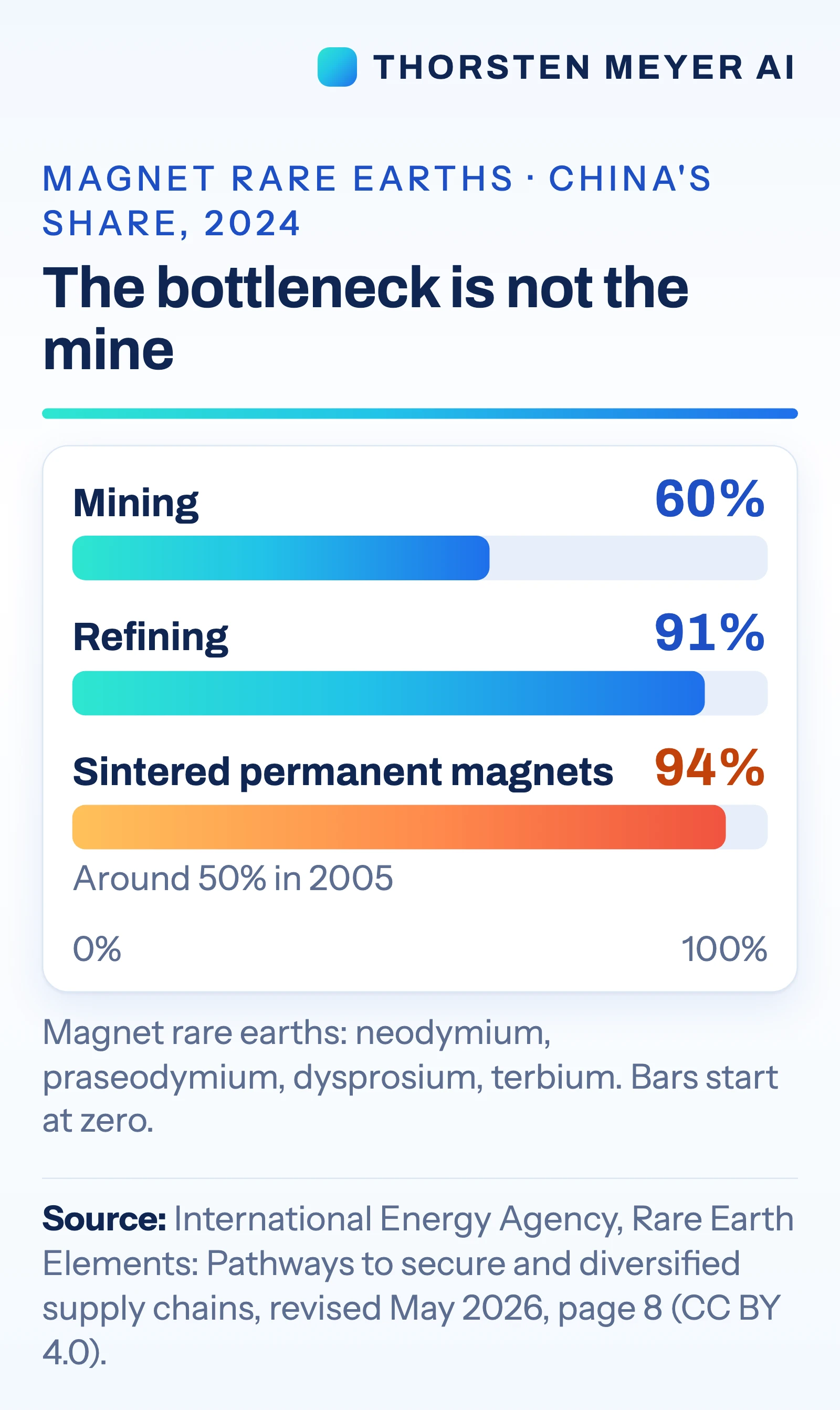
The IEA’s report on rare earths, revised in May 2026, puts it in three numbers for 2024: China accounted for 60% of global mined production of magnet rare earths, 91% of refined output, and 94% of sintered permanent magnets. Two decades earlier, its share of those magnets was around 50%.
The US Geological Survey gives the mining side for 2025: an estimated 270,000 tons of rare-earth oxide mined in China out of a world total of about 390,000 tons. Between 2021 and 2024, 71% of US imports of rare-earth compounds and metals came from China. For terbium, the figure was 100%.
Magnets are where the value is. Permanent magnets account for “around 95% of total rare earth consumption by value”, the IEA writes. Neodymium-iron-boron magnets, made mainly from neodymium and praseodymium, “often with dysprosium and terbium as performance-enhancing additives”, underpin “electric vehicles (EVs), wind turbines, industrial motors and AI data centres, as well as medical, aerospace and defence applications”.
Which rare earths matter where
- Neodymium, praseodymium: the core of NdFeB magnets in car and EV motors, wind turbines, industrial automation and data centres. Not listed as elements; NdFeB magnets with terbium or dysprosium are covered.
- Dysprosium, terbium: additives that keep NdFeB magnets strong at high temperatures. Licence required since April 2025, including magnets that contain them.
- Samarium: samarium-cobalt magnets for aerospace and defence. Licence required since April 2025.
- Yttrium: ceramics and coatings, phosphors, lasers. Licence required since April 2025.
- Scandium: aerospace alloys, solid oxide fuel cells, electronics. Licence required since April 2025.
- Gadolinium, lutetium: gadolinium is used as an MRI contrast agent; both are on the April list. Licence required since April 2025.
- Holmium, erbium, thulium, europium, ytterbium: erbium amplifies signals in fibre-optic networks, ytterbium powers industrial lasers, europium gives screens their red. Added in October 2025, paused until January 10, 2027.
Uses as described by the IEA and the USGS; status as published by MOFCOM.
Where is the link to chips? Two places. First, data centres: the IEA counts data centre servers, hard disk drives and cooling fans among the products that depend on rare-earth magnets. Second, the paused October rules aim at chipmaking directly. Announcement No. 61 says that exports for the research, development or production of logic chips at 14 nm and below or memory chips with 256 layers and above, and of equipment and materials to make them, would be reviewed case by case (our translation).
There is a precedent for how this lever works in practice. After China’s April 2025 controls, “export volumes of these rare earth elements and permanent magnets containing them fell sharply in April and May”, the IEA writes, and some automakers “were forced to cut utilisation rates or even temporarily shut down production”. Licences were eventually granted and volumes recovered, but a premium remained for magnets made outside China.
What is in force, what is paused

China’s rules, as published by MOFCOM:
- In force since April 4, 2025: licences for samarium, gadolinium, terbium, dysprosium, lutetium, scandium and yttrium and related items, including samarium-cobalt magnets and NdFeB magnets that contain terbium or dysprosium. These are not part of the suspension. By December 2025, the USGS notes, China had begun issuing general export licences to selected exporters.
- Paused until January 10, 2027: the six announcements of October 9, 2025. They cover superhard materials; rare-earth production equipment and raw materials; holmium, erbium, thulium, europium and ytterbium; lithium batteries and graphite anode materials; rare-earth items abroad, including the 0.1% rule and the case-by-case review for advanced chipmaking; and rare-earth technologies.
- Also on a timer: in December 2024, China said it would in principle not license exports of gallium, germanium, antimony and superhard materials to the United States. That provision was suspended on November 9, 2025 until November 27, 2026. When we checked MOFCOM’s list of 2026 announcements on November 16, we did not find a published extension. The ban on exports of dual-use items to US military users was not suspended.
The two sides have linked these pauses to their trade talks. After the eighth round of talks, MOFCOM said on September 28 that China and the US agreed to extend their Kuala Lumpur joint arrangement, which had suspended some tariff and non-tariff measures of both sides, to January 10, 2027, while they keep working on a solution.
What a full rollout would hit

The IEA has modelled what would happen if the October controls were implemented in full. Its estimate: “the economic value of downstream production at risk would reach USD 6.5 trillion per year for countries outside China.” The United States and Europe would each face potential direct losses of over USD 1.5 trillion.
By sector, the automotive industry carries the biggest risk, with over USD 3 trillion. The IEA also counts “almost USD 600 billion of losses in the defence sector and over USD 350 billion of losses for the data centre sector”. The United States is more exposed than others to data centre servers and defence, at 15% of its losses each.
To give a sense of scale, China exported 57 kt of rare-earth magnets in 2025. The IEA calculates that this is enough for components in over 61 million conventional cars, 44,000 military jets or 6,700 AI data centres.
These are model estimates of production at risk, not forecasts. They assume licences are not granted at all.
What it means for businesses
- Use the pause. January 10, 2027 is less than two months away. Ask your suppliers, in writing, which parts contain rare-earth magnets, which of those use dysprosium or terbium, and where the magnets and their rare-earth inputs were made. The paused 0.1% rule would reach products made outside China, so this question matters even if you never buy from China directly.
- Check what is already licensed. The April 2025 controls apply today. If you import magnets, yttrium or scandium products, know whether your supplier works under a general licence or applies shipment by shipment.
- Inventory is a decision, not a reflex. In 2025, automakers that ran out of magnets had to slow production. A few weeks of buffer stock for critical magnet parts may cost less than a stopped line; that is a judgement for your own risk team.
- Data centre and cloud operators now face two sets of rules at once: the US licence requirement for compute provided to China-headquartered customers above the threshold, and China’s rules on the magnets in drives, fans and cooling. The rule expects data centres to check their customers, including “any direct or indirect ownership or control by persons in Country Group D:5 or Macau”; the D:5 group includes China.
- Chip and equipment makers: the paused Announcement No. 61 names advanced logic and memory production as a case-by-case end use. If it returns, sourcing for fabs could get slower.
This is general information, not legal, trade-compliance or investment advice.
What it means for users
Nothing changes for consumers today. The April controls have applied for more than a year, and the bigger package is paused. If the pause ends and China tightens supply, the first effects would be felt by manufacturers, as in 2025, before anything reaches shop shelves. Whether and how much prices for cars, devices or cloud services would move is not known.
What is not known
- Whether China extends the pause again after January 10, 2027, or lets the October rules return.
- Whether Beijing would answer the November 16 rule or new US laws with rare earths. So far this is analysts’ speculation; the government has not said so.
- Whether the Trump-Xi meeting in Shenzhen takes place as reported and whether it addresses chips or rare earths. The foreign ministry had “no information to share” on bilateral meetings on November 16.
- Whether any of the four bills ends up in the final defence bill.
- When the BIS rule is published in the Federal Register, which starts its effective date and the 90-day licence window.
- The gallium, germanium and antimony suspension runs out on November 27, 2026 unless it is extended.
The bottom line
The headline sounds like a threat, but the substance is a calendar. China has rare-earth rules in force since April 2025, a much wider package paused until January 10, 2027, and a separate ban on some metals for the US paused until November 27. Washington has a new rule on remote access to AI chips and four bills waiting for the defence bill. Analysts say one could trigger the other. Neither government has said so.
For companies, the useful part of this story is not the speculation. It is the list of parts that would be affected if the pause ends, and the time left to write that list.
We wrote earlier about who will run Nvidia, and why Washington is pushing, about a US-blacklisted university that rented Nvidia H200 servers, and about China’s trade surplus and the AI boom.
I’m Thorsten Meyer. The full sources are below, and more reality checks are at thorstenmeyerai.com.
Sources
- Ministry of Commerce of the People’s Republic of China (MOFCOM) and General Administration of Customs: Announcement No. 58 of 2026 on the continued suspension, November 9, 2026 (Chinese; our translation)
- MOFCOM and General Administration of Customs: Announcement No. 18 of 2025 (medium and heavy rare earths), April 4, 2025; Announcements No. 55, 56, 57 and 58 of 2025, October 9, 2025; Announcement No. 70 of 2025 (suspension), November 7, 2025
- MOFCOM: Announcements No. 61 and 62 of 2025, October 9, 2025; Announcement No. 46 of 2024 (dual-use items to the United States), December 3, 2024; Announcement No. 72 of 2025, November 9, 2025
- MOFCOM: Department of American and Oceanian Affairs on the results of the eighth round of China-US economic and trade talks, September 28, 2026
- US Department of Commerce, Bureau of Industry and Security: “BIS Issues Rule Addressing Remote Access to American Super Intelligence Technology”, November 16, 2026, and the interim final rule “Addressing Remote Access to Advanced Semiconductors” (RIN 0694-AK50, as put on display)
- House Foreign Affairs Committee: “Chairmen Mast, Moolenaar, and Crawford Send Second Request to Jensen Huang and NVIDIA to Brief Congress”, November 12, 2026
- Ministry of Foreign Affairs of the People’s Republic of China: regular press conferences of November 12, 13 and 16, 2026
- International Energy Agency: Rare Earth Elements, Pathways to secure and diversified supply chains, revised version, May 2026 (CC BY 4.0)
- US Geological Survey: Mineral Commodity Summaries, February 2026: Rare Earths; Rare Earths (Heavy); Yttrium; Scandium
- Reuters: “China’s access to Nvidia chips in doubt as curbs gain traction in US Congress”, November 13, 2026 (as published by The Korea Times)
- Seoul Economic Daily: “China Could Curb Rare Earths if U.S. Tightens Chip Rules, Analysts Say”, November 14, 2026 (citing the South China Morning Post of November 13, 2026, which we could not access)
Researched and drafted with AI assistance, including Anthropic’s Claude. No government, company or person named here reviewed or sponsored this article. Our own text and graphics contain no affiliate links; offer and product boxes added by the site may contain Amazon affiliate links. This article is for information only. It is not legal, trade-compliance or investment advice. Rules and statements as checked on November 16, 2026; check MOFCOM, the Federal Register and the BIS website for later changes. Images: AI-generated illustration (Runware) and graphics by Thorsten Meyer AI; our own images show no real people or logos. Boxes added by the site may show product photos or people.