By Thorsten Meyer | November 23, 2026 | ThorstenMeyerAI.com

Get business pricing on tech for your team
- Business-only prices and quantity discounts
- Tax-exempt purchasing
- Multiple users, one account, clear invoices
When a bank in the euro area borrows from the central bank, it has to put something up as security: bonds and other assets on a list the Eurosystem publishes. Until now, that list barely touched the world of tokenised finance, where securities are issued and recorded on distributed ledgers. On Monday, November 23, 2026, the European Central Bank moved that line.
The ECB’s Governing Council “approved the acceptance of marketable assets issued on DLT platforms licensed under the EU DLT Pilot Regime Regulation as eligible collateral for Eurosystem credit operations, subject to specific Eurosystem requirements”, according to its press release. It is not a switch that flips today. The ECB expects to publish the detailed requirements in spring 2027, “with implementation planned to take effect in June 2027”.
This piece explains what was decided, which conditions apply, how it fits into the ECB’s wider plans for tokenised markets, what it could mean for banks, companies and ordinary savers, and what is still open. It is not investment advice, and it contains no prices of crypto-assets or other securities.
Facts as of 12:30 UTC on Monday, November 23, 2026.
Key takeaways
- What was decided: bonds and other marketable assets issued on DLT platforms licensed under the EU’s DLT Pilot Regime can become eligible collateral when banks borrow from the Eurosystem, subject to extra requirements.
- From when: not yet. The Eurosystem “expects to communicate the details of these requirements in the spring of 2027”, with implementation planned for June 2027.
- The conditions: the assets must meet all standard collateral criteria; they must reach the Eurosystem “via an eligible link to a central securities depository (CSD)” whose settlement system settles in TARGET2-Securities; and the DLT platforms must meet dedicated requirements, for example on settlement finality and the outsourcing of critical functions.
- What it is not: it does not yet cover assets “issued and settled entirely on DLT networks”. The ECB says it is still exploring that.
- Why it matters: collateral eligibility makes an asset more useful to the banks that hold it. The ECB calls the decision “a new milestone” towards a collateral framework “fit for a tokenised European financial market ecosystem”.
European Central Bank · decision of November 23, 2026
From a ledger to the central bank, step by step
How a bond issued on a licensed DLT platform could be used when a bank borrows from the Eurosystem.
- Step 1Issued on a licensed platformA DLT platform licensed under the EU DLT Pilot Regime, plus dedicated Eurosystem requirements.
- Step 2Standard criteriaThe bond must meet all standard collateral eligibility criteria, like any other.
- Step 3Linked to the old railsVia a central securities depository that settles in TARGET2-Securities.
- Step 4Pledged for creditA bank can then pledge it when it borrows from the Eurosystem.
Still exploringAssets issued and settled entirely on DLT networks
Not known: platformsWhich DLT platforms will meet the extra requirements
Not known: risk rulesWhether valuation or haircuts will differ for DLT assets
Sources: European Central Bank press release (November 23, 2026); ECB press release (January 27, 2026); ESMA, DLT Pilot Regime.
Graphic: Powered by Thorsten Meyer AI
Products Worth Considering

Logitech MX Creative Console with 9 Customizable Keys, Graphite

Amazon Kindle Scribe (16GB) with Premium Pen, Tungsten

Apple Watch SE 3 GPS 40mm Smartwatch
As an affiliate, we earn on qualifying purchases.
Collateral in one paragraph
Collateral, in the ECB’s own explainer, “is an item of value that a lender can seize from a borrower if he or she fails to repay a loan”. Central banks ask for it too: “When commercial banks seek funding from the ECB and the national central banks of the euro area that together form the Eurosystem, they must pledge collateral.” The Eurosystem publishes what it accepts, the “eligible assets”. If a type of security is on that list, a bank can turn it into central bank money when it needs liquidity. If it is not, the security is less useful on a bank’s balance sheet.
What exactly the ECB decided
The decision covers marketable assets issued on DLT platforms that hold a licence under the EU DLT Pilot Regime Regulation. That regime “has started applying in the EU as of 23 March 2023”, according to the European Securities and Markets Authority (ESMA). It provides the legal framework for trading and settling financial instruments in tokenised form and lets new kinds of market infrastructure operate under supervision.
Being licensed is not enough. According to the ECB, three conditions apply:
- Standard criteria: “the assets must meet all standard collateral eligibility criteria”, the same as for any other bond.
- A link to the existing system: the assets must be available to the Eurosystem “via an eligible link to a central securities depository (CSD) operating an eligible securities settlement system”. That system must comply with the Central Securities Depositories Regulation and offer settlement in TARGET2-Securities (T2S), the Eurosystem’s securities settlement platform.
- Extra rules for the platforms: DLT platforms “will need to meet dedicated Eurosystem requirements to ensure legal certainty and operational safety regarding, for example, settlement finality designation and the outsourcing of critical functions”.
Executive Board member Isabel Schnabel put the balance this way: “We support innovation without lowering our standards.” Executive Board member Piero Cipollone said that “by adapting our collateral framework, we are further enabling the European tokenised finance market to grow, while upholding the principles of safety, efficiency and a level playing field.”
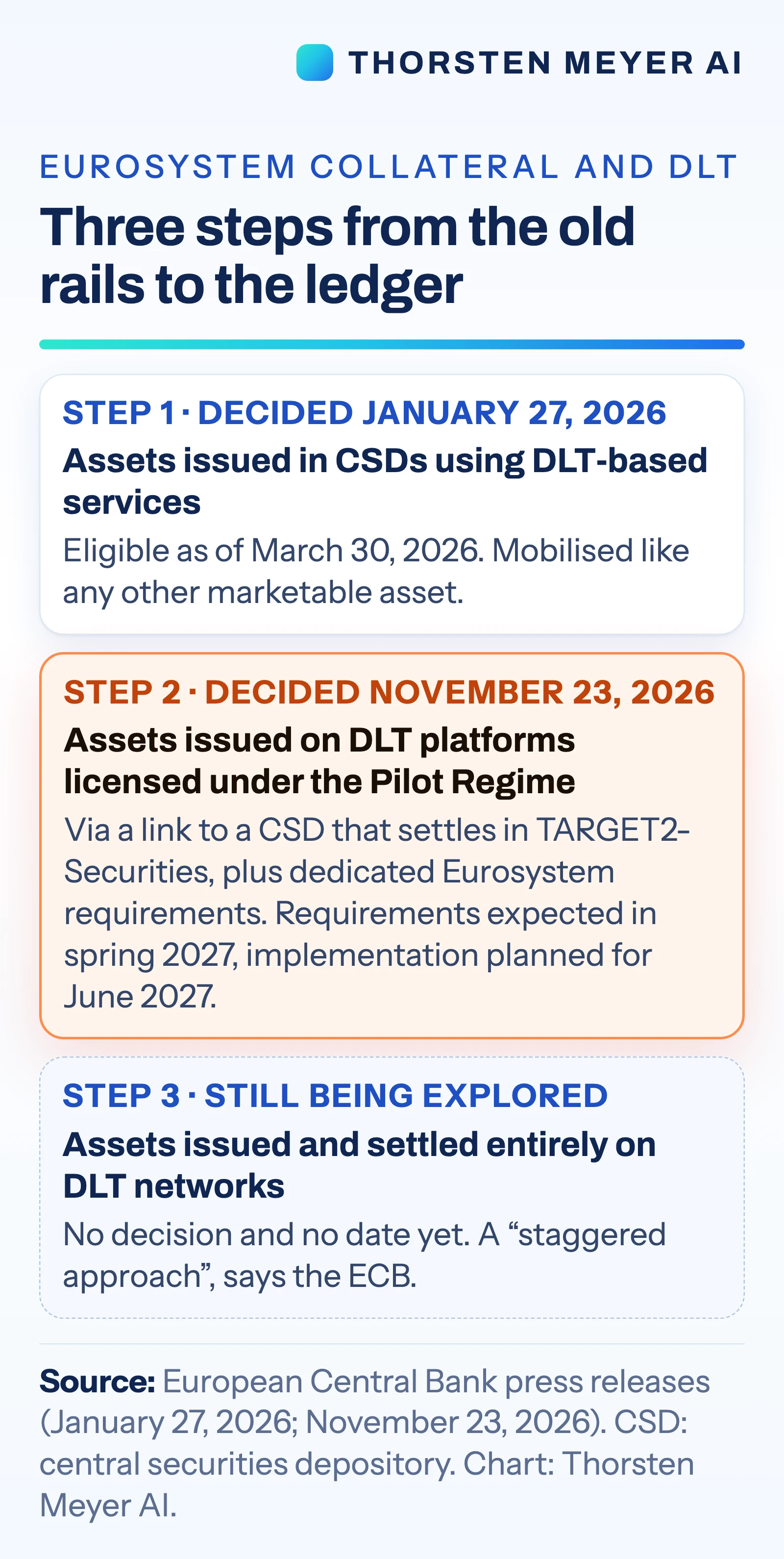
Step two of three
The decision is the second step on a path the ECB laid out in January. On January 27, 2026, it announced that it would accept “marketable assets issued in CSDs using DLT-based services” as collateral “as of 30 March 2026”. Those were assets issued by traditional central securities depositories that use distributed ledgers internally.
Monday’s decision reaches one step further out, to the new DLT platforms licensed under the Pilot Regime, as long as they connect to the existing settlement system. The third step is still open. The ECB’s roadmap “foresees further exploration of ways to expand eligibility to assets issued and settled entirely on DLT networks”. In January, the ECB described this as “a staggered approach” under which “subsets of DLT-based assets could gradually become eligible”.
The collateral decision sits next to two other Eurosystem projects. Pontes, launched on September 21, 2026, lets wholesale transactions in tokenised assets be settled in central bank money. It builds on Eurosystem trials between May and November 2024 with 64 market participants and “over 50 trials and experiments”. The ECB said an initial group of market participants and DLT operators had completed onboarding, and that “full implementation” is “expected by 2028”. Appia is the longer-term project to design a European tokenised financial ecosystem, “aiming to deliver by 2028 a blueprint”. Cipollone tied them together on Monday: “Pontes and Appia are helping turn Europe’s vision for tokenised finance into reality.”

What it would mean for banks
For banks that hold, or plan to hold, securities issued on a licensed DLT platform, the change is practical: from the planned start in June 2027, those securities could be pledged for Eurosystem credit, as long as they meet the criteria. That removes one reason to prefer a conventional bond over a tokenised one.
There is a catch. The route still runs through a central securities depository and T2S. The ECB itself says the decision supports “interoperability between DLT platforms and traditional systems”, in “the current hybrid environment”. A bank cannot pledge a token straight from a ledger. That is the third step, and it has no date.
What it would mean for companies and issuers
For companies, public agencies and other issuers that consider issuing bonds on DLT platforms, collateral eligibility can make those bonds easier to sell to banks. How large the effect will be is not known. The Pilot Regime caps what can be issued under it: for bonds, an “issuance size of less than EUR 1 billion”, with an exception for smaller issuers, according to ESMA. For shares, the cap is a market capitalisation below €500 million. ESMA also notes the pilot “is set to run for a period of at least 3 years” and could be extended or made permanent.
The broader idea behind tokenisation, in the ECB’s words, is that the technology “has the potential to make transactions faster and more efficient by bundling multiple steps of an asset’s lifecycle”, from issuance to settlement and servicing, and “by enabling automation and the development of innovative solutions through smart contracts”. That is the link to automation: much of the work between a trade and its settlement could run as code. Whether that delivers lower costs in practice is still being tested.
What it would mean for people
For savers and borrowers, nothing changes directly. The decision affects how banks borrow from the central bank, not how people bank. The ECB’s DLT page makes the scope clear: its tokenisation work is about wholesale markets and “the safety, stability and efficiency of the euro area financial ecosystem”. The decision is about securities such as bonds, not about cryptocurrencies, and it says nothing about prices.
Documented, claimed, unknown
Documented by the ECB: the decision and its conditions; the planned timing (requirements in spring 2027, implementation in June 2027); the January decision effective from March 30, 2026; the launch of Pontes on September 21, 2026; the Appia blueprint target of 2028. Documented by ESMA: the Pilot Regime’s start on March 23, 2023 and its size caps.
Claimed: that the decision “will significantly contribute to the interoperability between DLT platforms and traditional systems”. That is the ECB’s expectation, not a measured result.
Not known: which DLT platforms will meet the extra requirements; whether the haircuts and valuation rules will differ for DLT-based assets (the press release does not say); how many assets will qualify by June 2027; and if and when assets issued and settled entirely on DLT networks will be accepted.
What to watch
- The detailed requirements, which the ECB expects to publish in spring 2027.
- The planned start in June 2027.
- The next steps for Pontes and the Appia blueprint, both aimed at 2028.
For more context on central banks, read our explainer on inflation, interest rates and central banks and our report on the Fed’s Christopher Waller and a possible half-point rate hike.
I’m Thorsten Meyer. The full sources are below, and more reality checks are at thorstenmeyerai.com.
Sources
- European Central Bank: “ECB expands acceptance of DLT-based assets as eligible Eurosystem collateral”, press release, November 23, 2026
- European Central Bank: “ECB paves way for acceptance of DLT-based assets as eligible Eurosystem collateral”, press release, January 27, 2026
- European Central Bank: “Eurosystem brings central bank money to tokenised finance”, press release, September 21, 2026
- European Central Bank: pages on Pontes, Appia and distributed ledger technology (retrieved November 23, 2026)
- European Central Bank: “What is collateral?”, ECB explainers (retrieved November 23, 2026)
- European Securities and Markets Authority: “DLT Pilot Regime” (retrieved November 23, 2026)
Researched and drafted with AI assistance, including Anthropic’s Claude. No company or person named here reviewed or sponsored this article. Our own text and graphics contain no affiliate links; offer and product boxes added by the site may contain Amazon affiliate links. This article is for information only and is not investment, legal or tax advice. Statements as published by the European Central Bank and ESMA, as of 12:30 UTC on November 23, 2026; details may change when the ECB publishes its requirements. Images: AI-generated illustration (Runware) and graphics by Thorsten Meyer AI; our own images show no real people or logos. Boxes added by the site may show product photos or people.