
By Thorsten Meyer

Get business pricing on tech for your team
- Business-only prices and quantity discounts
- Tax-exempt purchasing
- Multiple users, one account, clear invoices
The old cry at a royal death — “The king is dead, long live the king!” — is not a contradiction. It’s a statement about continuity through rupture: the individual is gone, the institution endures, and in the same breath you bury one and crown the next. That is exactly the right frame for fintech in 2026, because the sector genuinely died, genuinely got buried, and is genuinely being reborn as something with a different body and the same crown. The trick is seeing that all three things are true at once.
This is the fourth piece in my cloud-to-AI series, and it’s the one where the pattern I keep pointing at — markets mispriced in both directions, value relocating rather than vanishing — shows up in its cleanest financial form.
The death was real
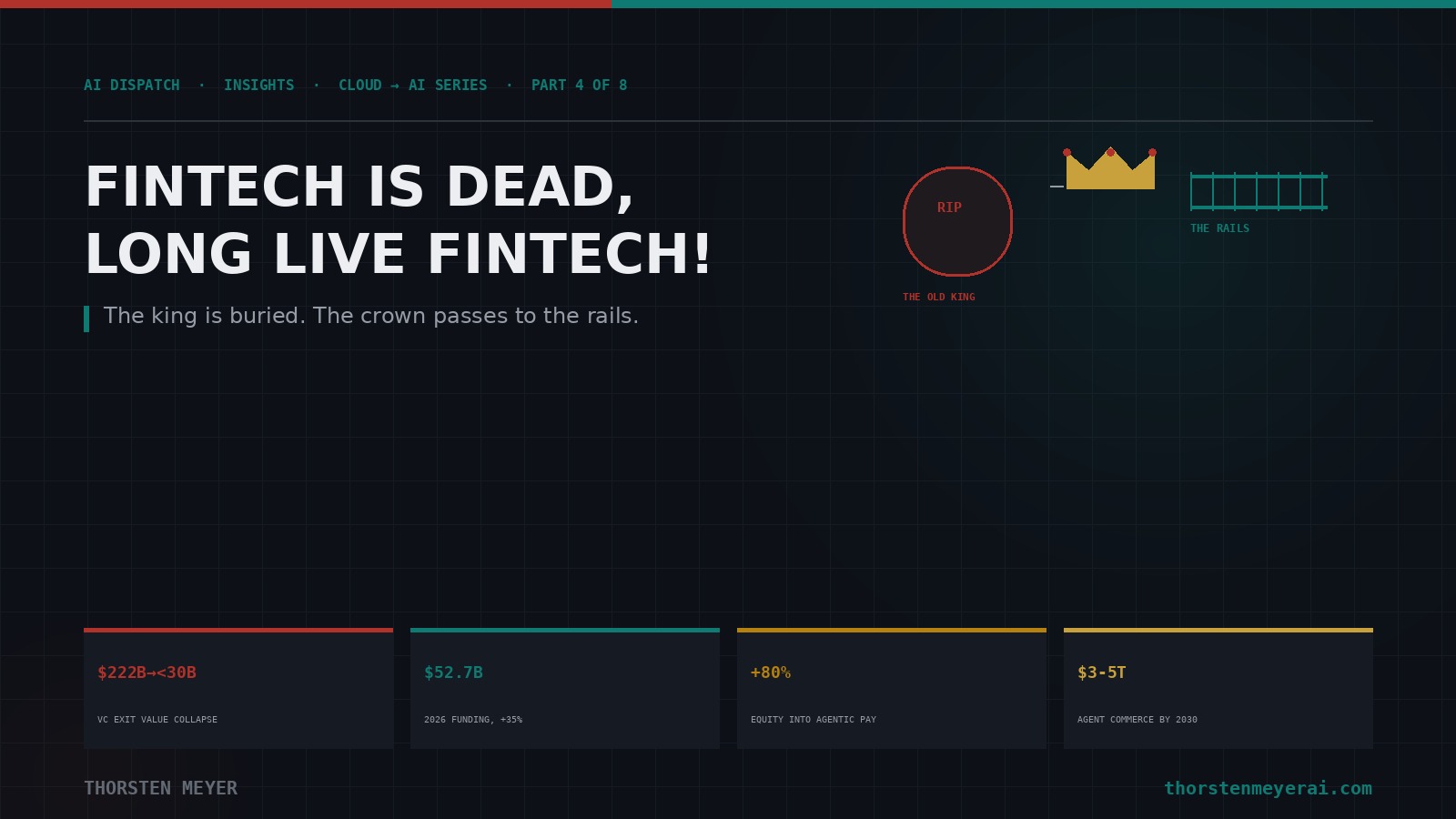
Let’s not soften it. From 2022 through 2024, fintech didn’t wobble; it collapsed. The sector that had been shorthand for the future of finance became a case study in restraint. VC exit value in the space fell from around $222 billion in 2021 to under $30 billion across the following years. IPOs vanished. Valuations didn’t dip, they reset — and the resets were brutal in a way that named the whole delusion of the prior era.
From 2022–24 the sector didn’t wobble; it collapsed. The velocity story — growth priced as if growth alone were a moat — is the thing that died.
The market said out loud that it had confused cheap capital and pandemic growth with durable value.
Klarna is the headstone. A company valued near $46 billion in private markets in 2021 went public in 2025 at roughly $15 billion — about a third of its peak. Chime, valued at $25 billion in 2021, debuted around $11–15 billion. These weren't failures, exactly; they were corrections, the market saying out loud that it had confused cheap capital and pandemic user growth with durable business value. The velocity story — faster payments, faster access, faster growth, priced as if growth alone were a moat — was the thing that died. And it deserved to.
The most useful way to read that death is the same lesson from the SaaS piece two days ago: the market stopped paying for the category and went back to paying for the company. "Fintech" as a valuation multiplier — the mere fact of being a financial-technology business earning a premium — that is dead. Correctly.
As an affiliate, we earn on qualifying purchases.
The burial had a lesson in it
What got exposed in the collapse is worth naming, because it's the reason the rebirth looks different. The fintechs that struggled most were the ones whose entire proposition was a thinner, faster interface on top of someone else's regulated infrastructure. When capital was cheap, a slick app with fast onboarding could raise at a premium on user growth alone. When capital got expensive, investors asked the question they'd deferred: where's the durable margin, and what stops a bank — or another app — from doing this?
For many, the honest answer was "not much." Chime's revenue still leans heavily on an interchange arrangement that may not last. Klarna's core BNPL product showed its limits — a record quarter of revenue paired with a widening loss, and a share price down 35% since listing as the market pressed on the profitability question. The interface was real value, but it was thin value, and thin value doesn't survive a rate shock. That's the buried king: fintech-as-a-prettier-front-end.
financial sector investment analysis books
As an affiliate, we earn on qualifying purchases.
As an affiliate, we earn on qualifying purchases.
Long live fintech: the crown passes to infrastructure and agents
Now the resurrection, because it's just as real, and the money is already moving. Global fintech funding rose to $52.7 billion in 2025, up 35% — the highest since 2022 — but the shape changed completely. Deal counts fell while dollars per deal rose: fewer, bigger, more selective bets. And the selection criterion is explicit. AI-enabled fintechs captured 23% of all fintech funding in Q3 2025, the highest share in nearly two years; five of the ten largest equity deals that quarter went to companies with AI at their core. The market that stopped paying for "fintech" is paying handsomely for a specific kind of it.
Fintech's new body is infrastructure for machine-initiated money — being built right now by the same networks that were supposed to be disrupted, in league with the AI labs.
Infrastructure for AI agents that handle money end to end — initiate, permission, settle, reconcile. This is not a fringe bet.
The category that barely existed two years ago and is now the sharp end of the whole sector is agentic payments — infrastructure for AI agents that handle financial tasks end to end, from initiating a transaction to reconciling it. Early-stage companies building this drew 80% more equity funding in 2025 than the year before, and the incumbents moved in force in a way that tells you this is not a fringe bet:
- Stripe and OpenAI shipped the Agentic Commerce Protocol, live in ChatGPT since September 2025 — a shopper completes a purchase inside the conversation, never clicking through to a website, with OpenAI taking a 4% merchant fee on completed checkouts.
- Visa launched Intelligent Commerce, partnered directly with OpenAI in June 2026 to embed payments into agent experiences, and built an Agent Score trust rating and a registry of verified agents — issuing, in effect, credit cards for AI agents with user-set spending caps and merchant restrictions.
- Mastercard launched Agent Pay and then Agent Pay for Machines, built for continuous agent-to-agent microtransactions "at machine speed" — settling amounts as small as fractions of a cent across cards, bank accounts, and stablecoins.
- Google announced its own coalition-backed Universal Commerce Protocol; the HTTP-native x402 protocol moved under Linux Foundation governance with 40 members including AWS, Visa, Mastercard, Stripe, Shopify, and Coinbase.
That is not a sector dying. That is a sector being rebuilt from the payment rails up for a world where the customer initiating the transaction is software. One projection puts agent-driven commerce at $3–5 trillion by 2030. Whatever the exact number, the direction is unmistakable: fintech's new body is infrastructure for machine-initiated money movement, and the crown has already passed to it.
AI-powered financial analysis software
As an affiliate, we earn on qualifying purchases.
As an affiliate, we earn on qualifying purchases.
Why this rhymes with everything else in this series
Step back and you'll see the same three-part shape I've been tracing since the cloud piece, which is why I wanted this in the series rather than as a standalone.
Don't ask whether fintech is dead or alive — that's the fixed-pie question again. Ask where the value moved.
The oligopoly-plus-tail structure is right there: the card networks and Stripe are the new hyperscalers of money movement, and a crop of specialist infrastructure players (the "Snowflake of agentic payments" that's still being built) will grow on top of them. The "commodity" trap applies: payment processing looked like a commodity for a decade, and the agentic layer just revealed a whole new frontier of scarce expertise in it. The frontier-moved logic from the SaaS piece is identical: the old fintech frontier was interface and user growth; the new one is trust, credentials, machine-to-machine settlement, and being the merchant of record when the buyer is an agent. And the bifurcation is the same one splitting SaaS multiples — AI-native fintechs raise easily at premiums while "regular fintechs" with fine numbers still face pressure. Same market, same message: which side of the line are you on?
fintech company valuation calculator
As an affiliate, we earn on qualifying purchases.
As an affiliate, we earn on qualifying purchases.
The honest bear case
I'd be doing the reflexive-hype thing I keep criticizing if I let the resurrection run unqualified, so here's the other side, and it's serious.
The rebound is real but fizzled fast in public markets. After 2025's IPO surge, the US market went quiet again — the only fintech listings in the first half of 2026 were foreign companies coming to New York. Stripe, Plaid, Revolut, Ramp, Monzo all stayed private, often at escalating private marks. A private premium is not a validated one; it's a bet the public market hasn't yet been asked to confirm, and Klarna's post-IPO slide is a warning about what happens when it is.
Agentic commerce is a build-out, not a proven revenue base. The infrastructure is shipping, but the economics are unsettled. Does the 4% agent fee hold, or does competition crush it? Even OpenAI has appeared to step back from native checkout in ChatGPT, shifting purchases toward merchant-controlled experiences — a reminder that the first architecture is rarely the final one. Merchants are fighting to stay the merchant of record precisely because they can see the agent layer trying to insert itself as a toll. This is a land grab with real technology under it, but land grabs have losers, and most of these companies will be them.
And regulation is a moat and a landmine. A financial license is a genuine barrier that AI can't dissolve — which is bullish for the regulated players. But agent-initiated payments raise questions nobody has fully answered: who's liable when an agent buys the wrong thing, or is manipulated into a fraudulent transaction? Europe just saw its first live regulated agent payment (Mastercard and Santander); the rules are being written in real time, and they could slow the whole thing as easily as enable it.
Where I land
Fintech is dead. The version that earned a premium for being a fast, pretty interface on rented rails — that king is buried, and the burial was deserved. But long live fintech: the crown has passed to the infrastructure of machine-initiated money, and it's being built right now by the same card networks and processors that were supposed to be disrupted, in league with the AI labs, into rails for a world where your agent holds the card.
The reframe I'd offer, consistent with this whole series: don't ask whether fintech is dead or alive, because that's the fixed-pie question again. Ask where the value relocated. It moved from the interface to the rails, from user growth to machine trust, from being a prettier bank to being the toll booth on agent-initiated commerce. The companies mourning the old frontier will keep dying. The ones building the new one are getting crowned. Same as cloud, same as SaaS, same as every rupture that turned out to be a relocation. Next in the series: the human side of all this — what talent density means when a small team with the right tools can outbuild a large one.
Analysis and opinion from a builder, founder, and post-labor economist running a local-first inference operation. Figures verified at time of writing against multiple 2026 sources (PitchBook/Crunchbase fintech funding and exit data, company IPO filings, and the public announcements of Stripe/OpenAI, Visa, Mastercard, Google, and the Linux Foundation on agentic-commerce protocols); valuations, fees, and funding figures are as reported and will change. Framework and interpretation are the author's own. This is analysis, not investment advice. Part 4 of an 8-part series. Point-in-time as of 14 August 2026.
Evergreen bestsellers Picks
bestsellers
As an affiliate, we earn on qualifying purchases.