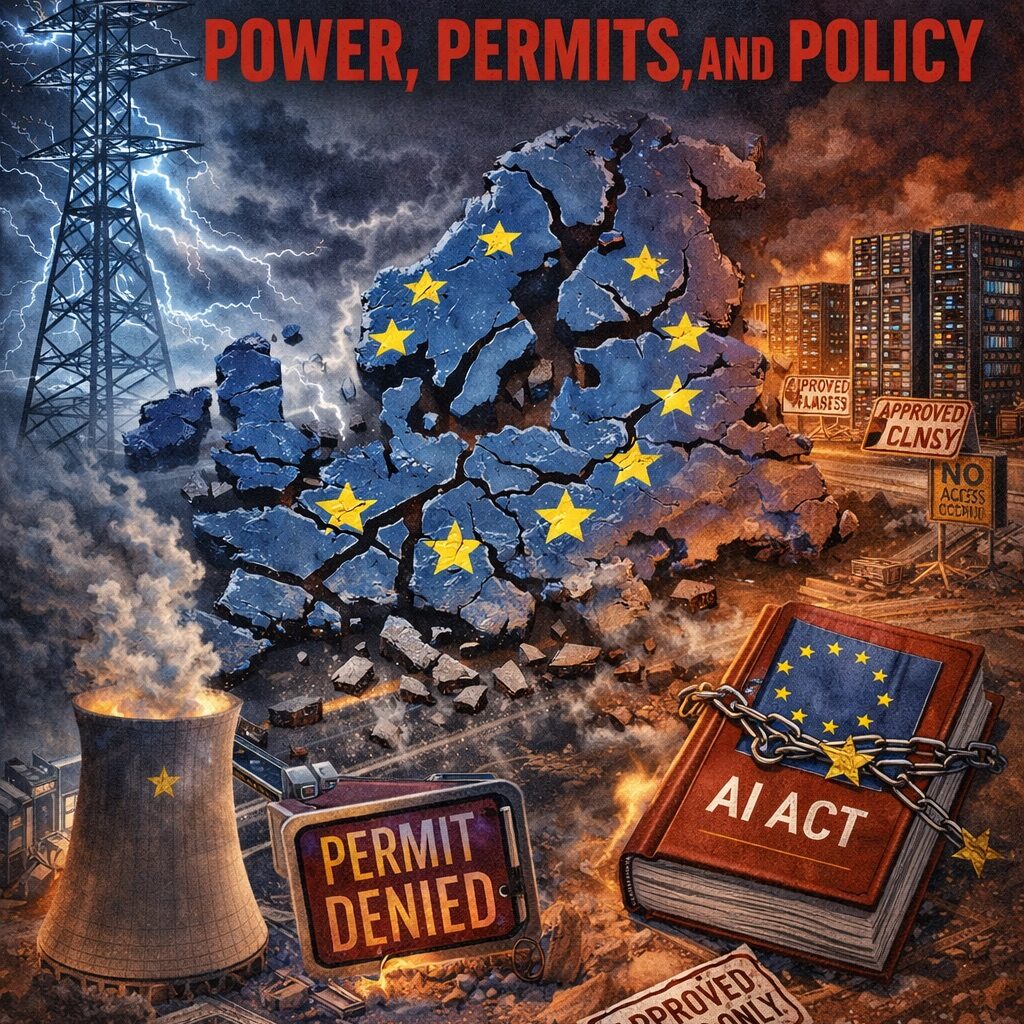

By Thorsten Meyer — January 30, 2026

Get business pricing on tech for your team
- Business-only prices and quantity discounts
- Tax-exempt purchasing
- Multiple users, one account, clear invoices
Europe is having the wrong argument about AI.
We debate ethics, copyright, and the philosophy of sentience while the rest of the world is debating transformers — the electrical kind — and how to connect hundreds of megawatts of new demand to the grid. AI has entered its “atoms over bits” era. Reality — energy, hardware, permits, and insurance — has become the bottleneck.
The new limiting factor is electricity
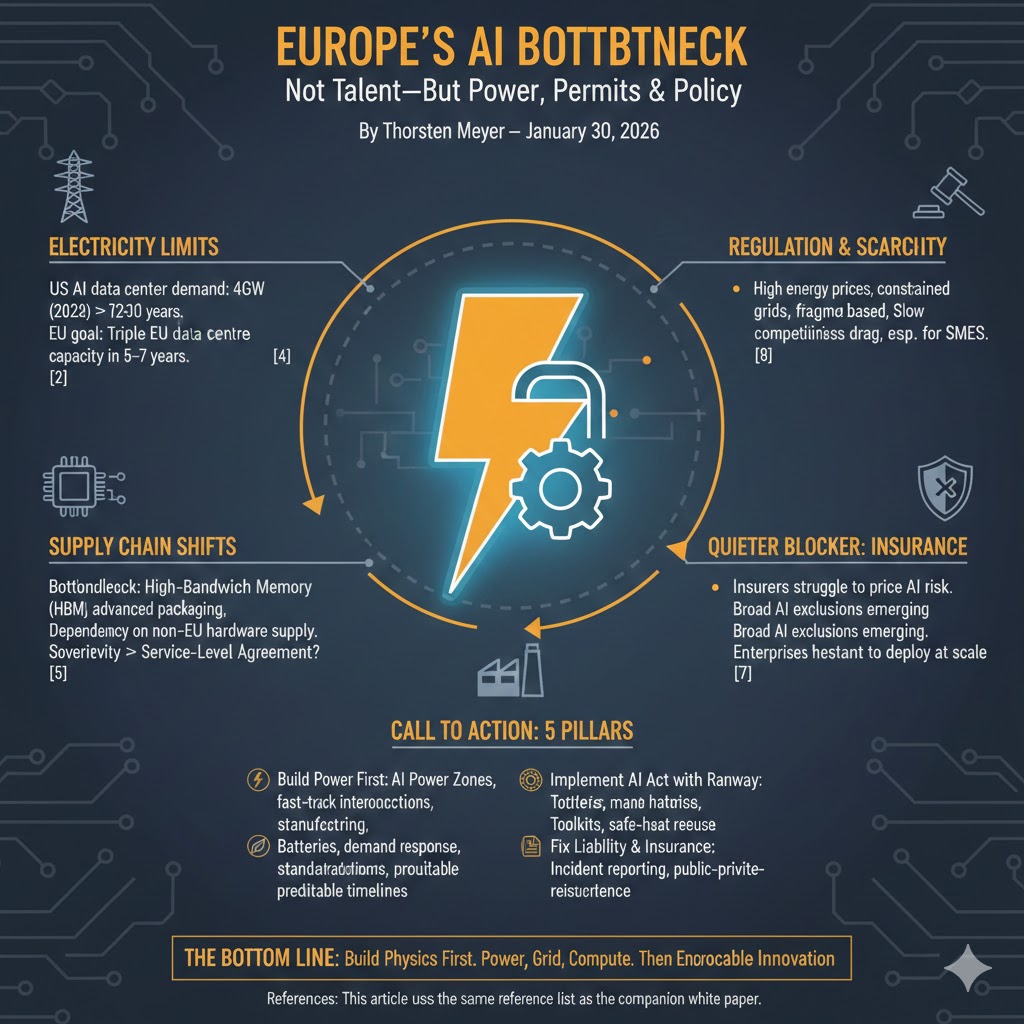
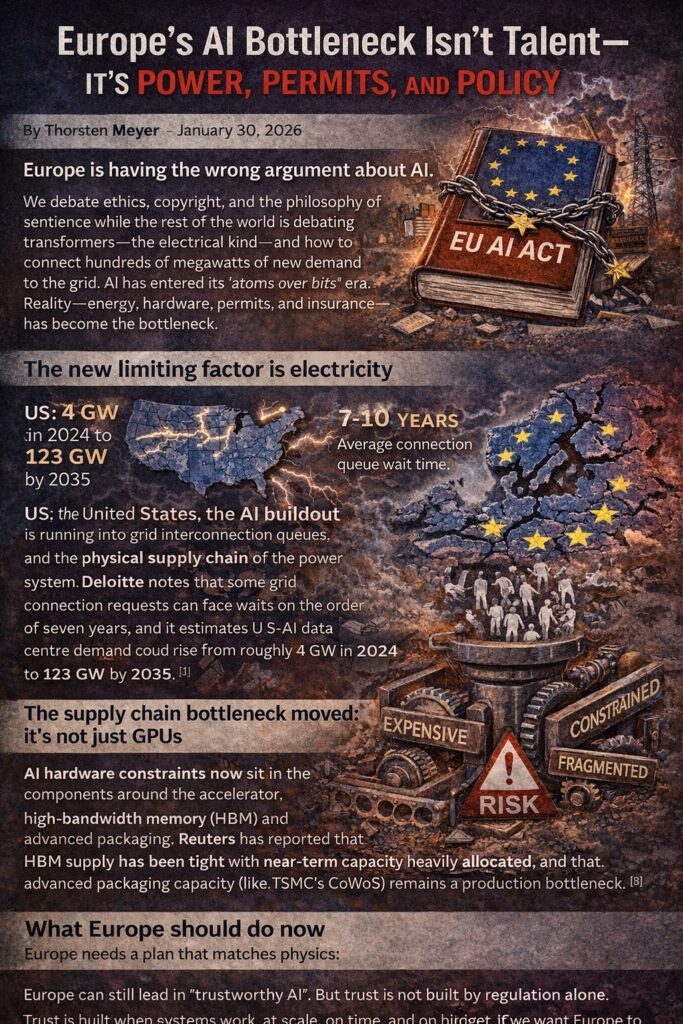
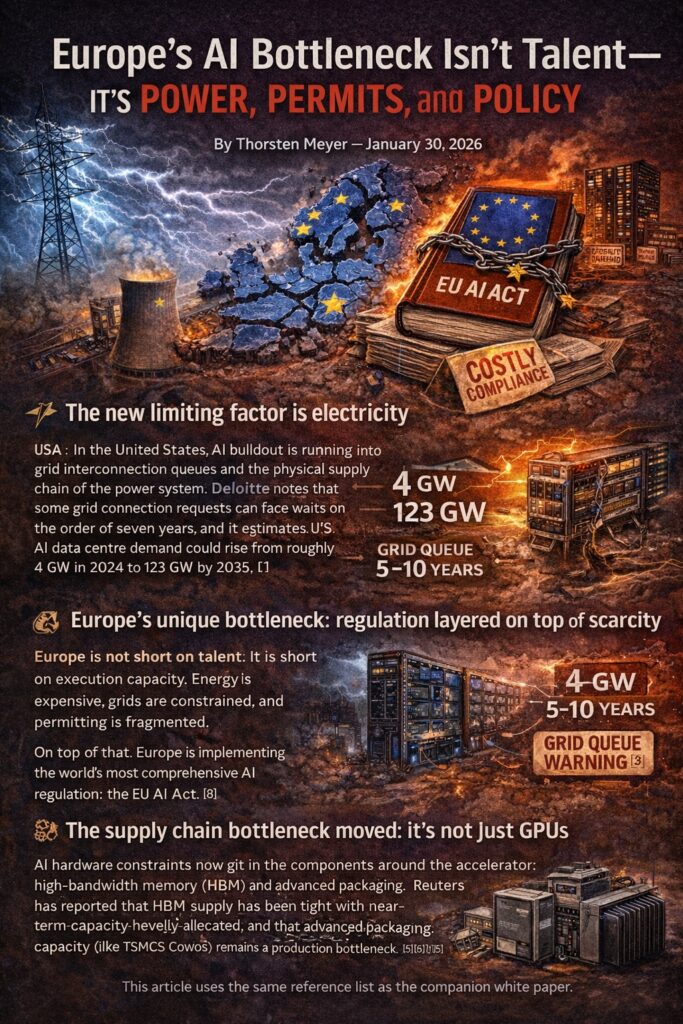
In the United States, the AI buildout is running into grid interconnection queues and the physical supply chain of the power system. Deloitte notes that some grid connection requests can face waits on the order of seven years, and it estimates U.S. AI data centre demand could rise from roughly 4 GW in 2024 to 123 GW by 2035. [1]
In Europe, the ambition is clear: the European Commission wants to at least triple EU data centre capacity within five to seven years. [4] But the IEA warns that connection queues in Europe’s major hubs can average seven to ten years — longer than the political cycle that created the policy. [2]
As an affiliate, we earn on qualifying purchases. As an affiliate, we earn on qualifying purchases.high bandwidth memory for AI servers
Europe’s unique bottleneck: regulation layered on top of scarcity
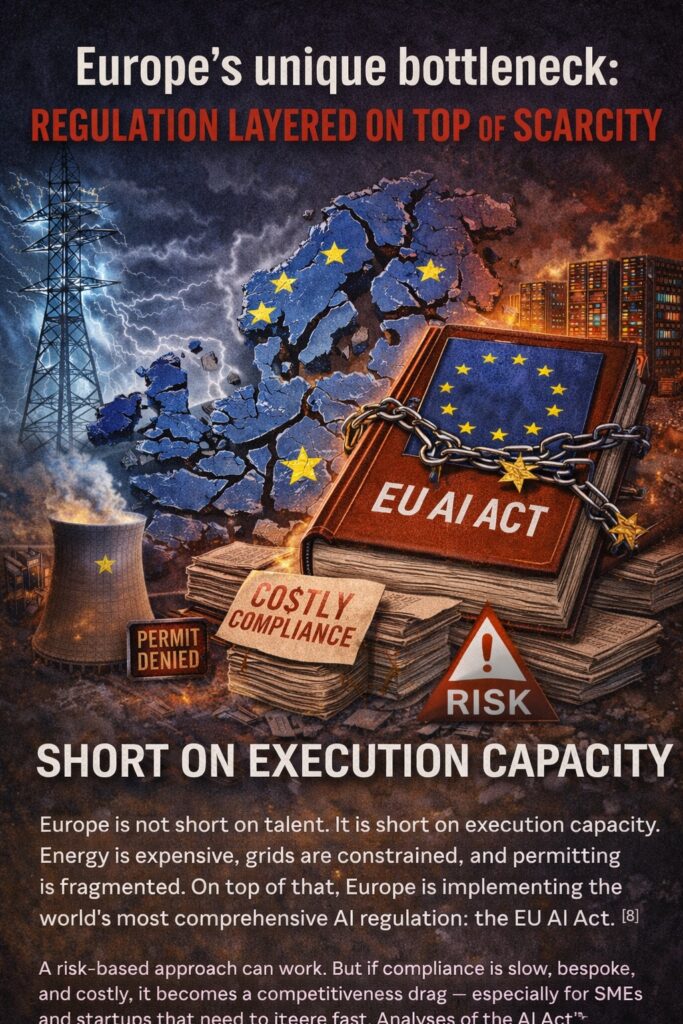
Europe is not short on talent. It is short on execution capacity. Energy is expensive, grids are constrained, and permitting is fragmented. On top of that, Europe is implementing the world’s most comprehensive AI regulation: the EU AI Act. [8]
A risk-based approach can work. But if compliance is slow, bespoke, and costly, it becomes a competitiveness drag — especially for SMEs and startups that need to iterate fast. Analyses of the AI Act’s compliance burden have warned that obligations such as quality management systems can impose substantial upfront and recurring costs. [9]
As an affiliate, we earn on qualifying purchases.
The supply chain bottleneck moved: it’s not just GPUs
AI hardware constraints now sit in the components around the accelerator: high-bandwidth memory (HBM) and advanced packaging. Reuters has reported that HBM supply has been tight with near-term capacity heavily allocated, and that advanced packaging capacity (like TSMC’s CoWoS) remains a production bottleneck. [5][6][15]
Europe’s extra disadvantage is dependency. If your cloud and AI stack depends on hardware supply and packaging capacity outside your region, you don’t have sovereignty — you have a service-level agreement.
As an affiliate, we earn on qualifying purchases.
A quieter blocker: insurance
There is also a mundane but powerful friction point: insurance. If insurers cannot price AI risk, they will exclude it — and if it is excluded, many enterprises will simply not deploy at scale. The trend toward broad AI exclusions is already visible in parts of the market. [7]
As an affiliate, we earn on qualifying purchases. As an affiliate, we earn on qualifying purchases.AI hardware supply chain components
What Europe should do now
Europe needs a plan that matches physics:
- Build power first: AI Power Zones with pre-approved grid capacity and fast-track interconnections.
- Treat transformers as strategic assets: expand manufacturing and standardise procurement.
- Deploy flexibility at the edge: batteries, demand response, and waste-heat reuse so data centres support the grid rather than overwhelm it.
- Implement the AI Act with a runway: reusable compliance toolkits, safe harbours for SMEs, and predictable conformity assessment timelines.
- Fix liability and insurance: standard incident reporting, and a public-private reinsurance backstop for high-impact deployments.
The bottom line
Europe can still lead in “trustworthy AI”. But trust is not built by regulation alone. Trust is built when systems work, at scale, on time, and on budget.
If we want Europe to shape the AI future, we need to build the physical prerequisites of that future: power, grid capacity, and compute — and then implement regulation that is enforceable without strangling innovation.
References
This article uses the same reference list as the companion white paper.
Fall Picks
fall essentials
As an affiliate, we earn on qualifying purchases.