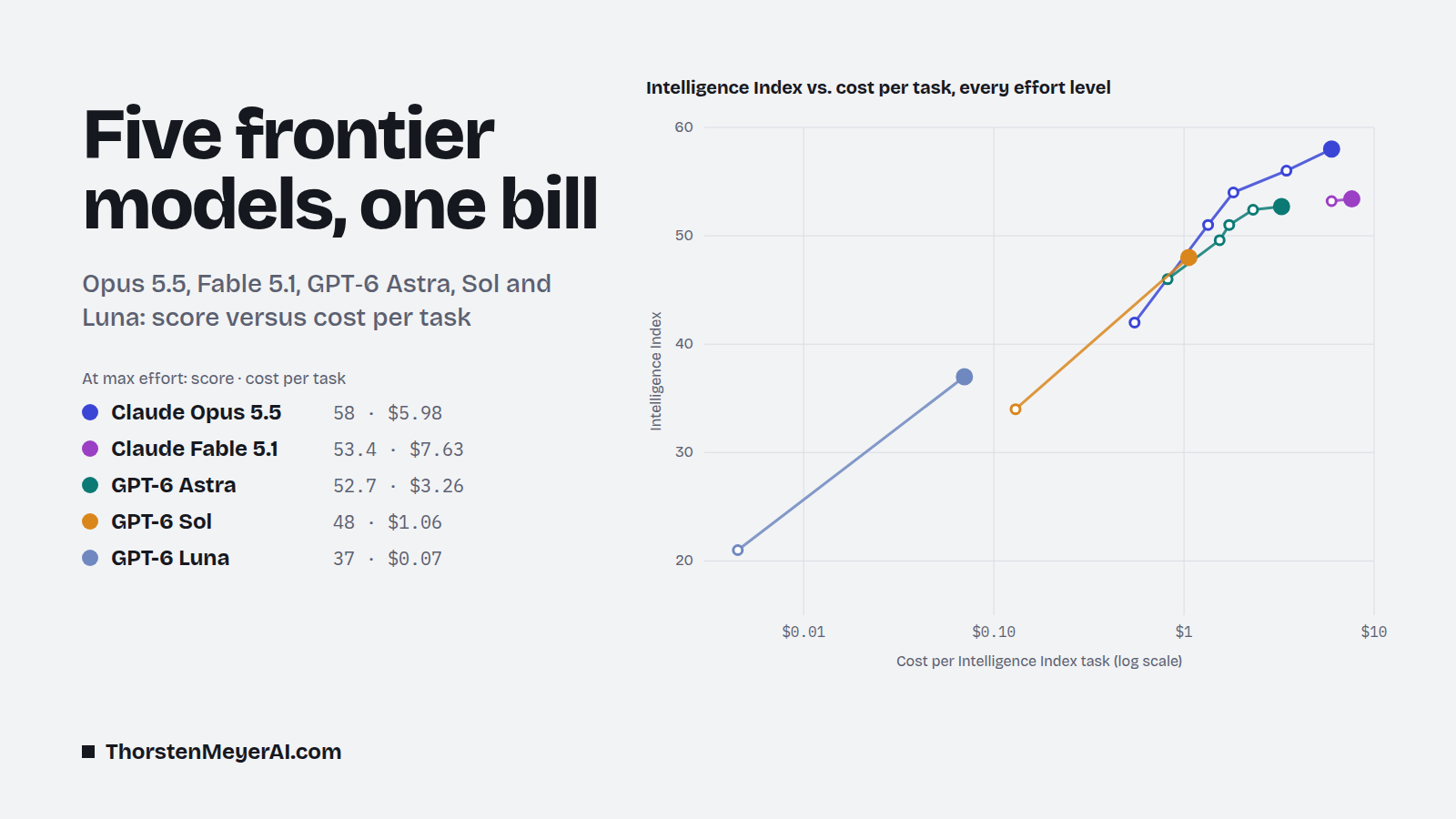

September 2026 gave us five new frontier models in three weeks. Ranking them by intelligence is the wrong question. The useful one is which one clears your quality bar at the lowest cost per task.

Get business pricing on tech for your team
- Business-only prices and quantity discounts
- Tax-exempt purchasing
- Multiple users, one account, clear invoices
In three weeks, Anthropic and OpenAI each shipped a full model lineup. Anthropic released Claude Fable 5.1 on September 1 and Claude Opus 5.5 on September 22. OpenAI released GPT‑6 Astra on September 3, then GPT‑6 Sol and Luna on the same day as Opus 5.5.
This piece puts all five side by side on the same independent yardstick, the Artificial Analysis Intelligence Index. It uses one metric that matters more than any benchmark headline: what one task actually costs.
Five frontier models, compared on what they cost to use
Claude Opus 5.5, Claude Fable 5.1, GPT‑6 Astra, GPT‑6 Sol and GPT‑6 Luna, all released in September 2026, measured on the same independent index.
Score versus cost per task
Each line is one model; each dot an effort level from low to max. Up and to the left is better.
Legend shows max‑effort score and cost. Fable 5.1 is shown at xhigh and max only; Sol and Luna at low and max.
The spec sheet
| Model | Price in / out per 1M tokens | Index (max) | Cost per task (max) | Output tokens/s | Context |
|---|---|---|---|---|---|
| Claude Opus 5.5 Anthropic · Sep 22 | $4 / $20 | 58 | $5.98 | ~76 | 1M |
| Claude Fable 5.1 Anthropic · Sep 1 | $10 / $50 | 53 | $7.63 | 66 | n/a |
| GPT-6 Astra OpenAI · Sep 3 | $10 / $50 | 53 | $3.26 | 58 | 1.05M |
| GPT-6 Sol OpenAI · Sep 22 | $2 / $10 | 48 | $1.06 | 115 | 872k |
| GPT-6 Luna OpenAI · Sep 22 | $0.10 / $0.50 | 37 | $0.07 | 154 | 1M |
Opus 5.5 speed is measured at medium and xhigh effort. Fable 5.1 context not listed in the sources used.
What $100 buys at max effort
Intelligence Index tasks per $100 (log scale).
Which one for which job
Claude Opus 5.5
Top independent score, mid‑tier price
Best for: Client‑ready knowledge work and long agentic coding. Run at medium effort first.
Watch: Most cybersecurity tasks re‑route to Opus 4.8; max effort writes many tokens.
Claude Fable 5.1
Anthropic’s Mythos‑tier model with safeguards
Best for: Workloads where your own tests show it ahead of Opus 5.5.
Watch: Now outscored by Opus 5.5 on the index at a higher cost per task.
GPT-6 Astra
OpenAI’s flagship
Best for: Computer use and agents where token efficiency matters.
Watch: Highest per‑token price; about 60% more per task than Sol at max.
GPT-6 Sol
The budget workhorse
Best for: Coding agents and business automation at scale.
Watch: Regressed on polished, complete deliverables (GDPval‑AA).
GPT-6 Luna
Sub‑cent tasks
Best for: High‑volume classification, extraction and routing.
Watch: Coding Agent Index slipped 2 points versus its predecessor.
Read the numbers carefully
As an affiliate, we earn on qualifying purchases.
The quick answer
| Model | Price (in / out per 1M) | Index at max | Cost per task at max |
|---|---|---|---|
| Claude Opus 5.5 | $4 / $20 | 58 | $5.98 |
| Claude Fable 5.1 | $10 / $50 | 53 | $7.63 |
| GPT‑6 Astra | $10 / $50 | 53 | $3.26 |
| GPT‑6 Sol | $2 / $10 | 48 | $1.06 |
| GPT‑6 Luna | $0.10 / $0.50 | 37 | $0.07 |
Four things stand out:
- Opus 5.5 has the top score. At 58 on max effort, it is the highest Artificial Analysis has measured, by several points.
- Astra is the best value near the top. It ties Fable 5.1 on score for well under half the cost per task.
- Sol and Luna own the budget end. They sit on the cost frontier below 50.
- Fable 5.1 is the one to question. It is now outscored by a cheaper sibling.
As an affiliate, we earn on qualifying purchases.
A warning before comparing anything
Artificial Analysis rebuilt its index this month, and the numbers aren’t comparable across versions. When Fable 5.1 launched, it scored 66 on the older version, the highest ever recorded. On the current version, the same model scores 53, tied with GPT‑6 Astra.
The model didn’t get worse. The test got harder. Any comparison that mixes launch-week headlines from different weeks is comparing different rulers. Every number in this article comes from the current v4.3 index.
AI productivity optimization software
As an affiliate, we earn on qualifying purchases.
As an affiliate, we earn on qualifying purchases.
Claude Opus 5.5: the new top of the table
Opus 5.5 is the surprise of the month. Anthropic positions it as performing at the level of Fable 5.1 on most work at 40% less cost than Opus 5. The independent index goes further and puts it clearly ahead, at 58 against Fable’s 53.

Its strongest area is professional work. On AA‑Briefcase, the private knowledge-work evaluation, it scored 1822 Elo, 143 points ahead of Fable 5.1. That was also the first time an Anthropic model beat GPT‑5.6 Sol on presentation quality.
The catch is how much it writes at max effort. It uses about 119k output tokens per task, compared with about 27k for GPT‑6 Astra. That’s why a model with less than half Astra’s per-token price still costs nearly twice as much per task at max.
At lower effort, the picture flips. Medium effort scores 51 for $1.34 per task, about what Astra scores at high effort for less money. For most teams, medium is where Opus 5.5 is competitive.
As an affiliate, we earn on qualifying purchases.
Claude Fable 5.1: a premium that now needs justifying
Fable 5.1 is Anthropic’s Mythos-tier public model, meaning it shares its underlying model with Claude Mythos 5.1 but carries additional safeguards. It is priced at $10 per million input tokens and $50 per million output, the same as Astra.
On the index, it is tied for second at 53. It is also the most expensive model in this group per task, at $7.63 at max effort. It’s verbose too: it generated 190M tokens across the index, against a median of 92M for comparable models.
Artificial Analysis summarizes the head-to-head with Astra bluntly: Astra matches Fable’s score for about 40% of the cost per task. Astra is also faster, at 8.2 minutes per task against Fable’s 12.2.
To be fair to Fable, it did lead two of the index’s hardest components when it launched, and Anthropic’s own view is that the gap to Opus 5.5 is narrower than the benchmarks suggest. But when the vendor’s own cheaper model outscores its premium one, the burden of proof moves to Fable. If you’re running it today, run the same tasks through Opus 5.5 and compare.
GPT‑6 Astra: the most efficient at the top
Astra is OpenAI’s flagship. It launched with a 1.05M-token context window and five reasoning effort levels at $10 and $50 per million tokens.
Its main strength is token efficiency. On Artificial Analysis’s Coding Agent Index, it used about a third of the tokens of GPT‑5.6 Sol per task. That offsets its high list price. Every Astra effort level sits on the cost frontier, from $0.82 per task at low effort to $3.26 at max.
Astra also made a big independent improvement on hallucination. Its rate on AA‑Omniscience fell to 51%, from 92% for GPT‑5.6 Sol.
Relative to its own family, the trade-off is steep. At max effort, Astra costs about 60% more than Sol for a five-point higher score. That can be worth it for computer use and long agent runs, but it isn’t worth it for everything.
GPT‑6 Sol: the workhorse
Sol is the price-performance story of the month. Its prices halved to $2 and $10, and it scores 48 at max effort for $1.06 per task.
It isn’t a clean upgrade on its predecessor, though. Independent testing found it dropped about 100 Elo on GDPval‑AA, largely because of weaker presentation and deliverables that leave out required elements. Sol is excellent for coding agents and automations that feed other systems. It’s less suited to documents a client will read.
GPT‑6 Luna: the sub-cent tier
Luna costs $0.10 per million input tokens and $0.50 per million output. At max effort it scores 37 for $0.07 per task, and at low effort 21 for less than half a cent.
That’s the right range for high-volume routing, tagging and extraction, where you need thousands of decent calls rather than a few brilliant ones. Avoid it for coding. Its Coding Agent Index score fell 2 points against its predecessor.
What $100 buys
Converting cost per task into volume makes the spread concrete. At max effort, $100 runs roughly:
- 13 index tasks on Fable 5.1
- 17 on Opus 5.5
- 31 on Astra
- 94 on Sol
- more than 1,400 on Luna
That’s a hundredfold range across five models released within three weeks of each other. The spread in capability is far smaller, running from 37 to 58 on the index.
Two things the table doesn’t show
Fallback behavior. Both Anthropic models are measured with safety fallback enabled, which routes flagged requests to older Claude models. For Fable 5.1, fallback served about 4% of output tokens across the index. For most business work this doesn’t matter. If you work in security or life sciences, test the fallback behavior specifically before you commit.
Effort settings. Every comparison above is at max effort, but production workloads rarely run there. At medium or high effort, the gaps between models narrow and costs fall sharply. Opus 5.5 at medium and Astra at high land within a point of each other, with Opus slightly cheaper.
How to choose
- Client-ready documents and analysis: start with Opus 5.5 at medium effort. Move up to high only if your quality checks require it.
- Agents and computer use where token efficiency matters: Astra is the strongest option near the top of the curve.
- Coding agents and automation at scale: Sol gives you most of the capability for about a third of Astra’s cost per task.
- High-volume, simple decisions: Luna, or a specialized decision model like Jev if the question is narrow enough.
- Fable 5.1: keep it only where your own tests show it beating Opus 5.5 on your workload.
The broader lesson from September is that no single model is the best choice. The frontier is now a price curve, and each of the five models occupies a different part of it. The organizations that do well will route each task to the cheapest model that clears the bar, and re-test every time the curve moves. This month, that happened twice in three weeks.
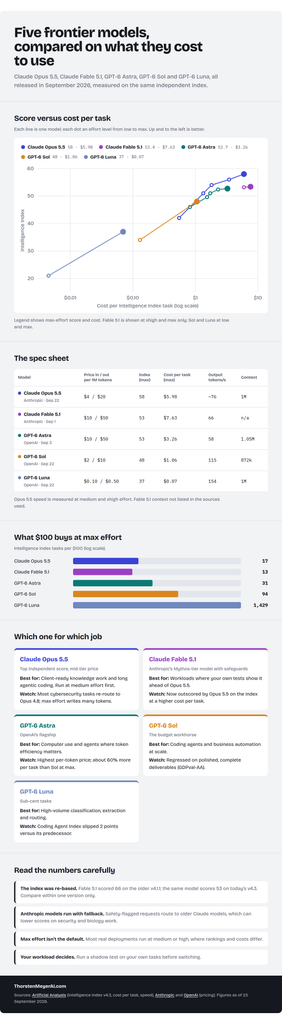
Sources: Artificial Analysis Intelligence Index v4.3 and model pages, plus Anthropic and OpenAI launch announcements. Figures as of September 23, 2026.
Columbus Day / Indigenous Peoples' Day Picks
long weekend sales
As an affiliate, we earn on qualifying purchases.