By Thorsten Meyer | November 12, 2026 | ThorstenMeyerAI.com

Get business pricing on tech for your team
- Business-only prices and quantity discounts
- Tax-exempt purchasing
- Multiple users, one account, clear invoices
Indonesia wants to rewrite its copyright law for the age of AI. On Wednesday, November 11, three of the biggest platforms in the country sat in front of lawmakers in Jakarta and pushed back. Google had already objected. Now Meta and TikTok joined it, Reuters reported.
The bill would do two big things. It would make platforms pay news publishers when they show their content, including link previews. And it would set rules for AI: what counts as an AI-assisted work, whether AI may imitate a creator’s style, when AI use has to be disclosed, and on what terms copyrighted work can be used for training. “If unregulated, it could kill human creation,” an official of Indonesia’s law ministry told Reuters in July.
Google’s answer at the hearing went further than a warning about access to news. A levy on links, its representative said, would leave Google “no choice” but to stop crawling, indexing and distributing Indonesian news.
Here is what the draft proposes, what each company objects to, what it could mean for AI developers, creators and publishers in Indonesia and elsewhere, how it compares with the EU and the US, and what is still open.
In brief
- The bill: A revision of Indonesia’s Copyright Law, Law No. 28 of 2014. It is a parliamentary initiative, approved as such in a plenary session on March 12, 2026, and now being deliberated by parliament’s Legislation Body (Baleg) together with the government.
- The hearing: On November 11, Baleg heard Google, Meta, TikTok, the Press Council (Dewan Pers) and Satu Lisensi Indonesia, according to Kompas.
- Google objects to payments for links and snippets, a single collective licensing body and mandatory licenses for AI training data, and asks to keep safe-harbor protection. It proposes a text and data mining exception with an opt-out such as robots.txt.
- Meta says sharing a link is not republishing, and that payment duties could cost publishers traffic and revenue.
- TikTok says AI disclosure should not apply where AI only assists, and wants safe-harbor protection kept.
- The press sees it differently. Dewan Pers told lawmakers that platforms take 80 percent of digital advertising and that traffic from platforms to news sites has fallen by up to 70 percent.
- Not law yet. The draft has changed since July, we could not obtain the full text under discussion, and we found no announced date for a vote.

Products Worth Considering

Amazon Kindle Scribe Colorsoft 64GB with 11-Inch Color Display and Premium Pen, Graphite

Bose TV Speaker Compact Soundbar with Bluetooth and HDMI-ARC, Black

LG UltraGear 34G600A-B 34-Inch Curved WQHD Gaming Monitor, 160Hz
As an affiliate, we earn on qualifying purchases.
What the draft would do
Reuters first reported the AI clauses on July 17, citing a draft of the bill. Hermansyah Siregar, a law ministry official overseeing intellectual property, confirmed the draft was authentic and said it would be the first explicit recognition of AI in Indonesia’s copyright law. “The development of generative AI has disrupted the copyright framework,” he said. He also said the draft was not final.
According to Reuters, the July draft would:
- Ban using AI to imitate a creator’s “distinctive style”.
- Require disclosure of AI use in content.
- Protect AI-assisted works only if they meet human involvement criteria. Fully AI-generated works would be excluded. The draft did not say how much human involvement is needed.
- Put AI training under fair use or licensing. “The use of copyrighted works to train AI models would also be subject to fair-use provisions or licensing agreements,” Reuters wrote.
- Make platforms pay for news. Tech platforms would pay compensation for aggregating, republishing or link-previewing news content, and for using it for AI training. The money would go to state-supervised collective management organisations, which would pass it on to publishers.
- Back it with sanctions. Platforms that do not comply could face sanctions, including the revocation of their local business permits.
The rules would cover a range of content, from video games and photography to computer programs, journalism and film.
At the November hearing, Google pointed to Articles 29 and 30 of the draft under discussion, which it said require payment for indexing, aggregation, curation and the display of news snippets, according to Suara. The full current text was not available to us. Parliament’s draft server refused our requests, and news reports cite different versions. Treat article numbers as provisional.
The bill sits on top of an existing rule. Since 2024, Presidential Regulation No. 32 of 2024 has required digital platforms to support quality journalism. Dewan Pers deputy chair Totok Suryanto told lawmakers that it has not worked as intended and that platform compliance is low, according to Aktual.
What the companies object to
Google. Agung Pamungkas, Google’s government affairs and public policy manager in Indonesia, told the hearing that requiring platforms to pay for showing links to news would limit Indonesians’ access to news, Reuters reported. According to Suara, he named four areas that need more discussion:
- Links and snippets. A levy on links would make it hard to index and distribute local news.
- Creator autonomy. Google wants voluntary, market-based deals instead of a blanket license through one central collective management organisation. Forcing music and news rightsholders to contract through one single collective body risks disrupting market efficiency, limiting creators’ income and deterring global investment, he said, according to Suara and Kompas.
- Safe harbor. Platforms are intermediaries and cannot decide on their own whether content infringes copyright. Google wants a notice-and-action system.
- AI training. Mandatory licenses for all training data are technically unworkable given the scale of the web, Google argues. It proposes a text and data mining exception with a standard opt-out such as robots.txt. Restricting training on local data would make AI worse at Indonesian, Agung said, which would hurt local developers.
Then came the sharpest line. Charging for links “would leave us at Google no other choice but to stop crawling, indexing and distributing Indonesian news to local residents,” Agung said, according to Suara (our translation). Google’s Southeast Asia news partnerships manager, Yos Kusuma, told lawmakers that Google sent more than 1 billion referral visits a month to Indonesian news publishers in 2025, and Suara reports that Google holds more than 30 active business-to-business licensing deals. These are Google’s own figures. In a statement quoted by Reuters in July, Google said “rigid, overbroad mandates” would leave Indonesia as “an international outlier”.
Meta. Berni Moestafa, Meta’s public policy head in Indonesia, said that requiring platforms to pay compensation meant news “publishers could lose readership traffic as well as potential advertising and subscription revenue,” according to Reuters. Directing readers to an article is different from reproducing or republishing it, he added. Kompas reports that Meta also asked for a notice-and-action process so that platforms would not have to check or block all uploads automatically.
TikTok. Noudhy Valdryno, TikTok’s head of public policy in Indonesia, told lawmakers that disclosure requirements should not apply where AI is used only in an assistive capacity rather than to fully create content, Reuters reported. He urged lawmakers to keep safe-harbor protection, saying platforms cannot reliably determine who owns a copyright or holds a license. According to Kompas, TikTok also asked for clear roles for the national and individual collective management bodies, to avoid double billing, and for direct licensing deals, including existing agreements with foreign partners, to remain valid.

The publishers’ side
The companies were not alone at the table. Dahlan Dahi, who chairs the Press Council’s commission on digital affairs and sustainability, gave lawmakers the other half of the story.
“80 percent of digital advertising is controlled by platforms, while media or publishers compete for 20 percent,” he said, citing Wavemaker 2025, according to Aktual (our translation). More than 50,000 press companies share that 20 percent. Traffic and page views from platforms to media sites have fallen by up to 70 percent, the Press Council said, as people get summaries straight from search engines and AI services.
The Press Council does not simply back the draft, though. It wants publishers’ economic rights treated separately from individual copyright, with compensation going only to professional outlets: legal entities with at least five workers, pay above the regional minimum wage and health insurance. Like Google, it wants direct business-to-business deals allowed next to the collective body, according to Kompas and Aktual. And Dahlan warned platforms not to use their “dominant position” to cut off news distribution in response to payment duties.
What it means
For AI developers. Three provisions matter most. First, training: if Indonesia ties training to fair use or licensing without a clear text and data mining exception, model makers face legal uncertainty for Indonesian-language data, and Google warns that could make models worse at Indonesian. Second, the style ban: “distinctive style” is not a legal term with a settled meaning, and the draft as reported does not define it. Third, disclosure: TikTok’s request to exempt assistive AI shows how much depends on where the line is drawn. Companies that sell AI tools in Indonesia should follow the final wording closely and get local legal advice. This article is not legal advice.
For creators and rightsholders. The draft offers things many artists have asked for: a ban on AI imitating their style, protection for AI-assisted work with real human input, and no protection for purely machine-made output. The price is centralised collective management, which even the Press Council and TikTok question. Baleg also heard musicians’ associations on the bill in November 2025, according to Antara.
For publishers. Indonesian publishers could gain a legal claim to payment for link previews and AI training. They also face the risk Google described: a platform that stops showing their news. Whether the money is worth the lost traffic depends on terms that are not yet written.
For users. Labels on AI content could become mandatory. In the worst case for users, news from Indonesian outlets could disappear from Google results in Indonesia, if Google follows through. That is a stated possibility, not an announced decision.
Beyond Indonesia. Indonesia could become the first country in Southeast Asia to put AI into its copyright law, Reuters notes. A large market writing AI training, disclosure and style rules into copyright law will be watched by regulators elsewhere in the region, and by every AI company that wants to serve them.
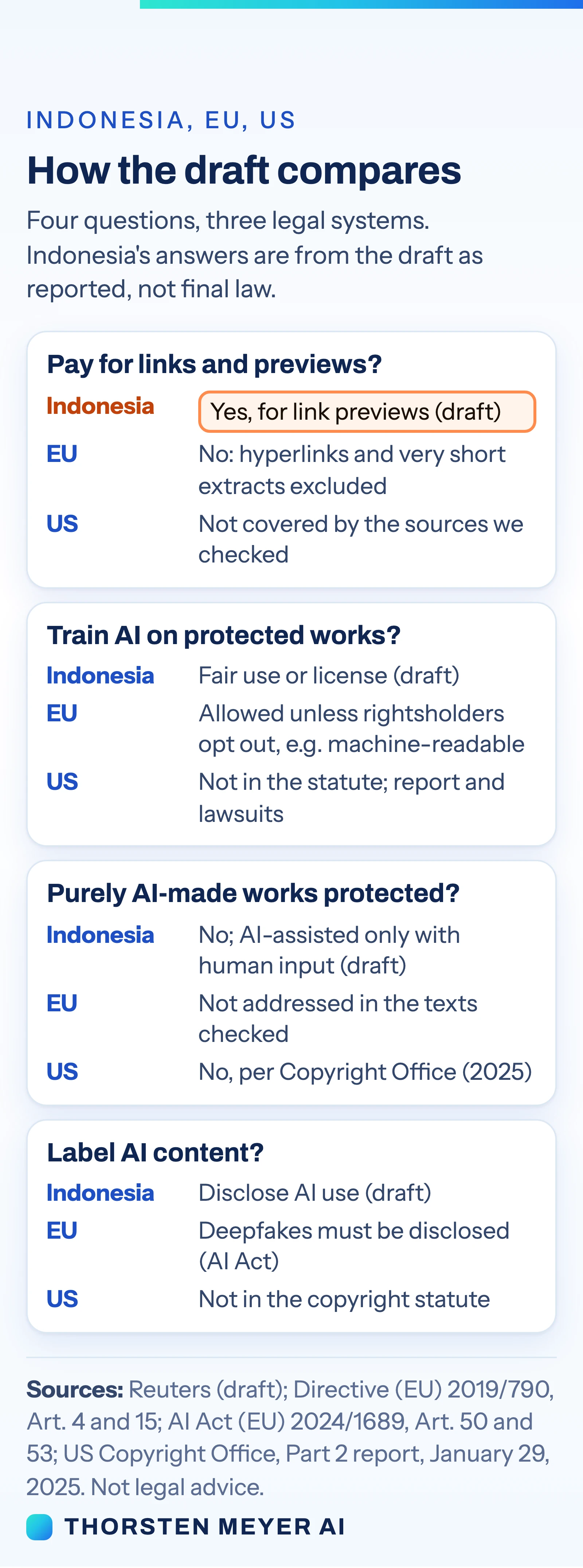
How it compares with the EU and the US
These are the verifiable differences, based on the texts we checked.
- Links and snippets. The EU’s press publishers’ right (Article 15 of Directive 2019/790) gives publishers rights over online use of their content, but says it “shall not apply to acts of hyperlinking” or to “individual words or very short extracts”. Indonesia’s draft, as reported, would require payment for link previews. That is a clear step beyond the EU rule.
- AI training. The EU allows text and data mining of lawfully accessible content unless rightsholders have reserved their rights “in an appropriate manner, such as machine-readable means”. That is close to the opt-out Google proposes for Indonesia. The EU AI Act adds duties for general-purpose AI providers: a copyright policy that respects such reservations, and a public summary of training content. The US statute does not mention AI, Reuters notes. The US Copyright Office released a pre-publication version of its report on AI training on May 9, 2025, and Reuters points to ongoing lawsuits such as the one led by The New York Times.
- AI-generated works. The US Copyright Office concluded in January 2025 that copyright “does not extend to purely AI-generated material, or material where there is insufficient human control over the expressive elements,” and that prompts alone do not provide sufficient control. Indonesia’s draft, as reported, follows the same human-involvement logic.
- Disclosure. The EU AI Act requires disclosure of deepfakes, with lighter rules for evidently artistic, satirical or fictional work. Indonesia’s draft, as reported, would require disclosure of AI use in content in general, which is why TikTok wants an exemption for assistive use.
- Style. The EU texts we checked contain no rule against imitating a creator’s style, and the US statute does not mention AI at all, according to Reuters. Indonesia’s proposal goes further.
For background, see our earlier pieces on an EU court adviser’s view of AI chatbots and press publishers’ rights and on what robots.txt opt-outs from AI training actually do.
What is not known
- The final text. The draft has changed since July, and article numbers differ between the versions cited in reports.
- Whether payment for link previews and snippets survives the deliberations, and at what rates.
- How “distinctive style” and the required level of human involvement would be defined.
- Whether Google would actually stop indexing Indonesian news. It described this as the consequence of a link levy, not as a decision.
- How the bill would fit with Presidential Regulation No. 32 of 2024, which already covers platforms and journalism.
- When the bill could be passed. Neither parliament nor the government has given a date.
- What Meta and TikTok said in writing. We found no published submissions; their positions here are as reported by Reuters and Kompas.
Sources
- Reuters: “Meta, TikTok join Google to push back on Indonesia’s planned AI copyright law revisions”, November 11, 2026 (via Yahoo News, The Star and New Straits Times)
- Reuters: “Indonesia’s copyright rewrite puts Google, AI platforms on notice”, July 17, 2026 (as republished by Global Banking & Finance Review, and by the Asia Pacific Solidarity Network via The Jakarta Post)
- Kompas: “Industri Digital dan Pers Keberatan Sentralisasi Pengelolaan Royalti”, November 12, 2026, and “Draf RUU Hak Cipta Rampung, Proses Selanjutnya Dinanti”, July 13, 2026
- Suara.com: three reports on Google’s statements at the hearing, November 11, 2026
- Aktual: report on the Press Council’s statements at the hearing, November 12, 2026
- Katadata: report on the hearing and on Komdigi’s position, November 12, 2026
- Antara: “Rapat paripurna setujui RUU Hak Cipta jadi usul DPR RI”, March 12, 2026
- Liputan6: “RUU Hak Cipta Dibahas, Karya AI hingga Platform Digital Bakal Diatur”, October 6, 2026
- European Union: Directive (EU) 2019/790 on copyright in the Digital Single Market, Articles 4 and 15; Regulation (EU) 2024/1689 (AI Act), Articles 50 and 53 (EUR-Lex)
- U.S. Copyright Office: “Copyright and Artificial Intelligence, Part 2: Copyrightability”, January 29, 2025, and the Office’s AI report overview page
Researched and drafted with AI assistance, including Anthropic’s Claude. No government, company or agency named here reviewed or sponsored this article. This article is for information only. It is not legal advice. Translations from Indonesian are my own. Images: AI-generated illustration (Runware) and graphics by Thorsten Meyer AI; no real people or logos are shown.