By Thorsten Meyer | November 12, 2026 | ThorstenMeyerAI.com

Get business pricing on tech for your team
- Business-only prices and quantity discounts
- Tax-exempt purchasing
- Multiple users, one account, clear invoices
For some people, ChatGPT’s voice is a feature. For others, it is a voice they have talked to for years. On November 10, OpenAI told both groups the same thing: two of the three voice modes in ChatGPT are going away. “We’re retiring Advanced and Standard voice from ChatGPT Voice on December 11, 2026,” the company’s newsroom account posted on X.
From that date, only GPT-Live, the voice model OpenAI launched in July, will be left in the voice settings. OpenAI says almost everyone has already moved. A vocal group of users says the old modes did things the new one does not, and some describe the change as losing something personal. TechRadar’s headline on November 11 quoted one of them: “I’m beyond disappointed because ChatGPT means a lot to me.”
Here is what is changing and when, what replaces it, what OpenAI says about why, what it means for users and for businesses that build on OpenAI’s voice technology, and what is still open.
In brief
- What goes: Advanced voice and Standard voice in ChatGPT. On December 11, 2026, both disappear from the model picker under Settings > Voice, and anyone who had picked one of them is switched to Live voice, powered by GPT-Live, according to OpenAI’s help center as reported by Interesting Engineering and FourWeekMBA.
- Why, per OpenAI: Voice usage has “nearly doubled” since GPT-Live arrived in July, and “virtually all” people using voice in ChatGPT now use GPT-Live, OpenAI said on X.
- What stays for now: Live video and screen sharing keep running on Advanced voice until GPT-Live supports them. OpenAI has not said when that will be.
- Your history: Conversations made with the old modes stay in ChatGPT and can be continued by text or voice. Spoken continuations then use GPT-Live.
- Developers: The ChatGPT change is not an API deprecation. OpenAI’s API deprecation page lists no voice entry for November 10. But several older API voice and audio models already have shutdown dates between January 6 and February 26, 2027.
- The catch: Users complain that GPT-Live interrupts, fills gaps with “yeah” and “anyway”, and does not sound like the voices they were used to, according to TechRadar. On OpenAI’s forum, some say they rely on voice for accessibility reasons.
Products Worth Considering

Apple Watch Series 12 GPS 42mm Smartwatch

Bose Lifestyle Ultra Soundbar and Ultra Subwoofer Bundle

DJI Mini 4 Pro Fly More Combo with DJI RC 2
As an affiliate, we earn on qualifying purchases.
What is changing, and when
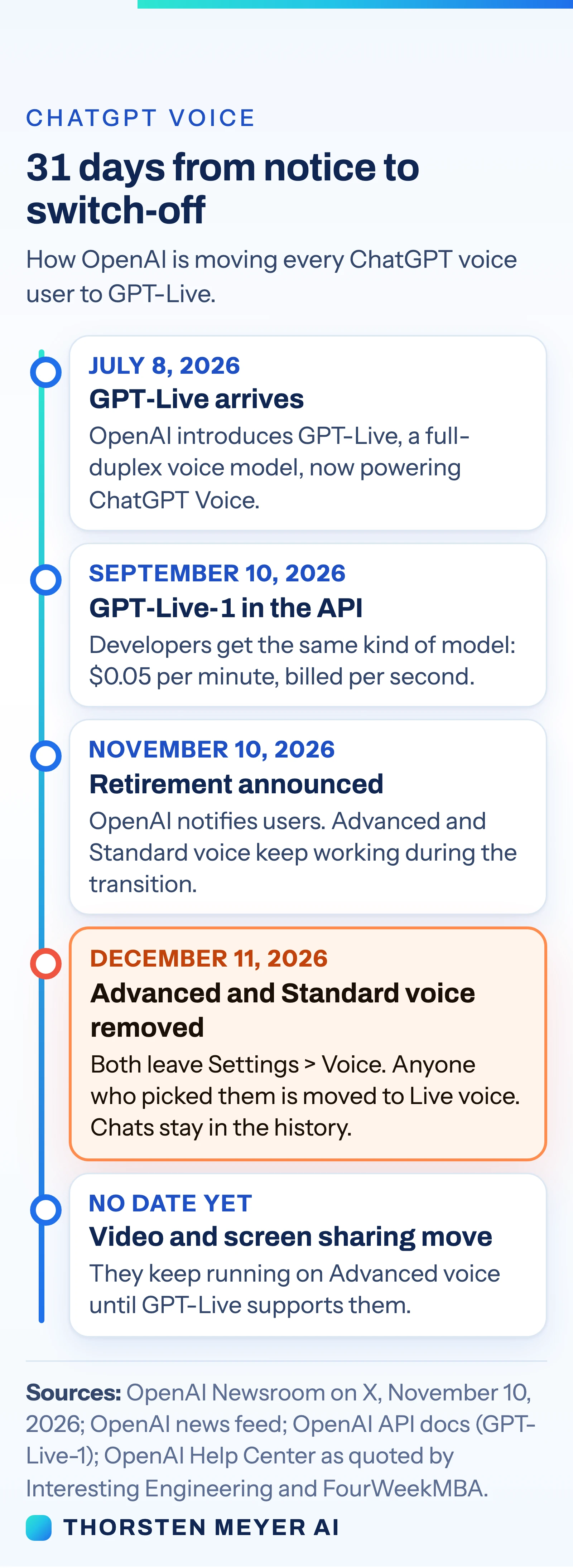
OpenAI started notifying users on November 10. OpenAI’s help center article on the retirement lays out three steps, according to the outlets that quoted it: users are notified, they can keep using Advanced or Standard voice during the transition, and on December 11 both options are removed from Settings > Voice. That is 31 days of notice.
Two exceptions are listed. “Live video and screen-sharing will continue to be powered by Advanced voice until GPT-Live has this capability,” the help center says, as quoted by FourWeekMBA. And: “Voice with custom GPTs will continue using Advanced voice until their deprecation on December 11, 2026.” That second line connects to a separate change. In September, OpenAI said in its release notes that it plans “to retire custom GPTs across ChatGPT plans” and move creators to plugins, according to MIXED. For Enterprise workspaces, OpenAI’s migration FAQ names December 11 as the retirement date, the day “custom GPTs stop running”.
Nothing is deleted. According to Interesting Engineering, previous conversations stay in the chat history and can be continued in text or with the new Live voice. Users do not have to migrate anything by hand.
One caveat on sourcing: OpenAI’s help center pages were not machine-readable when we tried to save them. The help center statements here are quoted from the outlets named above. The announcement itself and the reason OpenAI gives are from OpenAI’s own post on X.
Three voice modes, three architectures
The difference between the modes is not just the sound. Each works in a different way.
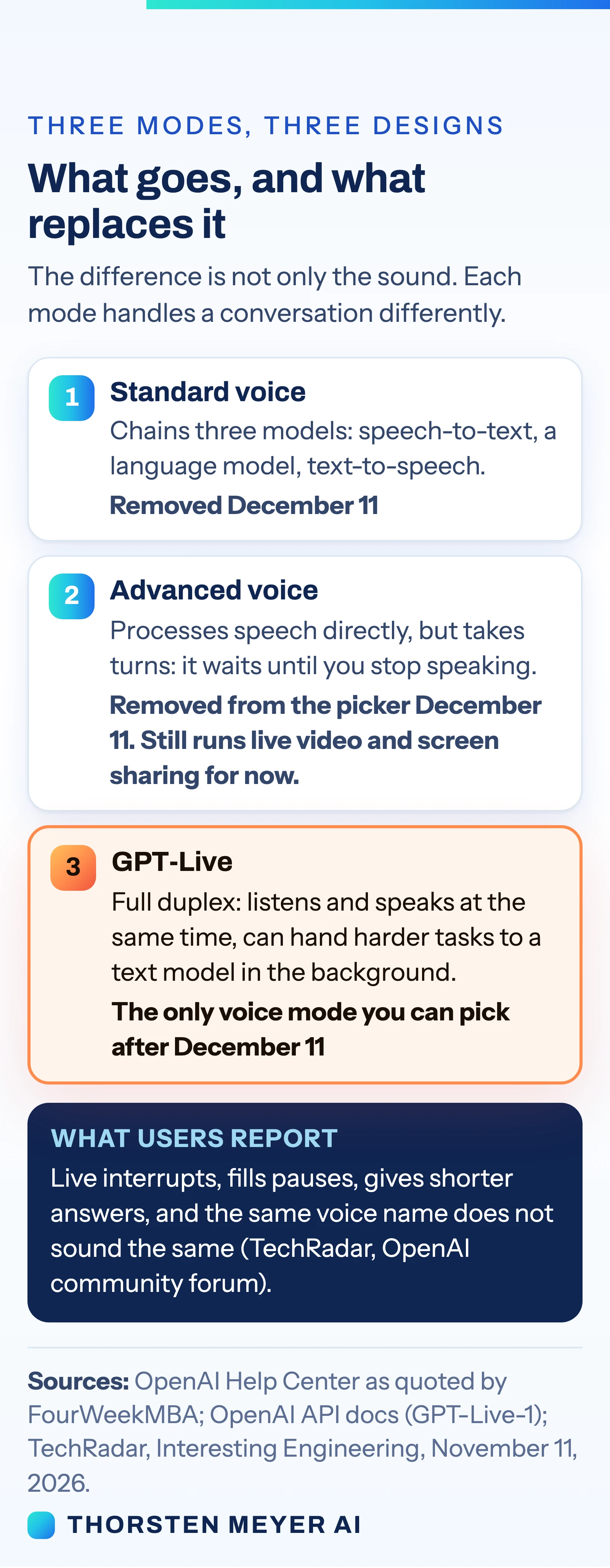
- Standard voice “chained three models together”, the help center says according to FourWeekMBA: speech-to-text, a language model and text-to-speech. TechRadar describes it as converting your speech to text, generating a text answer and reading it aloud.
- Advanced voice processes speech directly but “had to wait for the user to stop speaking before responding”. It takes turns. No interruptions.
- GPT-Live is a full-duplex model. It can listen and speak at the same time. OpenAI’s developer documentation describes the API version, GPT-Live-1, as “a full-duplex voice model for real-time conversations” that can “listen and speak at the same time, and delegate reasoning and tool use to a backend agent.”
That last point is OpenAI’s main argument. When a question needs more thinking or a tool, GPT-Live can hand the work to a text model in the background and keep talking, according to Interesting Engineering. OpenAI introduced GPT-Live on July 8 as “a new generation of voice models for natural human-AI interaction, now powering ChatGPT Voice.” OpenAI plans to bring the features of Advanced and Standard to GPT-Live, according to Android Authority, and to improve response depth, conversational continuity and personalization, according to Interesting Engineering.
Why some users are upset
The backlash is real, but it is hard to size. OpenAI says “virtually all” voice users already use GPT-Live. TechRadar calls the opposition “a small, but very vocal contingent”. On OpenAI’s own community forum, a thread titled “Keep Standard Voice Mode!” opened on November 10 and had 100 posts when we checked on November 12.
The complaints fall into three groups.
The voice itself. Many users have grown attached to a particular voice. TechRadar describes a Reddit poster who used the Vale voice for years and found it comforting, but says choosing Vale in GPT-Live does not reproduce the same experience. Several forum posts name Standard voices such as Cove, Breeze and Spruce.
How Live talks. GPT-Live “does a lot of ‘yeah’ and ‘anyway’ to fill in the gaps while it’s thinking. It interrupts, breaking the user’s train of thought,” TechRadar’s Graham Barlow writes, adding that he personally prefers Live by a long way. On the forum, users say they get shorter answers and lose the long-form back-and-forth they used for study or work. One poster made a point that applies to OpenAI’s own numbers: “Increased usage of Live Voice should not automatically be interpreted as increased user satisfaction or preference.”
Reliance. Some users describe voice as a tool they depend on. “I use it as a workaround for dyslexia,” one forum post says. Another: “For those who are neurodivergent this change is something that will make me stop using this app.” Others describe the voice as emotional support. One user wrote of “losing a good friend who helps me with my work, that I can talk to when I wake up at 3 a.m.” These are individual posts, not a survey. They still show why a change in voice software can land differently from a change in a text model.
OpenAI acknowledges this. “We recognize that some people are accustomed to Advanced or Standard voice’s style or way of responding, and these model transitions can be challenging,” it says in the help center, as quoted by TechRadar, pointing users to a separate article on what to expect when models change.
OpenAI has backed down before
This is not the first attempt. In August 2025, TechRadar reported that OpenAI planned to retire Standard voice on September 9, 2025 and keep only the newer Advanced voice. Users protested then too. On September 9, the company reversed course and said Standard voice would stay available while it addressed the feedback, according to TechRadar.
This time is different in two ways. OpenAI is retiring both older modes at once, and it backs the decision with a usage figure. TechRadar notes that the new announcement “feels more permanent”. Whether OpenAI shifts again depends on how much the resistance grows, which nobody can know yet.
What it means for users
- Try Live before December 11. If you use Advanced or Standard voice, switch to Live now under Settings > Voice while you can still switch back. You will find out where it falls short for you while there is still time to give feedback.
- Check your voice. If a particular voice matters to you, compare it in Live mode. Users report that the same name does not sound the same.
- Your chats are safe. Old voice conversations stay in your history. You can continue them in text or in Live voice.
- Video and screen sharing keep working on Advanced voice for now, with no end date announced.
- If you rely on voice for accessibility, test your actual daily routine in Live mode now, such as long dictation, studying or step-by-step help. Tell OpenAI through its feedback channels what breaks, and line up an alternative if it matters to your work or health.
What it means for businesses and developers
If your teams use ChatGPT voice: The same date applies to your workforce. Anyone using Advanced or Standard voice in meetings, field work or hands-free tasks will be on GPT-Live from December 11. If you have custom GPTs with voice, check the custom GPT retirement and plugin migration at the same time. OpenAI’s FAQ says custom actions do not carry over and have to be rebuilt, according to MIXED.
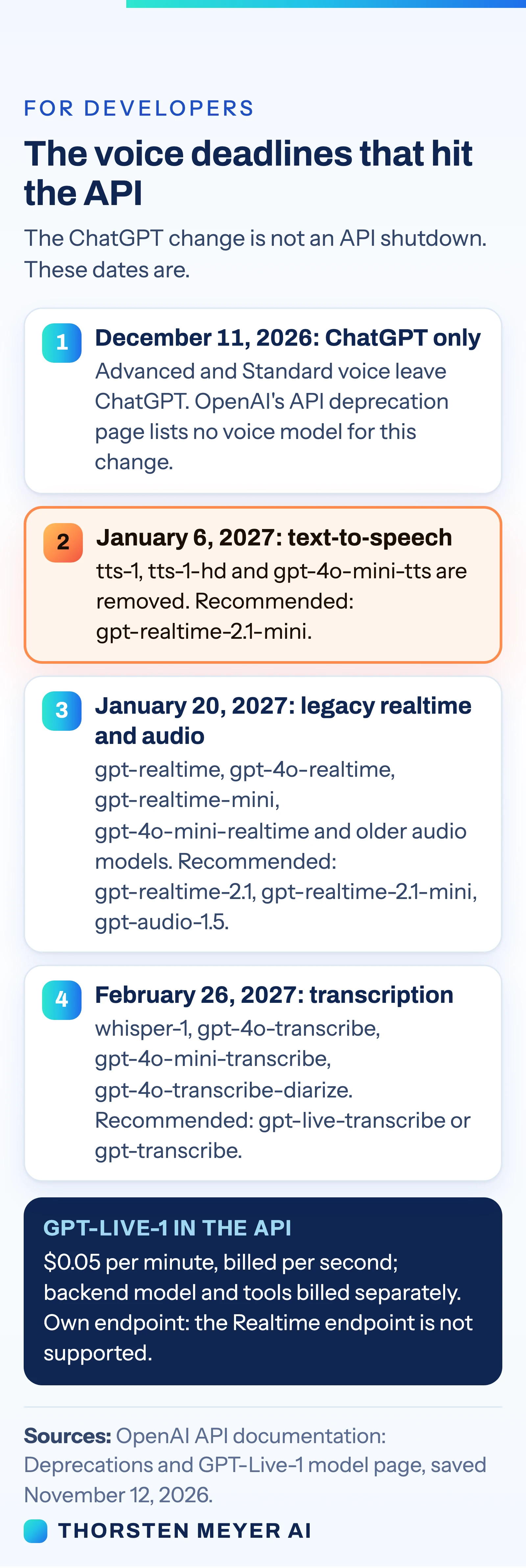
If you build on OpenAI’s voice API: The ChatGPT announcement does not shut down an API model. OpenAI’s deprecation page, as saved on November 12, lists only GPT Image 2 for November 10. GPT-Live-1 has been available in the API since September 10 at $0.05 per minute, billed per second, with backend model and tool use billed separately. It runs on its own endpoint, and the model page lists the Realtime endpoint as “Not supported”.
What developers do need to watch is OpenAI’s existing calendar for older voice models:
- January 6, 2027: text-to-speech models tts-1, tts-1-hd and gpt-4o-mini-tts are removed. OpenAI recommends gpt-realtime-2.1-mini.
- January 20, 2027: legacy audio and realtime families are removed, including gpt-realtime, gpt-4o-realtime, gpt-realtime-mini and gpt-4o-mini-realtime. Replacements are gpt-realtime-2.1, gpt-realtime-2.1-mini and gpt-audio-1.5.
- February 26, 2027: transcription models whisper-1, gpt-4o-transcribe, gpt-4o-mini-transcribe and gpt-4o-transcribe-diarize are removed. OpenAI points to gpt-live-transcribe or gpt-transcribe.
The ChatGPT change also says something about direction. The consumer product is dropping both the chained pipeline and the turn-based model in favor of full duplex. OpenAI’s API documentation still describes the Realtime API and chained voice applications next to GPT-Live and includes a migration guide from Realtime to GPT-Live. For now, developers still have a choice. If your product depends on strict turn-taking, such as a phone menu, a voice form or a guided interview, test GPT-Live’s interruption behavior carefully before you assume it fits. For apps that used manual turn control, OpenAI’s migration guide says to stream audio continuously: GPT-Live decides when to speak, and manual audio commits and voice-turn triggers have to be removed.
For anyone shipping a voice product: This week’s backlash is a warning. Users bond with voices. If you change a voice or how it behaves, give notice, offer a way to try the new one first, and explain why. OpenAI gave 31 days and a reason, and its own forum thread still reached 100 posts within two days. The same week, OpenAI also started pulling businesses deeper into ChatGPT; we looked at that in our piece on ChatGPT business profiles.
What is not known
- When GPT-Live will support live video and screen sharing, and therefore when Advanced voice will be fully switched off.
- How many people still use Advanced or Standard voice. OpenAI says “virtually all” voice users are on GPT-Live but has not published a number.
- Whether OpenAI will keep a legacy option or reverse course again, as it did on September 9, 2025.
- Whether Live voice will get changes that address the complaints about interruptions and shorter answers before December 11.
- Whether December 11 also applies to custom GPTs on Free, Plus and Pro plans. MIXED reported in September that OpenAI’s FAQ said those plans “may follow the same transition timeline”. Later third-party guides name December 11 for all plans, which we could not check against OpenAI’s own page.
- Whether any API voice model is tied to the ChatGPT change. OpenAI’s API deprecation page does not say so.
Sources
- OpenAI Newsroom on X: “We’re retiring Advanced and Standard voice from ChatGPT Voice on December 11, 2026”, November 10, 2026
- OpenAI: “Introducing GPT-Live”, July 8, 2026, and “Build more natural voice experiences with GPT-Live-1 in the API”, September 10, 2026 (OpenAI news feed entries)
- OpenAI developer documentation: Deprecations; GPT-Live-1 model page; “Getting started with GPT-Live”; “Migrate to GPT-Live” (saved November 12, 2026)
- OpenAI Help Center: article on retiring Advanced and Standard voice, and ChatGPT release notes, November 10, 2026 (as quoted by the outlets below; the pages could not be saved directly)
- OpenAI Developer Community: thread “Keep Standard Voice Mode!”, November 10 to 12, 2026 (posts by individual users, quoted without names)
- TechRadar: “‘I’m beyond disappointed because ChatGPT means a lot to me’: Users are furious that OpenAI is retiring their favorite voice modes”, November 11, 2026
- TechRadar: “ChatGPT is phasing out its Standard voice for the flashier Advanced option and some users are grieving the loss”, August 20, 2025
- Android Authority: “OpenAI is sunsetting ChatGPT Advanced and Standard voice next month”, November 11, 2026
- Interesting Engineering: “OpenAI pulls the plug on two major voice modes as GPT-Live takes over”, November 11, 2026
- FourWeekMBA: “OpenAI Retires 2 of 3 ChatGPT Voice Modes, 31 Days’ Notice”, November 11, 2026
- MIXED: “OpenAI is retiring custom GPTs, here’s what carries over to plugins”, September 18, 2026
Researched and drafted with AI assistance, including Anthropic’s Claude. Anthropic, maker of Claude, is a competitor of OpenAI. Neither OpenAI, Anthropic nor any company named here reviewed or sponsored this article, and it contains no affiliate links. User statements are quoted from public posts and named outlets; private users are not named. Statements as of November 12, 2026. Images: AI-generated illustration (Runware) and graphics by Thorsten Meyer AI; no real people or logos are shown.